Presence in Use: The Moment You Leave Yourself Before Movement Begins | Tommy Thompson Class 110
❝ In the Alexander Technique, what if the moment you leave yourself is the moment you stop experiencing life from within? ❞
Most people move through life by leaving themselves. They rush toward where they are going before fully arriving where they already are. According to Tommy Thompson, this is often where habitual tension, disconnection, and loss of coordination begin.
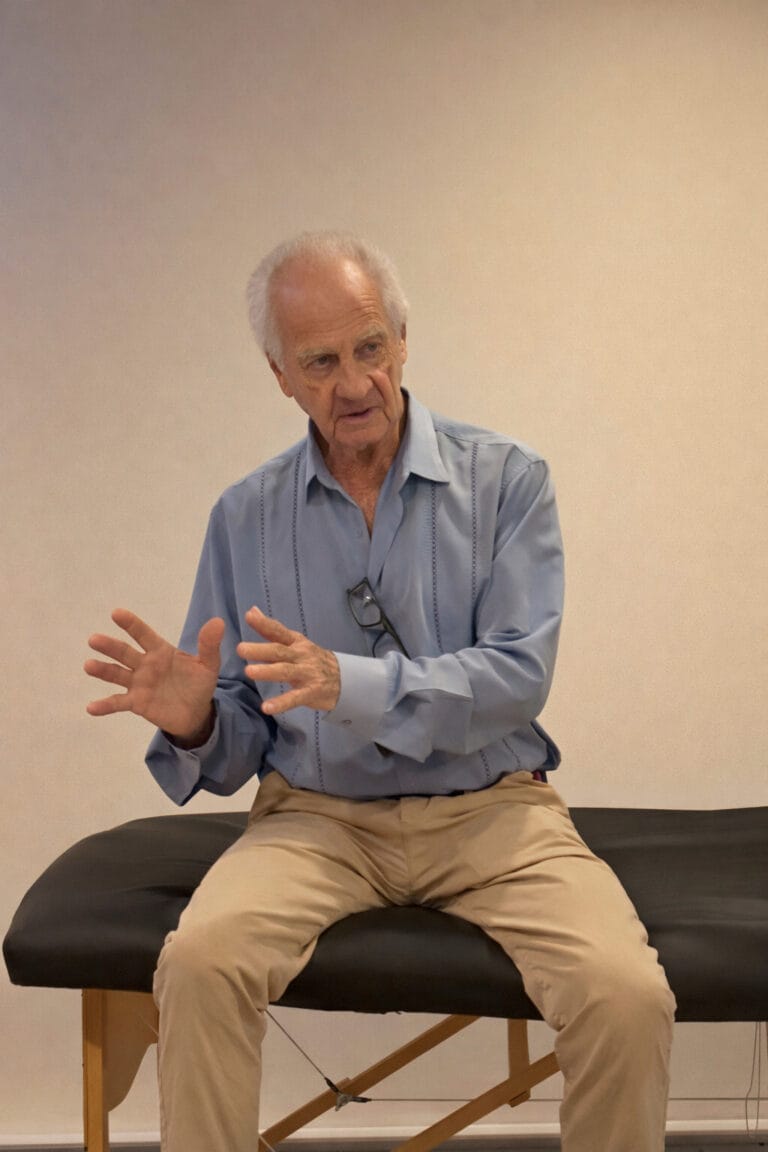
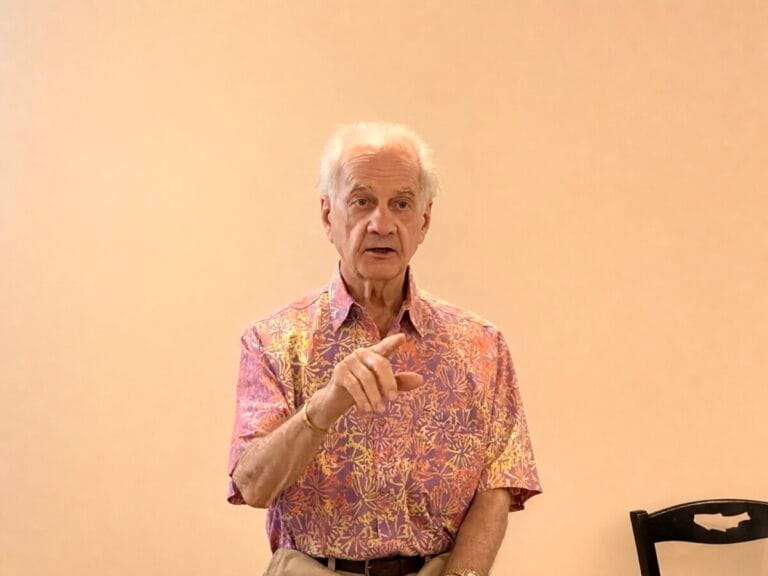
On April 30, 2026, in Boston, Massachusetts, USA, Tommy Thompson led a class in the Alexander Technique teacher training course exploring how Presence in Use changes movement, perception, touch, and awareness when a person remains connected to their own experience.
Again and again, the class returned to one deceptively simple word:
“Here.”
Not as philosophy, but as lived experience.
Tommy showed how people often leave themselves before action even begins. Attention moves outward, habit takes over, and the person loses contact with the experience unfolding within them. But when a person remains “Here,” a different quality of coordination emerges — a living sense of Presence in Use.
At the center of the class was one of Tommy’s most powerful invitations:
“Let there be here.”
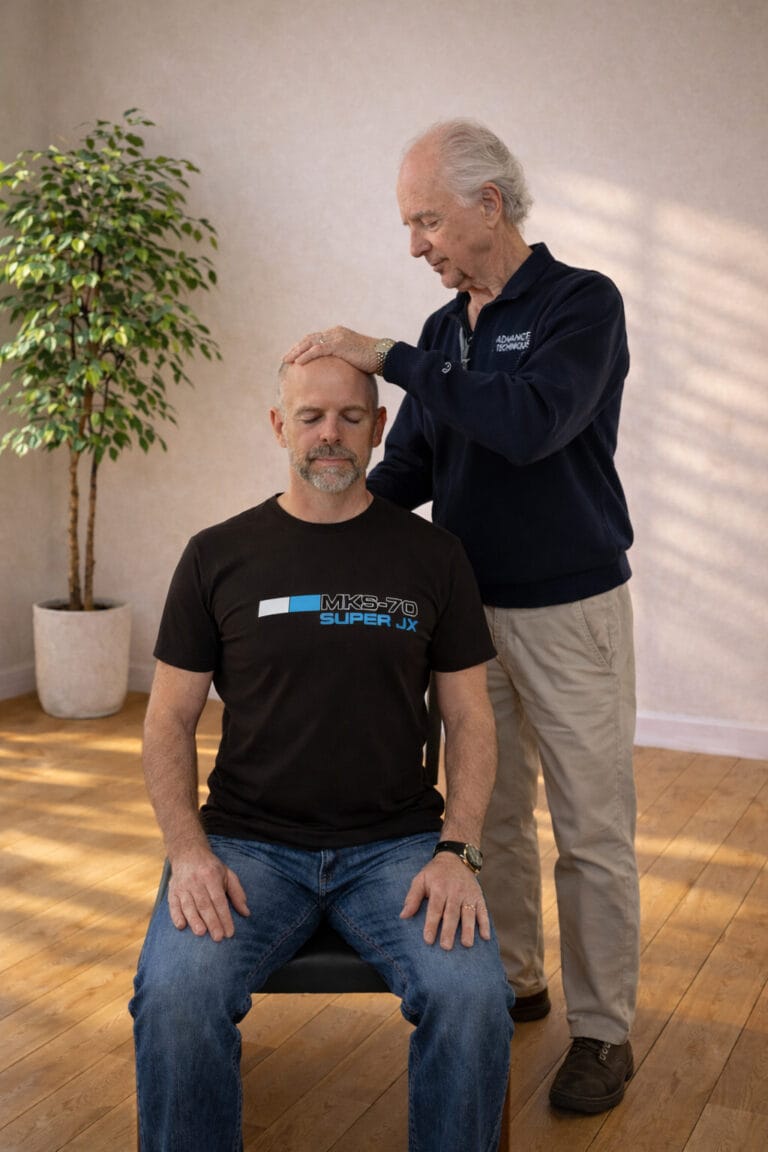
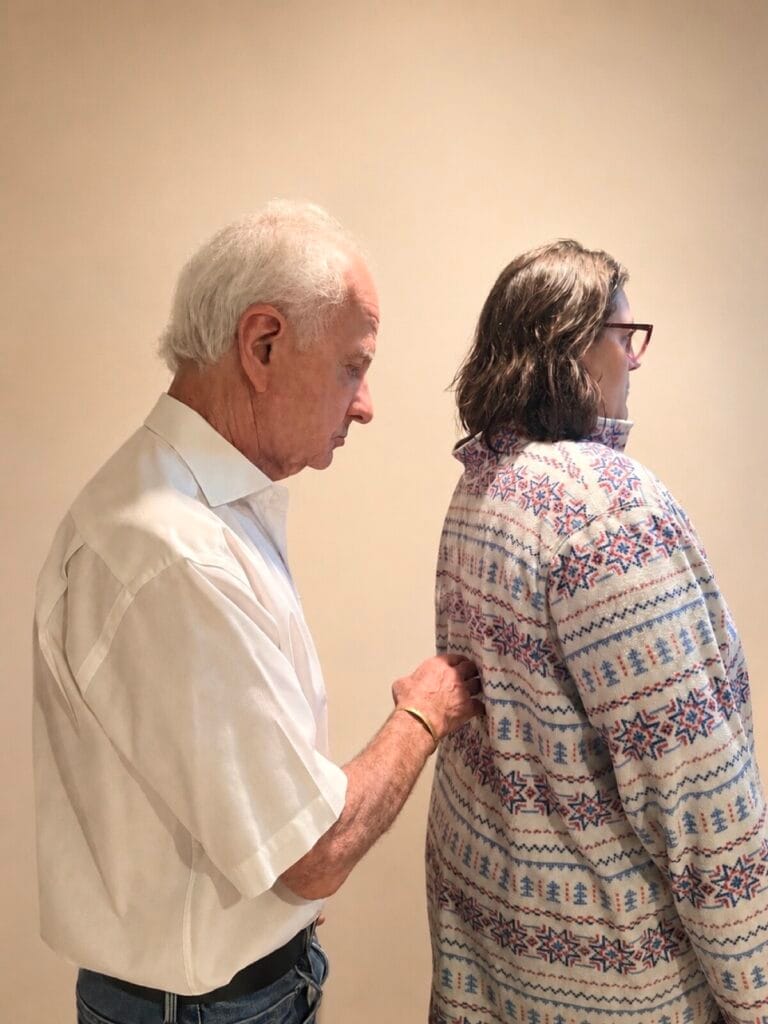
Through hands-on work, grounding, walking, and awareness, the students explored how the Alexander Technique is not simply about posture, but about remaining present within one’s own use while life is happening.
Key Objectives of the Class:
- Explore how Presence in Use changes movement, perception, and self-use in the Alexander Technique
- Understand the difference between looking at someone and truly seeing them
- Develop hands-on sensitivity through receiving rather than controlling
- Experience how grounding and integration emerge when attention remains present within experience
This blog series is based on Tommy Thompson’s Alexander Technique classes. Each post follows the flow and insights of the class to expand both self-awareness and practical consciousness applicable to everyday life.
New here?
If you’re new to the Alexander Technique, you can start with the resources below.
Alexander Technique Class Flow at a Glance
1. The Opening Question
❝ In the Alexander Technique, what if losing presence in use begins the moment you leave the experience you are already having? ❞
One of the deepest patterns Tommy Thompson explored in this class was the tendency to abandon ourselves the moment intention appears. Before the body even moves, attention often rushes toward the goal, the outcome, the next moment. And in that instant, people lose contact with the very experience that could support coordination, grounding, and awareness.
Again and again, Tommy guided the students back toward the possibility of remaining “Here.” Not as withdrawal from life, but as a living state of presence in use. When a person stays connected to the experience already unfolding within them, movement becomes less driven, touch becomes more receptive, and perception itself begins to reorganize.
Tommy’s Word
“Walk from where you are. Instead of focusing on where you’re going, walk from where you are right now, in your experience now.”
At the heart of Tommy’s teaching was a profound shift in orientation: stop abandoning the experience you already have in order to reach the experience you think you need. The Alexander Technique, as he presented it here, was not about forcing better movement, but about remaining connected to oneself while movement unfolds.
This was not simply about walking. It was an investigation into how human beings leave themselves through anticipation, performance, and habit — and how a different quality of organization becomes possible when awareness remains present within experience itself.
2. Core Learnings from This Class
Core Concepts
- Presence in use begins when a person stops leaving their own experience.
Rather than rushing toward an outcome, Tommy continually guided the students back toward the experience already unfolding within themselves. - Looking at a person is not the same as truly seeing them.
In the Alexander Technique, perception deepens when observation becomes less driven by memory, judgment, and habitual interpretation. - Touch becomes more responsive when the hand learns to receive instead of control.
Through the water exercise and hands-on work, the students explored how support can emerge through receptivity rather than force. - Movement changes when attention remains connected to the self.
Walking, climbing stairs, and transitioning off the table became opportunities to observe whether awareness stayed “Here” or rushed ahead toward performance. - Move through the issue into the part of the person that is still supported.
Tommy repeatedly emphasized working with what is available rather than becoming fixated on the problem itself.
Five Key Messages
- Stay with the experience you are already having.
Real change often begins when you stop abandoning yourself in anticipation of the next moment. - Out there is out there.
The world may exist outside you, but your lived experience occurs within your own awareness and use. - Receiving creates a different quality of touch.
The hand can listen, receive, and support without manipulating the person. - Habit often begins before movement becomes visible.
The brain organizes reactions so quickly that awareness must deepen before action unfolds. - Integration is more powerful than correction.
Grounding, support, and coordination emerge when the person remains connected to themselves as a whole.
Essential Terms
- Here
Tommy’s experiential cue pointing toward the place where experience is actually happening within oneself rather than “out there.” - Presence in use
The ability to remain connected to one’s own lived experience while moving, perceiving, touching, and acting. - Seeing
A deeper form of perception that goes beyond habitual looking, memory, and evaluation in order to perceive the whole person. - Pure intention
A subtle quality of awareness and directed presence that reduces unnecessary restraint without forceful manipulation. - Support fiber
Tommy’s embodied description of the underlying sense of support and organization still available within the person.
3. Tommy’s Insights
In Tommy’s words during class, there are not only the core principles of the Alexander Technique, but also practical wisdom that can be applied directly to daily life. His words go beyond simple advice about movement and prompt us to deeply consider how we choose to exist.1. “They’re not the same thing, looking and seeing. But seeing tends to be less focused on memory. Looking tends to be more focused on what you’ve seen before, how you see it, and how you evaluate it.”
➤ Tommy distinguishes conditioned observation from direct perception, where true seeing emerges beyond habitual interpretation.
2. “If you’re looking at just plain use, that’s what you’re looking at. If you’re looking at the use of the self, then you’re looking at the face, you’re looking at the heart, you’re looking at more than that. And it’s just something that, I think, is helpful to acquire: the ability to take a look at someone and see more than you’re simply looking at.”
➤ Self-use is never merely mechanical; it includes identity, relationship, emotion, and the whole quality of being.
3. “As you free her, you are inviting the fiber that is supporting her. And as you do that, you let yourself be supported by that as well. So we think of her as supporting you as well, and what you’re giving yourself is supporting her.”
➤ Hands-on work becomes relational rather than corrective, where support is mutually awakened instead of imposed.
4. “This is a practice that you really want to be able to instill the value of because most people just want to get to where they’re going. There’s nothing wrong with it, except that you’re leaving the experience that you’ve just been given. If you focus on the experience that you’re having right now, and walk from that experience and accomplish what you want to do, the experience that you’re having is within you.”
➤ Coordination emerges from remaining within present experience rather than abandoning oneself toward an end.
5. “Most people are having their experience out there, but the experience is in here. Stay in the experience that you have just been given. You want to take the experience that you’ve just been given on the table into what you’re doing. If you’re going to move from here right now, let the movement come from the experience you’re having. Don’t throw it away. That enables you, over time, to keep it.”
➤ The work deepens when a newly experienced coordination is carried directly into action.
6. “Frank Jones called it introspective. You’re designed to be introspective and extrospective at the exact same moment. So simply said: ‘Let here be there where you’re looking. Now let there be here.’ The only way I know how to explain it is: where is the experience you’re having? It’s within you. Out there is out there.”
➤ Awareness becomes integrated when inner and outer perception function simultaneously rather than separately.
7. “What I’m saying is: be where you are. Let there be here. It’s simply because that’s where you’re having your experience. So it’s not thinking about one step at a time. It’s just being present with where you are. Be present from where you are right now. Just be present. You’ll get there. Just be present. The hand is on the back because it’s keeping you integrated.”
➤ Presence is the capacity to move without leaving oneself.
8. “What you want them to understand is that it is the relationship of your head relative to the rest of you that really affects the totality of you. But your head is not just a head. Your head belongs to you, and you belong to your identity. It’s the overall pattern of thought, feeling, perception, and identity that is the problem.”
➤ The head–body relationship is inseparable from consciousness, perception, and identity.
9. “It’s more a way of thinking. You really have to be able to look at somebody who’s really screwed up and see them unscrewed up, see the possibility, the possibility of something other than that. Look for a place to find an opening. That place is often there, wherever you touch.”
➤ The practitioner learns to perceive possibility beneath fixation rather than defining a person by dysfunction.
4. Practical Tips for Everyday Life
What’s the Goal?
Tommy Thompson was not asking the students to “try harder” to stay present. The invitation was much simpler: stop leaving the experience you are already having.
In the Alexander Technique, a different quality of presence in use begins to emerge when attention remains connected to the self instead of constantly rushing ahead toward the next outcome.
How to Practice
- Walking
As you begin walking, notice if your attention arrives at the destination before your body does. Instead of rushing ahead mentally, walk from the experience you are having right now. - Climbing stairs
While walking upstairs, stop trying to “go up.” The stairs already go upward. Allow your awareness to remain connected to your back, your support, and the ground beneath you. - Listening to another person
Notice whether you are trying to fix or control the person while listening. Soften your attention enough to receive them rather than manage them.
What You’ll Notice
Movement may begin to feel less forced and more supported. Walking can become quieter. Touch may become more responsive. You may also notice that perception becomes less reactive when you stop abandoning yourself in anticipation of the next moment.
Over time, this practice becomes more than a technique. It becomes a different way of living from the experience that is already here.
5. Closing the Class
Key Takeaways
- People often leave themselves before movement even begins.
- Coordination changes when awareness remains connected to present experience.
- The Alexander Technique is not only about movement, but about how a person relates to experience itself.
- Support, grounding, and perception deepen when a person remains “Here.”
Core Insights
Tommy Thompson continually revealed that many human difficulties do not begin with movement itself, but with the moment attention abandons present experience in anticipation of what comes next.
Again and again, the class returned to a living sense of presence in use — not as an abstract idea, but as an embodied relationship with perception, touch, thought, and action.
A Final Invitation
The next time you walk across a room, climb a staircase, touch another person, or simply pause before speaking, notice where your experience is happening.
Not where you are trying to get to.
Not somewhere “out there.”
But here.
And perhaps, in that moment, something in the whole organism may begin to reorganize itself naturally.
6. One Key Practice
The next time you begin moving, pause for just a moment before action starts. Notice whether your attention has already rushed ahead toward the outcome, the destination, or the next thing you need to do.
Then quietly allow yourself to remain “Here” for one breath before moving. Not forcing stillness. Not trying to relax. Just not leaving yourself before movement begins.
And notice what happens when you begin moving without abandoning yourself first.
7. Three Questions to Ask Yourself
- Am I moving from the experience I am actually having, or from where I think I need to get to?
- What happens when I remain “Here” instead of rushing ahead of myself?
- In this moment, am I relating to myself as a problem to fix, or as a living organism capable of support, change, and reorganization?
8. For Those Who Wish to Learn More
Recommended Books
Body Awareness in Action: A Study of the Alexander Technique – Frank Pierce Jones
Few books reflect the spirit of this class more deeply than Frank Pierce Jones’ exploration of awareness, perception, habit, and psychophysical coordination. Tommy Thompson frequently echoed many of the same principles throughout Class 110: that human beings often lose themselves in anticipation, and that real change begins when awareness remains connected to present experience.
The book is especially valuable for understanding how the Alexander Technique is not simply about posture or mechanical movement, but about recovering the capacity to remain connected to oneself while action unfolds.
Official Website of Tommy Thompson
www.easeofbeing.com
This is the official website personally managed by Tommy Thompson, offering a wide range of resources and programs to deepen your understanding and practice of the Alexander Technique:
- Private session reservations and inquiries
- Workshop and seminar schedules
- Overview of international teacher training programs
- Essays and articles on the Alexander Technique
9. Next Class Sneak Peek
What happens when relational attunement becomes strong enough that the organism begins responding before conscious effort even appears?
The next class moves deeper into the relationship between awareness, protection, and the subtle moment where a person no longer feels the need to organize themselves through habitual control.
In Class 111, we’ll explore: how relational attunement begins to change coordination, perception, and response from within the organism itself.
10. Join the Alexander Technique Journey
Did this class leave a small resonance within you? Feel free to quietly hold it in your heart or share it in just a sentence or two. The comments are always open. Your one simple word may leave a gentle ripple in this ongoing journey.The journey of Resonance Flow continues across social media as well. Let’s continue this journey together.
 YouTube
 Instagram
 Threads
 Facebook