Before You Move, You’ve Already Decided Who You Are: The Liminal Moment | Tommy Thompson Class 98
❝ You’re about to stand up. Can you stop before you define yourself? ❞
Before any movement begins, something has already organized you. A familiar tone in the neck. A slight tightening in the back. A pattern that feels like “me.” In this Alexander Technique class, we examined that precise instant—the Liminal Moment—when intention arises but identity has not yet solidified into action.
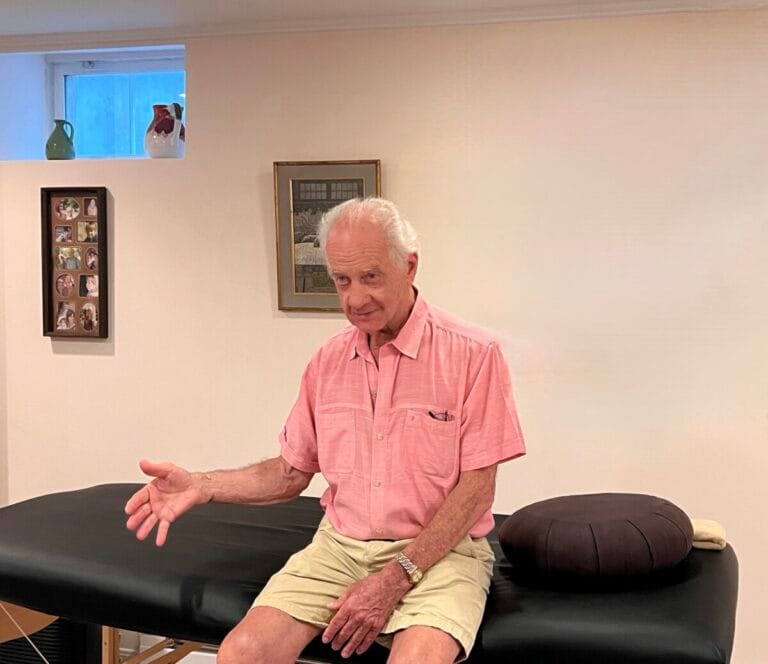
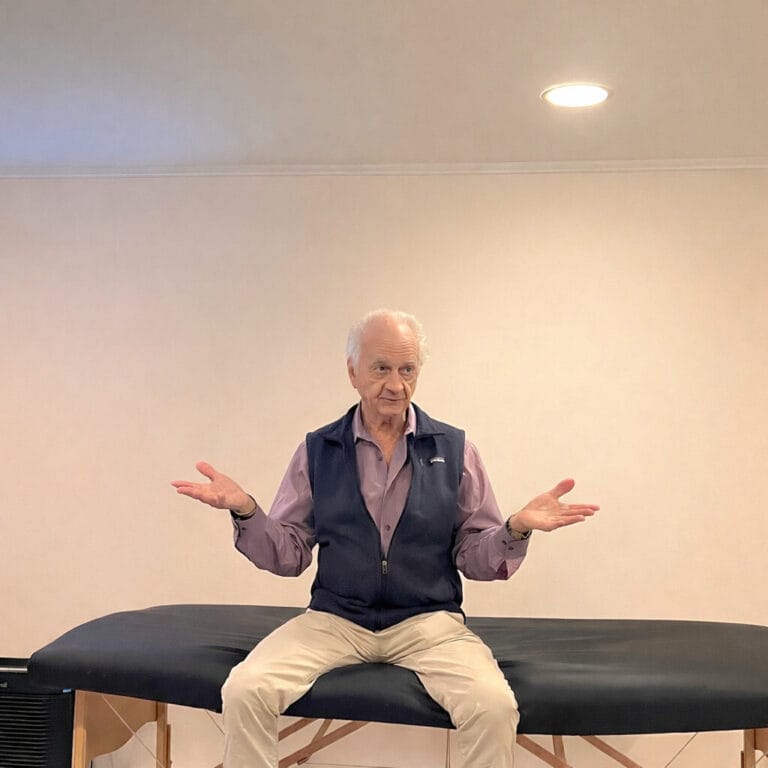
On December 2, 2025, in Boston, Massachusetts, USA, Tommy Thompson led a class in the Alexander Technique teacher training course, guiding trainees to notice what happens just before they move. “You’re not doing things,” he said. “You’re repeating yourself.” The work was not about correcting posture. It was about withholding the habitual definition that precedes it.
In the Alexander Technique, when you choose not to reinforce the familiar response, coordination reorganizes without force. The spine lengthens because interference decreases. Posture is no longer something you make happen; it becomes your organism’s response within gravity.
When you stop defining yourself in the usual way, a different use becomes possible.
That was the invitation. Awareness before action. And from there, a deeper quality of wellness begins.
Key Objectives of the Class:
- To distinguish habitual doing from supported being.
- To enter the Liminal Moment before identity becomes movement.
- To experience how non-doing allows natural coordination in the Alexander Technique to emerge.
This blog series is based on Tommy Thompson’s Alexander Technique classes. Each post follows the flow and insights of the class to expand both self-awareness and practical consciousness applicable to everyday life.
New here?
If you’re new to the Alexander Technique, you can start with the resources below.
Alexander Technique Class Flow at a Glance
1. The Opening Question
❝ Before you move, who have you already decided to be? ❞
In this Alexander Technique class, posture was not treated as correction but as repetition. Before you stand, sit, or reach, something familiar organizes you—often before you are aware of it. Not just muscle tone, but identity. The real inquiry was not how to fix posture, but what pattern is already shaping you.
The work turned toward the liminal moment—the instant before action, when a habitual coordination pattern prepares to define you. In the Alexander Technique, that moment is not abstract. It is observable. And it is trainable.
Tommy’s Word
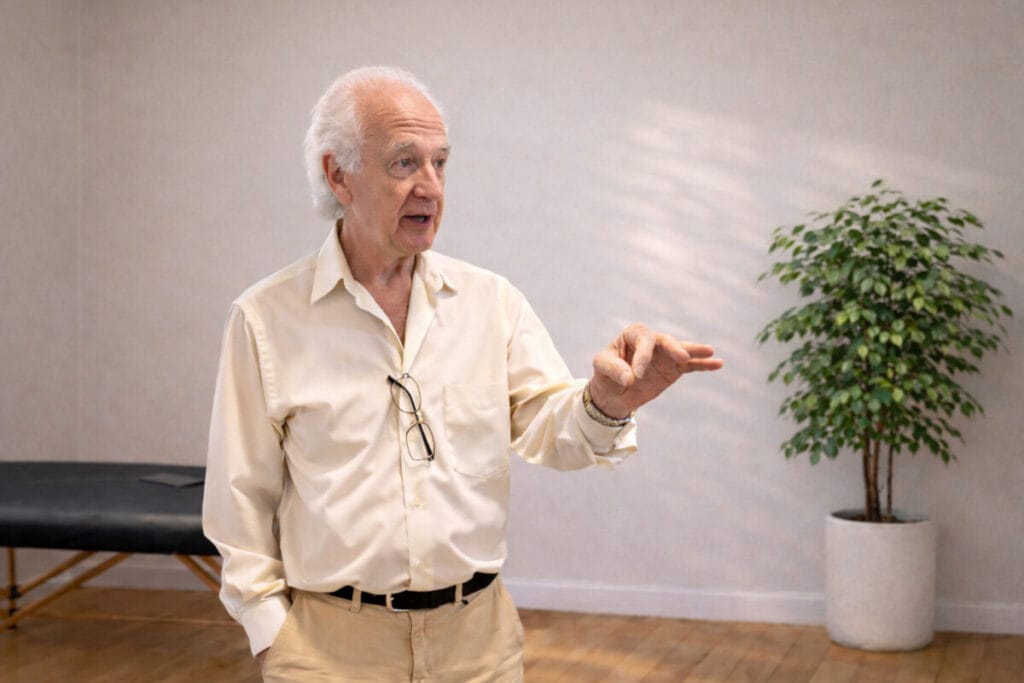
“You’re not doing things. And our lives are: you wake up in the morning and you do things all day long, and then you go to sleep and you’re still doing half of what you did during the day. Doing, doing, doing, doing—that very specific muscle fiber that’s used for that.”
Tommy was not criticizing effort. He was exposing repetition. The same neuromuscular pattern activated over and over, shaping posture as identity.
Posture is not a position. It is a repeated self in motion.
That is where the class truly began.
2. Core Learnings from This Class
Core Concepts
- Posture is the organism’s total response within a gravitational field.
Posture is not something you arrange. It is the whole organism responding to gravity, environment, and perception. If that total response does not change, no correction will last. - All habits are habits of identity.
What repeats in movement is not simply muscular tension but a personal narrative embodied over time. - Withholding definition opens the liminal space.
Before inhibition, there is a liminal space—a transitional field where you refrain from defining yourself in the usual way. It is not yet action. It is not yet correction. It is possibility. - The liminal space is where you consciously meet yourself being yourself.
The liminal moment is the lived instant within that space, preceding inhibition. It is the precursor. - Being fiber and doing fiber reflect two modes of organization.
The being fiber supports without strain. The doing fiber reinforces effort and habituation. What you want is balance. - Inhibition follows the liminal space.
In the Alexander Technique, inhibition is the conscious prevention of automatic reaction once you have entered that transitional field.
Five Key Messages
- You’re not doing things. You’re repeating yourself.
- Posture is not a three-dimensional arrangement of body parts. It is the organism’s total response within a gravitational field.
- It is the attachment to the personal narrative that we are truly changing when we change our use. Otherwise, we’re just getting better at being the person we’ve been.
- The Alexander inhibiting moment is the liminal space where consciously you meet yourself being yourself.
- When you don’t do what you usually do, the brain has already stepped in and taken charge of your use.
Essential Terms
- Personal narrative
The story you live inside and remain attached to through your use. It is the identity you keep becoming. When nothing interrupts it, you simply get better at being the person you have been. - Withholding definition
Not defining yourself as you customarily define yourself in the very moment before you move. - Liminal space
The transitional field where you consciously meet yourself being yourself before identity solidifies into habit. - Liminal moment
The lived threshold that precedes inhibition—the instant where a different use can emerge. - Inhibition
The conscious refusal to pursue the familiar reaction once it begins to organize you. - Posture
Not an arrangement of parts, but the organism’s total response within a gravitational field.
3. Tommy’s Insights
In Tommy’s words during class, there are not only the core principles of the Alexander Technique, but also practical wisdom that can be applied directly to daily life. His words go beyond simple advice about movement and prompt us to deeply consider how we choose to exist.1. “You’re designed to go back and up when you’re standing. Up the front and down the back—muscles in the back are more responsible for uprightness. So as he’s spreading her shoulders out like that, it frees the neck, and the head moves away from the body slightly. The whole spine lengthens.”
➤ Uprightness is not constructed by effort but revealed when the primary head–neck relationship allows the organism’s inherent design to organize itself in gravity.
2. “Everyone will see posture. But posture is not a three-dimensional arrangement of body parts. It is “the organism’s total response within a gravitational field. There’s no straight in your body; you are more upright. You’re fully upright, yes, and you’re allowing gravitational force to send you upward.”
➤ Posture is a coordinated whole-body response within gravity, not a fixed shape imposed upon isolated parts.
3. “Bad posture is the consequence of you not living in harmony with the environment. And the environment can be emotional or physical. You try to live in harmony with the environment. You grow up in a bad family. You have trauma. And you’re going to use yourself to respond to it. So it’s all about: How do I reclaim that first moment of birth?”
➤ Misuse is an adaptive response to lived experience, and freedom begins by restoring our original relational integrity with life.
4. “The Alexander inhibiting moment is the liminal space where consciously you meet yourself being yourself. The moment is transitional, where familiar responses to a circumstance are less pursued than the choices usually made, and where you can withhold defining yourself as you customarily do. In a quiet moment of absentia—you. That’s the moment you sustain what you just got.”
➤ Inhibition is the conscious threshold where habit is paused and self-encounter makes new organization possible.
5. “I think it’s the liminal moment that you want to live through as much as, if not more than, the inhibited moment. Because what you’re doing is you’re withholding defining yourself—and withholding definition is more liminal than inhibition. Withholding definition is more liminal definition. Yeah—so absentia. Absentia.”
➤ Lasting change unfolds in the suspension of self-definition, where identity softens and integration arises without force.
6. “It is the attachment to the personal narrative that we are truly changing when we change our use. Otherwise, we’re just getting better at being the person we’ve been.”
➤ Altering use reshapes the story we live inside, not merely the movements we perform.
7. “What you’re really dealing with right now is: How much do you want to identify yourself as you customarily identify yourself—which invites the habituation? So you are withholding defining yourself as “he who needs to get that right away to perform.” In doing that, you make space for the nervous system to come in and integrate you in that liminal moment. You don’t need to integrate yourself by letting your neck be free, necessarily.”
➤ Habituation is sustained by identity, and space for integration appears when that identification is gently released.
8. “You don’t have to do anything. The word is ‘let.’ Allow the musculature of your neck to be free, the purpose of which is to allow a movement of the head away from the body, which integrates the whole of you.”
➤ The directive “let” restores coordination by permitting natural relationships rather than imposing corrective effort.
9. “Try and tailor it to that particular person you’re working with. So it’s not ‘neck to be free’ as generic words that come out of your mouth. Tailor it for everybody, because it won’t work; it means nothing to most people. What does it mean to let your neck be free? Free from what? It’s free from habituation, but it’s also free from your personal narrative.”
➤ Teaching becomes effective when direction speaks to the individual’s lived patterns, not to abstract technical slogans.
10. “If you let your neck be free, the purpose of which is to allow a movement of the head away from the body, which then brings length through the spine and width to the back. The back muscles, if functioning as designed, promote upright posture.”
➤ When the neck is released, spinal length and back widening emerge organically, expressing uprightness as a consequence rather than a command.
4. Practical Tips for Everyday Life
What’s the Goal?
Not better posture. Not better performance.
The goal is to stop becoming who you always become.
Enter the liminal space before you act.
How to Practice
- You’re about to stand up.
Feel the impulse. Now—don’t. - Stay there.
Do not define yourself as the person who must move, hurry, respond, or fix. - Let length appear before action.
Allow the neck to be free. Let the head move slightly away. Then move.
Do this before opening your laptop.
Before answering your phone.
Before reacting in conversation.
Over and over and over.
What You’ll Notice
At first, discomfort. Then space. Then something quieter organizes you.
You will feel less compelled to brace.
Less urgent.
More integrated.
Posture stops being something you hold. It becomes something that happens.
And that is when the Alexander Technique begins to live in your day.
5. Closing the Class
Key Takeaways
This class was not about improving posture. It was about recognizing how identity organizes movement.
Tommy Thompson teaches that posture is not a three-dimensional arrangement of body parts. It is the organism’s total response within a gravitational field. When that response is habitual, it feels normal—even when it limits you.
Change begins not with effort, but when you refuse to define yourself in the usual way.
Core Insights
It is the attachment to the personal narrative that we are truly changing when we change our use.
Every movement carries that narrative. Every reaction reinforces it. When you enter the liminal space, you interrupt that reinforcement. You do not fix yourself. You withhold definition. In that pause, the nervous system reorganizes.
You did not make it happen. You removed interference.
The brain stepped in. Integration emerged. And you have to do that over and over and over and over.
A Final Invitation
When you leave this class, do not try to preserve a result. Let yourself continue to experience what you are experiencing as you return to your life.
Before you stand.
Before you respond.
Before you become yourself again.
Pause. Enter the liminal space and allow coordination to reorganize without force.
You do not have to do anything. The word is let.
6. One Key Practice
Before you move—don’t.
You’re about to stand.
About to answer.
About to react.
Pause.
Enter the liminal space. Do not define yourself in the usual way. Let the brain organize you. Then move.
Over and over.
7. Three Questions to Ask Yourself
- What am I about to reinforce right now?
- Am I becoming the same person again?
- Can I stay here for one more breath?
These are not reflective questions. Ask them in the moment—just before you act.
That is where change happens.
8. For Those Who Wish to Learn More
Recommended Books
Touching Presence – Tommy Thompson & Rachel Prabhakar
If this class shifted how you understand identity, use, and the liminal space, this book deepens that inquiry. In Touching Presence, Tommy articulates what he demonstrated in class: that change in the Alexander Technique does not come from trying harder, but from releasing the habitual way you define yourself.
You are not adding something new. You are removing interference so presence can emerge.
Read it slowly. Let it sit with you. Let it challenge how you move, respond, and become.
Official Website of Tommy Thompson
www.easeofbeing.com
This is the official website personally managed by Tommy Thompson, offering a wide range of resources and programs to deepen your understanding and practice of the Alexander Technique:
- Private session reservations and inquiries
- Workshop and seminar schedules
- Overview of international teacher training programs
- Essays and articles on the Alexander Technique
9. Next Class Sneak Peek
There is a threshold between who you habitually become and who you have not yet allowed yourself to be. It is not reaction, and it is not restraint. It is the unstable, living ground where definition has not yet closed.
What if that ground is not uncertainty—but Liminal Space, the place where real choice begins?
In Class 98, we’ll explore: the lived experience of Liminal Space—where identity loosens, perception widens, and transformation becomes possible before action takes form.
10. Join the Alexander Technique Journey
Did this class leave a small resonance within you? Feel free to quietly hold it in your heart or share it in just a sentence or two. The comments are always open. Your one simple word may leave a gentle ripple in this ongoing journey.The journey of Resonance Flow continues across social media as well. Let’s continue this journey together.
 YouTube
 Instagram
 Threads
 Facebook