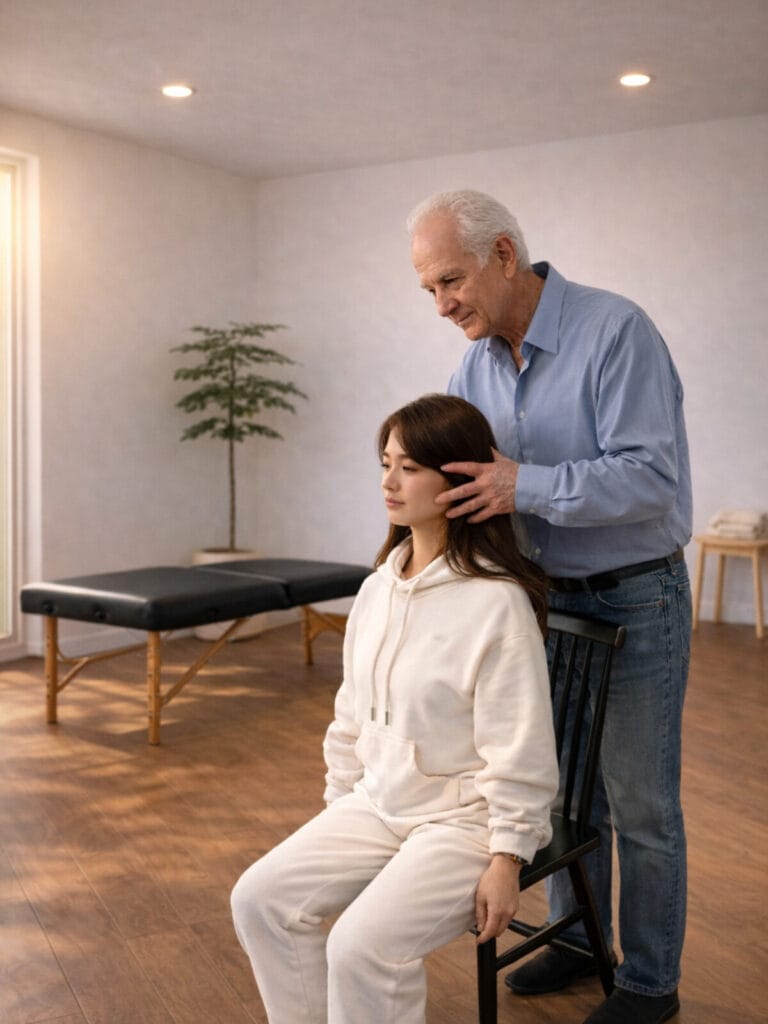
Kinesthetic Awareness: The Moment You Lose Yourself in Action | Tommy Thompson Class 109
❝ What if kinesthetic awareness in the Alexander Technique is not something you develop, but something you lose at the very moment you try to get it right? ❞
Most people assume awareness comes after the fact, once the task is finished or the tension is noticed. But what if kinesthetic awareness only matters in the exact moment you are reacting, when you are rushing, tightening, trying to get somewhere?
In this class, the Alexander Technique was not approached as a way to fix posture or remove discomfort. It became an exploration of whether awareness can remain present in the middle of action, especially when something is at stake. On April 29, 2026, in Boston, Massachusetts, USA, Tommy Thompson led a class in the Alexander Technique teacher training course where students were brought back to one essential question: can you stay aware of yourself while you are trying to do something?
Through hands-on work, whispered “ah,” and the observation of frustration during everyday activities like computer use, the class pointed to something deeper than sensing. It revealed the moment awareness either disappears or returns.
You don’t lose awareness by accident. You lose it the moment you try to succeed without yourself.
Key Objectives of the Class:
- To deepen kinesthetic awareness within real-time activity rather than after reflection
- To explore how inhibition interrupts automatic reactions and allows new coordination
- To understand why trust is essential for psycho-physical change
- To experience breathing and whispered “ah” as a practical gateway to embodied wellness
This blog series is based on Tommy Thompson’s Alexander Technique classes. Each post follows the flow and insights of the class to expand both self-awareness and practical consciousness applicable to everyday life.
New here?
If you’re new to the Alexander Technique, you can start with the resources below.
Alexander Technique Class Flow at a Glance
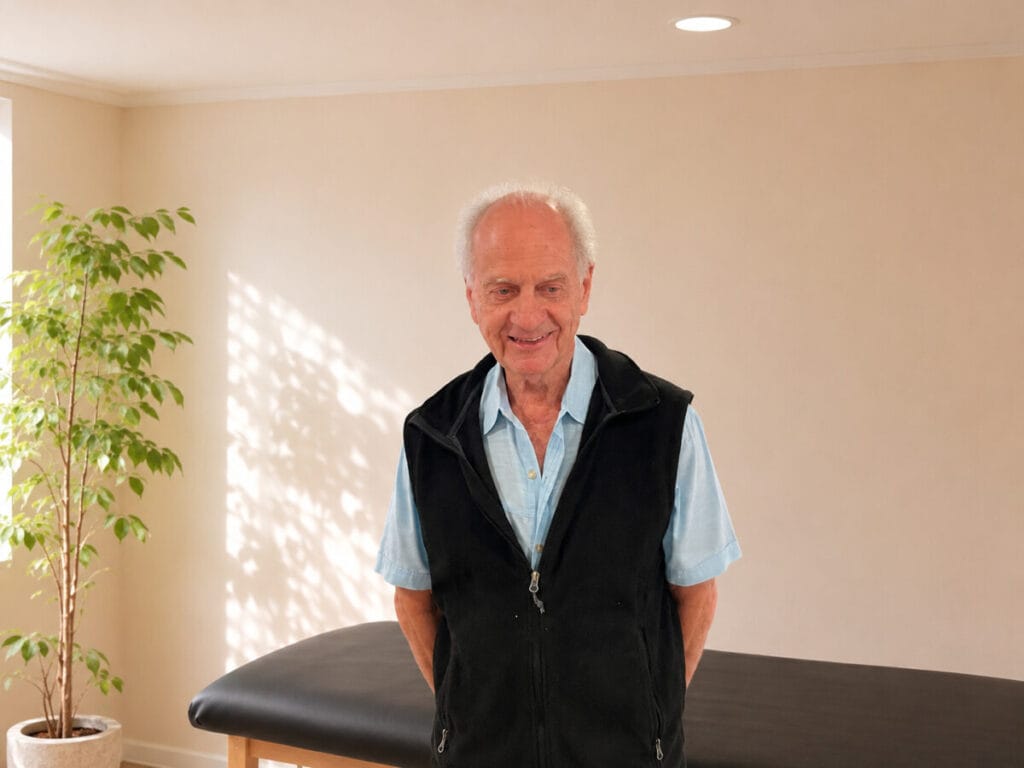
1. The Opening Question
❝ What happens to kinesthetic awareness the moment you become absorbed in getting something done? ❞
Most people don’t notice when it disappears. They notice the result—tension, effort, frustration. But in the Alexander Technique, that moment is everything. The moment you become absorbed in doing is the moment you leave yourself.
This class kept returning to that point as a direct experience. As soon as something mattered, awareness narrowed and the whole system followed. The question was not how to fix it afterward, but whether you could remain present while it was happening.
You don’t lose awareness because you don’t have it. You lose it because what you are doing becomes more important than how you are using yourself.
Tommy’s Word
“The role of the teacher is to shed light.”
The work is not about correcting or adding something new. It is about allowing a person to see what they are doing, while they are doing it.
And the moment you can see it, you are no longer lost in it.
2. Core Learnings from This Class
Core Concepts
- Kinesthetic awareness only matters in the moment of reaction
Most people become aware after the fact. In the Alexander Technique, awareness must exist at the exact moment you are about to tighten, rush, or try to get somewhere. - Awareness becomes meaningful when it turns into recognition
It is not enough to sense. The shift happens when you begin to recognize how you are using yourself while you are in the act of doing. - You do not change by improving the reaction. You change by not following it.
As Tommy often reminded the class, inhibition interrupts the pattern at its source. - There has to be total trust when you’re working with somebody.
Without that, the system continues to hold and protect its habits. - Breathing reveals whether you are holding on or allowing change
Through whispered “ah,” it becomes clear if you are staying with the known or allowing something new to come in.
Five Key Messages
- Awareness must be present during the activity
If it comes after, the pattern has already completed itself. - Stop trying to get it right
The moment you try to fix the result, you reinforce the habit. - Interrupt the reaction, don’t improve it
Change begins the instant the automatic response is not followed. - Stay with yourself when something matters
The more important the task feels, the easier it is to lose awareness. - Let something unknown enter the system
As Tommy said, change requires allowing what is new, different, and unfamiliar.
Essential Terms
- Kinesthetic awareness
The ability to remain aware of yourself while you are in the middle of doing something, not after it is finished. - Inhibition
The conscious decision to not follow an immediate, habitual reaction, allowing a different response to emerge. - Whispered “ah”
A practical process of releasing unnecessary holding, especially in the jaw and breathing, revealing a different coordination. - Trust
“There has to be total trust when you’re working with somebody.”
The condition in which the organism can begin to let go of protective patterns. - Recognition
The moment awareness becomes functional. When you recognize how you are using yourself in real time, especially in frustration.
3. Tommy’s Insights
In Tommy’s words during class, there are not only the core principles of the Alexander Technique, but also practical wisdom that can be applied directly to daily life. His words go beyond simple advice about movement and prompt us to deeply consider how we choose to exist.1. “The more we—you, me, all of us in this room and across the planet—use ourselves and behave in accordance with the way we are designed to function, the more likely our nervous system and overall organization are to become coordinated, efficient, and aligned with that design.”
➤ Coordination emerges not through force, but through functioning in harmony with the organism’s original design.
2. “You are there to guide them. I don’t know that you’re teaching them anything. The role of the teacher is to shed light. When you think of gurus and things, that means you shed light. Help shed light for them into their own truth. And they’ve all got income, and they’ve got everything, so the Alexander work is really good for them. It really is, because you don’t have to espouse what we’re talking about with them unless they want to. It’s very practical, and it’s practically demonstrated through an activity.”
➤ The teacher does not impose change, but illuminates the student’s capacity for self-discovery through lived experience.
3. “There has to be total trust when you’re working with somebody.”
➤ Psycho-physical change unfolds through relational safety and non-defensive presence.
4. “Whispered ‘ah’ really is a way of distinguishing the lower jaw from the upper jaw, and it’s a way of distinguishing the jaw from the head, because most people are really tight in the temporomandibular joint. But if your jaw is being held up here, it’s being considered part of your head, and it’s not.”
➤ The whispered “ah” restores differentiation, allowing the jaw to release from unconscious holding and become part of the whole organism again.
5. “Whispered ‘ah’ is a fair exchange between the Earth and you—that’s what’s going on. It really is. I see breathing as a metaphor for change. So when you do the whispered ‘ah,’ it’s a metaphor for changing your use. You let go of what you’ve been holding onto completely and totally, and you take in that which is new, different, and unknown every time you breathe. So the deeper you let go, the more that which is new, different, and unknown comes in. That’s a fair exchange. Try it. Close your lips and breathe. Let your head come forward and up.”
➤ Breathing becomes a practice of releasing habit and welcoming the unknown.
6. “What you really have to do is use your kinesthetic sense of perception to identify, in the midst of your frustration, how you’re using yourself. So that’s just learned behavior. It has to outweigh your desire to accomplish and finish and complete what you’re doing.”
➤ Transformation begins when awareness enters the habitual reaction instead of being absorbed by it.
7. “So you have to intervene. You can do that by letting your neck be free to lengthen, going through the elemental directions. That’s inhibiting the reaction to a given stimulus in order to meet the work directly.”
➤ Inhibition creates the space for a new coordination to emerge.
4. Practical Tips for Everyday Life
What’s the Goal?
The goal is not to do something better, but to not leave yourself while you are doing it. In the Alexander Technique, kinesthetic awareness is the moment you remain with yourself when you would normally rush, tighten, or try to get it right. This is not separate from life. It happens exactly when something matters.
How to Practice
- When urgency appears while working
The moment you feel “I have to finish this,” stop for one second. Don’t fix anything. Notice what you are doing—pulling forward, holding your breath, tightening. Let your neck be free and take your attention off the task for a brief moment, then return. - When frustration shows up
Don’t get rid of it. Stay with it. As Tommy would guide, this is where the work begins. Allow a gap where you do not immediately react. - When you take a breath
Let the exhale leave without control. Then receive the next breath without trying to shape it. Let go of what you were holding, and allow something new to come in.
What You’ll Notice
You begin to catch the moment you usually miss. The reaction slows down. Effort reduces without trying to relax. There is more space in your breathing and more clarity in your action.
And then something simple but profound happens: you are still there, even when something matters.
5. Closing the Class
Key Takeaways
- Kinesthetic awareness is not something you gain, but something you stop losing in the moment of action
- You do not change by fixing your reaction, but by not following it
- Trust is essential for real psycho-physical change
- Breathing shows whether you are holding on or allowing something new
Core Insights
The Alexander Technique does not ask you to become different. It asks whether you can remain with yourself while something is happening. That is where kinesthetic awareness begins to matter.
As Tommy emphasized, the issue is not what you are doing, but whether you are present in the doing. When awareness disappears, habit takes over. When it returns, something else becomes possible.
Change is not something you make happen. It appears when you stop interfering.
A Final Invitation
Take this into something real today, when something matters.
When you feel urgency or pressure, pause and notice. Stay with yourself just a little longer than you usually would.
That is where the work begins.
6. One Key Practice
The moment you feel “I have to finish this,” stop for one second.
Take your eyes off the task, allow your neck to be free, and do not follow the reaction.
That pause is kinesthetic awareness in action.
7. Three Questions to Ask Yourself
- Right now, am I trying to get somewhere, or am I here while I’m doing it?
- Can I notice the exact moment my attention narrows and my body follows?
- What happens if I do not follow this reaction, even for one second?
8. For Those Who Wish to Learn More
Recommended Books
The Use of the Self – F. Matthias Alexander
This book closely reflects the heart of this class. F. Matthias Alexander repeatedly returns to one essential issue: what happens to the self in the moment of reaction. The book explores how awareness disappears when we become absorbed in trying to accomplish something, and how inhibition allows a different coordination to emerge.
Kinesthetic awareness must exist in the middle of action, not after it.
That is what makes this book especially valuable for understanding the deeper work explored throughout this class.
Official Website of Tommy Thompson
www.easeofbeing.com
This is the official website personally managed by Tommy Thompson, offering a wide range of resources and programs to deepen your understanding and practice of the Alexander Technique:
- Private session reservations and inquiries
- Workshop and seminar schedules
- Overview of international teacher training programs
- Essays and articles on the Alexander Technique
9. Next Class Sneak Peek
What happens when a person stops leaving themselves the moment experience begins?
Class 110 moves deeply into the relationship between awareness, movement, and the place where experience is actually happening. As Tommy Thompson continues exploring presence in use, the class reveals how coordination changes when a person remains connected to themselves.
In Class 110, we’ll explore: how the Alexander Technique transforms movement and perception when a person learns to remain “Here” within their own experience.
10. Join the Alexander Technique Journey
Did this class leave a small resonance within you? Feel free to quietly hold it in your heart or share it in just a sentence or two. The comments are always open. Your one simple word may leave a gentle ripple in this ongoing journey.The journey of Resonance Flow continues across social media as well. Let’s continue this journey together.
 YouTube
 Instagram
 Threads
 Facebook