Embodied Identity: Transforming Self Through Movement | Tommy Thompson Class 17
❝ Who are you when you stop moving the way you’ve always moved? ❞
Most people assume identity lives in the mind—in what we think, believe, or remember. But what if identity is enacted through movement? What if the way you reach for a glass, brace yourself before standing, or hold your jaw when thinking is your body’s way of reinforcing who you’ve been?
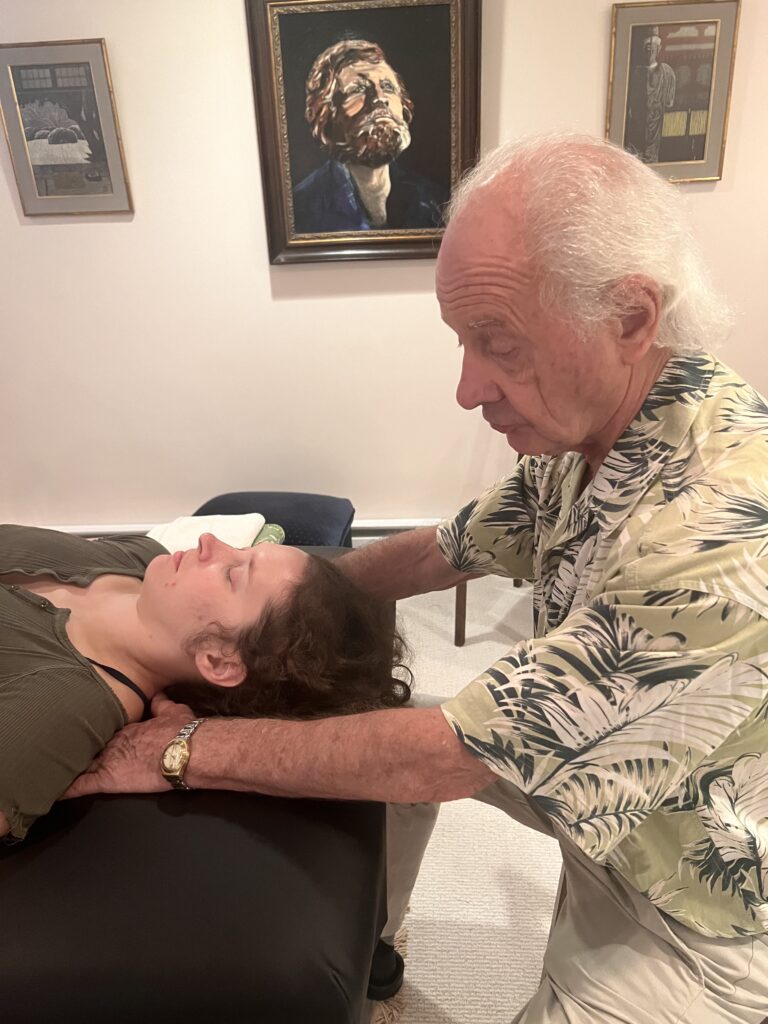
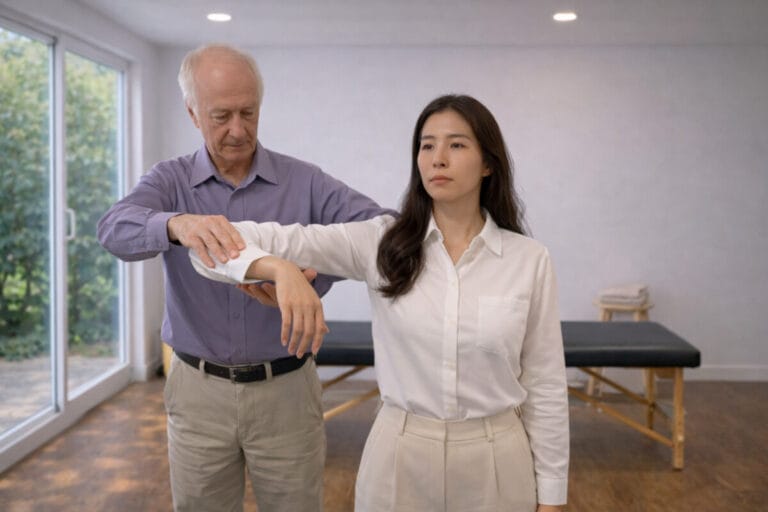
On October 23, 2024, in Boston, Massachusetts, USA, Tommy Thompson led Class 17 in the Alexander Technique teacher training course. In this class, Tommy invited trainees to explore the nature of Embodied Identity—the understanding that who we are is not static, but continuously shaped by our movement patterns, postural habits, and nervous system responses.
By withholding automatic reactions, we don’t just change posture—we create a space where new versions of ourselves can begin to emerge. This wasn’t a class about fixing posture. It was about recovering the freedom to choose how we respond.
In Tommy’s words, the body is not a machine to fix, but a mirror of how we see ourselves—moment to moment.
Key Objectives of the Class:
- To explore how unconscious movement patterns define and reinforce identity
- To experience how inhibition and conscious non-doing shift nervous system responses
- To reconnect with the body’s natural support systems through the principles of the Alexander Technique
- To understand how vision, voice, and touch create safe, instinctive pathways to presence and transformation
This blog series is based on Tommy Thompson’s Alexander Technique classes. Each post follows the flow and insights of the class to expand both self-awareness and practical consciousness applicable to everyday life.
New here?
If you’re new to the Alexander Technique, you can start with the resources below.
Alexander Technique Class Flow at a Glance

1. The Opening Question
❝ What part of you moves first—your body, or your identity? ❞
When you move—stand up, reach out, speak—is it your body that initiates the action, or your sense of self?
In Class 17 of the Alexander Technique teacher training course, this was the kind of question that didn’t require an answer. It required observation. This is the heart of Embodied Identity: not an abstract theory, but something we live through our movements, moment by moment. And the moment we withhold our usual response, something unexpected appears: a different way of standing, a different way of being.
This class wasn’t about movement correction. It was about recovering the subtle space between intention and action, where the possibility for transformation lives.
Tommy’s Word
“You’re going to brush your teeth. You’ve already started well before it. The nervous system has already given a different impulse.”
He wasn’t talking about dental hygiene. He was naming a moment—tiny, habitual—where identity reasserts itself through posture. And in that moment, Alexander Technique offers something radical: a chance to pause, and choose something new.
2. Core Learnings from This Class
Core Concepts
Identity is not who you think you are. It’s how you move.
In this class, Tommy invited trainees to move beyond self-perception and into self-embodiment. He wasn’t asking, “What do you believe about yourself?” He was asking, “What does your nervous system do before you even notice?” In the Alexander Technique, identity isn’t a belief—it’s a pattern. And that pattern is interruptible.
The nervous system remembers the self before thought does.
Tommy showed how past trauma, repeated behavior, or even emotional habits leave physical traces. They show up in how we sit, how we reach, how we anticipate movement. And until we pause, we’re just rehearsing old versions of ourselves. The power of inhibition lies in that pause—a space where the nervous system can choose something new.
Posture is autobiography.
How you stand, where your head sits, how your neck tenses—all of it tells a story. Not consciously, but habitually. Tommy taught that our postural habits are physical narratives. By changing them, even subtly, we don’t just move differently—we become different.
You are not here to fix your body. You’re here to let it speak.
Tommy repeatedly emphasized that the body is not a broken machine needing repair. It’s a self-regulating, deeply intelligent organism. The job of the teacher—or the self—is not to impose, but to create space for the body’s organic coordination to return.
Presence precedes technique.
In working with others, Tommy insisted that real change starts not with correction, but with connection. First, you see. Then, your voice adjusts. Then, perhaps, you touch. This is not just etiquette—it’s neurobiological safety. And it is foundational to teaching the Alexander Technique with integrity.
Five Key Messages
- You are not who you were. You are who you’re becoming.
In every movement, you’re rehearsing an identity. When you stop repeating the past, even briefly, the future opens. - Withholding definition creates freedom.
When you don’t rush to be someone, you give space for a different version of you to emerge—one that doesn’t carry the same tension, the same story. - Posture is not neutral—it’s loaded with memory.
You carry experiences in how you sit, how you wait, how you expect. That’s not bad. It’s just not always necessary anymore. - The smallest pause creates the biggest possibility.
It doesn’t take effort to change. It takes awareness. One second of not doing can redirect a lifetime of unconscious doing. - Embodied Identity is not a theory. It’s something you practice.
It’s not about finding your “real self.” It’s about being present enough to delay self-definition.
Essential Terms
Embodied Identity
The central theme of this class—and of Tommy’s teaching. Embodied Identity is not a concept. It’s a reality: the self as it is lived through movement, posture, and nervous system habit. How you move is how you know yourself. And when you move differently, you become someone new.
Withholding Definition
More than just inhibition, this is Tommy’s way of saying: Don’t decide who you are—yet.
It’s the space before movement, before reaction, before identity takes hold. You pause not merely to stop a habit, but to make room for something new to emerge. Not knowing who you are—even for a moment—is where freedom begins.
Inhibition
The conscious pause before automatic action. Central to the Alexander Technique, inhibition creates space for the nervous system to choose something unfamiliar, rather than repeat the known.
Postural Set
The unconscious pre-movement arrangement of the body. Tommy showed that most people enter this “set” before doing anything—standing, brushing teeth, even speaking. Changing it shifts the entire sequence
Stretch Reflex
An involuntary muscle response to perceived stress or pressure. Even the smallest stimulus can activate it. Tommy used this to show how deeply embedded our protective reactions are—and how sensitively they can be retrained.
Organic Movement
Movement that arises from the body’s own coordination, not from imposed effort. Tommy reminded us: don’t make movement happen. Make space, and let the body remember how.
3. Tommy’s Insights
In Tommy’s words during class, there are not only the core principles of the Alexander Technique, but also practical wisdom that can be applied directly to daily life. His words go beyond simple advice about movement and prompt us to deeply consider how we choose to exist.“No, I am not the man I was before. I could potentially be this man as well. I could be this man, or I could be that man.”
Identity is not fixed—it is fluid and shaped by how we choose to move in the present.
“The body knows far more than I do; it has cellular consciousness.”
The body carries intelligence deeper than thought—its awareness emerges from sensation, not analysis.
“The organic technique requires you to inhibit your reaction and replace it with allowing the neck to be free. This isn’t something you actively do—it’s something you allow. What will the neck do when it’s truly free? You might find that moving forward and upward is what naturally occurs—and in many cases, it’s the most appropriate response.”
Inhibition creates space for the nervous system to reorganize itself through non-doing, not force.
“Frank’s postural set precedes and accompanies movement. He demonstrated this during chair work, showing how most people, when standing up, unconsciously assume this postural set before they even begin to rise.”
Movement begins in pre-movement—the body acts before we think we are acting.
“That fluid state—when combined—changes the fluidity of your mind, thoughts, and intentions.”
Physical ease reshapes mental and emotional flow—the body leads the mind.
“Instinctive contact begins with vision, not with touch. That’s exactly what we’re doing. First, you make visual contact. You observe the other person closely—your first connection is made through sight. Then, the quality of your voice must reflect what you see. If you truly see someone, your voice will inevitably change.”
How you see someone alters how you speak, touch, and relate.
“So if I just did that, all I did was a tiny squeeze. That tiny squeeze triggers a stretch reflex.”
Even the smallest unconscious tension can trigger deep habitual responses in the nervous system.
4. Practical Tips for Everyday Life
What’s the Goal?
To begin sensing your embodied identity as something fluid, not fixed—by gently interrupting your automatic movements and seeing what else might be possible.
How to Practice
- Pause before you move.
Before standing up, brushing your teeth, or picking up your phone—take 2 seconds. Feel what your body is already preparing to do.
That moment of interruption is your chance to choose something different. - Try moving with less effort.
As you walk or reach for something, ask: “Can I do this with 10% less effort?” Let the movement reorganize itself without you pushing through it. - Switch hands for a familiar task.
Try brushing your teeth, holding your cup, or opening a door with your non-dominant hand.
Notice how the body compensates, resists, or adapts—this reveals unconscious postural sets.
What You’ll Notice
- Familiar movements will feel strange—but that’s the point.
- You may catch yourself doing before noticing—this is an invitation, not a failure.
- As awareness grows, you’ll find that how you move starts to shift how you feel—and even how you see yourself.
5. Closing the Class
Key Takeaways
- How you move is not just a habit—it’s how you define who you are.
- When you interrupt the automatic, even for a second, you create space for a new self to emerge.
- Your body isn’t waiting to be fixed. It’s waiting to be listened to.
Core Insights
This class wasn’t about learning a technique in the conventional sense. It was an invitation to observe the microscopic decisions you make with your body, and to notice how those decisions shape your thoughts, your emotions, and ultimately your identity.
Tommy didn’t just teach movement.
He asked: What if the way you move is the way you limit yourself? And more importantly: What happens when you stop defining who you are by what you’ve done before?
This is where the Alexander Technique becomes more than a method—it becomes a practice of releasing the self-image we’ve rehearsed and replacing it with a moment of presence.
A Final Invitation
So try this:
The next time you rise from a chair, pause.
Not because you’re trying to correct anything, but because you’re offering your body a question:
Is there another way I could be—just for this moment?
That’s the beginning of embodied identity.
And it starts with noticing what you usually don’t.
6. One Key Practice
Pause before you move.
That’s it. Before standing. Before speaking.
Before picking up your phone.
Take one breath. Feel what your body is already preparing to do. And in that pause, don’t fix—just notice.
That tiny space is where your embodied identity starts to shift. It’s not about doing it right.
It’s about not rushing past the moment where something else could happen.
7. Three Questions to Ask Yourself
These aren’t questions to answer with your head.
They’re invitations to feel what’s happening—right now, in your body.
- What is my body already doing before I think I’m doing anything?
→ Let yourself notice the pre-movement—the preparation your nervous system makes before you act. - Where in my movement is effort hiding?
→ Ask gently. You’re not trying to fix it. You’re just letting yourself see the unnecessary push. - What would it be like to not define myself by how I usually move?
→ This is where embodied identity begins—not in doing better, but in doing differently.
Use these questions as daily companions. Not to judge your movement, but to uncover the self that lives underneath your habits.
8. For Those Who Wish to Learn More
Recommended Books
- Touching Presence – Tommy Thompson
This is not a manual. It is a conversation between your nervous system and your evolving sense of self. In Touching Presence, Tommy distills over 50 years of experience with the Alexander Technique into profound insights on self-awareness, withholding definition, and the ongoing choice to inhabit new possibilities. Rather than presenting presence as a destination, he invites you to engage with it as a way of relating—to your body, your breath, and those around you.
If you’re ready to explore what it truly means to embody your identity through movement, this book is your essential guide to meeting yourself with acceptance, not correction. - The Use of the Self– F. M. Alexander
A seminal text from the founder of the Alexander Technique. This book explores how the “use” of the self—through movement, posture, and attention—shapes thought and behavior. It lays the groundwork for understanding how changing movement can change identity.
Official Website of Tommy Thompson
www.easeofbeing.com
This is the official website personally managed by Tommy Thompson, offering a wide range of resources and programs to deepen your understanding and practice of the Alexander Technique:
- Private session reservations and inquiries
- Workshop and seminar schedules
- Overview of international teacher training programs
- Essays and articles on the Alexander Technique
9. Next Class Sneak Peek
In the next class, we’ll explore how wave-like movement and self-awareness can guide us toward natural coordination—by releasing control and meeting the body with trust.
What We’ll Explore in the Next Class:
Understanding undulatory movement
How to recognize and cooperate with the body’s innate wave-like rhythms.
Rethinking traditional directionality
How letting go of fixed cues can create space for more natural coordination.
Observing habitual movement patterns
How unconscious habits and identity shape the way we move.
Balancing structure and flow
How to harmonize guidance with the body’s internal intelligence.
Experiencing non-interference
How stepping back allows freedom and efficiency to emerge on their own.
Come ready to experience a new relationship with movement—one that begins with trust.
10. Join the Alexander Technique Journey
Did this class leave a small resonance within you? Feel free to quietly hold it in your heart or share it in just a sentence or two. The comments are always open. Your one simple word may leave a gentle ripple in this ongoing journey.The journey of Resonance Flow continues across social media as well. Let’s continue this journey together.
 YouTube
 Instagram
 Threads
 Facebook