What Happens When You Stop Preparing? The Power of the Empty Palm | Tommy Thompson Class 61
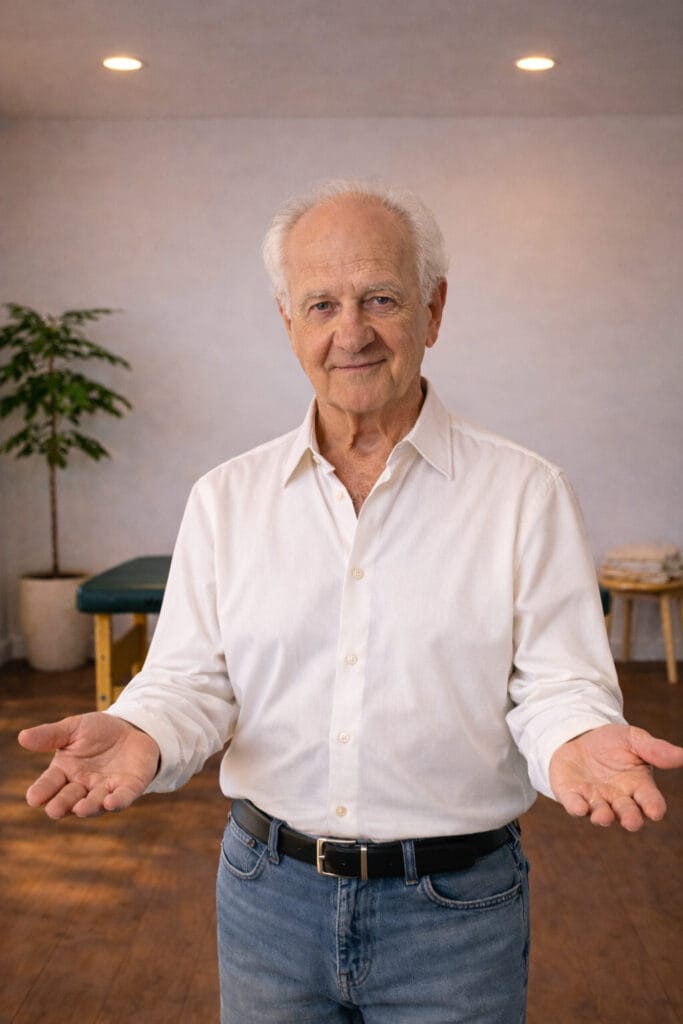
❝ What if your hand could stop holding your history? ❞
Most people try to change by adding something—more awareness, more willpower, more posture correction. But what if real change begins with less?
In the Alexander Technique, the transformation often begins not with the spine or breath, but with something far more subtle: the empty palm. A hand that stops holding. A hand that stops preparing. A hand that does not impose.
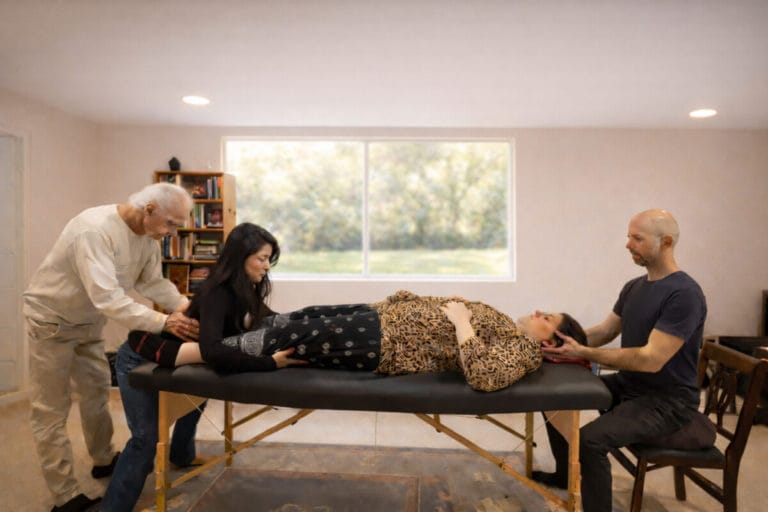
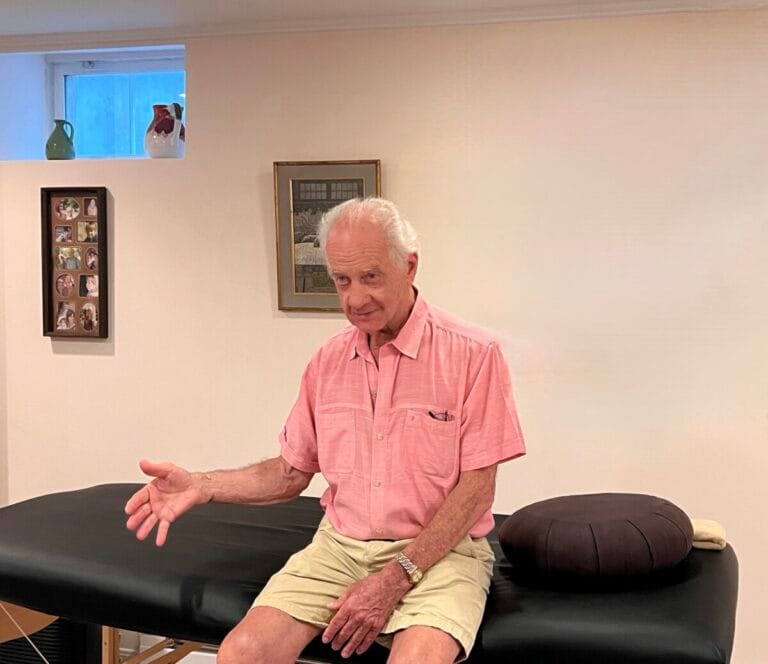
On April 15, 2025, in Boston, Massachusetts, USA, Tommy Thompson led a class in the Alexander Technique teacher training course that opened not with theory, but with sensation. He asked the trainees to begin where most people never think to start—by sensing their hands.
“Let your palm empty,” he said.
That’s all. No technique, no fixing, no solving.
Just an invitation to release what you didn’t even know you were holding.
As the hand released, so did the shoulder. So did the neck. And then something more subtle began to shift—the way each trainee identified their own “self” through posture, gesture, and effort.
This was a class about unlearning. About sensing instead of feeling. And about what happens when we stop manipulating ourselves and others—even through the touch of a single hand.
Key Objectives of the Class:
- To explore how releasing tension in the palm affects the radius, ulna, shoulder, and cervical spine
- To distinguish between manipulative and safe touch through kinesthetic awareness
- To introduce the empty palm as a gateway to Presence, mutual resonance, and non-habitual relationship
This blog series is based on Tommy Thompson’s Alexander Technique classes. Each post follows the flow and insights of the class to expand both self-awareness and practical consciousness applicable to everyday life.
New here?
If you’re new to the Alexander Technique, you can start with the resources below.
Alexander Technique Class Flow at a Glance
1. The Opening Question
❝ How do you know who you are, if you’ve never sensed yourself without tension? ❞
Tommy Thompson doesn’t ask this as theory. He asks it as practice.
And in this Alexander Technique class, the practice started where few expect it: the palm.
“Let your fingers extend. Let your palm be more open, more free from restriction. That’s when the person receives a safer hand.”
— Tommy Thompson
Not with posture. Not with the spine. Just the empty palm—noticing what it’s already doing, and letting it do less.
Tommy didn’t ask us to become better versions of ourselves; he invited us to notice the self already there—once we stop preparing.
“What are you sensing—not feeling, sensing?” he asked.
That distinction is everything. It invites a shift from emotional interpretation to kinesthetic awareness—from reaction to presence.
The palm opens. The nervous system listens. The other person feels safe. And maybe, for a moment, you stop identifying with what you’ve been holding.
2. Core Learnings from This Class
In this moment from Tommy Thompson’s class, trainees explore how Triadic Resonance changes the way the hand is perceived and used.
Watch how a simple shift in awareness awakens space, sensitivity, and coordination.
Why One Hand Feels Different — Triadic Resonance | Alexander Technique
Class 61 · April 10, 2025 · Boston, MA
Core Concepts
- The hand is where transformation begins.
Before the spine, before the breath, comes the palm. The act of opening the hand—of releasing the carpal bones and softening the touch—activates a shift that radiates through the body and into relationship. - Sensing is the first language of the self.
Tommy didn’t ask what you feel. He asked what you’re sensing. This wasn’t a vocabulary shift—it was a perceptual shift, from emotional narrative to embodied clarity. - Touch builds or breaks trust.
Every touch carries intention. It either listens or it pushes. Through the Alexander Technique, we practice touch that supports, not steers. - The way we hold ourselves is who we think we are.
And when we let go—even for a moment—we can access something beyond our patterns. The body is not just where tension lives. It’s where identity hides. - Presence begins in the hand, but it doesn’t stay there.
When the hand empties, attention spreads. The spine responds. The relationship shifts. What started as anatomy becomes awareness. What began as gesture becomes a gateway.
Five Key Messages
- “Let go of what you’re used to holding, and the real you might begin to appear.”
→ Identity is shaped by what we grip—physically and emotionally. - “Sensation is the body’s way of telling the truth.”
→ When you stop interpreting, you start perceiving. - “A safe hand is a hand that isn’t asking for anything.”
→ Presence communicates through absence of agenda. - “Stop preparing. Start receiving.”
→ The less you do, the more is available. - “When your palm empties, the rest of you listens.”
→ Touch isn’t just contact—it’s invitation.
Essential Terms
- Empty Palm
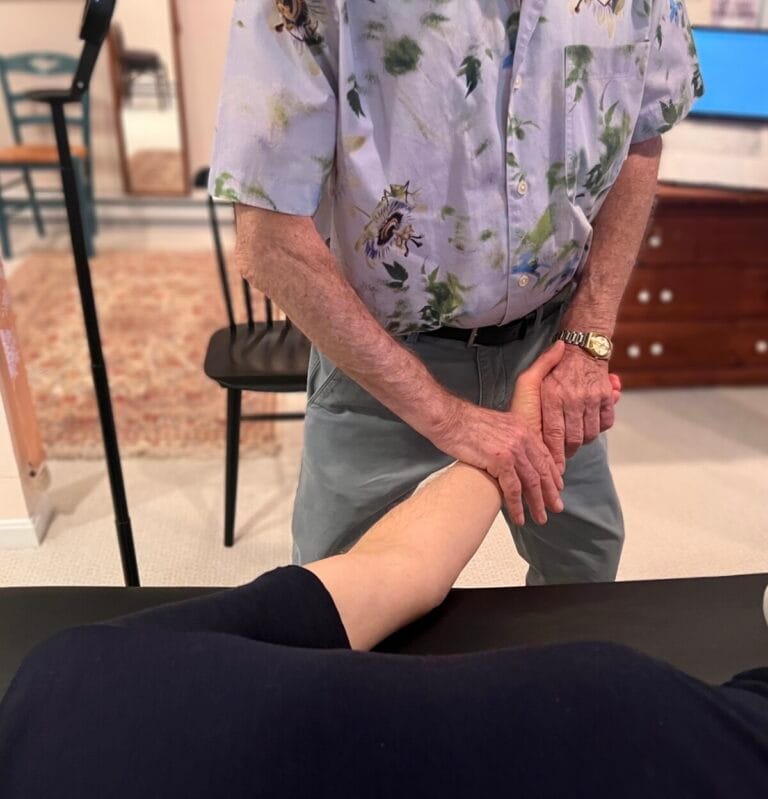
More than a metaphor, this is a physical and relational gateway. When the palm stops gripping, the carpal bones release, the radius and ulna uncoil, and the neck and spine respond. The empty palm allows presence to emerge without manipulation.
“What I’m doing is opening my hands. My fingers extend, my palm becomes more open, more free from restriction.” – Tommy
- Kinesthetic Sense
The body’s internal GPS. It tells you where you are in space, how you’re holding yourself, and whether you’re reacting or relating. Tommy teaches that sensing through this system—not “feeling”—is the first language of the self.
“Your kinesthetic sense is giving you information about yourself.”
- Safe Hand
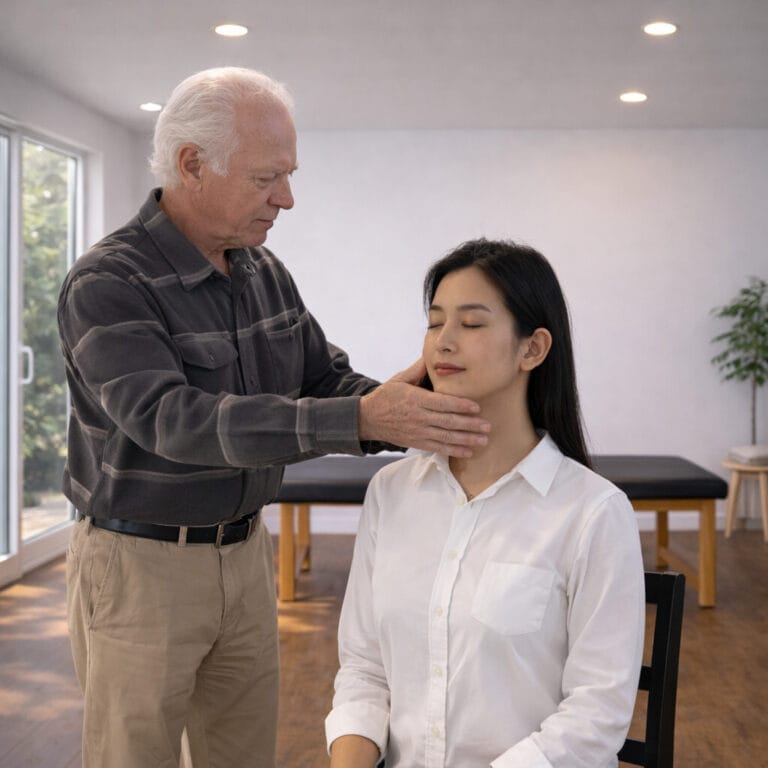
A safe hand doesn’t ask, direct, or fix. It simply meets. Tommy showed how a trainee’s hand could either create trust or tension—not by pressure, but by intention. The safe hand lets someone leave who they think they are, and step into the unknown with support.
“They have to feel safe beneath their hand, because they’re leaving who they know.”
- Triadic Resonance
A state—not a technique—where self, other, and the field between harmonize. This resonance is initiated by the open palm, sustained by attention, and carried by relational sensing. It’s when two bodies stop doing and start co-listening.
“Triadic resonance is a way of emptying the palm. That’s all. It’s: I stop doing this.”
- Withholding Definition
Instead of labeling what you’re sensing or who you’re with, you pause. You let sensation stay alive without putting it in a box. This opens all the senses. You begin to see instead of just look.
“Withhold defining it… and all your senses become more alive.”
- Let Yourself Be Touched
Touch becomes reciprocal. It’s not about doing to someone, but allowing yourself to be moved. When you let yourself be touched—by a person, an object, even a memory—you stop controlling and start receiving.
“Let yourself be touched while you touch someone else.”
3. Tommy’s Insight
In Tommy’s words during class, there are not only the core principles of the Alexander Technique, but also practical wisdom that can be applied directly to daily life. His words go beyond simple advice about movement and prompt us to deeply consider how we choose to exist.“Your kinesthetic sense is giving you information about yourself. It lets you experience where you are relative to the environment. You know how far away I am from you right now? That’s kinesthetic perception. It’s called proprioception. When you’re standing and working for a long time and your neck gets tight—sensing that tightness is kinesthetic perception.”
→ The kinesthetic sense is not just awareness—it’s your body’s native intelligence, always offering context through sensation.
“I base everything I work with partly on the difference between being in a relationship to something and doing something in relationship to something.”
→ The shift from acting on to being with is what makes presence relational rather than performative.
“The thing that helps you is to ask the person what they’re sensing. That helps you learn if you’re doing it correctly or not—by constantly talking to them and asking what they’re sensing. Not feeling, because ‘feeling’ is too many words. If you have your hand right in here, you would just say, ‘What are you sensing? What is your experience?’ But ‘sensing’ means they’re using their kinesthetic sense. You want them to start using that sense consciously. Pushing your kinesthetic section is unconscious.”
→ Asking about sensing—not feeling—trains both teacher and partner to inhabit the moment with embodied clarity.
“Withhold defining it. If you’re attracted to it while withholding definition, you’re using a different kind of touch. You’re seeing it instead of just looking at it. You could smell it—but all your senses become more alive if you withhold defining what it should feel like, look like, act like. You’ll be using your support fiber. It’s the difference between being and doing, seeing and looking, listening and hearing.”
→ Resisting the urge to label allows your full sensory field to wake up and engage without distortion.
“What I’m doing is opening my hands. My fingers extend, my palm becomes more open, more free from restriction. And I said, ‘Then it must be that the person is receiving a safer hand, because the nerve receptors go straight to the brain—for love, compassion, and understanding. That’s all in the center of the palm.’”
→ When the palm opens, the nervous system recognizes safety—before language, before cognition.
“They have to feel safe. They have to feel safe beneath their hand, because they’re leaving who they know. ‘Safe’ is one word you can use—cared for, stable, non-threatening—anything. But you’re removing them from their experience of themselves that they’re accustomed to. And the hands provide that safety—because of the quality of the touch. It’s unconditional. I condition.”
→ The quality of your touch can hold space for someone’s identity to dissolve—without fear or force.
“Habituation—sometimes you develop patterns to protect yourself. Sometimes it’s just totally unconscious. So if you’re asking a person to feel safe—I mean, to change—that’s what you’re saying. You’re suggesting it’s possible to change. It’s possible. I’m not asking you to change—you don’t have to. Just: possible. So I think triadic resonance is a great way into that. That’s not part of the Alexander world—except for the people who take my workshops. And you can practice that yourself.”
→ Safety makes change possible, and possibility is often more transformative than instruction.
“Triadic resonance is a way of emptying the palm. That’s all. Emptying your hands—it’s a metaphor. It’s about letting go of what you’re used to holding, or preparing. It’s not magic. It’s: I stop doing this.”
→ Letting go isn’t mystical—it’s practical: a repeated act of stopping what no longer serves.
“The exercise I used to use was: let yourself be touched while you touch someone else. Still useful.”
→ Reciprocal touch means releasing the performer and allowing yourself to be moved—together.
4. Practical Tips for Everyday Life
What’s the Goal?
The goal isn’t to fix yourself. It’s to interrupt what’s automatic—what you do without knowing. In the Alexander Technique, even a small shift in attention can change how you move, relate, and respond.
Start with what’s already doing something: the palm.
How to Practice
1. Start with your hand, not your posture.
Let the fingers lengthen. Let the carpal bones rest. Let go of the idea that you need to do anything.
→ Presence starts when interference stops.
2. Ask, “What am I in relationship with?”
Not “How’s my posture?”, but “How am I meeting the floor, the air, the object?”
→ The Alexander Technique is less about position, more about relation.
3. Let yourself be touched.
Touch a surface—but allow it to register in you. Don’t do, receive.
→ This is the empty palm in action: giving up control to gain connection.
What You’ll Notice
- Less preparation, more perception.
- Natural length and ease in your body.
- Relational stillness, not frozen stillness.
- No effort to be present—just presence.
5. Closing the Class
Key Takeaways
We didn’t try to fix our posture.
We didn’t try to do better.
We practiced something far more radical:
Letting go of what we usually do, to discover what we actually are.
And we began it all through the palm.
Core Insights
In the Alexander Technique, change doesn’t happen through effort.
It happens through interruption, through awareness, through a safe space to not know.
Tommy didn’t ask us to become better versions of ourselves.
He invited us to notice the self that’s already there—once we stop preparing.
He reminded us:
“Stop preparing. Start receiving.”
This is how we move from doing to being.
From reacting to relating.
From habit to presence.
A Final Invitation
As you leave the studio, or your chair, or this page—
Don’t try to remember what you learned.
Let your body recall what it didn’t have to do.
Let the empty palm lead your next gesture. Let it be relationship—not control—that shapes how you meet the world. Let this be not a method, but a way of being touched by life itself: unarmed, receptive, awake.
6. One Key Practice
Let the palm empty. That’s it.
Not your whole body. Not your breath. Just your palm.
Let it rest. Let it soften. Let it not know what to do.
And in that moment—your spine listens, your breath returns, and your body becomes available.
Letting go doesn’t begin in the spine. It begins in the hand.
The empty palm doesn’t perform; it receives.
It doesn’t lead; it relates. And that changes everything.
7. Three Questions to Ask Yourself
1. Is my hand preparing for something— or just here?
→ You don’t need to fix it. Just notice: is it holding, adjusting, anticipating? Or simply resting?
2. Am I in relationship with what I’m touching— or just using it?
→ Whether it’s a chair, a phone, or a person—am I allowing contact, or controlling outcome?
3. What am I aware of—without trying to be?
→ Before intention, before effort—what’s already being sensed, felt, noticed in this moment?
8. For Those Who Wish to Learn More
Recommended Book
Body Learning – Michael J. Gelb
A modern, perceptual journey into the Alexander Technique, this book translates core principles like unlearning habitual tension, balanced resting state, and sensory awareness into gestures, relationships, and daily life.
Drawing on these foundations, Gelb helps readers explore how everyday movements—including something as subtle as an open hand—can become ways of sensing, choosing, and relating with greater presence.
“Gelb provides a clear, well‑organized, and engaging account of how the Alexander Technique can improve coordination, posture, and overall well‑being.” — Alexander Technique International
Official Website of Tommy Thompson
www.easeofbeing.com
This is the official website personally managed by Tommy Thompson, offering a wide range of resources and programs to deepen your understanding and practice of the Alexander Technique:
- Private session reservations and inquiries
- Workshop and seminar schedules
- Overview of international teacher training programs
- Essays and articles on the Alexander Technique
9. Next Class Sneak Peek
What if your hand knew more than your head?
In Class 60, we follow a simple but radical thread:
that your hand isn’t just an instrument—it’s an expression of how you relate to the world.
We’ll explore what Tommy calls “the intelligence of the hand”:
its ability to signal safety, receive contact, and extend intention without effort.
When you stop using your hand to do—and start allowing it to relate—
your entire coordination changes.
Not just in movement, but in meaning.
In Class 60, we’ll explore:
how presence travels through the hand, how safety begins with touch, and how the body reorganizes when nothing is being asked of it.
10. Join the Alexander Technique Journey
Did this class leave a small resonance within you? Feel free to quietly hold it in your heart or share it in just a sentence or two. The comments are always open. Your one simple word may leave a gentle ripple in this ongoing journey.The journey of Resonance Flow continues across social media as well. Let’s continue this journey together.
 YouTube
 Instagram
 Threads
 Facebook