What Really Happens When You Stop Trying to Help? Position of Mechanical Advantage | Tommy Thompson Class 76

❝ What if your entire sense of balance—physical, emotional, even spiritual—could reorganize itself the moment you stop trying to control it? ❞
That question wasn’t written on the whiteboard.
It was written in the room—between the pauses, the silences, and the hands that didn’t push.
On September 17, 2025, in Boston, Massachusetts, USA, Tommy Thompson led a class in the Alexander Technique teacher training course that centered on what he called the most honest position a human being can enter: the Position of Mechanical Advantage.
But this wasn’t a lecture about anatomy. It was a training in presence.
Tommy didn’t ask trainees to do more. He asked them to do less, then less again—until movement was no longer something they performed, but something they allowed.
He spoke not of correcting posture, but of recovering relationship—between the head and spine, the hands and back, the self and the environment. And he did it with the kind of unshakable softness that made you believe:
If I stop holding myself together, maybe I won’t fall apart. Maybe I’ll stand up.
Key Objectives of the Class:
- To explore the Position of Mechanical Advantage as an evolutionary and functional reset point for integrated movement.
- To experience how non-doing and inhibition allow the neuromuscular system to organize itself intelligently.
- To embody the principle that the hands belong to the back, transmitting presence without effort.
- To reconnect movement and identity through the practice of conscious direction and inner stillness using the Alexander Technique.
This blog series is based on Tommy Thompson’s Alexander Technique classes. Each post follows the flow and insights of the class to expand both self-awareness and practical consciousness applicable to everyday life.
New here?
If you’re new to the Alexander Technique, you can start with the resources below.
Alexander Technique Class Flow at a Glance
1. The Opening Question
❝ What is the one position where effort ends—and everything in you starts to organize itself? ❞
Midway through the class, after several quiet rounds of getting in and out of the chair, Tommy turned to us and posed that question—not as a prompt to think, but as a chance to notice.
He was pointing to what he called the Position of Mechanical Advantage. And he didn’t teach it by telling. He stepped into it, like slipping into stillness, and let his hands say the rest.
“You can’t use your hands effectively—can’t even give the impulse to change the tissue—unless you go to the position of mechanical advantage.”
Tommy echoed F.M. Alexander’s insight to Frank Pierce Jones: this isn’t optional—it’s essential.
This wasn’t about fixing posture. It was about entering a state where the nervous system stops bracing and starts remembering.
He showed us with his body, not just his words, what happens when you stop interfering and trust the structure itself.
“It’s not a position you do. It’s the one you return to when you stop doing what’s unnecessary.”
→ The body already knows. Our job is to listen, not override.
2. Core Learnings from This Class
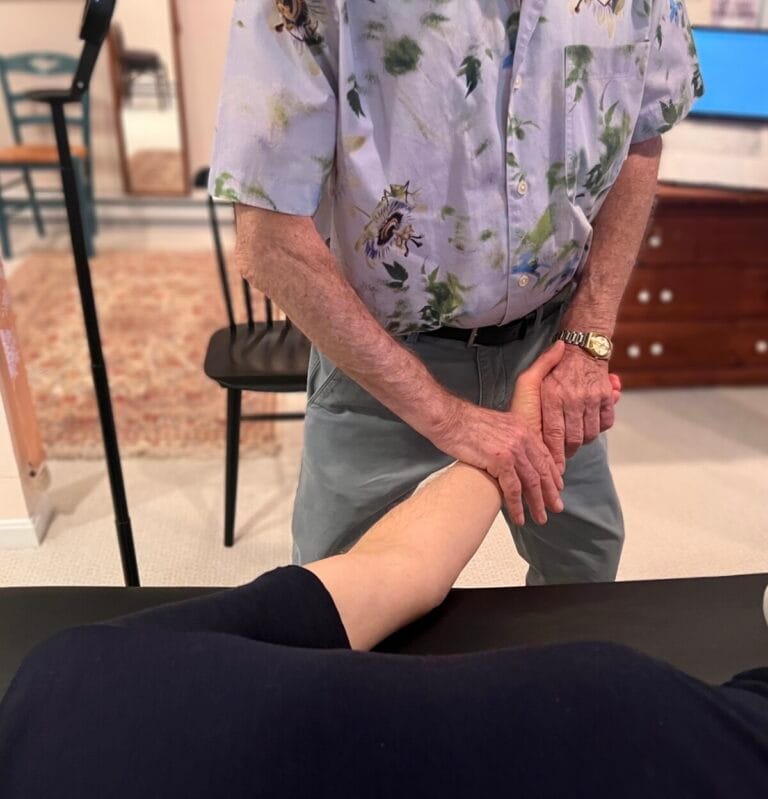
What actually happens when a teacher places their hands on someone?
This moment from the Alexander Technique teacher training course in Boston shows Tommy Thompson demonstrating the Position of Mechanical Advantage, one of the central principles of hands-on work.
By organizing himself so the arms belong to the back and the knees move forward and away, contact can be made without unnecessary effort or interference. Mechanical advantage allows the organism’s natural coordination to function freely, without force or tension.
Position of Mechanical Advantage | Alexander Technique
Class 76 · September 16, 2025 · Boston, MA
Core Concepts
- The Position of Mechanical Advantage is not a form—it’s a condition.
→ This position allows you to stop bracing, stop collapsing, and instead let the head, spine, and limbs relate intelligently, without tension or control. - The Alexander Technique is not about fixing posture, but about restoring internal relationships—between parts of the self, and between the self and the space around it.
- The arms must belong to the back. This isn’t metaphorical—it’s anatomical, functional, and deeply psychological.
- Every time you go in and out of a chair, you’re reconditioning your neuromuscular system to remember uprightness as a state of allowance, not effort.
- Wellness is not the absence of dysfunction, but the presence of awareness. What you’re doing with your attention is what you’re doing with your body.
Five Key Messages
- Mechanical advantage is a return to natural coordination—not a shape to perform.
- Your hands don’t work on someone. They communicate what’s already alive in you.
- When the neck is free, the knees go forward and away. Movement flows upward.
- You don’t learn to sit. You learn to inhibit—and allow sitting to happen.
- The way you look at someone—with presence or with fear—is part of the technique.
Essential Terms
Position of Mechanical Advantage
A semi-flexed, dynamically balanced condition in which the neuromuscular system functions with minimal interference. This is the “monkey” or “semi-flexion” form—but without holding.
“You can’t use your hands effectively—can’t even give the impulse to change the tissue—unless you go to the position of mechanical advantage.”
→ Tommy quoting F. M. Alexander’s words to Frank Pierce Jones: this isn’t optional—it’s essential.
Inhibition
A moment of conscious pause, allowing the system to not default to habitual responses. It is the basis of choice in movement.
“You’re not learning how to sit—you’re learning how to inhibit.” — Tommy
Back and Up
A directional cue describing the natural flow of postural support through the spine and torso. Not something to do—but something to allow.
“Patrick was known for saying: up to go down, up to go up.” — Tommy
Hands Belong to the Back
A teaching principle where the arms are not isolated tools, but extensions of a well-coordinated torso. The arms “belong” because they originate in the back’s support, not in muscular effort.
Non-Judgmental Hand
A quality of touch that transmits safety, empathy, and connection—activating the body’s capacity to reorganize from within.
“Your hands can convey love, compassion, and understanding through touch.” — Tommy
“You’re placing your hands on someone from a position relative to the evolutionary aspect of yourself.”
→ This is not a mechanical intervention. It’s a resonance from one organism to another, rooted in shared human design.
3. Tommy’s Insights
In Tommy’s words during class, there are not only the core principles of the Alexander Technique, but also practical wisdom that can be applied directly to daily life. His words go beyond simple advice about movement and prompt us to deeply consider how we choose to exist.“Alexander told Frank Pierce Jones that he did not believe that you could use your hands effectively and provide the impulse to change the response of the muscle tissue to lengthen unless you could go to the position of mechanical advantage. So he felt that the position of mechanical advantage was absolutely essential to learning how to use your hands to provide the kinesthetic cues for the person to feel it and for the muscle itself to respond.”
➤ Coordination begins when the body organizes itself from mechanical advantage—when direction replaces effort and touch becomes a form of listening.
“That’s a semi-flexion movement. It was a position that Alexander felt a teacher had to go into in order to have the arms belong to the back — that was his wording. And the arms belong to the back, because the arms originate from the lower back and spread out, and your hands belong to your back. Alexander didn’t say that, but I do, because they belong to you.”
➤ True use of the hands begins in the back’s support; every gesture, to be genuine, must originate from the depth of the torso, not the shoulders.
“When you let your neck be free, the purpose of letting the neck be free is severalfold. One, you’re not doing with the neck what you usually do unconsciously — and that can be a variety of things. You’re allowing the neck to be free to lengthen rather than contract, so that if I stay in this position like this for a while, I’m contracting the muscles through here, and that contraction will show throughout my entire body. So I’m putting pressure on my knees — and when that happens, the knees move forward, out, and away, rather than simply dropping down.”
➤ The neck’s freedom initiates the body’s reorganization; when the neck lengthens, every joint follows its natural evolutionary line of support.
“You’re placing your hands on someone from a position relative to the evolutionary aspect of yourself.”
➤ To touch another is to connect from the deepest part of one’s human lineage—the upright intelligence that remembers standing and sensing.
“It’s a combination of the two aspects of the fiber. And there are bunches of other fibers too, but the basic fibers — the fiber of support and the fiber of action. There’s a strength fiber and a fiber of support, and they’re in the same muscle groups.”
➤ Movement depends on the partnership between stability and vitality; action without support collapses, and support without action stagnates.
“The hand became utilitarian. So you stand there and you go through triadic resonance, and you will position yourself for either the Patrick McDonald version or the Carrington version or the Frank version. And now, because that’s going to take you back and up, it’s going to take you back and up. So you’ve got your hands up — but no tension.”
➤ In triadic resonance, the hand stops doing and starts resonating; upward movement becomes the natural consequence of connection, not control.
“Because the palms of your hands are rich with sensory receptors, they can convey feelings of love, compassion, and understanding through touch. These sensations can stimulate neural pathways that influence the release of serotonin, oxytocin, and dopamine in the brain — chemicals associated with safety, trust, and connection. So you have a non-judgmental hand, a hand filled with understanding for their habituation, and you guide them into remembering what’s possible.”
➤ The hand that listens can reawaken the body’s chemistry of trust—reminding both teacher and student that presence heals more than correction ever could.
“You’re not learning how to sit down. You’re learning how to inhibit. It’s all based on that moment of inhibition when you sense that you’re doing something you don’t need to do, and you wait. And in that waiting, the brain is given the license to do what it’s designed to do — and does best. And then you sit. And over time, you and the brain are working in time because you’re remembering what it’s like to be — who you can be — if you’re not misusing your body based on the way it’s designed to function.”
➤ Inhibition is not stillness but intelligence in pause—the moment the body remembers its own design and begins to move without interference.
“Never leave yourself. It’s you interpreting someone else. You never leave yourself.”
➤ All teaching and movement begin from self-connection; when you stay with yourself, every act becomes honest, unforced, and whole.
4. Practical Tips for Everyday Life
In this moment from Tommy Thompson’s class, trainees explore not leaving themselves in movement.
Rather than pulling into action, they pause, allowing support to organize through the body.
Watch how this shift allows movement to emerge with greater ease and coordination.
Stop Leaving Yourself When You Move (This Changes Everything) | Alexander TechniqueClass 76 · September 17, 2025 · Boston, MA
What’s the Goal?
To stop moving from habit and begin moving from awareness.
Not to perfect posture, but to discover the natural coordination that’s already available — when you stop trying to control it.
This is the foundation of what the Alexander Technique restores: a return to intelligent movement through conscious attention.
How to Practice
- Pause Before Action
Before you get up from a chair or reach across a table, pause. Let your neck be free, and don’t rush. That moment of stillness isn’t delay — it’s recalibration. - Let Your Knees Lead
As you stand or sit, allow your knees to move forward and away. Don’t aim to be straight — let direction emerge from release. - Connect Your Hands to Your Back
In any task, feel your hands belong to your back. Don’t initiate from your arms. Let movement rise from your torso, so your gestures carry presence, not tension.
What You’ll Notice
- Movement becomes smoother, not stiffer
- Actions feel lighter, less effortful
- You stop correcting and start allowing
- You feel — as Tommy said — that the body is “remembering what it knows”
5. Closing the Class
Key Takeaways
This class wasn’t about learning how to move, but discovering what happens when you stop interfering.
Tommy didn’t ask trainees to try harder. He asked them to notice. And when they noticed, they remembered.
“You’re not learning how to sit — you’re learning how to inhibit.”
When inhibition enters, something ancient reawakens: movement without command, support without tension.
The Alexander Technique doesn’t give you a better body — it gives you back to your body.
Core Insights
- Mechanical advantage is a condition, not a posture — it lets the system self-organize.
- The arms belong to the back — which means action must rise from support.
- Movement begins not with the legs or the spine, but with awareness.
- The hand is a teacher — it teaches by transmitting presence, not pressure.
- Inhibition is the doorway — not into stillness, but into timing.
Tommy’s way of teaching doesn’t separate touch, thought, or movement.
He asks: What if they’re all the same thing — just seen from different angles of attention?
That’s the work.
A Final Invitation
“Never leave yourself.”
He said it without explanation, because it doesn’t need one.
If you don’t leave yourself, the whole system — body, brain, and breath — knows what to do.
You don’t have to manage it.
You just have to stay.
6. One Key Practice
Let your neck be free, and wait
That’s it.
This moment — the moment before you move, reach, speak, or react — is the only place where real change can begin.
When you wait, the whole system is given a chance to reorganize itself, without your habits deciding first.
You’re not fixing your posture.
You’re getting out of your own way, so something wiser can do the organizing for you.
It starts with a pause.
And in that pause, you become possible.
7. Three Questions to Ask Yourself
These aren’t for correction.
They’re here to remind you: attention, not effort, leads to coordination.
Use them during simple moments — brushing teeth, walking, sitting, reaching.
- What am I doing that I don’t need to do?
➤ Ask without judgment. Most doing begins before you even move. - Where is my back right now?
➤ Not just physically — is your sense of support behind you, or have you moved ahead of it? - Have I already left myself?
➤ In action or attention — are you still home in your own awareness?
These aren’t techniques.
They’re reminders of something your body already knows — if you’re listening.
8. For Those Who Wish to Learn More
Recommended Book
The Use of the Self – F.M. Alexander
This is the essential text every serious Alexander Technique trainee — and teacher — must return to.
It’s not a manual. It’s a record of discovery: how removing interference, not adding effort,
unlocks the body’s capacity to organize itself.
In The Evolution of a Technique, Alexander doesn’t just explain inhibition —
he lives through it, letting us watch as thought, perception, and action slowly re-align.
You won’t find techniques here.
You’ll find questions that ask you to stop, and listen — to your own habits, your own design.
Ideal for:
- Trainees learning to touch without imposing
- Teachers refining direction and presence
- Anyone ready to sense movement as memory
This book is not an ending.
It’s where the Technique becomes your own language.
Official Website of Tommy Thompson
www.easeofbeing.com
This is the official website personally managed by Tommy Thompson, offering a wide range of resources and programs to deepen your understanding and practice of the Alexander Technique:
- Private session reservations and inquiries
- Workshop and seminar schedules
- Overview of international teacher training programs
- Essays and articles on the Alexander Technique
9. Next Class Sneak Peek
Class 77 enters the heart of the Alexander Technique: withholding definition — the brief pause where intention stops, identity softens, and new coordination begins to reveal itself.
We explore what becomes possible before doing:
when direction turns into perception,
when touch listens instead of corrects,
and when the organism reorganizes through the absence of interference.
At its center lies one essential question:
What arises when you stop defining yourself, even for one breath?
In Class 77, we’ll explore:
- How withholding definition expands perception
- The shift from effort to allowing
- Identity and use as one pattern
- Homeostasis guiding coordination
- Touch as non-interference
10. Join the Alexander Technique Journey
Did this class leave a small resonance within you? Feel free to quietly hold it in your heart or share it in just a sentence or two. The comments are always open. Your one simple word may leave a gentle ripple in this ongoing journey.The journey of Resonance Flow continues across social media as well. Let’s continue this journey together.
 YouTube
 Instagram
 Threads
 Facebook