
Withholding Definition: The Hidden Mechanism That Changes Everything | Tommy Thompson Class 77
❝ What becomes possible in the Alexander Technique when you practice withholding definition—when you suspend the impulse to manage your response and allowing the organism to reveal what it is already designed to do? ❞
In that suspension, a different order of intelligence becomes available.
By refraining from defining how you think you should act, adjust, or correct, you create the conditions through which the organism reorganizes according to its inherent design: the head releasing away from the body, the spine lengthening, the back widening, breath settling, and perception is no longer constrained by identity. What emerges is not technique-as-doing but coordination revealed through non-interference.
On September 18, 2025, in Boston, Massachusetts, during Class 77 of the Alexander Technique teacher training, Tommy Thompson led an in-depth exploration of this principle. Here, direction becomes an act of permission rather than control; touch becomes a modality of listening rather than shaping; and inhibition becomes the perceptual gateway through which the system returns to coherence. The class unfolded around one central inquiry:
how does transformation arise when we stop defining what we think should happen?
Key Objectives of the Class:
- To articulate the role of withholding definition in perceptual accuracy and psychophysical change
- To refine the meaning of the inhibited moment within the Alexander Technique
- To examine the structural unity of use and identity
- To understand how homeostasis and vagal regulation support non-interference
This blog series is based on Tommy Thompson’s Alexander Technique classes. Each post follows the flow and insights of the class to expand both self-awareness and practical consciousness applicable to everyday life.
New here?
If you’re new to the Alexander Technique, you can start with the resources below.
Alexander Technique Class Flow at a Glance
1. The Opening Question
❝ What if the most decisive moment in the Alexander Technique is not the moment you direct, but the moment you withhold defining how you think direction should operate—allowing perception to reorganize before you act? ❞
This question forms the conceptual axis of Class 77.
Tommy proposed that the habitual self—the one who tries to lengthen, tries to free the neck, tries to widen the back—is the very structure that interferes with the organism’s inherent design. Before any direction can be meaningful, there must be a moment in which identity loosens its grip, judgment quiets, and the nervous system is permitted to provide more accurate information.
This is the inhibited moment: a suspension in which the system is no longer constrained by pre-existing definitions of how movement, posture, or self “should” be. In this interval, direction does not originate in willful intention but arises as a perceptual consequence of non-interference.
Tommy’s Word
“Withhold defining how you think you should do it. And you’re giving the brain a chance—you’ll feel more. Now, let your neck be free, the purpose of which is to allow movement of the head away from the body, and the back to lengthen and widen.”
In this statement, Tommy articulates a fundamental sequence:
- Withholding definition expands perception
- Expanded perception refines the conditions for direction
- Direction becomes emergent rather than imposed
This reflects a key principle of his teaching:
coordination improves when identity stops interfering.
2. Core Learnings from This Class
In this moment from Tommy Thompson’s class, trainees explore what happens when there is no natural sense of attunement with another person. The focus is on withholding definition—allowing the other to be as they are, rather than trying to change them.
Watch how working with what is actually happening allows connection and coordination to emerge.
What Happens When You Can’t Attune to Someone? | Alexander Technique Insight
Class 77 · September 18, 2025 · Boston, MA
Core Concepts
- Withholding definition creates the perceptual space where direction can arise.
Tommy emphasized that direction is never something the student “does.”
When habitual framing and identity pause, the nervous system provides clearer information for coordination. - Use and identity operate as one integrated system.
As Tommy often reminded the class, how a person moves reflects how they conceive of themselves.
Changing use requires loosening the identity patterns that maintain reactive habits. - Non-interference allows the organism’s inherent design to reorganize itself.
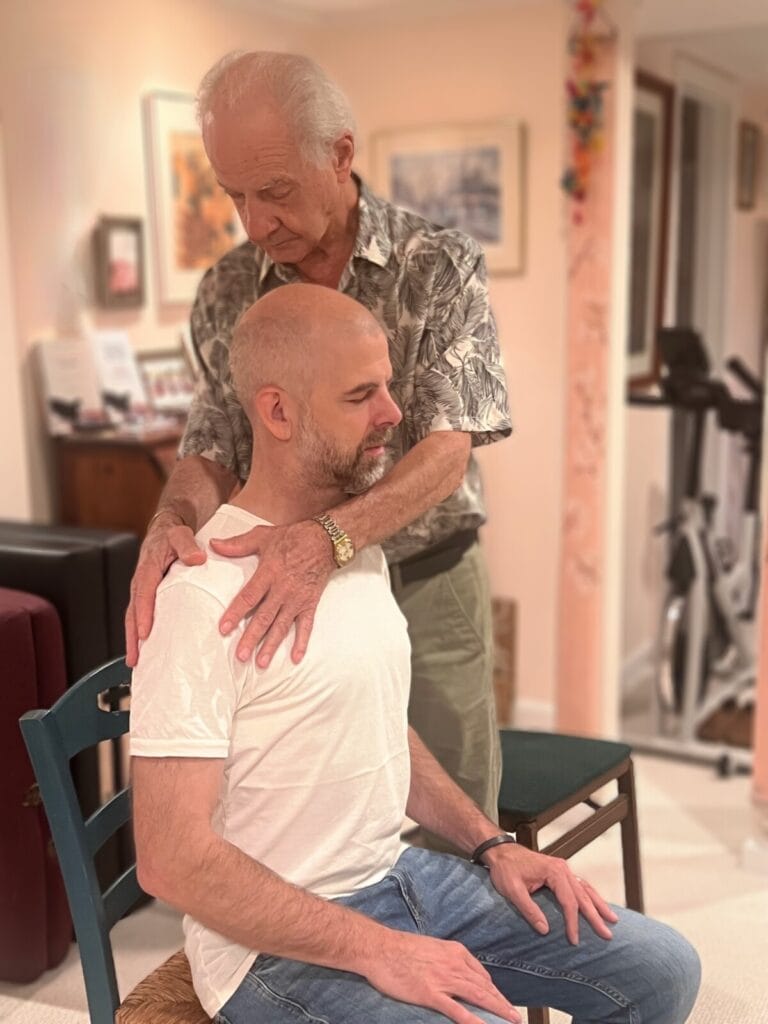
In the Alexander Technique, equilibrium—supported by vagal regulation and homeostasis—emerges when habitual effort fades. - Touch becomes effective only when it is a form of listening.
When touch is offered without imposing change, the student’s system reveals its own coordination. - The inhibited moment initiates psychophysical reorganization.
Inhibition expands perception rather than restraining action, opening a sensory interval before reaction occurs.
Five Key Messages
- Direction works only when doing has stopped.
Non-interference, not effort, makes direction effective. - Identity and use cannot be separated.
Coordination shifts when self-concept softens. - The organism seeks equilibrium.
Homeostasis restores itself as habitual intention decreases. - Withholding definition increases perceptual accuracy.
When judgment pauses, the nervous system offers more reliable information. - Touch transmits presence rather than correction.
Through listening hands, the student meets themselves more clearly.
Essential Terms
- Withholding Definition
A deliberate suspension of self-judgment and intention, allowing the organism’s natural design to express itself.
As Tommy said, “It’s going to get free because you’re not doing that.” - Inhibition
The conscious refusal to react to stimulus, generating the perceptual interval in which new coordination becomes possible. - Organism
The unified psychophysical system whose movement expresses perception, emotion, thought, and identity. - Homeostasis
The innate biological drive toward equilibrium that appears when interference stops. - Vagus Nerve
A key channel of autonomic regulation that becomes more coherent when habitual patterns soften.
3. Tommy’s Insight
In Tommy’s words during class, there are not only the core principles of the Alexander Technique, but also practical wisdom that can be applied directly to daily life. His words go beyond simple advice about movement and prompt us to deeply consider how we choose to exist.“I’ve talked about this—you can give the direction, the tried and true—but it’s all about letting something happen that’s already in the process of wanting to happen, because it’s designed to happen, and the only reason it’s not happening is because of you. That’s because of where you’re using yourself at a given moment in your life, and it’s usually habitual. Usually.”
➤ True direction is not an act of will but an allowance — freeing the self from habitual interference so the organism’s innate intelligence can restore balance.
“Withhold defining how you think you should do it. And you’re giving the brain a chance—you’ll feel more. Now, let your neck be free, the purpose of which is to allow movement of the head away from the body, the back to lengthen and widen—and you’ll feel a deeper connection with your hands when you do that. Your back is involved in this, and you’ll be more precise during your direction.”
➤ The discipline of withholding allows perception to refine itself; sensation becomes intelligence when the body is not commanded but invited.
“Early on, it was impossible for me to separate use from identity, because you acquire patterns of use while you’re acquiring a sense of who you are. They’re integral.“
➤ Our “use” is our lived identity; the way we move, think, and respond is the biography written in muscle and breath.
“So with me, I like withholding defining myself at the moment. I discover myself to explore that moment. You can give direction in that moment, but do you have to? I don’t believe you have to.”
➤ Presence begins when self-definition pauses — when being replaces doing, and discovery arises instead of performance.
“When you touch somebody, you are giving them yourself. Now you’re also giving them themselves, because you’re removing patterns of behavior that don’t have anything to do with what’s making them happy.”
➤ Touch becomes a mirror: it transmits awareness, dissolving mechanical habits so the student can meet their authentic coordination.
“Alexander says the most important thing is the person who can decide not to do something and stick with that decision. That’s saying stop. That means exactly what Walter said. You don’t need to let your neck be free. But once they said it—the way they said it—the way to do that is you’re in the way.”
➤ True inhibition is the mastery of choice — not in action, but in restraint; freedom begins in the refusal to interfere.
“Everything within the organism is about homeostasis, especially the vagus nerve. So homeostasis is equilibrium, given what you’re doing, thinking, perceiving, etc.—given the circumstance.”
➤ The organism is a living dialogue between stimulus and response; the vagus nerve is its voice of equilibrium, mediating the unity of body and thought.
“I think your question is, he didn’t say stop giving directions, but he said, Stop trying to let your neck be free, which is the first direction that’s given.”
➤ The effort to “do the right thing” becomes the interference itself — freedom emerges not from doing but from ceasing to strive.
“So, when you withhold defining someone, and you do it, and then when you withhold defining how you think you should be doing it, the first thing that happens is—you feel a little bit more. You become aware of more than you did before, because you’re listening.”
➤ To withhold definition is to enter true listening; awareness expands in the silence where judgment stops and perception awakens.
4. Practical Tips for Everyday Life
What’s the Goal?
The aim is simple: create small moments in daily life where you stop defining yourself long enough for the organism to show its natural design.
Not correcting. Not improving.
Just interrupting habit so that new sensory information can appear.
How to Practice
- Walking → Drop the idea of “walking correctly.”
Pause the instant you notice effort.
Let the movement of the head away from the body happen on its own.
Allow the back to lengthen and widen without trying to make it so.
Notice what unfolds when you don’t interfere. - Sitting → Don’t fix your posture.
When you feel yourself adjusting or bracing,
simply withhold defining upright for a moment.
Let the chair meet you.
In that pause, you feel a little bit more, and the system reorganizes. - Using your hands → Stop telling them what to do.
Before typing, cooking, or reaching,
release the intention to control anything.
Let the hands respond through the whole back.
Often, this alone brings about a deeper connection with your hands.
What You’ll Notice
Small pauses open the system.
Breath settles.
The neck quiets.
Sensation becomes more reliable.
You feel homeostasis beginning to do its work.
And movement stops being something you manage —
it becomes something that happens through you.
5. Closing the Class
Key Takeaways
- The most transformative moment of coordination appears when you stop trying to do it right and allow the organism to organize itself.
- Withholding definition opens a perceptual interval where new possibilities emerge without force.
- Use and identity move together; shifting one always reveals the other.
- Touch, perception, and direction become clear only when habitual interference quiets.
Core Insights
- Tommy reminded the class that you’re in the way far more often than you realize; freedom begins not in effort but in the willingness to pause.
- The organism continually moves toward homeostasis when you stop defining how things should be.
- Reliable coordination arises from listening — not correcting — both in yourself and others.
A Final Invitation
Let the rest of your day become part of this lesson.
Before acting, take one brief moment to withhold defining who you think you are and how you think you should move.
Tommy would say: allow yourself the chance to feel a little more.
In that quiet space, the next movement, the next breath, and the next thought can reorganize from a deeper intelligence already present within you.
6. One Key Practice
If you take one thing from this class, let it be this:
For one breath, withhold defining how you think you should move.
Whenever you feel effort — walking, sitting, reaching, speaking — pause the intention to get it right.
Do nothing extra.
Let the movement of the head away from the body and the gentle lengthening and widening appear on their own.
Try it for 10 seconds, three times today.
In that brief space, awareness returns, and the organism begins its own reorganization.
7. Three Questions to Ask Yourself
- What happens if I stop deciding how I should be right now?
A moment of non-definition often reveals more than correction ever could. - Can I allow one breath in which I don’t interfere?
This single breath is enough for new coordination to surface. - What do I feel when I listen instead of manage?
Sensation becomes clearer when judgment quiets and perception leads.
8. For Those Who Wish to Learn More
Recommended Books
- Touching Presence — Tommy Thompson
This is the single book where Tommy’s lifetime philosophy is distilled with exceptional clarity.
It offers deep insight into withholding definition, listening through the hands, and allowing the organism to function through its own design rather than through intervention.
The book captures Tommy’s authentic teaching language and real examples, showing how a non-defining presence brings forward more truthful coordination and connection.
As a companion to Class 77, it is the most direct guide for integrating these principles into daily life and hands-on practice.
Official Website of Tommy Thompson
www.easeofbeing.com
This is the official website personally managed by Tommy Thompson, offering a wide range of resources and programs to deepen your understanding and practice of the Alexander Technique:
- Private session reservations and inquiries
- Workshop and seminar schedules
- Overview of international teacher training programs
- Essays and articles on the Alexander Technique
9. Next Class Sneak Peek
The next class turns our attention even closer to the quiet instant before action—the place where the body organizes, the mind anticipates, and habit silently prepares its claim. Tommy invites us to sense how intention, timing, and presence intersect in that fragile threshold, and how a different coordination becomes possible when we stop defining ourselves too soon.
It is a class about what chooses for you—and what becomes possible when you truly see it.
In Class 78, we’ll explore:
- the preparation behind every habitual response
- the delicate timing where inhibition actually begins
- how touch reveals the system’s hidden decisions
- what opens when you notice the moment of choice before it closes
10. Join the Alexander Technique Journey
Did this class leave a small resonance within you? Feel free to quietly hold it in your heart or share it in just a sentence or two. The comments are always open. Your one simple word may leave a gentle ripple in this ongoing journey.The journey of Resonance Flow continues across social media as well. Let’s continue this journey together.
 YouTube
 Instagram
 Threads
 Facebook