Go to Your Back: The Alexander Technique Shift You’ll Feel Instantly | Tommy Thompson Class 47
❝ What if the most powerful part of your body… is behind you? ❞
We’ve spent our lives believing that good posture is something to be achieved—shoulders back, chin up, spine straight. But what if the source of true balance isn’t effort… but presence?
On March 12, 2025, in Boston, Massachusetts, USA, Tommy Thompson led a class in the Alexander Technique teacher training course that challenged everything we think we know about movement and presence. At the heart of the class was one deceptively simple but radically transformative phrase: Go to your back.
This wasn’t about technique for technique’s sake. It was about reorienting how we touch, how we teach, and most of all, how we exist in our own bodies. The class was a call to stop reaching outward and instead inhabit the back as the true center of self-use. Or as Tommy Thompson puts it: “Everything goes into your back. Everything.”
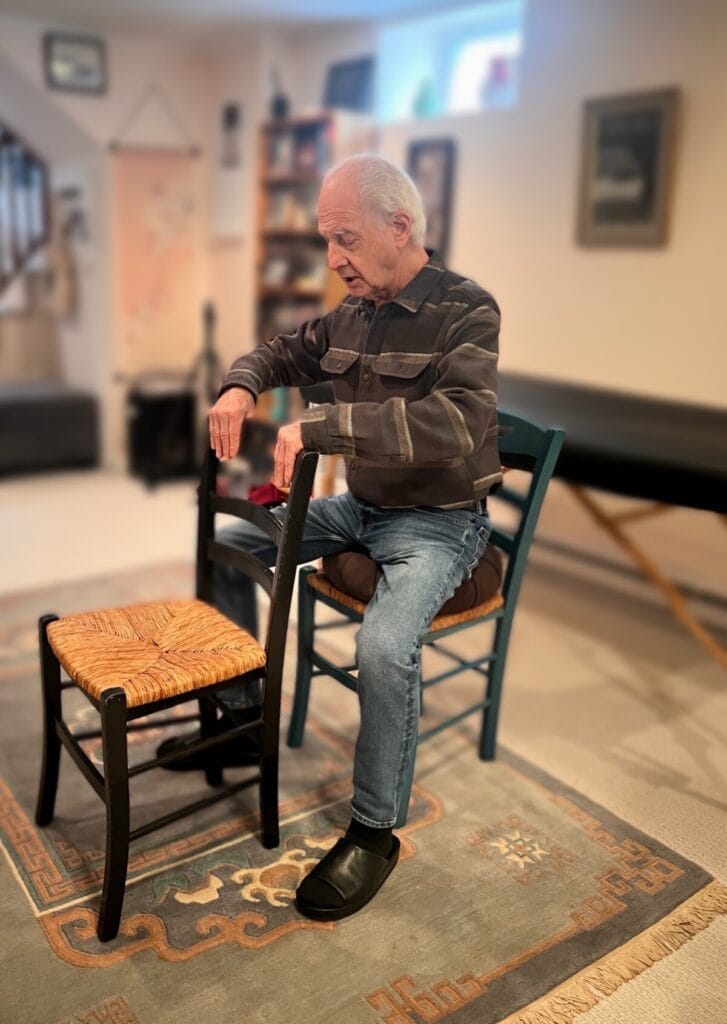
As he often reminds trainees: “Every time I touch you, I want to give you to your back.” This class reflected that core philosophy—using the chair not to learn how to move an object, but how to move with presence.
Key Objectives of the Class:
- To guide trainees toward the experience of presence through the back, not the front
- To demonstrate how touch becomes transmission when anchored in one’s own back
- To deepen the understanding of inhibition and direction as internal conditions, not external techniques
- To embody the principle that, as Tommy states, “The purpose of hands on back of chair is to teach you how to use your hands on a person.”
This blog series is based on Tommy Thompson’s Alexander Technique classes. Each post follows the flow and insights of the class to expand both self-awareness and practical consciousness applicable to everyday life.
New here?
If you’re new to the Alexander Technique, you can start with the resources below.
Alexander Technique Class Flow at a Glance

1. The Opening Question
❝ Can your hands speak before you say a word? ❞
Not in language—but in the way they reveal your internal state. In this class, Tommy Thompson reminded us: your hands don’t act in isolation. They reflect the condition of your back, the quality of your attention, and the precision of your direction.
We’re used to treating touch as something we do to others. But in the Alexander Technique, as Tommy teaches it, touch becomes something we allow through ourselves. Inhibition isn’t about stillness or hesitation—it’s a living, fluid readiness. It’s presence without push.
And it’s in that non-doing that your hands become intelligent. They don’t manipulate—they inform. They don’t control—they invite. And all of it begins in the back.
Tommy’s Word
“How do I convey the inhibitive process with my hands? And it’s a process that no other person that works with you with their hands has.”
This wasn’t a technical challenge—it was a philosophical one. Tommy wasn’t asking for a method. He was pointing to an inner state. The work, he reminded us, begins in your back, not your fingers. It’s not about placing hands. It’s about becoming present enough that your hands carry direction without trying to impose it. That is the inhibitive process in touch—and it’s uniquely Alexander.
2. Core Learnings from This Class
Core Concepts
Go to your back — The fundamental directive of the class. Not a command of posture, but a call to redirect awareness to the place where real support arises: the back. In Tommy’s words, it’s the center from which presence becomes possible.
Touch as Transmission — Touch, when rooted in one’s own back and presence, becomes a form of communication, not correction. You are not doing something to someone—you’re giving direction through yourself.
Direction before contact — Movement begins not with motion, but with inner preparation. “You wait, you give the directions again,” Tommy said. The directions precede the hands.
Five Key Messages
- The back is the origin of uprightness and coordination. The front supports organs; the back supports movement and expression.
- You don’t place your hands—you bring yourself to your back, and then contact follows. This is where presence starts.
- Pulling the chair back apart is not about strength—it’s about expansion. Tommy repeated, “Wrists in, elbows out and down.” It’s not about mechanics—it’s about opening.
- Inhibition is awareness, not pause. It’s what allows movement to happen from presence, not habit.
- Everything goes into your back. Everything. This is not metaphor. This is the literal direction of use. It’s how support becomes felt.
Essential Terms
Inhibition – The conscious prevention of habitual reaction, allowing space for new coordination. Central to Alexander Technique work, and foundational to Tommy’s way of teaching.
Direction – The mental and physical intention that shapes movement before it begins. Not effort—clarity.
Back – More than anatomy; the functional and perceptual center of support and identity in this work. It’s where presence starts.
Hands-on Back of Chair – A traditional Alexander Technique procedure used not to teach manipulation, but to train presence in touch. As Tommy puts it: “The purpose is to teach you how to use your hands on a person.”
Transmission – What happens when touch carries presence rather than pressure. It’s the body speaking without pushing.
Go to your back – Tommy Thompson’s core phrase emphasizing internal redirection before any action or contact. This isn’t imagery—it’s instruction.
Presence – The condition of being fully directed, aware, and non-doing. It’s not a mental state; it’s a whole-body coordination.
Self-use – How we employ ourselves in activity—mentally, physically, perceptually. All of Tommy’s teaching circles back to this.
Non-doing – The paradoxical skill of allowing coordination rather than forcing it. It doesn’t mean passivity—it means availability.
Neutral – Not a position, but a readiness. A preparatory state from which movement can happen without precondition—an idea central to the Alexander Technique and key to learning how to Go to your back.
3. Tommy’s Insight
In Tommy’s words during class, there are not only the core principles of the Alexander Technique, but also practical wisdom that can be applied directly to daily life. His words go beyond simple advice about movement and prompt us to deeply consider how we choose to exist.“You’re applying just enough pressure so that your hands, when you go into it, don’t come off when you’re going to move the chair. So when you put your hands on the back of the chair like that, once you get there, it takes Alexander to go through a long rig of all the directions you give before you ever get there.”
→ Minimal, intentional contact builds awareness and prevents habitual effort, aligning with Alexander’s principle of direction before action.
“It immediately takes the arm back into the back, so you’re operating more from the spinal muscles and activating all the back. The back muscles are primarily responsible, almost totally, for uprightness and balance. The muscles through the front of you—except for some—basically keep the viscera where it’s supposed to be. The back is the reason Alexander asks you to ‘stay in your back,’ and the hand coming back to the chair does, in fact, keep you in your back.”
→ Redirecting movement generation to the back reconnects limbs to central support, aligning the body with its natural balance mechanisms.
“In the Hands-on Back of Chair practice, when you come forward, your arms go out, and everything goes into your back. You don’t hang on to the chair. Everything goes into your back. You can stop anytime you want to.”
→ Initiating movement from the back—rather than from effort or tension—preserves balance, clarity, and direction.
“You slowly make the contact and do that with both hands before you even move, so that by the time you’re here, you’ve already opened and gotten the arms to come through the back. You come forward, but you give directions before you do this. You wait right there and give the directions again. Then you put your hand—well, you don’t put it on the chair yet. You wait and give the directions again. That’s the exercise.”
→ This preparatory sequence illustrates how direction precedes contact and movement, embodying the Alexander principle of inhibition not as delay, but as conscious readiness.
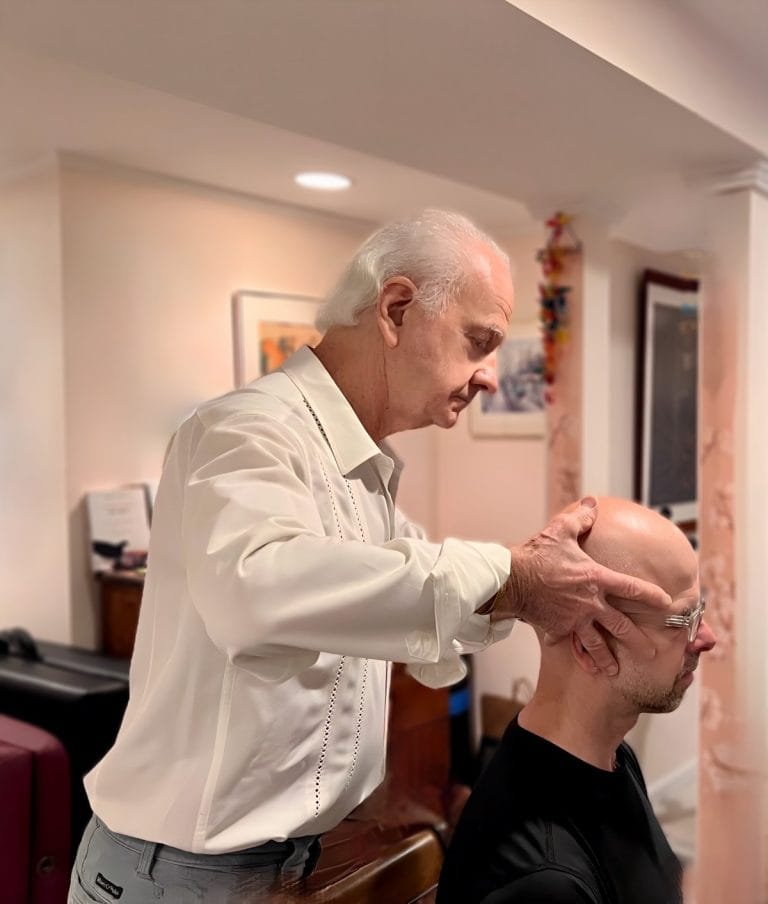
“Let that aspect of your neck be free to lengthen—all the muscles of the neck lengthening, as opposed to shortening. The purpose is to allow a movement of the head away from the body, forward and up, which brings length through the spine and width through the back.”
→ Freedom in the neck governs the whole body’s organization via primary movement, which initiates postural ease.
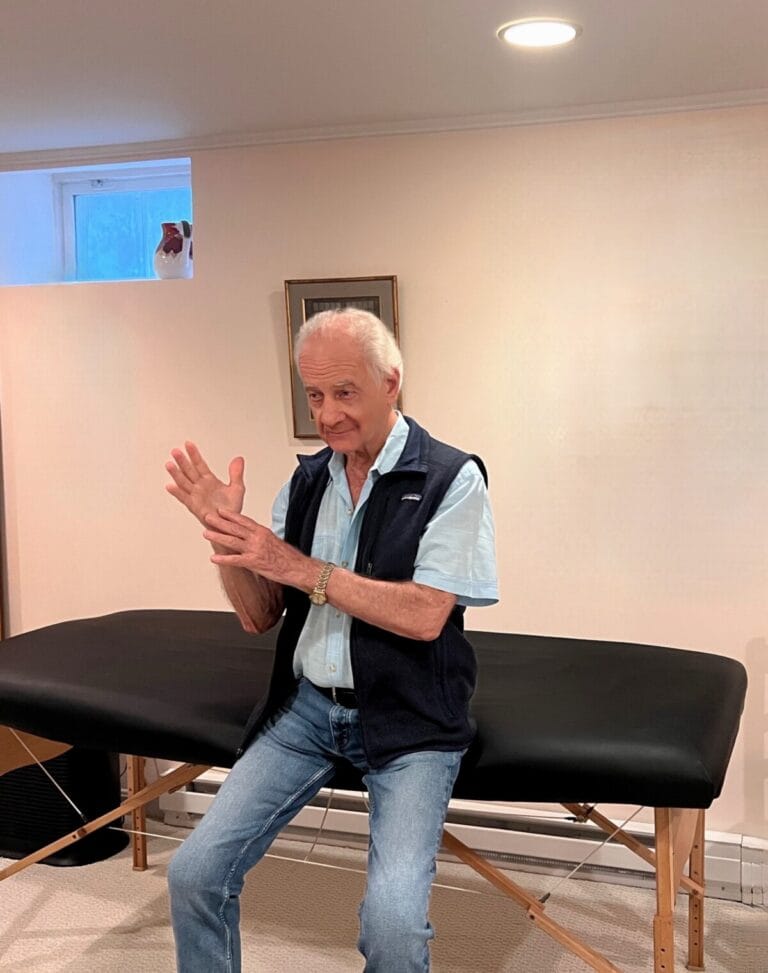
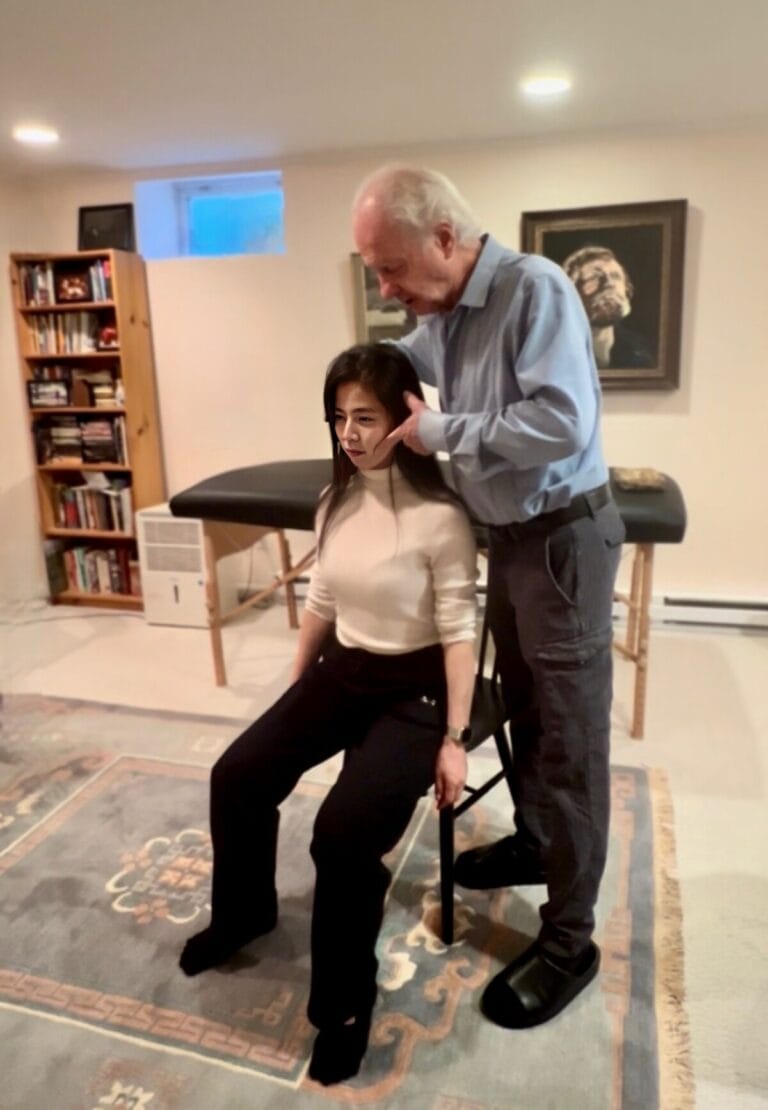
“Every time I touch you, I want to give you to your back. That’s what it is. It’s learning how to do that. You can learn how to do that by just going—pulling a table portion, pushing the table away. You can learn how to do that by putting a hand on yourself. You can learn how to do that by doing triadic resonance.”
→ All touch must support the person’s return to back-directed integrity, not forward collapse or bracing. Triadic resonance—sensing yourself, the surface, and the space—trains the kind of listening that makes touch a transmission, not an instruction.
“I want to take you into that awareness you weren’t in, so that next time, you really have it — which you know is within you. Even though I’m giving it to you, I’m only giving you what you already have, by dispersing your commitment to what you’re used to. That’s why I use the word ‘diffuse’ — probably not the right word — but I mean diffusing the localization of muscular contraction. You’re not really doing that — you’re connecting in a deeper way to the person.”
→ The teacher’s role is to awaken intrinsic coordination by reducing habitual contraction and reconnecting the student with internal availability.
“The idea was to work with yourself—which is what Alexander did. He created a training course based on the way he himself learned—what he allowed himself to be taught. The whole thing was based on inhibition and supplanting it with direction—looking in the mirror. His student was himself. He did that for a long time before he started teaching. He figured—that’s what you had to do.”
→ Self-observation and direction-based self-teaching were foundational to Alexander’s development and remain central to the work.
“How do I convey the inhibitive process with my hands? It’s a process that no other person who works with you with their hands has.”
→ Effective hands-on guidance must transmit the quality of non-doing and direction, not mechanical placement.
4. Practical Tips for Everyday Life
What’s the Goal?
To bring the principles of the Alexander Technique—especially the shift of returning to your back—into daily life. Not as a separate practice, but as a way of brushing your teeth, writing emails, or standing in line. The goal is to shift from doing to being, without losing movement.
How to Practice
One Hand on the Object, One on Yourself
Before picking up a cup or opening a door, pause. Place one hand on the object, the other lightly on your thigh or torso. Let your awareness return to your back. Move only once direction is present.
Waiting for the Elevator? Go to Your Back
While waiting for the elevator—or for someone to arrive—don’t just stand still. Feel your back widen, your weight settle downward. Rest your hands with awareness. You’re not simply waiting—you’re organizing from within.
Before Typing, Pause into Your Back
Whether you’re writing something or working at the keyboard, take a moment before your hands move.
Let your neck be free to lengthen, head forward and up, back wide. Allow your fingers to move from your back—not from effort. Don’t type to produce; type to connect.
What You’ll Notice
You’ll stop “doing posture” and start feeling organized from within. Breath eases. Tension fades. Awareness sharpens. As Tommy reminds us: even simple touch is a chance to return to the back. And that opportunity begins wherever you are.
5. Closing the Class
Key Takeaways
- Go to your back is not a correction—it’s a return. A return to your own coordination, your own presence.
- The back isn’t metaphorical. It’s functional, perceptual, and alive.
- Every action, every touch, every moment of stillness begins in this internal space of support.
Core Insights
Tommy Thompson didn’t teach from method—he taught from relationship. Relationship with the back, with the floor, with the other person, and most of all, with the self.
He reminded us that presence is not a state you enter—it’s a direction you give. Inhibition isn’t delay. It’s clarity. It’s the discipline to not react and the courage to allow a new organization to emerge.
The class wasn’t about chairs or techniques. It was about recognizing where we come from when we move. It was about learning how to transmit presence through touch—without doing, without controlling.
And it was about learning, again and again, to give yourself to your back.
A Final Invitation
In the quiet after class, the real work begins. As you pick up your phone, greet a colleague, or sit down at your laptop, ask yourself: Am I in my back?
Not to judge yourself. But to redirect. This is the Alexander Technique. This is wellness through awareness. And as Tommy said again and again: “Everything goes into your back. Everything.”
6. One Key Practice
Just One Thing Today: Try This
Don’t overthink Hands on Back of Chair. For today, make it simple. Just give yourself one minute—and follow these steps:
Stand in front of a chair. Let your hands move slowly toward the backrest. Pause. Ask yourself: “Am I going to my back? Give direction before contact.
Only then, let your hands arrive.
This isn’t about moving a chair. It’s about organizing from within—without doing, without forcing. It’s a moment to feel presence, not posture. Repeat this once a day. That’s all.
The simplest action, practiced with intention, creates the deepest shift.
7. Three Questions to Ask Yourself
1. Are you coming from your back—or reaching forward again?
This is the core check-in: are you moving from presence, or defaulting to habit?
2. What can you stop doing right now?
Inhibition begins not by freezing, but by letting go of excess effort.
3. Can your hand arrive only after you’ve returned to yourself?
Direction comes first, then movement.
Tommy would say: “Wait. Give direction. Then move.”
8. For Those Who Wish to Learn More
Recommended Book
Constructive Conscious Control of the Individual – F. Matthias Alexander
This book is more than theory—it’s a manual for the kind of presence Tommy Thompson teaches. Every time he says “Wait. Give direction. Then move,” he’s echoing Alexander’s foundational idea: that true coordination begins with conscious intention, not effort.
In this class, we practiced going to the back before any contact. That insight lives in this book. For anyone who felt something shift during this class, this is your next step—not to learn more technique, but to deepen your experience of self-use and presence through the lens of the Alexander Technique.
Official Website of Tommy Thompson
www.easeofbeing.com
This is the official website personally managed by Tommy Thompson, offering a wide range of resources and programs to deepen your understanding and practice of the Alexander Technique:
- Private session reservations and inquiries
- Workshop and seminar schedules
- Overview of international teacher training programs
- Essays and articles on the Alexander Technique
9. Next Class Sneak Peek
In our next class, we move from finding presence to learning how to stay there—while in motion. What happens when walking, speaking, or playing an instrument isn’t a break from awareness, but a deeper invitation into it?
Tommy will guide us through how presence isn’t lost in activity—it’s fulfilled by it. Instead of correcting movement, we’ll ask: Can you act from who you are?
Expect more than coordination. Expect to meet the part of you that’s always been here—now ready to move.
10. Join the Alexander Technique Journey
Did this class leave a small resonance within you? Feel free to quietly hold it in your heart or share it in just a sentence or two. The comments are always open. Your one simple word may leave a gentle ripple in this ongoing journey.The journey of Resonance Flow continues across social media as well. Let’s continue this journey together.
 YouTube
 Instagram
 Threads
 Facebook