Is Your Movement Identity Holding You Back? | Tommy Thompson Class 46
❝ What if your body isn’t stuck in tension—but in your story of who you are? ❞
Every movement you make might be a memory of who you think you are. What if the reason your body can’t shift into better use isn’t due to technique—but because of the narrative you unconsciously keep rehearsing?
On March 11, 2025, in Boston, Massachusetts, USA, Tommy Thompson led a pivotal class in the Alexander Technique teacher training course. This class invited trainees to pause—not just physically, but personally. It revealed that at the heart of real change lies the willingness to withhold the definition of self, even for a moment. Because habitual identity doesn’t live in your thoughts alone—it lives in your spine, your wrists, your walk, and your way of seeing.
This is more than a movement practice. It’s a process of remembering your body’s original design—and recovering the natural coordination that returns when interference ceases. In that quiet space, Wellness begins not with effort, but with awareness.
Key Objectives of the Class:
- Explore how habitual identity limits coordination and perception
- Learn the principle of inhibition as a conscious pause before self-definition
- Reclaim the back as the primary source of movement, not the limbs
- Begin to see the Alexander Technique as a relationship-based approach to human presence
This blog series is based on Tommy Thompson’s Alexander Technique classes. Each post follows the flow and insights of the class to expand both self-awareness and practical consciousness applicable to everyday life.
New here?
If you’re new to the Alexander Technique, you can start with the resources below.
Alexander Technique Class Flow at a Glance

1. The Opening Question
❝ What if your movement identity isn’t who you truly are—but just what your body has rehearsed the longest? ❞
What moves you is not always conscious. Every gesture, every alignment, every holding pattern may not be a choice—but a continuation. The question isn’t only “How do I move?” It’s “Who do I become when I move this way?”
In this class, we confront the startling possibility that your movement identity—what feels like “you”—is actually a rehearsal of old narratives. The Alexander Technique offers not just awareness of these patterns, but a doorway out of them. It’s not about replacing them with new ones. It’s about remembering the design that came before habit. This isn’t about control. It’s about permission.
Tommy’s Word
“Your habitual patterns of behavior belong to who you feel you are—your sense of identity, and you cultivate it at the exact same time you’re cultivating a sense of who you are.”
Tommy reminds us that movement and identity don’t merely coexist—they co-create. The body doesn’t just reflect the self—it shapes it. And until we pause that feedback loop, we continue to become the same self, in the same way.
2. Core Learnings from This Class
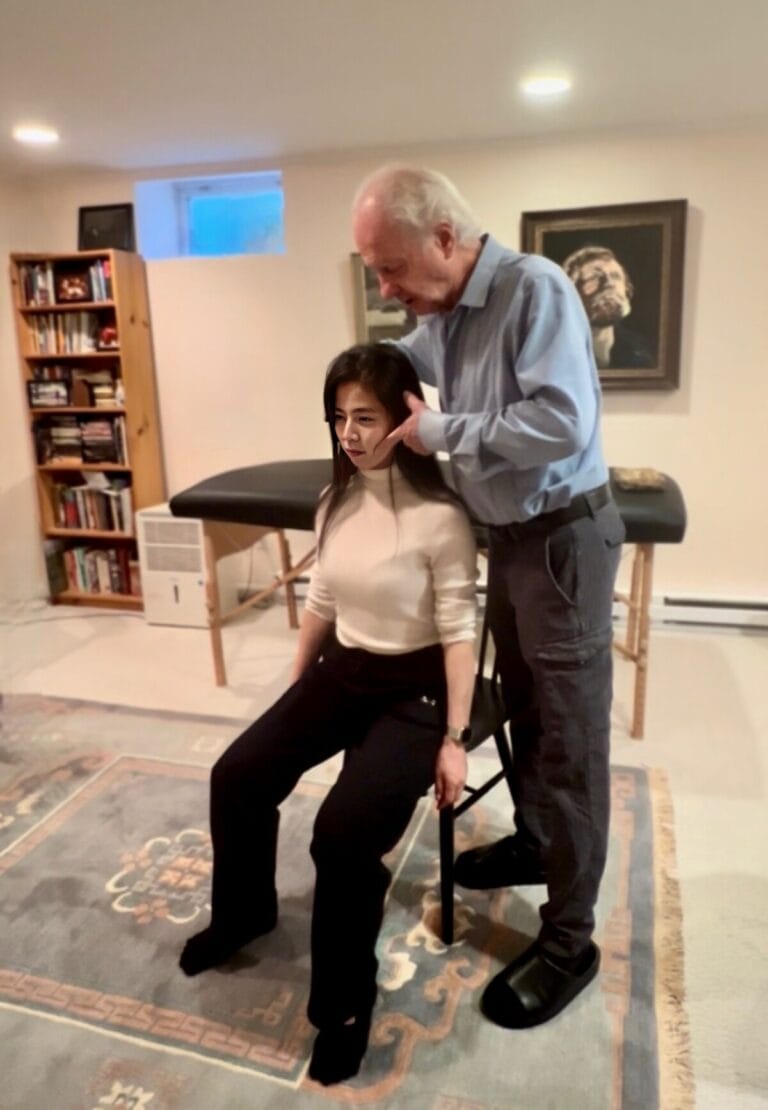
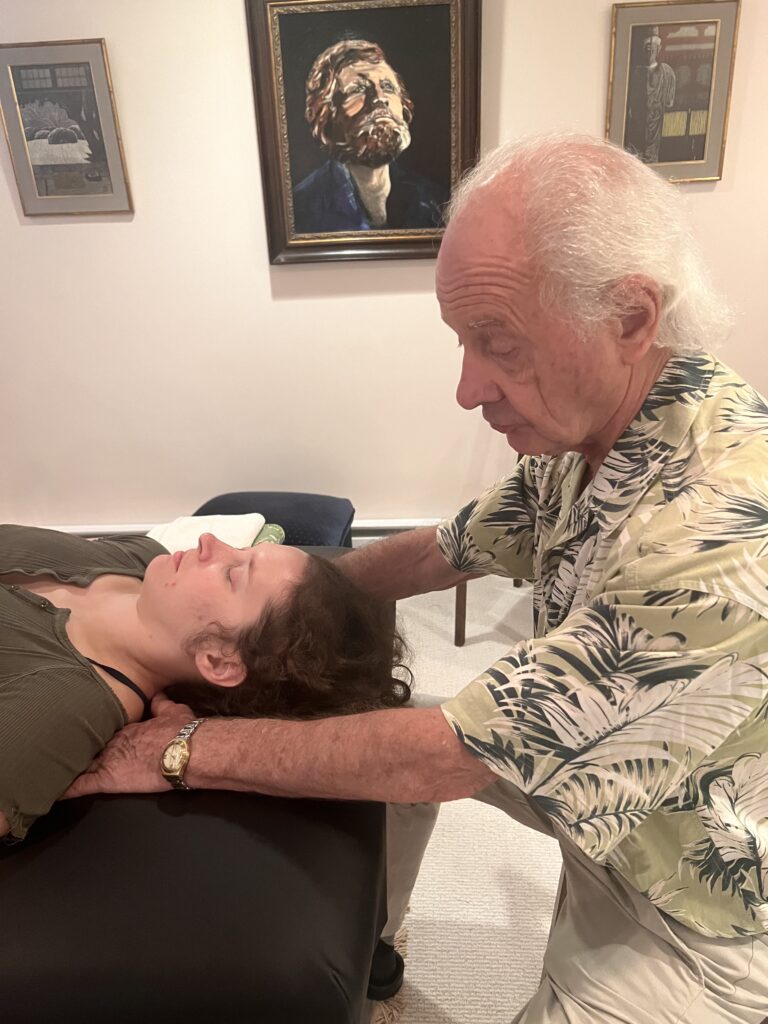
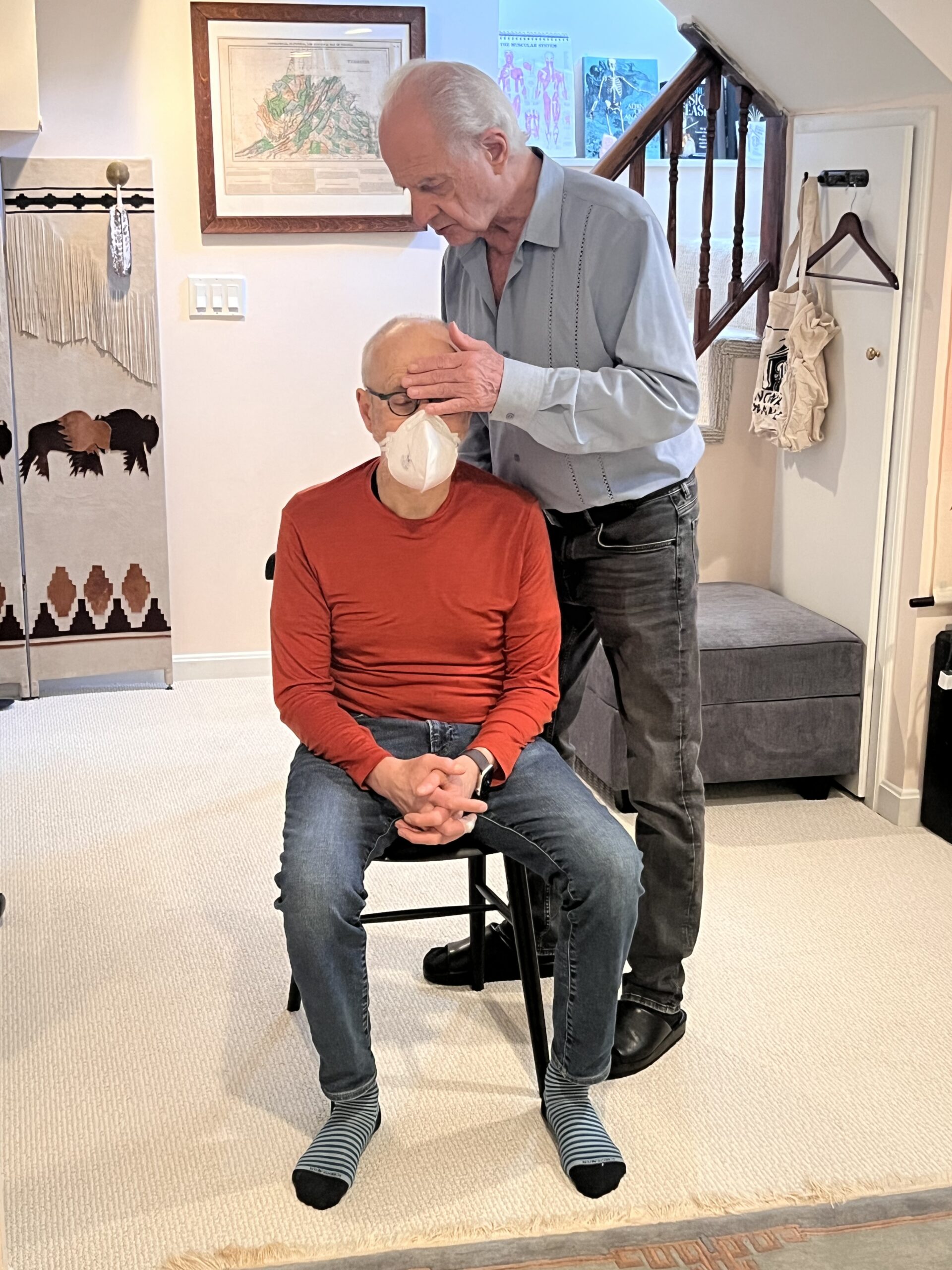
In this moment from Tommy Thompson’s class, trainees explore what it means to “never leave the back.”
Watch how contact that stays with the self allows movement and coordination to reorganize naturally.
Not Broken, But Stuck? | Hands-On with Tommy Thompson
Class 46 · Boston, MA
Core Concepts
- Movement identity shapes your experience of movement, self, and others.
In the Alexander Technique, movement is not simply mechanical—it is autobiographical. How you move reflects who you unconsciously believe yourself to be. To change movement, you must address identity. - Inhibition is the conscious space where new coordination can emerge.
Instead of reacting from pattern, you pause. This act of inhibition is not resistance—it is a space of presence. In this space, your system can reorganize without force, in line with its natural design. - The back leads, the limbs follow.
True coordination originates from the back-body. The spine, pelvis, and torso form the foundation of integrity. When movement initiates from the back, it becomes integrated, fluid, and less effortful. - You are always using yourself in relationship.
The Alexander Technique is not just a method of personal awareness—it’s a method of relational use. Your self-use expresses how you relate to space, to gravity, to others. Presence is contextual. - Your body holds your narrative until something interrupts it.
Physical use is how stories stay alive. Bracing, collapsing, or over-efforting often mirror early identity patterns. By shifting your use, you begin to rewrite what your body believes to be true. - Wellness begins with subtracting interference, not adding control.
The more you try to ‘do’ good posture or ‘fix’ your body, the more you override your design. The Alexander Technique teaches that when you stop interfering, coordination and wellness return naturally.
Five Key Messages
- You cannot change how you move without changing how you define yourself.
Movement identity is a reflection of your self-concept in action. - Change begins with a pause, not a correction.
Inhibition gives the nervous system a chance to reorganize without repeating the past. - Your back knows the way; your habits don’t.
Back-initiated movement restores natural order and reduces effort. - Presence is not internal—it’s relational.
Good use is about awareness within context: with gravity, space, and people. - Your body tells your story until you give it a new choice.
Somatic narrative is real, but not permanent—it shifts with presence.
Essential Terms
Habitual Identity
The ingrained fusion of self-definition and automatic behavior. It determines how you interpret, move, and relate, often unconsciously. In the Alexander Technique, it limits potential until reexamined.
Movement Identity
The embodied expression of self-perception. Every movement pattern reflects an inner story. Movement identity explains why change must happen through both awareness and use.
Inhibition
A deliberate pause before reaction or definition. It interrupts habit and opens the field for reorganization. In the Alexander Technique, it is the foundation of change.
Back-initiated motion
Movement that originates in the spine and axial system, rather than the limbs. This principle restores unity, balance, and efficiency.
Somatic Narrative
The history your body tells through unconscious habits. It includes patterns shaped by experience, emotion, and memory—repeated until conscious use offers a new direction.
3. Tommy’s Insight
In Tommy’s words during class, there are not only the core principles of the Alexander Technique, but also practical wisdom that can be applied directly to daily life. His words go beyond simple advice about movement and prompt us to deeply consider how we choose to exist.“Your habitual patterns of behavior belong to who you feel you are—your sense of identity, and you cultivate it at the exact same time you’re cultivating a sense of who you are.”
Habit and identity are not separate; they co-create each other, making deep change impossible without shifting self-concept.
“As long as you tell yourself the same story every moment of your life, you’re thinking the same way—your thoughts interfere with everything, and you define yourself very quickly, and you hold on to that.”
Repeating your story perpetuates the very interference the Technique seeks to dissolve—it all starts in the thinking.
“If you can just withhold—just for one moment—defining yourself in the way you usually do in a situation, something changes, because the nervous system is not doing what you’ve told it to do; it does what it’s designed to do, within reason—but it needs your cooperation.”
The act of inhibition makes space for the nervous system to recover its natural organization—if we stop controlling it.
“You can come into a very pristine state when you are using yourself more in accord with the way you’re designed to function, and why doesn’t it last? Because you go right back to who you think you are.”
Optimal coordination collapses when habitual identity reasserts itself—this is the core challenge of sustainable change.
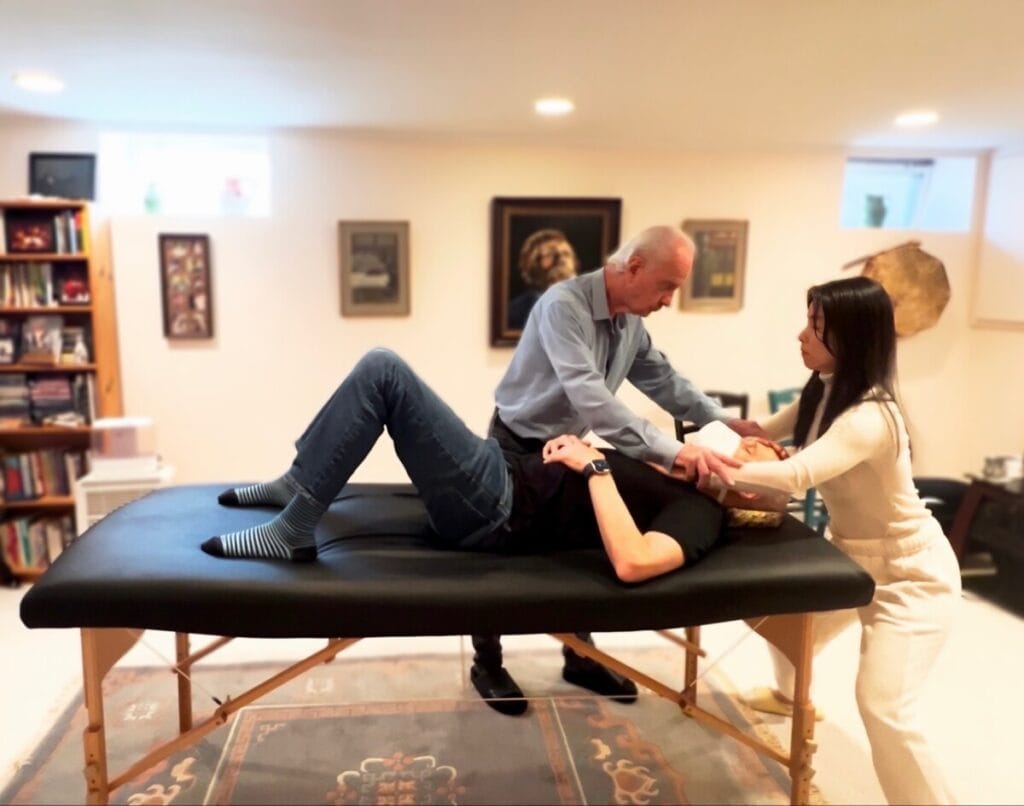
“See what’s happening right now? It’s not happening from my hands—it’s happening from my back. You’re taking you this way. You’re taking me this way. If you’re here, you’re taking me that way.”
True movement begins from the back, enabling relational direction rather than isolated effort.
“Yes—at that moment, withhold defining yourself. And you could say: ‘I am going to inhibit reacting to the way I am responding to what is being said.’ ‘I will let my neck be free, understanding that the neck goes down into the back. I will let my neck be free—the purpose of which is to allow a movement. My back will lengthen and widen naturally.’”
Tommy describes how inhibition, paired with direction, allows natural reorganization when self-definition is temporarily suspended.
“In reflecting on this chapter, David recalled a pivotal moment in his teaching—realizing that a student’s sensory perception was not faulty, but perfectly aligned with their sense of self. This insight profoundly shifted his approach to teaching, and he often shared the experience in his lectures as a key example.”
David’s realization revealed that perception isn’t broken—it’s loyal to identity, and this changed how he guided students.
4. Practical Tips for Everyday Life
What’s the Goal?
To make the insights of the Alexander Technique part of how you live, not just how you think. The real transformation happens not during class, but in your daily moments—at the sink, in the car, in conversation—where your movement identity usually runs on autopilot. The goal is to interrupt that autopilot with attention.
How to Practice
1. “Pause before action” ritual
Right before a familiar gesture—reaching for your phone, opening a door, standing up—take a half-second pause. Don’t correct. Don’t change anything. Just notice what wants to happen, and ask, “Is this how I want to show up right now?”
This simple ritual trains inhibition and helps you reclaim choice from habit.
2. Use your back in transitions
When going from sitting to standing or walking to stopping, direct your attention to your back—not your legs or arms. Sense your spine initiating the movement. Let your limbs respond to that.
It’s not about doing it “right.” It’s about letting your back lead again.
You’re not correcting posture—you’re inviting support from your design.
3. Create one ‘Wellness Window’ each day
Choose a 5-minute activity—tea-making, dishwashing, commuting—and turn it into a mini Wellness practice. Your only job: stay aware of how you move, not just what you do. Notice tension, breath, tempo, and space.
This anchors the Alexander Technique in your actual life, not as a technique, but as a way of being.
What You’ll Notice
- Your movements will begin to feel less effortful and more integrated.
- You’ll recognize moments where your movement identity reasserts itself—and gently invite something else.
- Over time, this builds a quality of living that is not just functional, but well.
5. Closing the Class
Key Takeaways
This class wasn’t about learning new movement techniques. It was about unlearning the invisible habits that define your movement identity. And more importantly, it was about discovering that you can choose—again and again—not to follow them.
In Tommy’s teaching, the Alexander Technique is not something you do. It’s something you allow. You step out of the way. You create a gap where a new possibility—one not governed by old definitions—can arise. That’s the real shift. Not posture. Not performance. But presence.
Core Insights
- Change doesn’t require effort—it requires space.
When you pause, you invite what’s already intelligent in your system to come forward. - You don’t have to fight your habits—you just don’t have to obey them.
Inhibition is not resistance. It’s a respectful refusal. - Your body isn’t the obstacle—it’s the medium.
It holds not just tension, but intelligence. The path to integration is through your actual use, not despite it. - Wellness isn’t something you need to achieve—it’s what emerges when interference falls away.
The more gently you treat your system, the more powerfully it responds.
A Final Invitation
You don’t need to push harder. You don’t need to hold yourself together. You don’t need to fix your body. What you need is permission: To slow down. To feel. To not know. That’s the space where your system begins to reorganize—not through will, but through design.
And in that space, the Alexander Technique becomes not a technique at all—but a return to what was always available: your own clarity, coordination, and quiet strength.
6. One Key Practice
Let your back begin. Whatever the movement—standing, turning, reaching—let it begin from your back. Not from your hands. Not from your thoughts. Pause. Soften. Sense your spine, your ribs, your pelvis. Then move—not with effort, but with permission.
This is where the Alexander Technique lives:
In the moment you stop defining yourself by what you should do, and start discovering who you are in how you move. This is movement identity—not trained, but remembered.
7. Three Questions to Ask Yourself
- Where in my movement am I trying to prove something?
Notice if effort is coming from a need to perform, correct, or earn approval. Can you let that part of you be met, not managed? - What does my back know that I keep ignoring?
Before you speak, stand, or step—can you include your spine in your awareness?
Can you let movement begin there, without adding? - Am I moving from memory, or from presence?
Every gesture carries traces of history. But right now, in this moment—can you respond freshly, without rehearsing?
8. For Those Who Wish to Learn More
Recommended Books
1. Body Learning – Michael Gelb
This is one of the most accessible introductions to the Alexander Technique. Gelb writes not just about how the technique works, but how it changes the way you think, move, and relate. It’s especially helpful in seeing how movement identity shapes everything from posture to perception.
“The Alexander Technique is not about doing something right; it’s about not doing what gets in the way.”
2. The Thinking Body – Mabel Elsworth Todd
This classic work explores how thought, intention, and structure are deeply intertwined in physical use. Todd’s insights align closely with Tommy Thompson’s philosophy, emphasizing how bodily movement carries personal narrative. If you’re interested in how somatic awareness can lead to wellness, this book offers both poetic and anatomical depth.
“The body is shaped by the mind’s idea of how to live in space.”
Official Website of Tommy Thompson
www.easeofbeing.com
This is the official website personally managed by Tommy Thompson, offering a wide range of resources and programs to deepen your understanding and practice of the Alexander Technique:
- Private session reservations and inquiries
- Workshop and seminar schedules
- Overview of international teacher training programs
- Essays and articles on the Alexander Technique
9. Next Class Sneak Peek
10. Join the Alexander Technique Journey
Did this class leave a small resonance within you? Feel free to quietly hold it in your heart or share it in just a sentence or two. The comments are always open. Your one simple word may leave a gentle ripple in this ongoing journey.The journey of Resonance Flow continues across social media as well. Let’s continue this journey together.
 YouTube
 Instagram
 Threads
 Facebook