Intention Before Touch: The Key to Effortless Movement | Tommy Thompson Class 72
❝ What happens when you stop trying to do something—and simply let intention arise? ❞
We often believe that change comes through effort. But what if the most meaningful shift happens when you stop—and allow intention to emerge without control?
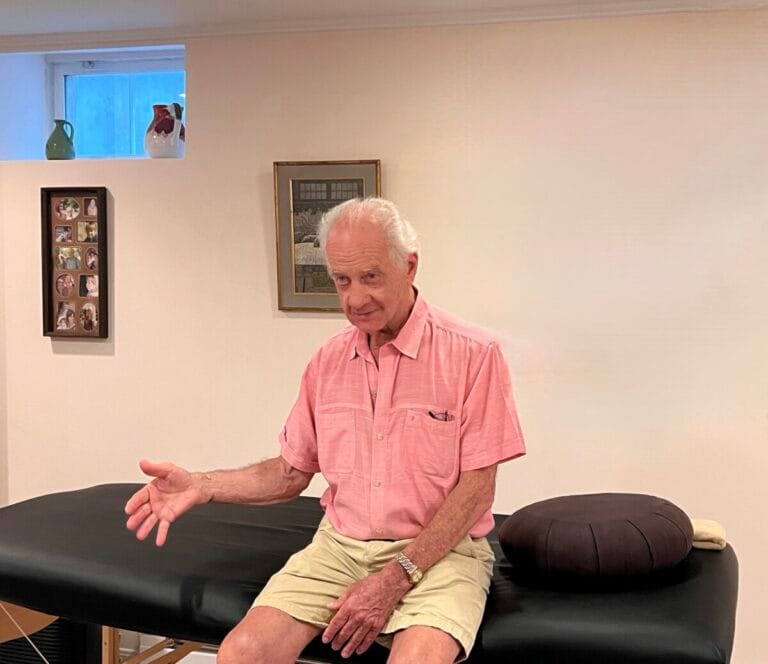
On September 9, 2025, in Boston, Massachusetts, Tommy Thompson led a class in the Alexander Technique teacher training course that gently upended assumptions about movement, learning, and human connection.
This wasn’t about posture correction or technique drilling. It was about remembering how to move in alignment with your original design—through intention, direction, and integration. In that space, effort dissolves. The arms return to the back, breath flows, and touch becomes mutual. Your system recalibrates—not through force, but through presence.
This class distilled the Alexander Technique into its essence:
You are not the doer. You are the space where intention moves — not passive, but aligned.
Key Objectives of the Class:
- Reclaim the natural sequence of Intention → Direction → Movement.
- Explore how the arms and hands belong to the back, anatomically and functionally.
- Practice mutual touch as a core of human experience and coordination.
This blog series is based on Tommy Thompson’s Alexander Technique classes. Each post follows the flow and insights of the class to expand both self-awareness and practical consciousness applicable to everyday life.
New here?
If you’re new to the Alexander Technique, you can start with the resources below.
Alexander Technique Class Flow at a Glance
1. The Opening Question
❝ What does it mean to touch—without trying to do anything? ❞
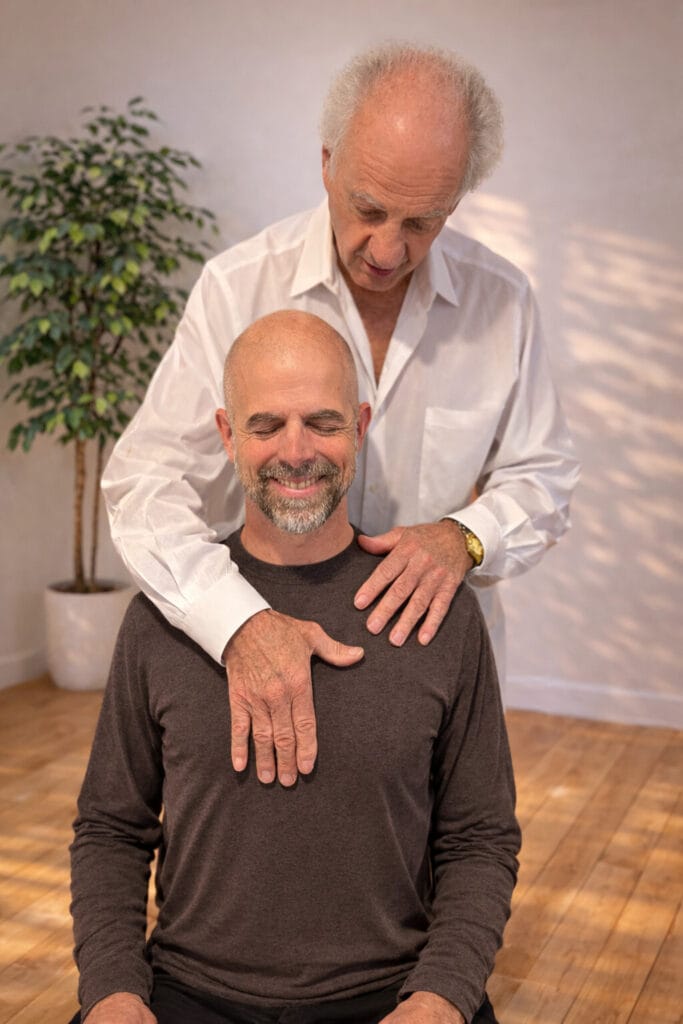
In Alexander Technique, the word “touch” is never just physical. It’s energetic. It’s directional. It’s a conversation—but only if you allow yourself to be touched, too.
In this class, Tommy Thompson invited trainees to drop everything they thought they knew about giving hands-on work. Instead of trying to do something, we were asked to intend. And then… wait.
“Intention is very, very, very, very powerful. The moment you have an intention, you don’t try and do something with it. Intention is just what happens.” – Tommy Thompson
What followed was a profound shift: hands softened, breath returned, and we weren’t “doing” the Alexander Technique. We were being done by it.
Tommy’s question wasn’t about technique—it was about trust.
Can you trust your nervous system to respond before you interfere?
Can you let your presence touch someone, before your hands do?
This redefinition of touch lies at the center of Tommy’s work. And it reminds us why integration—not manipulation—is the quiet force behind true coordination.
2. Core Learnings from This Class
What changes before you touch someone?
In this moment from the Alexander Technique teacher training course in Boston, Tommy Thompson explores mechanical advantage as whole-body organization rather than force.
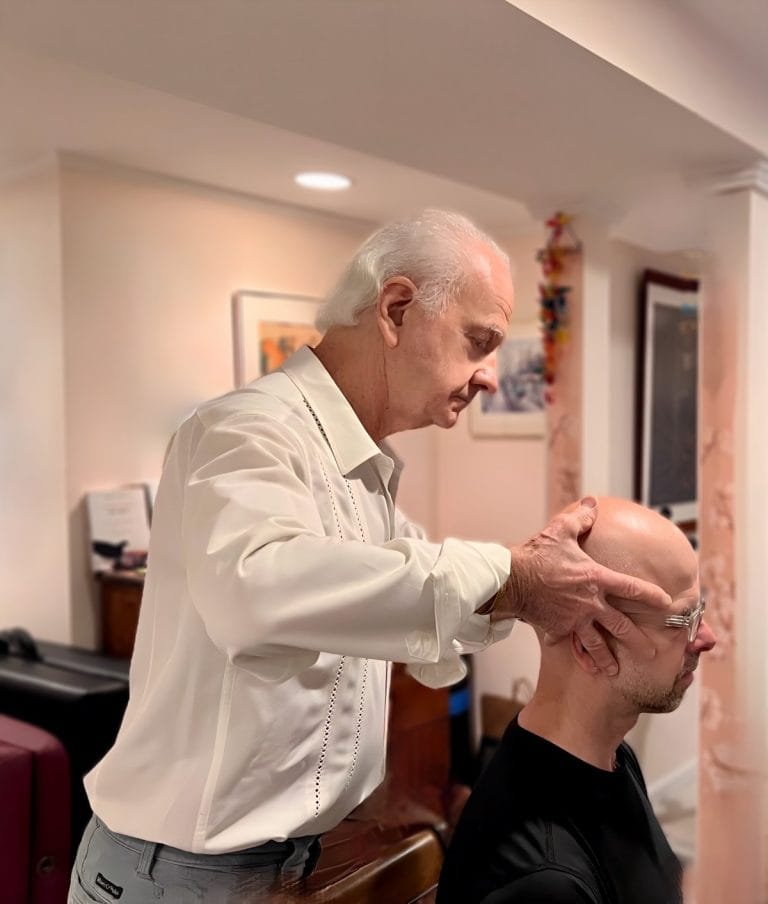
Before placing the hands on another person, the teacher stands in mechanical position, allows the neck to be free, and gives direction so the pressure of the hands and feet begin to balance.
When this balance appears, movement begins to travel through the organism—down through the pelvis and feet, and back up through the spine.
Alexander Technique | You Don’t Touch First. You Organize First.
Class 72 · September 9, 2025 · Boston, MA
Core Concepts
- Intentional use begins before movement.
The Alexander Technique invites us to recognize that movement is never first—intention comes before, and direction follows. This subtle shift changes everything. - The body works best when it’s integrated.
Arms, hands, and even fingers are not separate tools—they belong to the back. When movement arises from the back, not the periphery, the result is light, coordinated, and free. - You are not the doer.
As Tommy said, “You are being done by it.”
This class reminded us that it’s not about making something happen, but allowing coordination to arise through presence, awareness, and trust in design.
Five Key Messages
- Return to your design.
Use begins in the spine, not the limbs. Let your arms belong to the back. - Intention is not doing.
It arises. And when it does, it informs the body without you trying. - “Mechanical advantage” is not effort—it’s orientation.
You align, you don’t push. The body organizes itself when placed well. - Touch must be mutual.
The real work is in allowing yourself to be touched, not just placing your hands. - Integration means nothing is isolated.
Movement, thinking, breath, and touch are one process—when they’re not, tension begins.
Essential Terms
- Mechanical Advantage
A principle of optimal positioning that allows for maximum efficiency and minimal strain. - Belonging to the Back
A key image in Alexander Technique: arms, hands, fingers coordinate from the back, not from isolated action. - Direction
Not physical movement, but an internal instruction of openness and orientation in space. - Intention
Not effort. It is what arises and is picked up by the brain before we know it. - Touch and Be Touched
A foundational principle: allow the possibility of being affected, not just affecting.
If we don’t restore integration, coordination becomes mechanical, touch becomes manipulative, and presence is replaced by habit.
This class was a reminder to begin again—not by changing what we do, but by returning to how we’re designed.
3. Tommy’s Insights
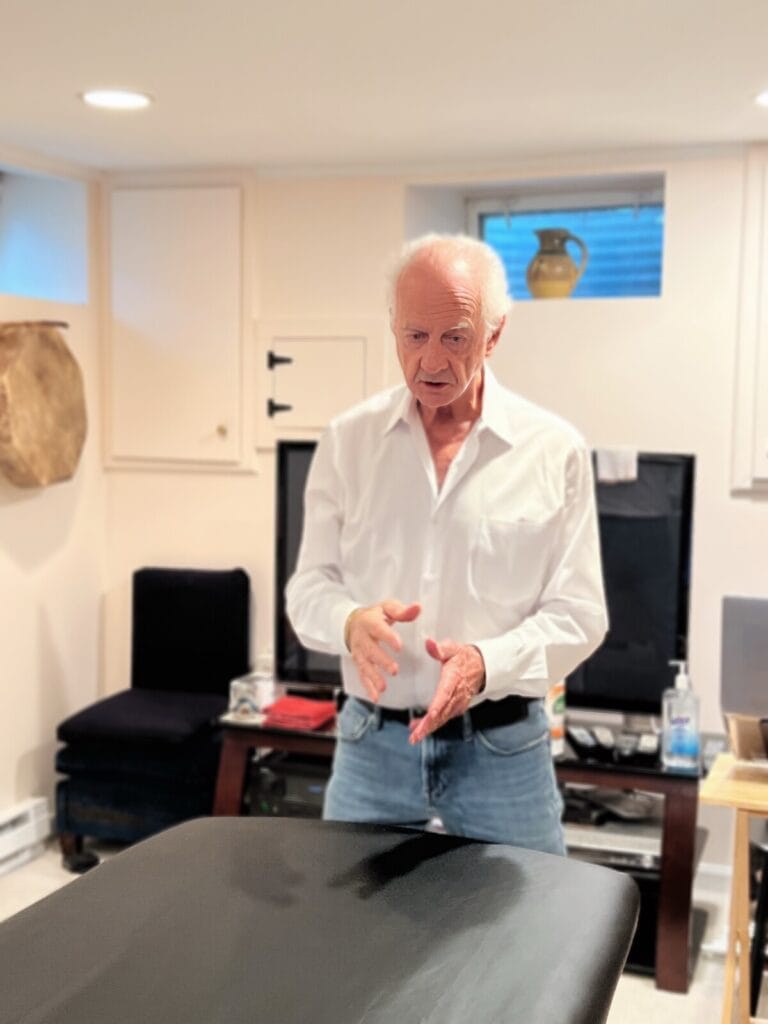
In Tommy’s words during class, there are not only the core principles of the Alexander Technique, but also practical wisdom that can be applied directly to daily life. His words go beyond simple advice about movement and prompt us to deeply consider how we choose to exist.“The moment you decide not to do what you usually do, having some kind of kinesthetic recognition that you’re using yourself a little bit more inappropriately—in terms of your design—you have given the brain the opportunity to use itself as it is designed to do, which is to let the neck be free. The freer you are through this region of your body, the closer you are to using yourself more in accord with the way you’re designed to function outside of habituation.”
➤ When you stop interfering with your natural design, the body remembers its original coordination.
“Alexander said that you let the arms belong to the back and the arm work and back. Anatomically, your arms start down at the lower back, and then specialized tissue turns into little flippers here. This is: the arms belong to the back, the hands belong to the back, fingers belong to the back. Everything belongs to the back. And Alexander wanted you to stay in your back while you work with a person.”
➤ True support arises when all actions originate from the back—not from isolated effort.
“You move from here to here, and the arms must still belong to the back like this. They don’t belong to where you’re touching. This is what most people do—they grasp. But you are going into this position of mechanical advantage, then placing your hands on the person, and you get this movement, this movement, this movement. And then you take the person out of the chair. And that’s a way of training yourself to use your hands.”
➤ Hands don’t act independently; they express a whole-body conversation shaped by direction and relationship.
“And when you touch someone, there’s both an energetic touch and an elementary touch, because you’re not trying to grasp anybody.”
➤ Touch becomes transformative when it is offered, not imposed.
“Mechanical advantage lies at the heart of Alexander’s work. This is mechanical in nature. The term ‘mechanical reflection’ better describes this kind of movement. Frank once told me that Alexander believed you couldn’t use your hands effectively without first aligning into a position.”
➤ Alignment is not a posture—it’s a condition for clarity, readiness, and truthful contact.
“The arms would belong to the back, and if the back is open, the neck is free, freedom. The head is free to do what it’s designed to do.”
➤ Openness through the back allows the head and neck to reorganize into natural freedom.
“You want to trust that the very thing that you are teaching is happening within you—correct.”
➤ Authentic teaching emerges when the work is already living through your own use.
“Intention is very, very, very, very powerful. The moment you have an intention, you don’t try and do something with it. Intention is just what happens.”
➤ The body responds not to control, but to the quiet clarity of your intention.
4. Practical Tips for Everyday Life
What’s the Goal?
The purpose is simple, but powerful:
To awaken the intelligence of intention and let the arms belong to the back—in daily, ordinary action.
The Alexander Technique isn’t something you add on; it’s something you return to.
As Tommy often said, “The arms don’t belong to where they’re touching. They belong to the back.”
How to Practice
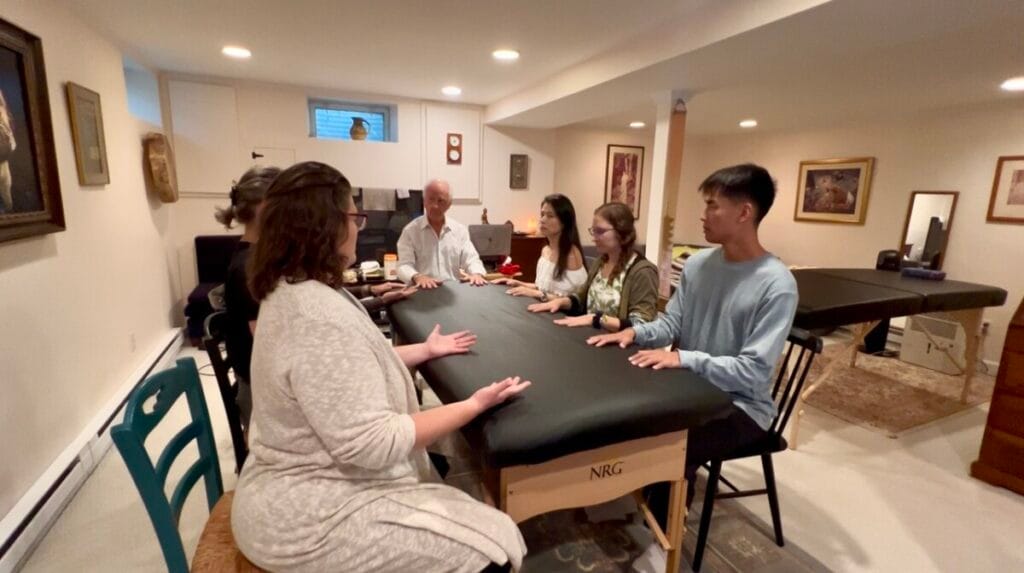
1. Push and Pull the Table — Balancing Pressure Between Hands and Feet
Place your hands on the table. Move forward from your hips, and with intention—without moving your hands—let the table come toward your pelvis.
Notice if your lower back begins to open.
Then gently push the table away, allowing the spine to expand back and up from the pelvis.
Keep the pressure equal between your hands and feet, finding a four-footed balance. Alternate pushing and pulling naturally, observing how pushing opens the front, and bringing the table toward the pelvis opens the back.
Purpose: To restore freedom through the neck and spine, and to awaken a coordinated direction between the back and pelvis.
2. Let Intention Arise Before You Move
Next time you reach for a glass or open a door, pause for a second. Let your intention arise—not as a command, but as a quiet direction. Then allow the movement to happen.
As Tommy said: “You don’t need to act on intention. It’s already been picked up.”
3. Arms Belong to the Back
During any action—typing, brushing teeth, lifting—imagine your arms growing out of your back. Feel the support behind your elbows, the width across your back.
Notice what happens when you don’t grasp, but stay connected.
What You’ll Notice
- A sense of lightness, especially through the neck and shoulders.
- A shift from “doing” to being in motion.
- Less tension, more clarity.
And most of all, you’ll begin to trust that your body knows how to move, if you allow it.
5. Closing the Class
Key Takeaways
- Intention precedes action. It does not push, it summons.
- The arms and hands do not act alone—they are the expression of a deeper alignment.
- Touch is not something you do; it’s something you allow.
These are not techniques to perform—they’re ways of returning to your design.
As Tommy said,
“You want to trust that the very thing you’re teaching is happening within you.”
Core Insights
In this class, “mechanical advantage” was more than a concept. It was a felt experience—an entry into alignment, clarity, and economy of movement.
When the neck is free, and the arms belong to the back, coordination becomes effortless.
And when intention quietly leads the way, everything changes without force.
This is the Alexander Technique at its most alive:
not imposed, but uncovered.
A Final Invitation
What if the way you sit, stand, or reach for a cup could reflect your wholeness?
Not because you tried to do it right—but because you allowed intention to be clear?
Try it.
Trust that you are already built to know.
As Tommy reminded us through every gesture,
“You’re never alone. Your body is already listening.”
6. One Key Practice
Let your arms belong to your back
Don’t try to control your hands. Don’t force your touch.
Let the movement begin in your back—not in your fingers.
The moment you do this, you are already practicing the Alexander Technique at its most essential. This isn’t about correcting posture. It’s about returning to your original design.
Let your intention rise—not from the head, but from the whole self.
Wait. Listen. Then move.
That’s it.
This is where mechanical advantage begins: Not in how you move—but in how you intend to move.
7. Three Questions to Ask Yourself
These are not questions for reflection on the past, but invitations to meet yourself in the present moment—where your body, mind, and attention converge.
Just like in Tommy’s class, awareness becomes movement, and movement becomes awareness.
- Am I doing this—or is this doing me?
→ Is the movement flowing from me, or moving through me? - Where is my back in all of this?
→ Am I present through my back, or pushing forward from the front? - Am I listening with my whole self?
→ Is my attention embodied—or just located in my head?
8. For Those Who Wish to Learn More
Touching Presence – Tommy Thompson
Drawn from over 50 years of teaching, this book gathers Tommy Thompson’s core insights and principles into clear, accessible reflections.
It explores themes like intention, direction, use, and human connection—echoing the very heart of this class.
Many of today’s class ideas—the arms belonging to the back, touch that listens, and movement arising from intention—are directly rooted in the perspectives shared here.
If you wish to carry this work beyond the classroom, this book is an ideal companion.
Official Website of Tommy Thompson
www.easeofbeing.com
This is the official website personally managed by Tommy Thompson, offering a wide range of resources and programs to deepen your understanding and practice of the Alexander Technique:
- Private session reservations and inquiries
- Workshop and seminar schedules
- Overview of international teacher training programs
- Essays and articles on the Alexander Technique
9. Next Class Sneak Peek
What if your attention is already doing more than your hands ever could?
In the next class, Tommy leads us into the quiet power of attention—not as effort, but as presence. We won’t be “applying” attention; we’ll be listening with it.
You’ll be invited to:
- Let attention guide, not effort.
- Sense how attention reorganizes the system from within.
- Trust that what you notice is already moving.
Tommy’s hands will rest on more than muscles—they’ll meet intention. And in that stillness, something deeper begins to shift.
In Class 73, we’ll explore:
“The shape of your attention shapes the way you move.”
10. Join the Alexander Technique Journey
Did this class leave a small resonance within you? Feel free to quietly hold it in your heart or share it in just a sentence or two. The comments are always open. Your one simple word may leave a gentle ripple in this ongoing journey.The journey of Resonance Flow continues across social media as well. Let’s continue this journey together.
 YouTube
 Instagram
 Threads
 Facebook