What If One Thought Could Heal You? The Hidden Power of Intention | Tommy Thompson Class 39

❝Can a single thought change how your body responds to pain?❞
What if doing less—or not doing at all—was the start of healing?
What if a simple thought could release your neck, open your spine, and restore your natural poise?
On February 20, 2025, in Boston, Massachusetts, USA, Tommy Thompson led a class in the Alexander Technique teacher training course where he challenged how we think about movement, tension, and change itself.
This wasn’t a class about posture correction or physical technique. It was about the power of intention—the non-doing kind. A thought you hold, without effort, that lets the body reorganize itself.
Tommy’s words weren’t just instructional. They were lived. Felt. Spoken like someone who has spent decades listening to what the body says when you stop trying to fix it.
In this class, Alexander Technique wasn’t taught—it was demonstrated, moment by moment. In your hands. In your thoughts. In your own use of self.
And that’s where true wellness begins.
This blog series is based on Tommy Thompson’s Alexander Technique classes. Each post follows the flow and insights of the class to expand both self-awareness and practical consciousness applicable to everyday life.
New here?
If you’re new to the Alexander Technique, you can start with the resources below.
Alexander Technique Class Flow at a Glance
1. The Opening Question
❝What does it really mean to let the neck be free—and why do we start there?❞
In Alexander Technique, we don’t begin with what the body is doing. We begin with what you’re thinking. That’s the first lesson Tommy gave us in this class: The neck doesn’t change because you stretch it. It changes because you stop shortening it.
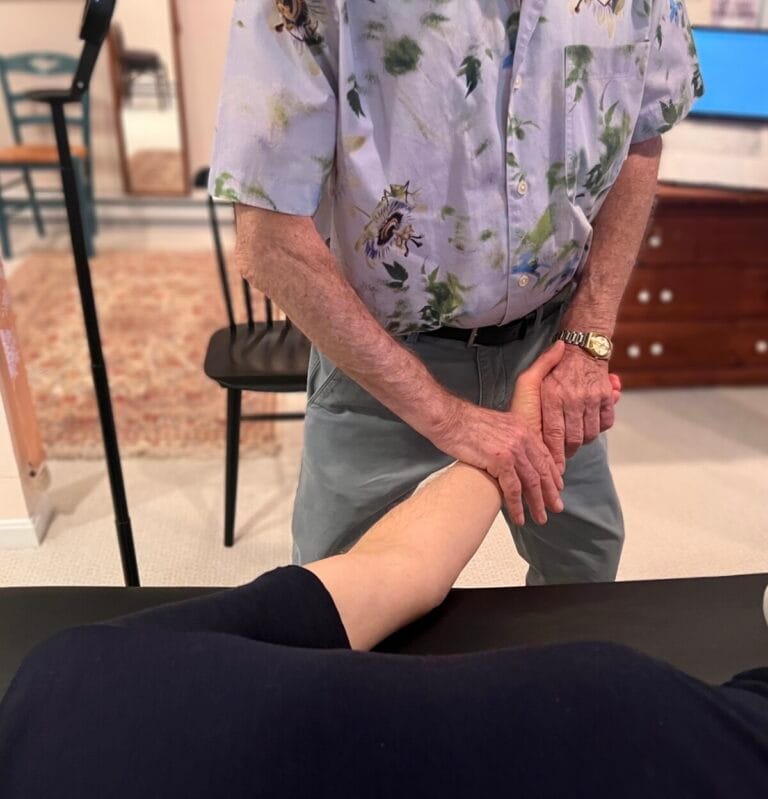
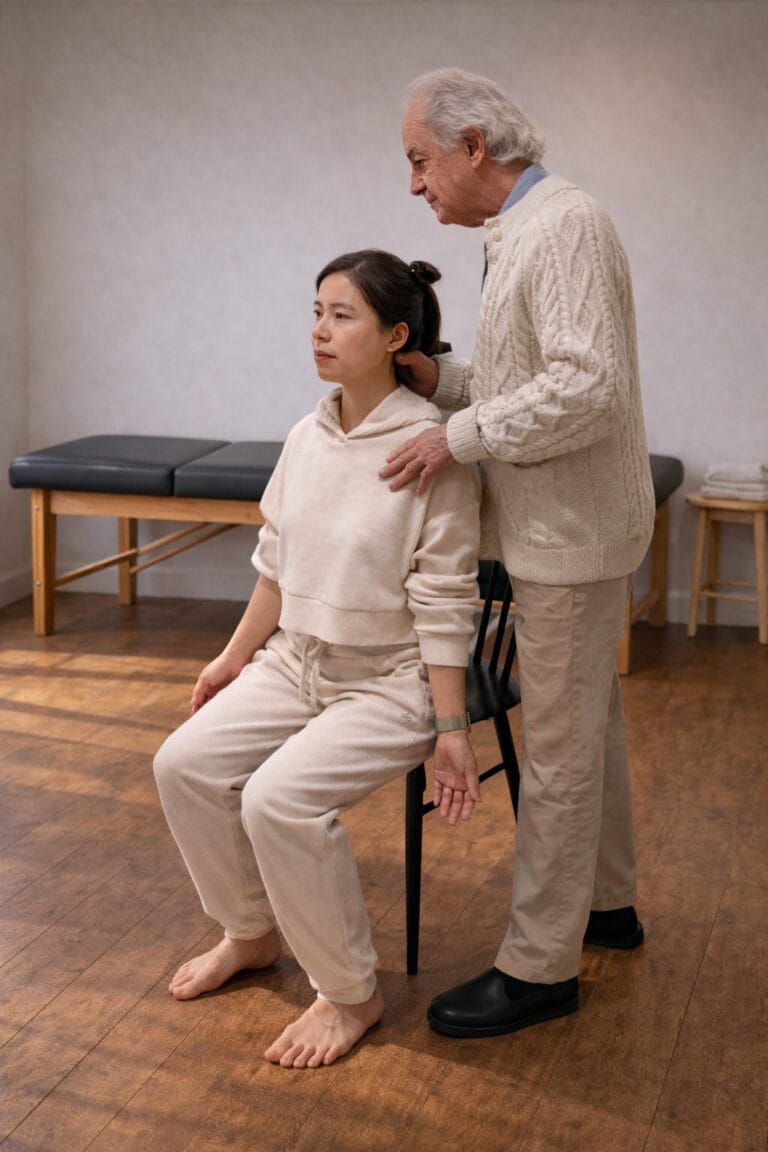
When trainees placed hands on someone’s face or back, Tommy reminded them that change happens through direction, not manipulation. You intend the release—you don’t do it.
The first direction—“Let the neck be free so the head can move away from the body”—isn’t a command. It’s an offering. A whisper. A suggestion the whole body can follow.
The more quietly and consistently you hold that thought, the more the body listens. And from that intention, everything else—freedom, coordination, upward movement—begins to unfold.
Tommy’s Word
“No. I’m letting the neck be free to lengthen. You don’t do anything — register the intention: ‘My neck to be free to lengthen, so my head can move away from the body.'”
This isn’t about action—it’s about direction. A conscious, non-doing thought that leads the body back to its natural organization.
2. Core Learnings from This Class
Core Concepts
- A thought can change the body.
Tommy showed again and again: change doesn’t begin with effort. It begins with a quiet direction. Just thinking “let the neck be free” can reorganize how the whole system moves. - The face reflects the whole self.
When you place hands on the face, you’re not just contacting muscle—you’re affecting how the nervous system processes pain. Expression and coordination shift together. - You teach through how you use yourself.
In hands-on work, your self-use becomes part of the communication. The direction you give yourself shapes the outcome more than any technique.
Five Key Messages
- Change starts in thought.
Movement follows mental direction, not effort. The body listens when the thinking is clear. - The neck initiates the sequence.
When the neck is no longer shortened, the head moves away from the body and the spine finds space to lengthen. - Hands speak through intention.
A quiet, non-invasive hand—with clear thinking—guides deep reorganization in the other person. - Opening the hand affects the spine.
When the carpal bones release, that opening echoes up through the shoulder and neck, freeing the head. - Repetition makes it real.
A consistent intention becomes sensation. And sensation leads to movement that’s more integrated and whole.
Essential Terms
- Intention
The quiet wish that begins change. As Tommy said, “You’re not doing anything—it’s like a wish.” This is the center of everything. - Direction
A conscious mental pathway that leads the body toward release, not control. It’s not an action—it’s a message. - Self-use
The way you manage your own presence while working with others. It shapes what your touch communicates. - Lengthening
A return to natural muscular tone, especially through the neck and spine. It happens through non-doing, not pulling. - Expansion
What follows when interference stops. As thinking clears, the whole body opens upward and outward.
3. Tommy’s Insights
In Tommy’s words during class, there are not only the core principles of the Alexander Technique, but also practical wisdom that can be applied directly to daily life. His words go beyond simple advice about movement and prompt us to deeply consider how we choose to exist.“When you change the person’s facial expression, that lets them experience whatever pain they’re having without the accompanying expression, which would otherwise show up in the same way in the body.”
→ Pain and pattern are inseparable—softening expression interrupts the body’s learned reaction to discomfort.
“I’m letting the neck be free to lengthen. You don’t do anything — register the intention: ‘My neck to be free to lengthen, so my head can move away from the body.’”
→ True direction begins in thought, not movement—it’s a conscious shift that invites the body to reorganize.
“Let your neck be free — select it — without doing it. No doing. Just thought.”
→ Selection means awareness with choice, not effort; the change happens by allowing, not commanding.
“I want it to be free enough so that the neck muscles — all of the muscles in the neck — trapezius, sternocleidomastoid especially — lengthen, rather than shorten.”
→ These primary muscles hold the whole head-body relationship; their length reflects your moment-to-moment use.
“Because usually, when a person does something, the neck shortens. So I go through all those directions before I put my hands on. And when I have my hand on you, I continue to repeat it.”
→ Before and during any contact, the teacher’s thinking must lead—direction is the invisible foundation of the work.
“And while you have your hands there, you’re still giving yourself the directions: You’re letting your neck be free to lengthen. You’re not doing anything whatsoever — except it’s like a wish.”
→ Effective touch carries the teacher’s clarity; direction is maintained as a continuous inner whisper.
“As I start to work, I really want to pay attention to how I’m using myself.”
→ Self-use is the primary tool—how you organize yourself determines what you offer through your hands.

4. Practical Tips for Everyday Life
What’s the Goal?
The goal isn’t to fix yourself. It’s to interrupt the habits that interfere with how you’re already designed to function.
In the Alexander Technique, direction—not effort—is what restores coordination.
Even simple moments can become practice.
How to Practice
- Start your day with a direction.
As you wake, pause for a moment. Think:
“Let my neck be free, so my head can move away from my body.”
No effort—just intention. Let that guide your first movement. - Touch as a quiet teacher.
Rest your hand gently on your cheek, shoulder, or sternum.
Don’t fix. Don’t press. Let the touch reflect your own stillness.
See how your system responds when you stop managing it. - Let your hands lift you.
When your fingers lengthen out through the palm, the palm opens naturally.
As Tommy showed, when the carpal bones release, the shoulders follow—and so does the neck.
A rising begins without you doing the rising.
What You’ll Notice
You may feel taller without trying.
Breath may move more freely, even if you didn’t think about it.
Small things may become lighter—not because they’ve changed, but because you have.
This is the Alexander Technique in life: doing less, while becoming more awake.
5. Closing the Class
Key Takeaways
Tommy’s February 20 class wasn’t about posture or how to stand taller. It was about how a simple, clear direction—without doing—can change the entire system.
He asked us to offer the body nothing but awareness.
Not correction. Not control. Just a message.
What emerged was this:
a shift that begins in intention, and deepens through non-doing.
Core Insights
The moment we stop trying to fix the body, it begins to restore itself.
The spine lengthens not because we make it, but because we stop pulling it down.
Touch becomes powerful when we give up effort, not when we apply more of it.
“The direction you give yourself is more important than anything you do.”
That direction is not an action. It’s a way of being.
A Final Invitation
Let yourself listen more than act.
Let the thought come before the movement.
Let your next gesture arise from stillness.
This is what the Alexander Technique points to—
not a system for control, but a practice of returning to your natural, intelligent design.
6. One Key Practice
Think: “Let my neck be free.”
Don’t act on it—just keep thinking it.
This is not a command, but an invitation. Hold that thought like a quiet presence as you move through your day.
Let it guide your walking, reaching, typing, breathing.
Don’t do the release—let the intention keep showing up.
That’s where the real change begins.
7. Three Questions to Ask Yourself
- Am I doing more than I need to right now?
What happens if I stop? - Is my neck free—in thought, not in action?
You don’t have to make it happen. Just remember. - What direction am I giving myself, even in silence?
Stillness speaks too. What is yours saying?
8. For Those Who Wish to Learn More
Recommended Book
The Alexander Technique: A Personal and Critical Guide for Practitioners, Students and Performance Artists – Peter Ribeaux
This book dives deeper than posture—it’s about clarity, choice, and the silent dialogue between intention and movement. Ribeaux, with over 45 years of teaching experience, strips away mysticism and offers a grounded, direct view of the Technique.
His insights echo Tommy’s core teaching: real change comes not from what you do, but from how you think.
If you’re looking for a companion that speaks to both your inner and outer practice, this guide will meet you where you are—and move with you.
Official Website of Tommy Thompson
www.easeofbeing.com
This is the official website personally managed by Tommy Thompson, offering a wide range of resources and programs to deepen your understanding and practice of the Alexander Technique:
- Private session reservations and inquiries
- Workshop and seminar schedules
- Overview of international teacher training programs
- Essays and articles on the Alexander Technique
9. Next Class Sneak Peek
What if the way you move is the way you believe?
In Class 40, Tommy leads us into how use of the self reflects identity—through posture, facial expression, and movement.
What we think is “just how we sit or stand” may actually be the body repeating an old narrative.
In Class 40, we’ll explore:
- How the face and posture express unconscious identity
- Why subtle movement tells the story before words do
- How the Alexander Technique opens new ways of being
This next class asks: What story is your body living—and can you choose a different one?
10. Join the Alexander Technique Journey
Did this class leave a small resonance within you? Feel free to quietly hold it in your heart or share it in just a sentence or two. The comments are always open. Your one simple word may leave a gentle ripple in this ongoing journey.The journey of Resonance Flow continues across social media as well. Let’s continue this journey together.
 YouTube
 Instagram
 Threads
 Facebook