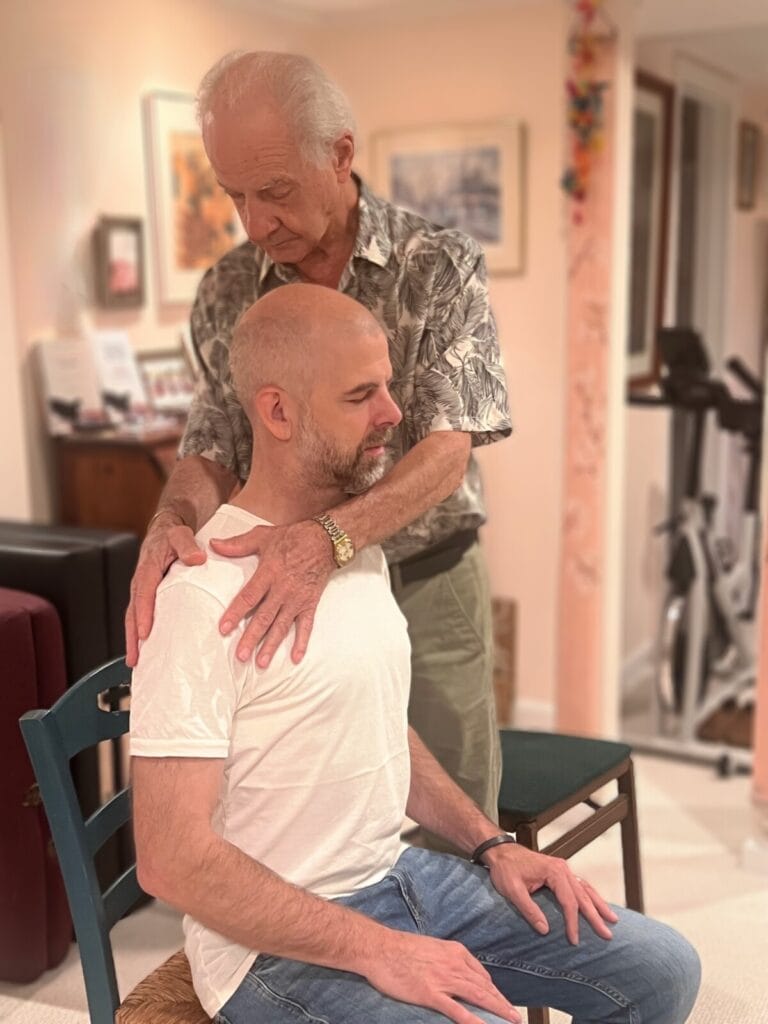
Coexistence: If the Brain Is Already Organizing You, Why Are You Still Interfering? | Tommy Thompson Class 87
❝ If your nervous system is already organizing you, why are you still trying to take over? ❞
This question doesn’t ask how to do the Alexander Technique better.
It asks something more unsettling: whether your effort to improve is the very thing that interrupts coordination.
In this class, Coexistence emerged not as a philosophical idea, but as a lived skill—staying present with what is already happening so the organism can do its work without interference. Neck freedom and forward–up were approached not as instructions to carry out, but as conditions that allow the nervous system to regulate itself with precision and ease.
On October 29, 2025, in Boston, Massachusetts, USA, Tommy Thompson led a class in the Alexander Technique teacher training course where the focus shifted from directing change to recognizing when to stop stepping in.
Key Objectives of the Class:
- Explore Coexistence as an embodied practice rather than a conceptual stance
- Reframe neck freedom and forward–up as relational conditions, not mechanical actions
- Develop sensory education so anatomical relationships can be directly perceived
- Understand change as participation in an ongoing continuum, guided by the nervous system’s intelligence
This blog series is based on Tommy Thompson’s Alexander Technique classes. Each post follows the flow and insights of the class to expand both self-awareness and practical consciousness applicable to everyday life.
New here?
If you’re new to the Alexander Technique, you can start with the resources below.
Alexander Technique Class Flow at a Glance

1. The Opening Question
❝ If your brain is already organizing you, where do you notice yourself stepping in? ❞
This question didn’t invite analysis. It invited sensing.
Again and again, it drew attention back to the same moment—when effort quietly replaced awareness, and intention slipped into interference.
Rather than aiming at improvement, the question redirected attention to relationship: how you relate to what is already happening. It functioned as a practical lens, returning the class to the immediacy of use—felt in the neck, the back, and the quality of attention itself.
Tommy’s Word
The work is about—maybe I’ve never said that before—but it’s about consciously coexisting with the brain’s directive.
This reframes the Alexander Technique from a method of control into a practice of restraint. To consciously coexist with the brain’s directive is not to withdraw, but to stop overriding. Coexistence here names an active attentional stance—one that allows coordination to emerge by reducing interference rather than adding instruction.
2. Core Learnings from This Class
In this moment from Tommy Thompson’s class, the traditional direction “let the neck be free” is seen in a different way.
Rather than treating it as something to do, the focus shifts to recognizing an ongoing continuum—and how our use can interfere with it.
Watch how this shift from directing to allowing reveals a different quality of coordination.
You’re Interfering More Than You Think | Alexander Technique
Class 87 · October 29, 2025 · Boston, MA
Core Concepts
- Allowing rather than directing
Throughout the class, directions were approached not as instructions to make something happen, but as invitations to stop interfering with an intelligence that is already at work. - Neck freedom as a relational condition
Neck freedom was explored as something that arises through relationship—between head, spine, and attention—rather than through release or effort. - Forward–up as a unified action
Forward and up were treated as a single directional quality, sensed internally through movement rather than applied as a positional correction. - The ongoing continuum
Use was understood as participation in a living process already in motion, where coordination is continuously reorganizing rather than being produced. - Interference and inherent freedom
The class repeatedly returned to how interference disrupts coordination, and how allowing inherent freedom restores the system’s capacity to self-regulate.
Five Key Messages
- Improvement often disguises interference.
- Coordination reorganizes itself when interference subsides.
- Neck freedom is something you allow, not something you do.
- Forward–up is sensed as movement, not imposed as position.
- Coexistence is the practice of staying present with the brain’s directive rather than overriding it.
Essential Terms
- Coexistence
Consciously participating with the brain’s directive while refraining from overriding it through habit, effort, or correction. - Neck freedom
A relational state that allows the head–neck–back relationship to organize itself appropriately for the activity at hand. - Forward–up
A unified directional quality perceived through internal movement, rather than a mechanical adjustment of posture. - Ongoing continuum
The uninterrupted process through which coordination is constantly reorganizing within the living system. - Interference
The habitual tendency to step in and control, which interrupts the nervous system’s inherent capacity to coordinate itself.
3. Tommy’s Insights
In Tommy’s words during class, there are not only the core principles of the Alexander Technique, but also practical wisdom that can be applied directly to daily life. His words go beyond simple advice about movement and prompt us to deeply consider how we choose to exist.1. Letting the neck be free to lengthen, the purpose of which is to allow a movement of the head away from the body, forward and up, which brings length to the spine and width to the back.
➤ This articulates direction not as a physical action but as a relational condition that allows the body’s spatial organization to emerge without interference.
2. If you think of letting the neck be free, the purpose of which is to allow a movement of the head away from the body, forward and up, you’ll sense it. You can sense. You can learn how to sense the internal movement of the atlas moving along the condyles. And you will go back. You will go back. And you will experience the length of your spine and the width of your back as you breathe.
➤ Here, sensory education replaces mechanical effort, emphasizing that coordination is refined through cultivated perception rather than imposed control.
3. I wouldn’t say it’s directions, but I’m not delegating. I would say you’re allowing something to happen that’s part of an ongoing continuum, because the way you’re using yourself is inhibiting or impeding that ongoing continuum. We’re not tough. You’re letting something—you’re allowing something—to happen that is part of an ongoing continuum, depending on how much you are interfering with that ongoing continuum.
➤ Tommy frames change as participation in a living process already underway, where the primary task is to stop interrupting what is inherently organizing itself.
4. When you allow the freedom—when you allow the neck its inherent freedom to know exactly how much tension is necessary for you to accomplish a given task—it’s built into the system, the brain, to do that.
➤ This reflects a deep trust in neurophysiological intelligence, asserting that appropriate tone arises naturally when excessive conscious control is relinquished.
5. So if I spend my life, as best as I’m able, in enough situations, I then train myself to exist—or coexist—consciously. Consciously coexist with my brain. The work is about—maybe I’ve never said that before—but it’s about consciously coexisting with the brain’s directive.
➤ The Alexander Technique is presented here as an ongoing existential practice, aligning awareness with the brain’s innate capacity to guide action moment by moment.
6. The moment I get over here—I don’t want to say what you did was wrong. I want to say: this exists within the context of what you did.
➤ This reveals an ethical stance in teaching, where judgment is replaced by contextual understanding that preserves the student’s agency and dignity.
7. Inspansion and expansion at the selfsame moment. When you expand—consciously expand—someone, you are meddling with the necessary amount of opposition that the nervous system needs to allow this expansion.
➤ Tommy distinguishes organic expansion from imposed stretching, warning that interference disrupts the nervous system’s finely tuned balance of forces.
8. But before that—and it accentuates the length—but it takes you away from your feet. But if I get just enough, just enough length, I have to find an expansion. I have to go into the body. I have to go into the ocean, beneath the wave. I have to go into it.
➤ This metaphor points to depth over display, suggesting that true length and support arise from inward settling rather than outward striving.
4. Practical Tips for Everyday Life
What’s the Goal?
The aim is not to improve how you move, but to recognize when you interfere.
This practice invites you to shift from correction to relationship—learning to coexist with the brain’s directive while life is already in motion.
How to Practice
- Choose an ordinary action: standing up, reaching, or beginning to walk.
Before you move, pause briefly and notice whether you are preparing, fixing, or bracing. - Instead of correcting, allow the neck its freedom and let the movement happen.
As you move, stay with sensation rather than outcome. - When effort returns, simply recognize that you have stepped in—and allow yourself to step back.
Carry this attitude into daily life, not as a technique, but as a way of meeting activity.
What You’ll Notice
You may first notice how often you interfere.
Then, gradually, less preparation and more continuity.
Movement may feel easier, better timed, and more supported through the back.
Most importantly, coordination begins to improve without being managed.
Change happens not because you direct it, but because you stop interrupting it.
5. Closing the Class
Key Takeaways
This class wasn’t asking you to do the Alexander Technique better. It was asking you to notice when “better” becomes interference. Again and again, the work returned to one practical point: coordination is already organizing, and your job is to recognize when you step in and override it.
Tommy said: The work is about—maybe I’ve never said that before—but it’s about consciously coexisting with the brain’s directive.
Core Insights
As Tommy often reminded the class, directions are not commands to manufacture an effect. They are invitations to stop interrupting what is already intelligent in you. Neck freedom and forward–up are not mechanical targets; they are relational conditions that let the system regulate itself with less effort.
And the shift is not only physical. It’s ethical: instead of judging what happens, you meet it in context.
A Final Invitation
As Tommy often reminded the class, you don’t have to command the brain—you have to stop stepping in. Choose one ordinary action today. Pause just long enough to notice interference, then allow the action to organize itself.
If you can stay with that, Coexistence stops being an idea and becomes your lived use.
6. One Key Practice
The single most important practice from this class is this:
Before you move, pause just long enough to notice whether you are stepping in.
Then allow the neck its freedom and let the action happen without helping it along.
Stay with sensation rather than outcome.
When effort returns, recognize it—and step back.
Not as a technique,
but as a way of coexisting with the brain’s directive.
7. Three Questions to Ask Yourself
These are not questions to answer.
They are questions to return to—in the middle of action.
- Where do I notice myself stepping in right now?
- Can I allow this movement to organize itself without helping it?
- What changes if I stay with sensation instead of outcome?
Each question invites you back into the present moment—
not to fix what’s happening, but to meet it with awareness.
8. For Those Who Wish to Learn More
Recommended Books
The Alexander Technique: The Essential Writings of F. Matthias Alexander – F. Matthias Alexander (selected and with an introduction by Edward Maisel)
This class turns on language—let, allow, neck freedom, and forward–up as lived direction rather than posture. Maisel’s selection returns you to the original source of those directions, so Tommy’s emphasis on non-interference and the brain’s organizing intelligence can be heard with sharper ears.
If you want the cleanest bridge between Alexander’s classic wording and Tommy’s invitation into Coexistence, this is the most direct next step.
Official Website of Tommy Thompson
www.easeofbeing.com
This is the official website personally managed by Tommy Thompson, offering a wide range of resources and programs to deepen your understanding and practice of the Alexander Technique:
- Private session reservations and inquiries
- Workshop and seminar schedules
- Overview of international teacher training programs
- Essays and articles on the Alexander Technique
9. Next Class Sneak Peek
In the next class, the focus turns to a question at the center of the Alexander Technique:
how do you know what information to trust?
Class 89 will explore how to distinguish Reliable information from the sensory habits that create Interference. What feels familiar often feels right—but that familiarity is frequently the source of interference itself.
This class clarifies how perception becomes distorted and how change begins only when that distortion is clearly recognized.
10. Join the Alexander Technique Journey
Did this class leave a small resonance within you? Feel free to quietly hold it in your heart or share it in just a sentence or two. The comments are always open. Your one simple word may leave a gentle ripple in this ongoing journey.The journey of Resonance Flow continues across social media as well. Let’s continue this journey together.
 YouTube
 Instagram
 Threads
 Facebook