Lengthening Secrets: Why Letting Go Changes Everything |Tommy Thompson Class 38

❝ What if every bit of tension you’ve been holding… was never needed in the first place? ❞
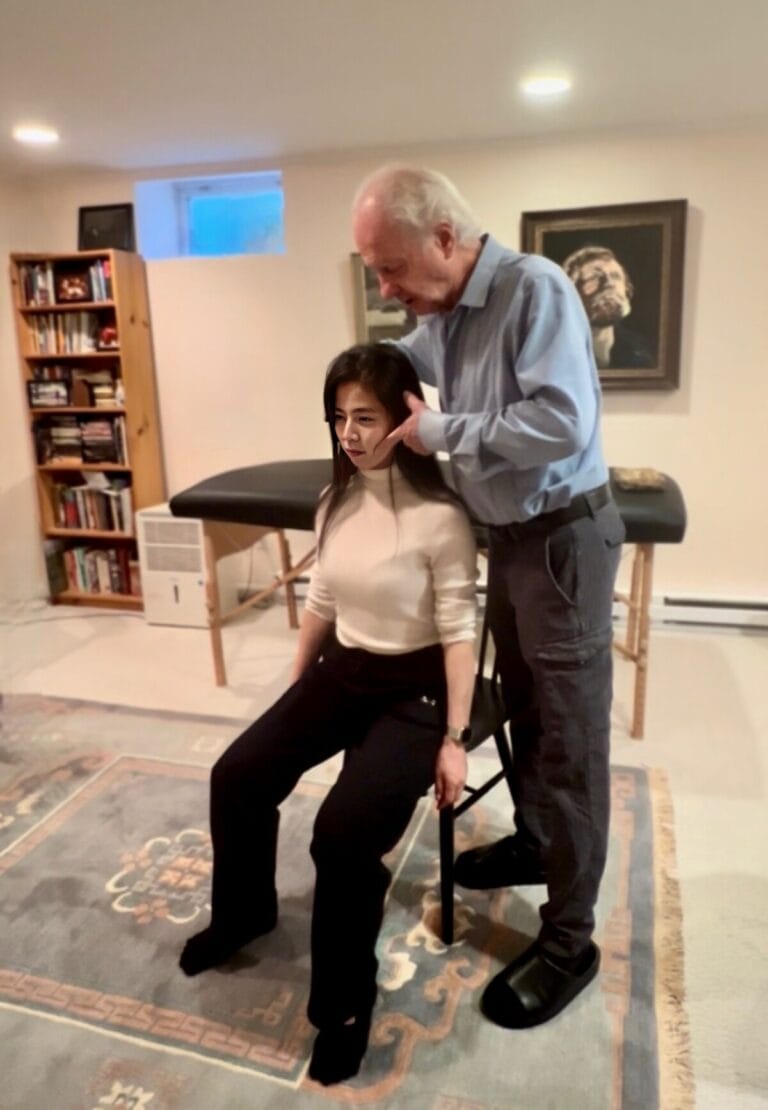
You’re standing there, thinking you’re “holding yourself up.” I walk over, place my hands lightly on your neck and shoulders, and say, “Let your neck be free. Let the spine lengthen. Stop trying—just allow.”
In that moment, you feel it—the release. Your head moves away from your body, not because you forced it, but because your system remembered what it’s designed to do. This isn’t posture correction. This is lengthening—gravity working with you instead of against you.
On February 18, 2025, in Boston, Massachusetts, Tommy Thompson led a class in the Alexander Technique Teacher Training Course. Trainees didn’t just hear about anatomy; they experienced it. They felt the trapezius respond to the lightest touch, the spine expand without effort, and the breath deepen without command. This was wellness in motion—movement and stillness in harmony.
Key Objectives of the Class:
- To discover lengthening as the body’s natural response to gravity.
- To use subtle touch that invites change rather than forcing it.
- To integrate Alexander Technique into daily life so alignment becomes second nature.
This blog series is based on Tommy Thompson’s Alexander Technique classes. Each post follows the flow and insights of the class to expand both self-awareness and practical consciousness applicable to everyday life.
New here?
If you’re new to the Alexander Technique, you can start with the resources below.
Alexander Technique Class Flow at a Glance
1. The Opening Question
❝ How would your movement change if you stopped holding yourself up… and simply let yourself lengthen? ❞
Most people live in a constant low-level fight with gravity—shoulders braced, spine compressed, neck locked. The Alexander Technique isn’t about adding effort. It’s about removing the interference so your body can return to its design: to lengthen, to expand, to move with ease.
Tommy didn’t give a checklist of “good posture rules.” Instead, he invited the class to notice, to pause, to sense the difference between forcing and allowing. That single act of allowing changes everything.
Tommy’s Words
“You are bringing length to the spine. If the neck muscles are free to lengthen rather than shorten, this allows for expansion. Shortening looks like this, but if the muscles are lengthened, this happens naturally.”
This wasn’t just instruction—it was a shift in identity. Lengthening isn’t something you “do”; it’s what happens when you stop preventing it. When the neck is free, the spine lengthens on its own, and the whole body reorganizes—breath, balance, and presence align without strain.
2. Core Learnings from This Class
Core Concepts
- Forward and Up
In the Alexander Technique, forward and up is not a rigid posture but a direction that invites Lengthening through the whole system. - Light Touch for the Trapezius
The trapezius responds best to gentle touch, allowing the body to self-adjust without force. - Gravity as a Partner
The body is built to lengthen in response to gravity, not collapse under it.
Five Key Messages
- Lengthening is not doing—it’s allowing.
Trying to “hold yourself up” often creates compression. - Your body already knows how to realign.
Subtle, mindful input beats forceful correction. - The neck leads the way.
Freeing the neck unlocks the spine and balance. - Everyday movement is the real practice.
The goal is wellness in life, not just in class. - Observation comes before intervention.
See what’s already happening before changing it.
Essential Terms
Lengthening
“Stop trying to pull yourself up. Let your neck be free, and the spine will lengthen on its own.”
For Tommy, this isn’t something you “do”; it’s what happens when you stop interfering.
Inhibition
“Pause before you react.”
The conscious gap before movement lets the nervous system choose a better way.
Forward and Up
“Forward and up” means the head gently moves forward and upward, allowing the spine to lengthen naturally. In contrast, “back and down” means the head tilts backward and presses downward, which shortens the spine.
Trapezius Release
“It’s a superficial muscle—light touch is enough.”
With the right contact, the trapezius coordinates with the whole body.
Gravity Response
“We are designed to lengthen in response to gravity.”
When aligned with this truth, balance and ease emerge without effort.
3. Tommy’s Insights

“You are bringing length to the spine. If the neck muscles are free to lengthen rather than shorten, this allows for expansion. Shortening looks like this, but if the muscles are lengthened, this happens naturally.”
→ The essence of lengthening is the release of habitual neck contraction, allowing the spine’s natural upward response to gravity without manufactured effort.
“That’s not me (Tommy) doing it; it’s your own system releasing your trapezius right now. And you do this—you unwind naturally when you stand for a long time while reading. You’ve trained yourself to allow your body to naturally lengthen. To free your trapezius, the movement will go back like that.”
→ True change happens when the body’s own coordination restores itself; the teacher simply creates the conditions for that restoration.
“Then you can explain that if the shoulder opens this way, it frees the head nut to move in this direction. This lengthens her entire spine throughout her body.”
→ Freedom in the shoulder girdle releases the head to lead movement, initiating whole-body lengthening through balanced direction.
“These are the ribs—right here, the ribs. These are the intercostal muscles, located between them. When you place your hand here, you are freeing the intercostal muscles while also making contact with the diaphragm. This action helps open up the entire body, allowing for expansion.”
→ Gentle contact at the ribs and diaphragm facilitates integrated breathing, which in turn supports natural postural lengthening.
“You are one big wave. That’s what we are. We are one big wave-like motion. That’s what we are.”
→ Coordination in the Alexander Technique is not mechanical but continuous, like a living wave connecting every part of the self.
“We are naturally designed to respond to gravity by lengthening, and this process is ongoing.”
→ The body’s structural intelligence is to lengthen in response to gravity; the teacher’s role is to remove obstacles to that process.
“The trapezius is a superficial muscle, meaning you only need a light touch to remind it of its intended function. If you overdo it, the effect is lost. You don’t need to go deeper—the trapezius will naturally communicate with the other muscles in the body.”
→ Minimal, precise input awakens the trapezius to resume its coordination with the whole, preserving the nervous system’s responsiveness.
“Simply inhibiting my usual habitual response—pausing before reacting—lets the brain understand that it is not bound by old movement patterns.”
→ Inhibition is the gateway to change, giving the brain time to choose new, more efficient patterns over ingrained habits.
4. Practical Tips for Everyday Life
What’s the Goal?
To let the principle of lengthening weave through your whole day—so it’s not a special “exercise,” but the way you live, breathe, and move.
How to Practice
- When You First Stand Up in the Morning
Before your feet touch the floor, think: “Neck free, head forward and up.” As the head moves away from the body, let it move forward and up, allowing the spine to lengthen. Don’t push—just allow the body to rise into the day. - As You Move Through Crowded Spaces
Walking to the bus, down the hallway, or through the market, imagine the crown of your head moving slightly ahead of you, leading your spine into length. Let your shoulders soften as if the air itself is carrying them. - When You’re at Home Doing Small Tasks
Washing dishes, pouring tea, or folding laundry—notice your breath and place a fingertip lightly at the back of your neck. Remind yourself: no pressing down. This light contact is enough to keep the spine alive and ready.
What You’ll Notice
Movements feel less like effort and more like flow. The spine finds its own upward path, breathing comes without demand, and tension shows up only as an invitation to release. In time, this way of moving stops being a practice—and starts being who you are.
5. Closing the Class
Key Takeaways
Tommy reminded us that this work isn’t about creating a perfect posture or locking ourselves into a “correct” shape. It’s about letting the body’s own intelligence rise to the surface. When we stop interfering, the head leads, the spine lengthens, and movement becomes lighter without forcing it.
Core Insights
“We are naturally designed to respond to gravity by lengthening, and this process is ongoing.”
In the Alexander Technique, gravity isn’t an enemy to resist—it’s the partner that gives you lift. By freeing the neck, releasing habitual contraction, and allowing the body to reorganize, we return to what was always there: a natural upward flow.
Tommy often began with observation before offering any adjustment. He engaged with trainees not to “fix” them, but to open a door they could walk through themselves. This class was an invitation to trust that the smallest changes—often just a thought—can ripple through the entire coordination.
A Final Invitation
The lesson doesn’t end on the table or in the chair. It continues in the kitchen, at the crosswalk, in the quiet moments before answering a question. Bring this awareness into those spaces. Let each pause, each release, be a reminder that change is available in the present moment. That’s where lengthening begins, and where it lives.

6. One Key Practice
Let your neck be free and trust gravity to lift you
This thought is the distilled essence of the class. You don’t have to force an upright posture or stretch yourself taller.
Pause for a breath, release the neck, and allow the spine to find its natural length.
Practice this in the flow of daily life—standing in line, sitting at your desk, or waiting for the kettle—moments when tension usually creeps in unnoticed.
7. Three Questions to Ask Yourself
- “Am I holding myself up, or am I letting myself be lifted?”
→ Brings awareness to the difference between tension and true support. - “What changes if I let my neck be free right now?”
→ Opens the door to Lengthening in the present moment. - “Is my movement coming from ease, or from habit?”
→ Reveals the patterns that interfere with natural coordination.
8. For Those Who Wish to Learn More
Recommended Book
Body Learning – Michael J. Gelb
For those who wish to explore further, Body Learning by Michael J. Gelb offers a clear, engaging introduction to the Alexander Technique. Rather than a technical manual, it feels like a conversation—rich with stories, observations, and simple experiments you can try immediately.
The book shows that real change comes from noticing, pausing, and allowing the body to reorganize itself. Much like this class, each page becomes your teacher.
“You can’t do something you don’t know, if you keep on doing what you do know.”
F.M. Alexander’s reminder to step beyond habit and discover a new way of being.
Official Website of Tommy Thompson
www.easeofbeing.com
This is the official website personally managed by Tommy Thompson, offering a wide range of resources and programs to deepen your understanding and practice of the Alexander Technique:
- Private session reservations and inquiries
- Workshop and seminar schedules
- Overview of international teacher training programs
- Essays and articles on the Alexander Technique
9. Next Class Sneak Peek
The next class isn’t about correcting movement—it’s about changing your body through thought and intention alone.
Through “non-doing” and “intention,” Tommy shows how you can shift your structure, awareness, and even pain responses with a quiet, unspoken direction.
You’ll see a transformation: with no visible movement, simply intending to free and lengthen the neck allows the spine and body to respond.
Even now, without moving a muscle, you can begin by letting intention lead. If thought can guide movement, this class will be your first step
10. Join the Alexander Technique Journey
Did this class leave a small resonance within you? Feel free to quietly hold it in your heart or share it in just a sentence or two. The comments are always open. Your one simple word may leave a gentle ripple in this ongoing journey.The journey of Resonance Flow continues across social media as well. Let’s continue this journey together.
 YouTube
 Instagram
 Threads
 Facebook