Why Dialog, Not Correction, Changes Everything in Alexander Technique – Tommy Thompson Class 50
❝ Can a touch be a conversation? ❞
What if teaching wasn’t about instructing—but about listening with your whole body, and responding with presence, not performance?
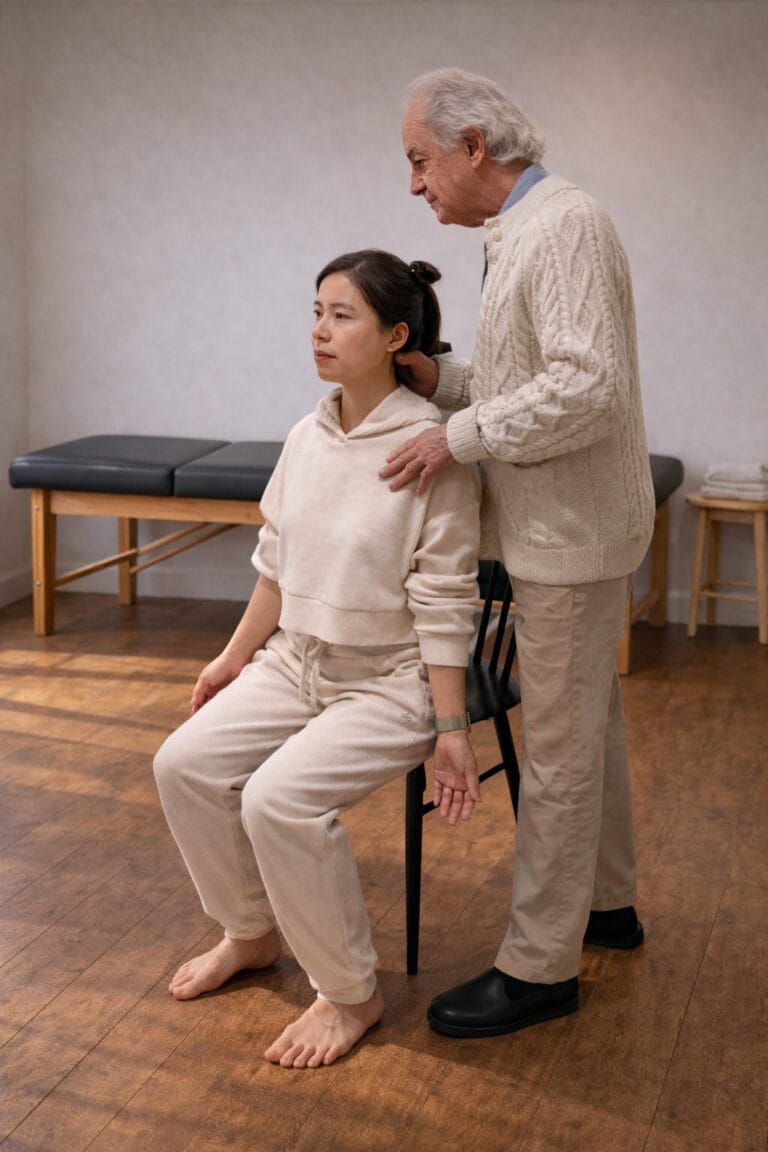
On March 19, 2025, in Boston, Massachusetts, USA, Tommy Thompson led a class in the Alexander Technique teacher training course that reframed what it means to teach. This wasn’t about posture, alignment, or even movement—it was about dialog. A sensory, embodied dialog that flows through contact, perception, and relationship.
Tommy often emphasized that teaching is a dialog—with the nervous system, with breath, even with what the trainee isn’t saying. It’s not just about what’s visible or verbal, but about staying in contact with the whole person—seen and unseen. This class wasn’t about fixing anyone. It was about being with them.
He invited trainees to stop performing teaching—and start practicing presence. The body knows what it needs. It doesn’t require correction. It needs company.
Key Objectives of the Class:
- To redefine teaching as a dialogic, sensory relationship, not a technique
- To ground trainees in presence, not performance
- To explore how the Alexander Technique supports wellness through real contact
This blog series is based on Tommy Thompson’s Alexander Technique classes. Each post follows the flow and insights of the class to expand both self-awareness and practical consciousness applicable to everyday life.
New here?
If you’re new to the Alexander Technique, you can start with the resources below.
Alexander Technique Class Flow at a Glance

1. The Opening Question
❝ What happens when you stop trying to fix someone, and start listening to how they’re already functioning? ❞
Most teacher training emphasizes what to correct, what to improve, what to change. But in this Alexander Technique class, Tommy asked something radically different. What if nothing needed fixing? What if the student’s body already held the intelligence it needed—if only we could learn how to be in contact with it, without interference?
This isn’t about stepping back. It’s about stepping in, with presence and trust, allowing the student’s nervous system to reveal its own way of organizing. Tommy didn’t teach from authority. He taught from relationship. And his question, implicitly or explicitly, was always:
“What’s already working here—and how can we support it?”
That’s the heart of this class: stop doing, start listening. Not just to the words, but to the waves of breath, balance, emotion, and presence moving through the other person.
Tommy’s Word
“The logic is: if you come here and make changes that relate to how you’re designed to function—which is to be in support while you do what you do—that’s it. You’re silent. The person is doing what they’re used to doing, but their brain isn’t being told what to do. You’ve got to trust your brain.”
This statement isn’t just technical—it’s philosophical. Tommy reframes the teacher’s role: you’re not a mechanic adjusting parts. You’re a companion noticing what wants to happen naturally, and giving it space. He reminds us that the brain doesn’t need commands—it needs support. The body, when met with safety and trust, reorganizes itself.
This is the Alexander Technique at its most profound: a re-education in trust, non-interference, and functional presence. The moment we stop trying to improve others, something in them begins to unfold.
2. Core Learnings from This Class
Core Concepts
- Teaching is an embodied dialog.
In this Alexander Technique class, teaching was not presented as something a teacher does to a trainee, but as something that happens with them. The work is not a demonstration—it is dialog: a real-time, relational process where both bodies listen, respond, and co-regulate. - Presence supports perception.
Your ability to sense what’s happening in another person begins with your own groundedness. When a teacher is truly present, the trainee’s system becomes more available. You cannot sense clearly if you’re not truly here—because the quality of your perception is shaped by your presence. - Support invites function.
Instead of trying to fix what seems wrong, this class emphasized supporting what is already working. The Alexander Technique invites us to recognize how the body is designed to function—and to let that intelligence surface through dialog, not correction. In this way, support becomes the true application of the Alexander Technique.
Five Core Principles of Dialog-Based Teaching
- Stop correcting. Start contacting.
The more you try to fix, the more the system defends. But when your hands become a space for listening, something reorganizes on its own. That is the quiet power of dialog. - Be still enough to feel.
Slowness isn’t passive. It’s how we create the space to sense. Real change in the Alexander Technique doesn’t come from action—it comes from attention in relationship. - Safety comes before technique.
If the teacher’s system isn’t regulated, the trainee will tighten in response. Comfort is not optional—it’s essential for learning. You teach nervous systems, not just people - Let the body lead.
You don’t need to be ahead of the process. Wait. Listen. Watch. Respond. Dialog means being open to not knowing—and that’s where discovery lives. - Teaching is co-practice.
In this work, the teacher is always learning. There is no endpoint. Each moment of touch, of contact, of reflection, is part of an evolving dialog that includes both people equally.
Essential Terms
Dialog
A living, sensory-based exchange between teacher and trainee. In Tommy’s class, dialog included not just touch and perception, but also verbal feedback—asking, listening, adjusting. It’s how learning unfolds in the Alexander Technique.
Contact
More than touch—it’s being with. True contact is quiet and emotionally present. It creates the condition for integration, not through pressure, but through attention.
Support
What you offer when you stop correcting. Support means meeting what’s already working in the body and accompanying it without force.
Presence
The teacher’s ability to remain grounded and receptive. Presence isn’t stillness—it’s alert, settled availability that allows safety to arise.
Function
The body’s natural design in action. Tommy emphasized that function doesn’t need help—it needs room. When you support it instead of managing it, it begins to reorganize.
Cradling
Not a technique, but a gesture of care. Cradling means holding someone in attention and love, without judgment or agenda.
Non-Interference
The discipline of letting things be. It’s not passive—it’s precise restraint that gives space for the system to show its intelligence.
3. Tommy’s Insight
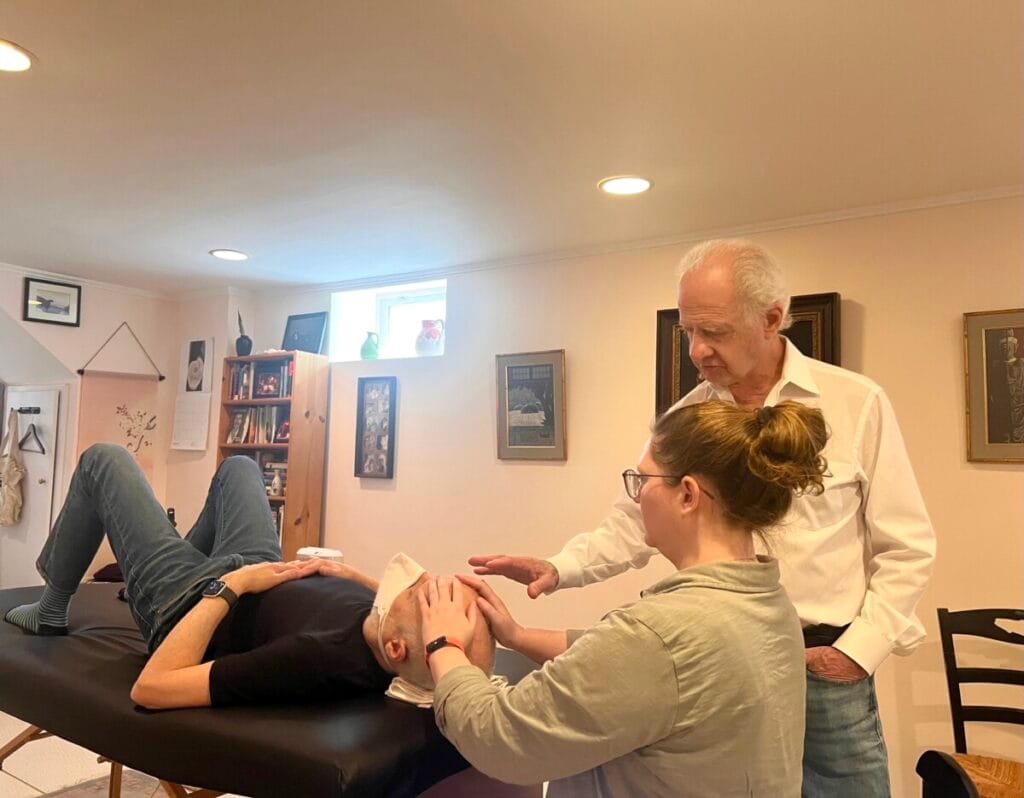
In Tommy’s words during class, there are not only the core principles of the Alexander Technique, but also practical wisdom that can be applied directly to daily life. His words go beyond simple advice about movement and prompt us to deeply consider how we choose to exist.“Dialog with your students while you’re working, so you get feedback from them. This is the place to do it—even in a regular lesson with somebody you don’t know, feedback is important. Unless you can pick up and sense everything that’s going on, feedback helps you know which decisions to make, what choices to take.”
→ Clear, verbal exchange with students enhances mutual awareness and guides more accurate, responsive teaching.
“I think everything is cradling. It’s a love affair. I’m not about words. You’re doing this out of love. There’s no criticism—it’s about helping her, and ‘her’ can be anybody—make peace with themselves, so they can be at peace with themselves.”
→ Teaching from love and non-judgment fosters the inner integration that supports healing and change.
“When you move it fast, it’s going to defend itself. When you move it really slowly, barely perceptibly, you let the muscles lengthen because you’re not triggering a stretch reflex. But in a quick moment—maybe once—I just set off a stretch reflex.”
→ The nervous system must be approached with subtlety to avoid defensive tension and enable deep release.
“If I just touch her here in a deep, meaningful way, I’ll be touching every single part of her.”
→ Intentional contact resonates through the whole system, making local touch a global experience.
“I need to make true contact right here. True contact. And again—just leave your… watch the person’s expression. You feel the whole of their body, and then ask her what she’s sensing.”
→ Real contact includes emotional presence and mutual attention, allowing embodied awareness to surface.
“The logic is: if you come here and make changes that relate to how you’re designed to function—which is to be in support while you do what you do—that’s it. You’re silent. The person is doing what they’re used to doing, but their brain isn’t being told what to do. You’ve got to trust your brain.”
→ Supporting inherent function while leaving space for autonomy respects the student’s innate intelligence.
“You have to teach from a comfort zone, because you’re instilling something sensitive in a person.”
→ Comfort in the teacher grounds the emotional and somatic safety needed for lasting learning.
“It’s a dialog between yourself and your student, and you never stop training yourself. Never, ever. I certainly haven’t. Asking your student what they’re experiencing helps both you and them, because it compels them to articulate something they don’t usually express. You want them to practice articulating kinesthetically how they’re behaving.”
→ Mutual learning deepens through shared articulation of somatic experience—this is central to the Alexander approach.
4. Practical Tips for Everyday Life
What’s the Goal?
To bring the essence of dialog from the studio into everyday moments—by meeting life with the same presence, care, and sensory attention we practice in the Alexander Technique.
How to Practice
1. Make your morning routine a dialog
As you brush your teeth, pour coffee, or tie your shoes, slow down just enough to feel.
Let each action be something you accompany, not control. Ask gently, “Is this contact? Am I here for this?”
2. Have one “non-fixing” conversation each day
Choose one interaction—at home, work, or anywhere—where you simply listen. No advice, no fixing. Just stay present with the words and with your breath. Let your silence be a form of support.
3. Touch one object as if it were a person
Pick up your phone, close a door, or wash a dish as if it were a living being. Let your hand arrive, make contact, and release without rushing. Feel the weight, the texture, the timing—just as you would with a trainee.
What You’ll Notice
You move through the day less like a performer and more like a participant. Your body becomes more responsive. People feel more at ease around you. Even in silence, dialog continues—because you’re still here.
5. Closing the Class
Key Takeaways
This class wasn’t about fixing posture, controlling form, or applying technique. It was about recognizing that teaching is a relationship—a space held between two people, where dialog unfolds without pressure.
It reminded us that the Alexander Technique is not something we do to someone—it’s something we do with them. That’s why the Alexander Technique remains a foundation not just for movement education, but for cultivating wellness through attention.
We don’t lead the body; we walk beside it.
The goal isn’t performance. The goal is presence.
Core Insights
- The nervous system learns through safety, not instruction.
- Presence creates the conditions for perception and change.
- Dialog isn’t just verbal—it’s physical, emotional, and attuned.
- You can’t teach something you haven’t embodied.
- The hands are not tools. They are extensions of your attention.
A Final Invitation
Don’t try to teach the right way. Instead, ask:
“Am I here?”
“Can I stay with what’s happening?”
“Can I let this be a dialog?”
Tommy would say, “You’re not here to change people. You’re here to be with them, and let something shift because of that being-with.”
That’s the heart of this class. And maybe, that’s not just the heart of teaching—it’s the beginning of transformation.
6. One Key Practice
Touch Without Fixing
What if your touch didn’t try to help—but simply stayed?
Choose one small action today—like closing a door or picking up a cup—and let your hand arrive without any agenda. Don’t adjust. Don’t interpret. Just stay long enough to notice what you’re sensing.
The goal isn’t to change the object, or yourself.
It’s to realize that the moment is already full of dialog, if you’re there for it.
Tommy might say, “You don’t teach by doing. You teach by being. And if your hand is being with someone, that’s enough.”
Try it—just once. And that’s where practice really begins.
7. Three Questions to Ask Yourself
These aren’t questions you rush to answer. They’re invitations to slow down, sense, and notice.
- When I reach out—do I bring presence, or do I try to manage?
Not just with people, but with objects, with yourself. What energy lives behind your touch? - Can I pause—before I explain, fix, or answer?
In the smallest interactions, a breath of space can change everything. Where can you leave room for that today? - What happens in me when I listen without needing to respond?
If I stay with the moment… can I feel my breath even as I listen?
These are not concepts. They are doorways—to embodied dialog, to connection, to real change
8. For Those Who Wish to Learn More
Recommended Book
Touching Presence – Tommy Thompson
This compact but profound book distills Tommy Thompson’s decades of teaching into a series of short texts, reflections, and embodied invitations. It doesn’t explain what to do—it shifts how you relate to doing.
What makes Touching Presence deeply relevant to this class is its unwavering focus on contact as relationship, and presence as the foundation of teaching. Just like in the March 19 class, the book does not instruct from above—it engages from alongside.
Tommy speaks not in abstraction, but in direct, sensory language. Each page feels like an extension of the same dialog explored in class: a call to notice, to stay, to feel.
“You will understand what it means, when you become what it means.”
— Tommy Thompson
If this class asked you to stop fixing and start sensing, this book shows you how to live that orientation—moment by moment, body to body, with attention as the only instruction.
Official Website of Tommy Thompson
www.easeofbeing.com
This is the official website personally managed by Tommy Thompson, offering a wide range of resources and programs to deepen your understanding and practice of the Alexander Technique:
- Private session reservations and inquiries
- Workshop and seminar schedules
- Overview of international teacher training programs
- Essays and articles on the Alexander Technique
9. Next Class Sneak Peek
What if the most powerful kind of change happens—
not when you try, but when you let go?
Next class isn’t about learning to fix anyone. It’s about discovering how connection happens when you stop trying—and start listening. This is where Tommy takes us deeper: into the intelligence of touch, breath, and presence.
In Class 52, we’ll explore:
- How being touched—not physically, but relationally—can reset the whole system
- Why trying to help often gets in the way of actual change
- What it means to offer yourself fully in the moment, without losing yourself
This is where connection becomes real. Not applied. Just received.
10. Join the Alexander Technique Journey
Did this class leave a small resonance within you? Feel free to quietly hold it in your heart or share it in just a sentence or two. The comments are always open. Your one simple word may leave a gentle ripple in this ongoing journey.The journey of Resonance Flow continues across social media as well. Let’s continue this journey together.
 YouTube
 Instagram
 Threads
 Facebook