Beyond Use: Why Alexander Technique Teaching Begins with Perception, Not Correction | Tommy Thompson Class 86
❝What changes when you stop trying to know me—and choose to see me, in the Alexander Technique?❞
Most people come to the Alexander Technique to improve their use—to move with less strain, to sit and stand with more ease, to feel freer in their bodies. That work matters. It works.
But in this class, a quieter and more demanding question emerges.
What if the real work of teaching begins not with correction, but with perception?
What if the teacher’s biggest habit isn’t looking for physical tension, but deciding too quickly what a student is like—before really seeing them?
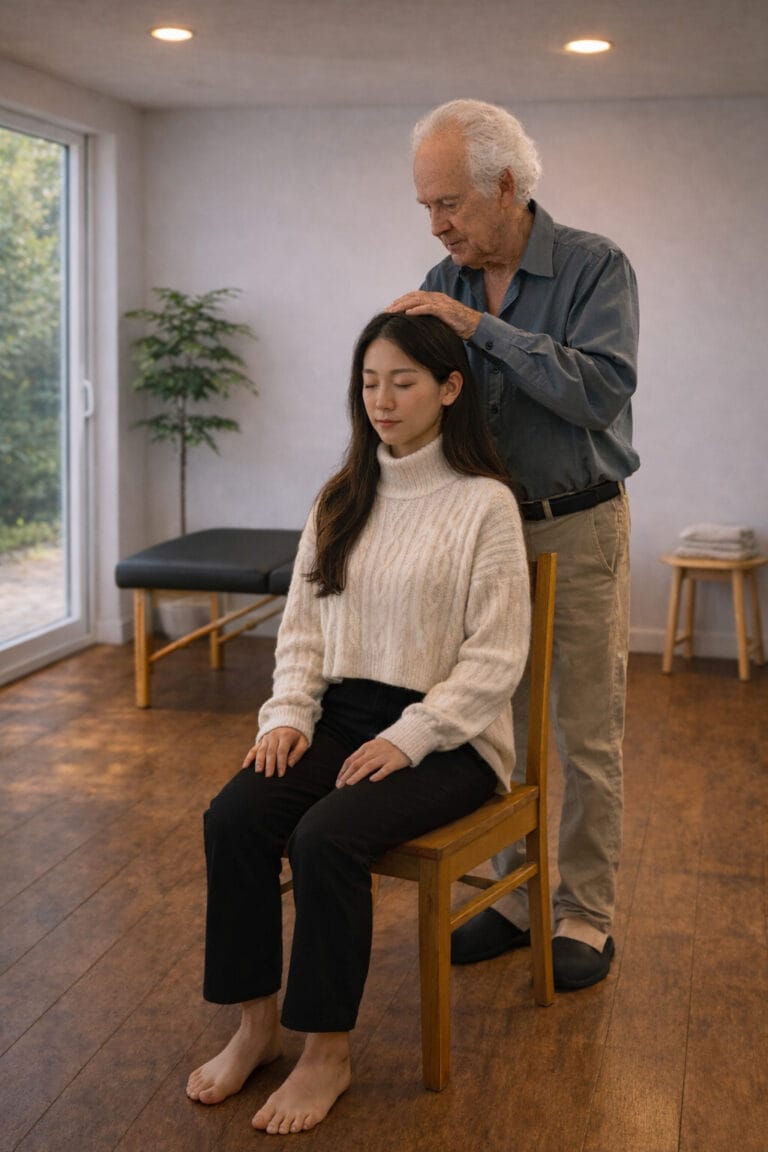
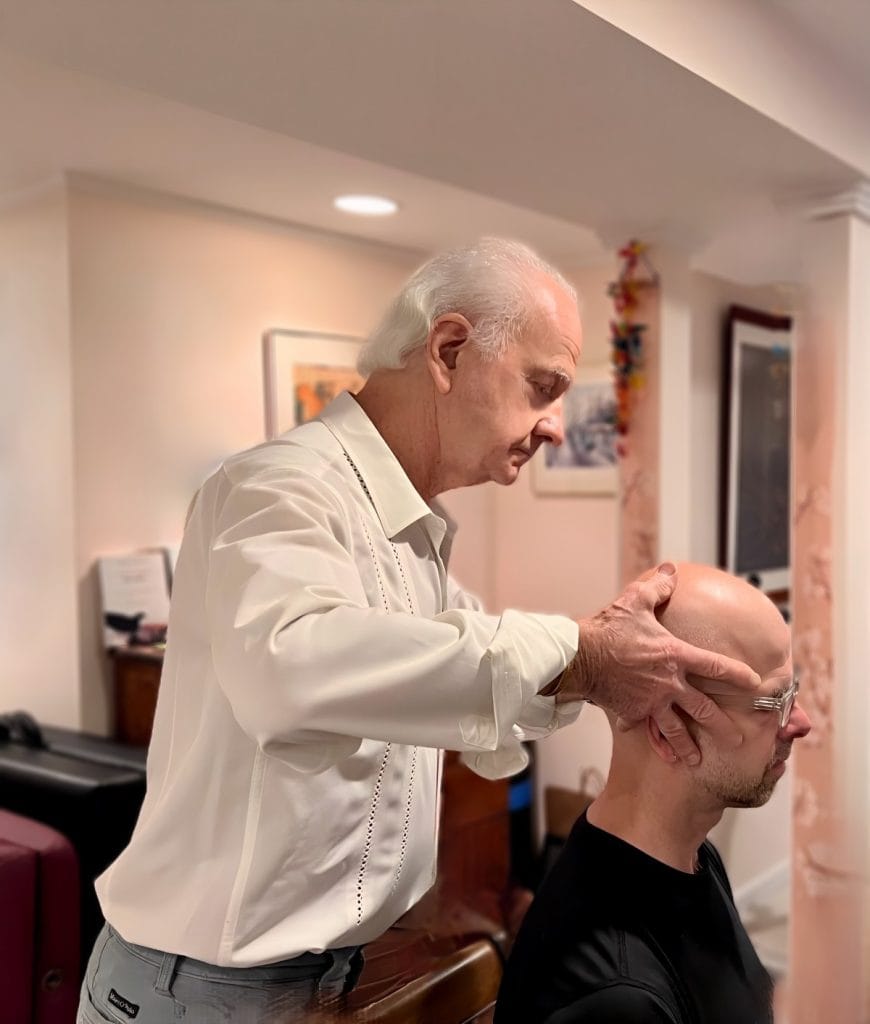
On October 28, 2025, in Boston, Massachusetts, USA, Tommy Thompson led a class in the Alexander Technique teacher training course that began simply: sitting together, looking carefully at two photographs. No fixing. No explaining. Just time, attention, and restraint.
What unfolded was a study in responsibility—how identity shapes coordination, how personal narrative alters touch, and how teaching asks us to look at ourselves first.
This was not a class about abandoning use.
It was about recognizing its limit—and stepping Beyond Use, where perception stays alive and accuracy begins with not deciding too soon.
Key Objectives of the Class:
- To recognize how “use” can improve while deeper identity patterns quietly keep repeating
- To practice withholding immediate conclusions so perception can stay alive and responsive
- To notice how personal narrative changes the teacher’s hands, words, and timing
- To clarify the ethical responsibility of the teacher: precision of influence rather than control of outcomes
This blog series is based on Tommy Thompson’s Alexander Technique classes. Each post follows the flow and insights of the class to expand both self-awareness and practical consciousness applicable to everyday life.
New here?
If you’re new to the Alexander Technique, you can start with the resources below.
Alexander Technique Class Flow at a Glance
1. The Opening Question
❝ Are you seeing the person—or the meaning you’ve already assigned to them?❞
This question sits at the heart of this class—not as philosophy, but as a real demand placed on the teacher.
In the Alexander Technique, perception is never neutral. The moment a teacher decides what they are seeing, that decision begins to organize the hands, the timing, and the direction of the work. Touch follows meaning.
What this class reveals is simple and unsettling:
teaching does not begin with changing another person—it begins with interrupting the teacher’s own certainty.
Again and again, Tommy returns to this insistence: The ability to pause a conclusion, even briefly, creates a different field of contact. In that pause, something else can appear.
This is where the work moves Beyond Use—not by rejecting use, but by recognizing its limit, and allowing perception to stay alive.
Tommy’s Word
“I will never seek to know you. I will always long to see you.”
This is not poetry. It is instruction.
To seek to know is to finalize perception.
To long to see is to keep the work human.
2. Core Learnings from This Class
In this moment from Tommy Thompson’s class, the focus shifts from improving “use” to perception. Instead of correcting the body, the teacher begins to question what they are actually perceiving.
Watch how this simple shift—what are you really touching?—allows the organism to respond and reorganize differently.
What Are You Really Touching? This Changes Everything in the Alexander Technique
Class 86 · October 23, 2025 · Boston, MA
This class reframes teaching in the Alexander Technique not as the application of skill, but as an ongoing act of perception and responsibility. What emerges is not a new technique, but a clearer understanding of where change actually begins.
Core Concepts
- Use is shaped by identity.
Patterns of coordination do not arise in isolation. How a person understands who they are—often unconsciously—organizes how they use themselves long before choice or correction enters. - Withholding a finding transforms perception.
When a teacher pauses an immediate conclusion, even briefly, perception stays responsive. That pause changes not only what is seen, but how contact unfolds. - Personal narrative reorganizes touch.
Seeing someone as depressed or contemplative is never neutral. Meaning alters the hands, the timing, and the direction of the work before any technique is applied. - Self-observation is an ethical requirement of teaching.
A teacher cannot see another clearly without including themselves in the field of observation. Responsibility begins with how one is seeing. - Inward listening allows intelligence to emerge.
Rather than directing change outwardly, allowing contact to move inward supports organization to arise from within the person.
Five Key Messages
- Teaching begins before the hands move.
- Meaning organizes touch.
- Certainty is the first habit to interrupt.
- Perception carries responsibility.
- Change appears when definition pauses.
Essential Terms
- Withholding a finding
The disciplined practice of suspending immediate interpretation so perception can remain alive, responsive, and accurate. - Personal narrative
The story we automatically tell ourselves about ourselves before we are aware of it, shaping how we use ourselves, how we touch, and the direction of our teaching. - Use
The functional coordination of the whole self, never neutral and always influenced by identity, perception, and narrative. - Inspansion
A form of inward contact that listens rather than directs, allowing organization and change to arise from within the organism. - Responsibility
Not control over another person’s outcomes, but accuracy in how one’s perception, words, and hands affect another—and in the willingness to observe oneself in that process.
3. Tommy’s Insights
In Tommy’s words during class, there are not only the core principles of the Alexander Technique, but also practical wisdom that can be applied directly to daily life. His words go beyond simple advice about movement and prompt us to deeply consider how we choose to exist.1. The function is on use, and it’s exceptional as the Alexander Technique. And the other is the simple fact that there’s a way of developing patterns of use that are not favorable to your life without being connected to the evolution of your own sense of identity, who you are.
➤ Tommy establishes use as the functional ground of the work, while simultaneously pointing to its limitation when separated from the ongoing formation of identity.
2. The story is based on who we perceive ourselves to be as a story, and that’s our identity. And you develop corresponding patterns of use that are associated with that, and you do it, usually unconsciously, sometimes consciously, and it’s not good for you.
➤ Here, personal narrative is revealed as the silent architect of coordination, shaping use long before conscious choice enters the picture.
3. It’s a mark of an Alexander teacher who sees the immediate but is able to withhold a finding just for a second and see what else might come up. Because seeing her depressed is moving into the personal narrative. Seeing her contemplative is also moving into the personal narrative. You will touch differently. You will touch her differently if you see her depressed than you will if you see her contemplative. You can’t do or say anything wrong in this exercise.
➤ Teaching becomes an act of perceptual restraint, where the quality of touch follows the meaning the teacher assigns to what they see.
4. An Alexander teacher can’t look and see what they need to see without looking at themselves to some degree. That’s what separates us from the medical world and all kinds of worlds. You’re willing to look at yourself as deeply as you are willing to look at someone else. You’re willing to come up with a perception of somebody else’s life no different than you’re willing to look at the perception of your own life.
➤ Self-observation is presented not as self-reflection but as an ethical requirement of seeing another person clearly.
5. When you change the teacher’s pattern of use—if the teacher changes their own pattern of use because they’re not certain of the definition that they have of the person they’re working with, and are willing to give that person a little bit more chance to show up in a different way—they work on themselves to change that perception.
➤ Uncertainty becomes a productive force, allowing perception to reorganize rather than collapse into fixed definition.
6. The exercise is: how do you really train yourself to teach more than use? There’s nothing wrong, I don’t think, in just improving a person’s use. They’ll do what they will in their life. You’re not responsible for their life. But you are responsible—I think we are responsible—you and I, I am responsible, I’ll just say that—for how what I say and what I do affects another person. Yeah, I am responsible for that. And I want to be as accurate as I can be. And I can only be as accurate depending on how much I’m willing to study me.
➤ Responsibility in teaching is framed as precision of influence rather than control over outcomes.
7. When you inspansion, I’m—no signs of approval from you—you move into and through a whole web of cellular consciousness. And as you do that, you are being spoken to. You’re spoken to at a deeper level of that person’s being, because their cellular consciousness understands exactly what needs to be happening with this person.
➤ Inspansion names a form of contact that listens inwardly, trusting the organism’s own intelligence to articulate its needs.
8. I will never seek to know you. I will always long to see you.
➤ This line encapsulates Tommy’s refusal of definition in favor of an ongoing, living perception of the person in front of him.
4. Practical Tips for Everyday Life
This class does not ask you to add a practice to your life.
It asks you to remove what you add too quickly.
What’s the Goal?
The goal is not better use or correct movement.
The goal is to pause definition long enough for perception to stay alive.
How to Practice
- In everyday movement
When you sit, stand, or walk, notice the urge to adjust. Don’t correct it. Pause for a second and let the movement happen without improving it. - In moments of discomfort
When tension appears, resist naming it as a problem. Stay with the sensation without deciding what it means. See what changes when interpretation stops. - In relationship
Notice the story you silently tell about another person. Pause that story, even briefly. Let your response come from what you actually see, not what you assume.
What You’ll Notice
Movement becomes simpler. Reactions soften.
Most importantly, responsibility shifts—
from fixing yourself or others to staying accurate in how you see.
That shift allows the work to move Beyond Use, not as a technique, but as a way of living.
5. Closing the Class
Key Takeaways
This class makes one thing clear: improvement alone is not the measure of good teaching.
- Use can change while deeper identity patterns remain untouched.
- Perception organizes touch before technique begins.
- Responsibility lives in how the teacher sees, pauses, and responds.
What matters most is not what is done to another person, but what the teacher is willing to interrupt in themselves.
Core Insights
Tommy Thompson returns to a simple but demanding truth: teaching is an ethical act. Every word, every hand placement, every moment of timing carries consequence.
Accuracy does not come from certainty. It comes from restraint.
When definition pauses, perception stays alive. When perception stays alive, something larger than habit has room to appear.
This is where the work moves Beyond Use—not away from use, but into a wider responsibility for how meaning and contact are formed.
A Final Invitation
This class does not ask you to become better at fixing.
It asks you to become more precise in seeing.
Pause before you define.
Stay a moment longer with what you see.
Let teaching—and living—begin there.
6. One Key Practice
Choose one ordinary movement today.
Pause for a second before you act.
Do not improve it. Do not correct it. Do not decide what it is.
Let the movement happen while meaning waits.
That pause is the practice.
Small enough to do anywhere, deep enough to shift how you move and how you meet your life Beyond Use.
7. Three Questions to Ask Yourself
- What am I already deciding about this moment?
(And can I let that decision wait?) - What changes when I stay with what I see—just a little longer?
- Am I responding to what is here, or to a story I’ve already told?
These are not questions to answer.
They are questions to return to—again and again—until perception stays alive and choice becomes possible.
8. For Those Who Wish to Learn More
Recommended Book
Touching Presence – Tommy Thompson
This book is the clearest written extension of this class. Touching Presence is not about technique, but about the quality of perception that precedes it—and the responsibility that arises the moment we place our hands on another person.
Throughout the book, Tommy returns to the same central question explored here: what are we really touching when we touch someone? Beyond structure or habit, he points toward identity, meaning, and presence, inviting the reader to slow interpretation and allow the person to appear without definition.
For those moving Beyond Use, this book reframes teaching as an act of perception rather than correction, and touch as listening rather than control—extending the work from the classroom into daily life.
Official Website of Tommy Thompson
www.easeofbeing.com
This is the official website personally managed by Tommy Thompson, offering a wide range of resources and programs to deepen your understanding and practice of the Alexander Technique:
- Private session reservations and inquiries
- Workshop and seminar schedules
- Overview of international teacher training programs
- Essays and articles on the Alexander Technique
9. Next Class Sneak Peek
The next class turns toward a fundamental question:
what it actually means to live and act in Coexistence with the nervous system, rather than merely understanding the idea.
Attention shifts from technique to relationship—from directing change to recognizing how coordination organizes itself when interference falls away.
It is a class that quietly asks whether presence itself can become the ground of use.
In Class 87, we’ll explore: Coexistence as a lived practice—consciously aligning with the brain’s directive in movement, perception, and action.
10. Join the Alexander Technique Journey
Did this class leave a small resonance within you? Feel free to quietly hold it in your heart or share it in just a sentence or two. The comments are always open. Your one simple word may leave a gentle ripple in this ongoing journey.The journey of Resonance Flow continues across social media as well. Let’s continue this journey together.
 YouTube
 Instagram
 Threads
 Facebook