Embodied Initiation: What If You Moved From Who You Are Now? | Tommy Thompson Class 65
❝ What if the most important thing you do today is… not move? ❞
What if you paused—really paused—before taking that next step? Not to stretch. Not to decide. But to simply stand still, letting your body tell you who you are now.
On April 23, 2025, in Boston, Massachusetts, USA, Tommy Thompson led a class in the Alexander Technique teacher training course that revolved around a deceptively simple premise: don’t move yet. Just stand. Let the system quiet. In that moment of stillness, something begins to change—your sense of direction, your perception, even the way your feet meet the floor. This is what This is what can be understood as Embodied Initiation, based on Tommy’s teaching.
To the outside eye, nothing is happening. But inside, everything is. The spine reorganizes. The nervous system resets. You’re not walking from memory. You’re walking from presence. This is not just movement. It’s the beginning of a new way of sensing and responding.
Key Objectives of the Class:
- To explore how Embodied Initiation shifts habitual movement into conscious presence
- To recognize standing as an active state of reorganization, not passivity
- To learn how movement, perception, and touch emerge from who we are now, not from who we’ve been
This blog series is based on Tommy Thompson’s Alexander Technique classes. Each post follows the flow and insights of the class to expand both self-awareness and practical consciousness applicable to everyday life.
New here?
If you’re new to the Alexander Technique, you can start with the resources below.
Alexander Technique Class Flow at a Glance

1. The Opening Question
❝ Are you moving from who you are now—or from who you’ve always been? ❞
Most of us move automatically. We walk, reach, respond—driven by habit, not awareness. But what if you paused before that next step? Not to prepare, but to wait. To let something shift inside. In this class, Embodied Initiation asks: Can you let the body move from presence, not memory?
This shift is the core of the Alexander Technique: choosing to not react. To stand. To not define. And in that stillness, something new organizes. You’re no longer repeating; you’re responding.
Tommy’s Word
“You’re going to withhold defining yourself the way that you usually take a walk, and just stand there while you inhibit reacting to the stimulus to walk. And as you stand there, the brain is reorganizing you without you even knowing it, because you’re not asking it to do what you’ve told it to do so many other times. Stand there and do that. And then walk from who you are now.”
➤ Tommy’s words offer a simple challenge: stop defining how you move—and let something else emerge. This is where coordination shifts. When you stand without reacting, the system listens. And movement becomes an act of presence.
2. Core Learnings from This Class
Core Concepts
- Movement that starts in stillness
You don’t improve the old movement—you wait for the new one to emerge. This is the heart of Embodied Initiation. - Stillness is not passive—it reorganizes
Standing is the start of coordination. No fixing, no controlling. Just inhibiting long enough to let something shift. - Perception precedes motion
When you stop reacting, you start noticing. You see and hear differently—and movement follows that expanded awareness. - Touch is whole-body communication
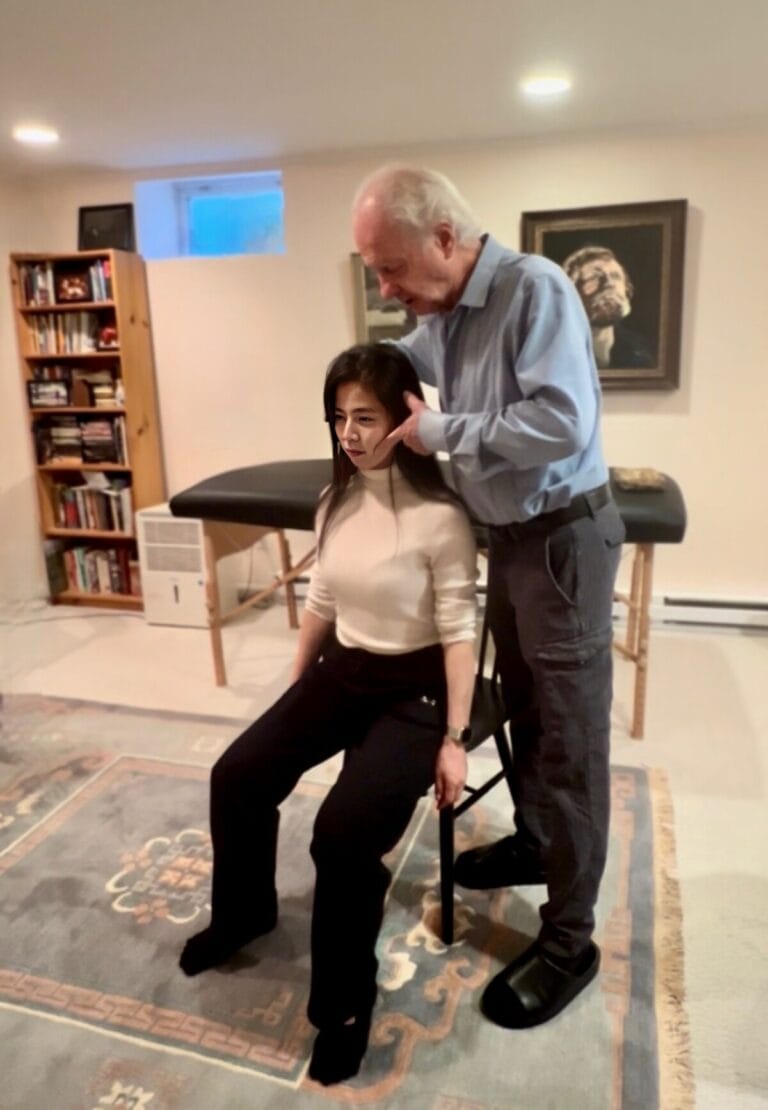
Real contact doesn’t come from the hand—it comes from the self. When your arms are supported by the back, touch becomes connected and intentional.
Five Key Messages
- Pause before movement—so something else can begin
Standing still interrupts the pattern and makes space for new coordination. - Don’t fix—inhibit
It’s not about trying to get it right. It’s about not doing what you always do. - Let perception reorganize the moment
Stillness shifts how you see, feel, and act. - Touch starts in the back—not the fingers
When the back leads, the arms follow naturally, and contact becomes alive. - Walk from who you are now—not who you’ve been
This isn’t just walking. It’s a real-time exploration of identity in motion.
Essential Terms
- Withholding Definition
The conscious act of not defining your movement before it begins. This allows the body to reorganize without reverting to habitual patterns. - Standing as Reorganization
Standing isn’t static. It’s a live process in which the nervous system resets and aligns—without needing to “do” anything. - Walk from Who You Are Now
Tommy’s core instruction: move from present awareness, not remembered movement. Each walk becomes a reset. - Perceptual Shift
A change in how you experience sound, sight, and sensation when you stop reacting. New awareness leads to new coordination. - Hands Belonging to the Back
True touch originates in the back, not the hand. When the back supports the arm, the whole self becomes involved in the contact.

3. Tommy’s Insight
In Tommy’s words during class, there are not only the core principles of the Alexander Technique, but also practical wisdom that can be applied directly to daily life. His words go beyond simple advice about movement and prompt us to deeply consider how we choose to exist.“To explore more of who you can be before you walk, stand there. Let your neck be free and your head move away from the body, forward enough. Let your back lengthen and widen—not doing anything or totally defining the way you usually walk. Standing still, something will happen within you.”
→ Allowing the system to quiet before action reveals the potential for conscious choice over habitual movement.
“You’re going to withhold defining yourself the way that you usually take a walk, and just stand there while you inhibit reacting to the stimulus to walk. And as you stand there, the brain is reorganizing you without you even knowing it, because you’re not asking it to do what you’ve told it to do so many other times. Stand there and do that. And then walk from who you are now. Walk now.”
→ Inhibition creates space for an updated coordination pattern to emerge—one based on present awareness, not past repetition.
“Everything is familiar to you—you take note of the different experience you have when this is integrated through here. And the path might look different. Mountains might look different. And you can be different. It’s more present with what is.”
→ Familiarity often blinds us to change, but embodied awareness brings freshness to even the most known landscapes.
“The mountain looks like it doesn’t change. But day by day, hour by hour, the dirt changes. Everything changes, of course—being affected, somewhat changing. Still dirt, still air, but all is changing. And you’re wanting to be as present as humanly possible. So this is your experience you’re having.”
→ Noticing subtle shifts in the environment deepens presence and reveals the impermanence within the seemingly stable.
“You’re not committing yourself to an action except standing. And standing is a different experience. Perception is a different experience. Your sight is differently experienced. Sound is differently experienced. Are you letting all of that register? And then you commit yourself to what you know, which is to walk from where you are—from the experience you’re having. You—you can do this in your morning routine of exercising.”
→ Stillness offers a recalibration of the senses, creating a gateway for embodied, responsive action.
“When you take a walk from where you are, walk from the experience you’re having now. Don’t just walk the way that you remember walking. Do it from the experience you’re having, because it might be different.”
→ Every moment presents a new internal condition; authentic movement arises only when we respond from that living present.
“You free your wrists in and elbows out and down and belong to your back. And then it just goes everywhere. It goes all the way down through your whole body.”
→ True release is systemic; when limbs reconnect to the back, the whole self participates in movement.
4. Practical Tips for Everyday Life
What’s the Goal?
To shift your actions—walking, reaching, touching—away from habit and into present awareness. Embodied Initiation is not about doing more. It’s about starting differently.
How to Practice
1. Stand before you act
Before walking, pause. Let your neck be free and your head move away from the body, forward and up. Don’t define the next step. Just stand. Let your body begin to speak.
2. Inhibit during routines
While brushing your teeth or tying shoes, notice the impulse to rush. Don’t fix anything. Just wait. Let movement come from now.
3. Let your hands come from your back
Drop your elbows and soften your wrists. Feel your back before your hand. Even holding a glass becomes a whole-body event.
What You’ll Notice
- Calm where there used to be rush
- A shift in sensation—less effort, more clarity
- Touch that feels like listening
- Movements that reflect you now
- A quiet sense of wellness throughout daily life
5. Closing the Class
Key Takeaways
This class wasn’t about walking better. It was about not walking—yet. To pause. To stand. To let the body reorient before the mind interferes. To let something move in you before you decide to move.
The instruction was simple but radical: withhold, stand, notice. And when you stop preparing to be yourself, you begin to discover who you are now. You don’t just shift your body. You shift the story you’re telling—with your body.
Core Insights
As Tommy often reminded the class:
“You’re not committing yourself to an action except standing. And standing is a different experience. Perception is a different experience. Your sight is differently experienced. Sound is differently experienced. Are you letting all of that register?”
Stillness isn’t absence. It’s not empty. It’s alive. Intelligent. A place where your system begins to listen—without being told.
You meet your own timing, your own coordination, a quieter story waiting. And in that moment, something in you changes. Not because you fixed it, but because you finally let it move.
A Final Invitation
Stand still. Inhibit. Don’t define.
Let the experience of who you are now be enough to move.
This isn’t just technique. It’s how you meet your day—with presence.
6. One Key Practice
Before you walk—stand
Don’t adjust. Don’t fix. Just stand there. Let your neck be free. Let your head move slightly forward and up. Feel your feet.
Wait.
Don’t define how to move. Don’t plan the step.
Let the experience of standing begin to move you.
And when it does, walk—not from habit, but from the you that’s standing there now.
That’s the whole practice. One moment. Every day.
7. Three Questions to Ask Yourself
1. Am I moving from memory—or from what I’m sensing now?
When you begin to walk, reach, or speak—what’s leading the action? Habit or presence?
2. What happens when I don’t define the next move?
Can you stand still long enough to let your system suggest a different beginning?
3. Is my touch connected to my back—or just my hand?
Whether touching someone or holding something—where is the contact starting from in me?
8. For Those Who Wish to Learn More
Recommended Book
Touching Presence – Tommy Thompson (with Rachel Prabhakar)
This is not just a book—it’s a distillation of over 50 years of Tommy’s teaching. In Touching Presence, you’ll find the very language, rhythms, and principles explored in this class: withholding definition, standing as reorganization, and moving from presence, not pattern.
What makes this book unique is that it doesn’t teach posture—it invites you into a new way of being. Through personal stories and practical insights, Tommy shows how stillness, intention, and perception change not just movement, but identity.
If this class opened the door to Embodied Initiation, this book helps you stay there longer—with awareness, care, and choice.
Official Website of Tommy Thompson
www.easeofbeing.com
This is the official website personally managed by Tommy Thompson, offering a wide range of resources and programs to deepen your understanding and practice of the Alexander Technique:
- Private session reservations and inquiries
- Workshop and seminar schedules
- Overview of international teacher training programs
- Essays and articles on the Alexander Technique
9. Next Class Sneak Peek
In Class 66, we’ll take Intention into motion — sustaining it as we walk with someone and guiding without pulling or pushing.
We’ll bring stillness into movement, exploring triadic resonance and “casting the spider web” on the move to show how minimal touch can deliver maximum clarity, even over distance.
“Can you let your direction travel with them — without pulling, pushing, or proving?”
In Class 66, we’ll explore:
- Maintaining Intention while moving with another person.
- Coordinating head–neck–body alignment in motion.
- Using energetic connection, not physical force, to communicate direction.
10. Join the Alexander Technique Journey
Did this class leave a small resonance within you? Feel free to quietly hold it in your heart or share it in just a sentence or two. The comments are always open. Your one simple word may leave a gentle ripple in this ongoing journey.The journey of Resonance Flow continues across social media as well. Let’s continue this journey together.
 YouTube
 Instagram
 Threads
 Facebook