Support Revealed: How the Alexander Technique Unlocks Natural Uprightness | Tommy Thompson Class 70
❝ Are you truly supported when you move through life, or are you carrying yourself as if the ground beneath you has disappeared? ❞
Most people never stop to ask themselves this question. Yet it strikes at the very heart of the Alexander Technique. On September 3, 2025, in Boston, Massachusetts, USA, Tommy Thompson led a class in the Alexander Technique teacher training course, reminding every trainee that the key is not to manufacture support but to recognize it. Support is not a muscular trick. It is the given design of the human organism—our birthright in relationship with the earth.
Tommy’s classes are never abstract lectures; they are living encounters. He invites you to pause, to notice, to suspend the rush of identity, and in that brief suspension, to discover a freedom that was always waiting. This class was no exception. What unfolded was a series of insights, questions, and experiences that revealed how deeply our sense of support governs everything about the way we move, breathe, and live.
Key Objectives of the Class:
- To rediscover support not as effort but as an innate design.
- To understand the head–neck relationship as the primary gateway to coordination.
- To explore how withholding self-definition awakens new possibilities of movement.
- To experience touch as receptivity—an invitation to wholeness, not correction.
- To extend the discoveries of the Alexander Technique into daily life and ordinary activity.
This blog series is based on Tommy Thompson’s Alexander Technique classes. Each post follows the flow and insights of the class to expand both self-awareness and practical consciousness applicable to everyday life.
New here?
If you’re new to the Alexander Technique, you can start with the resources below.
Alexander Technique Class Flow at a Glance

1. The Opening Question
❝ How do you know if you are truly in support, or if you are only holding yourself together by habit? ❞
This question cut straight to the heart of the class. It was not about posture in the superficial sense, but about how the organism relates to the ground, to itself, and to the world. The moment you ask honestly, you begin to notice the difference between straining to hold up and recognizing support as something already given.
The central question captured the essence of the class: the Alexander Technique does not ask you to build a new structure—it asks you to uncover what was there from the start.
Tommy’s Word
“You’re designed to be in support. If you ask most people whether or not they feel supported when they walk and run and do this or not, why would you say something’s wrong? Because they’re not using themselves. You are. You’re designed to function in relationship to the earth around. You’re designed to be fully upright.”
Tommy reminded us that people often abandon their own design, replacing natural support with effort. This work is not about correction but about allowing the original design to reappear—freedom that comes when you stop forcing and start receiving.
2. Core Learnings from This Class
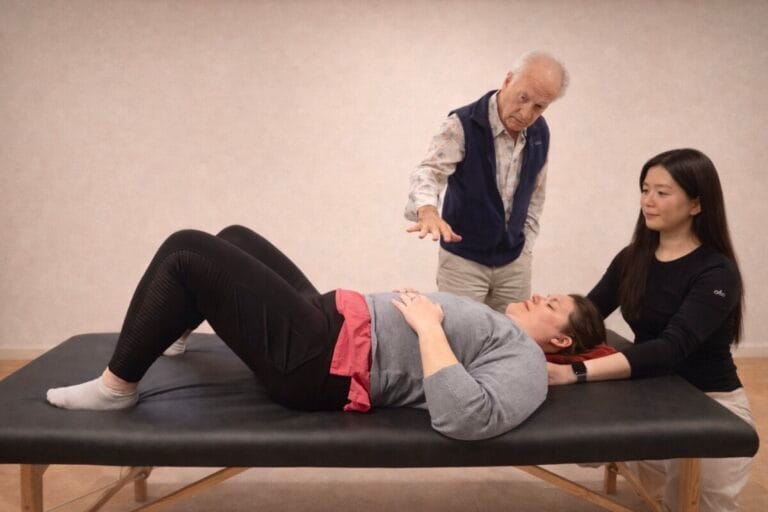
In this moment from Tommy Thompson’s class, trainees explore the practice of withholding definition.
Rather than reacting to what they think they see, they pause long enough for perception to change and awareness to become clearer.
In this moment from Tommy Thompson’s class, trainees explore the practice of withholding definition.
Rather than reacting to what they think they see, they pause long enough for perception to change and awareness to become clearer.
Watch how this simple shift allows the organism to reorganize and respond differently.
Alexander Technique: Are You Seeing People or Defining Them?
Class 71 · September 4, 2025 · Boston, MA
Core Concepts
- Support is innate
Support is not something you create through effort; it is already given in your relationship with the ground. The Alexander Technique is about recognizing, not manufacturing, support. - Head–neck relationship governs the whole
The freedom or tension in this relationship determines coordination throughout the body. It is the primary gateway to uprightness. - Withholding self-definition awakens freedom
By pausing before defining yourself, the brain no longer obeys old patterns. In that moment, integrity and ease re-emerge.
Five Key Messages
- Support is about allowing, not holding.
- Head–neck freedom organizes the whole self.
- Touch communicates love and acceptance, not correction.
- Everyday actions are opportunities for discovery.
- Inhibition means withholding self-definition, not resisting life.
Essential Terms
Support
The natural, given relationship with the ground. Not manufactured by effort, but recognized when you allow uprightness.
Head–neck relationship
The pivotal coordination that governs the whole organism. When free, it restores the body’s original design.
Total use
Awareness of the person as a unified whole. Freedom in one part transforms the entire self.
Inhibition
The act of withholding self-definition. Not stopping movement, but suspending the habitual identity that narrows possibility.
Touch
Non-manipulative contact received by the organism. It communicates love and acceptance, awakening receptivity and wholeness.
3. Tommy’s Insights
In Tommy’s words during class, there are not only the core principles of the Alexander Technique, but also practical wisdom that can be applied directly to daily life. His words go beyond simple advice about movement and prompt us to deeply consider how we choose to exist.“You’re designed to be in support. If you ask most people whether or not they feel supported when they walk and run and do this or not, why would you say something’s wrong? Because they’re not using themselves. You are. You’re designed to function in relationship to the earth around. You’re designed to be fully upright.”
→ In Alexander Technique work, support is not manufactured but recognized: it is the natural alignment of the self in relation to the ground, available whenever we allow uprightness to emerge.
“Whatever you’re doing with your head and neck, relative to the rest of the body, is going to show up closely in the way you’re designed to function, or not function. And everything comes from that relationship.”
→ The head–neck relationship governs the coordination of the whole; when it is free, the organism can function according to its original design.
“We’re teaching the value of understanding the head–neck relationship, and how it affects the total use of the person.”
→ Alexander Technique is not about fixing parts but about cultivating awareness of this pivotal relationship, which transforms the total use of the self.
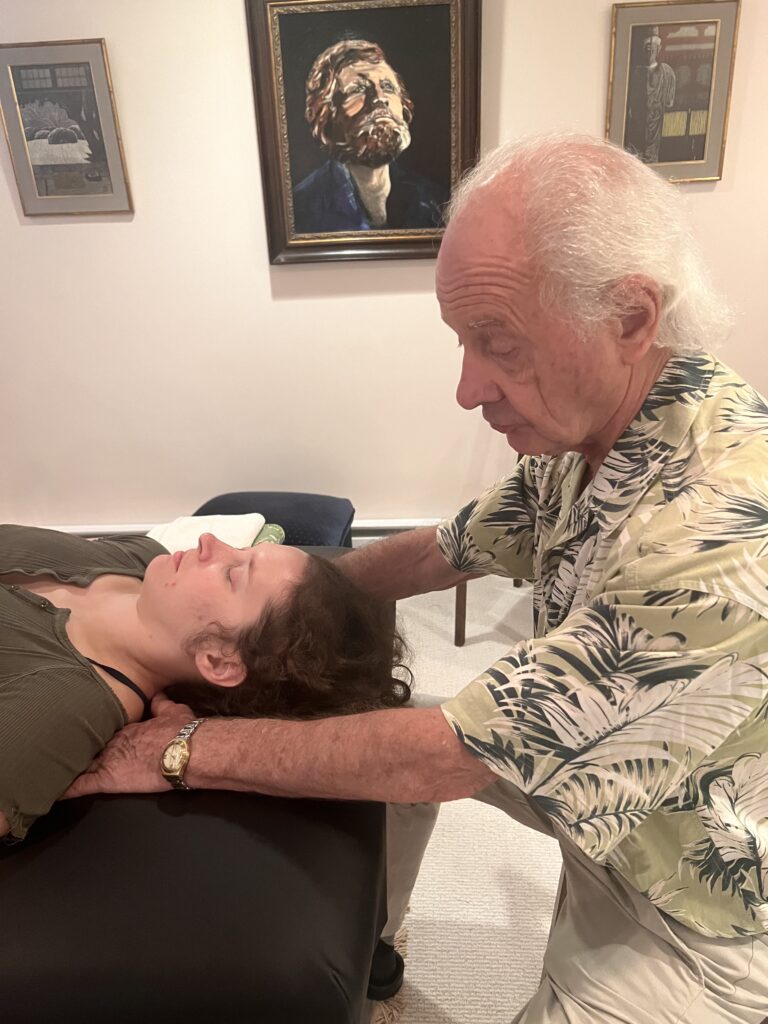
“When I put my hand on the organism, it’s to be received. You are designed to receive that non-manipulative touch.”
→ Hands in this work do not impose; they invite. The touch is a conversation with the nervous system, awakening the capacity to respond rather than to resist.
“The body is designed to receive that touch. And that touch is love. That touch is acceptance. That touch is designed to enable you to respond more completely to a given circumstance, in a complete and whole way.”
→ Touch here becomes a medium of unconditional acceptance, reminding the body of its wholeness and enabling a fuller, more integrated response to life.
“How do you bring the principles and concepts of the Alexander Technique into the activities of your life? First of all, you might think about what you discover, as much as you think about freeing your neck.”
→ The Technique is a practice of discovery. Each activity—however ordinary—becomes an opportunity to notice, to release, and to allow freedom into movement.
“If you can withhold defining yourself, just for a brief moment— It doesn’t mean you won’t define yourself, just that you’re withholding— In that moment, the brain knows it doesn’t have to obey what you usually do. And it does what it’s designed to do. And the whole of your neuromuscular–skeletal integrity comes alive—Because you allowed it to come alive— Because you didn’t totally define yourself as the person who had previously defined herself.”
→ By suspending the habitual definition of self, we free the brain from compulsion. This pause opens the space for the neuromuscular system to function as it was designed.
“The habituation of ourselves conditions it to expect and perform the way we’ve trained it to. By withholding the definition, just for a moment— From the moment you moved, the organism actually started doing more of what it’s designed to do.”
→ Habituation narrows possibility, but a moment of non-definition allows the organism to reawaken its innate adaptability and freedom.
4. Practical Tips for Everyday Life
What’s the Goal?
You’re not here to fix yourself—you’re here to rediscover what is already given. Support is not effort or holding; it is design. The goal is simple: let ordinary life become your practice. Every step, every reach, every breath can reveal the Alexander Technique at work.
How to Practice
Pause before you move. Notice the ground—it is already supporting you.
Then allow the head–neck relationship to be free. Let the neck lengthen, let the head move away from the body, and trust that the head will find its place as designed.
Don’t force, don’t correct, don’t try. Simply withhold the old habit and allow.
From there, walk, sit, or reach—not as someone holding it all together, but as someone designed to receive.
What You’ll Notice
At first, it may feel unusual—lighter, less controlled, almost uncertain. But soon you notice freer breath, less strain, and an uprightness that costs you nothing. This is wellness: not something added to your life, but your life itself when you stop fighting support and start living in it.
5. Closing the Class
Key Takeaways
As the class drew to a close, Tommy reminded us: “Support is not something we achieve but something we recognize.” When you stop holding yourself up, you begin to sense the ground rising through you. The Alexander Technique is not about correction; it is about returning to the design that was already yours.
Core Insights
The freedom of the head–neck relationship is central, but its meaning is greater than posture. It is about identity—how you define yourself in each moment. If you withhold that old definition, even briefly, the brain and body reorganize into integrity. And when touched without manipulation, you are reminded of love, acceptance, and wholeness.
A Final Invitation
“Don’t look for something new to add. Look for what is already here.” Each ordinary activity is an opportunity. Every time you pause, you practice. Each time you receive support, you rediscover yourself.
The class closed not with a formula but with an invitation: to live daily life as practice, to carry the Alexander Technique into every moment, and to see wellness not as something separate but as your natural state—waiting each time you choose to allow it.
6. One Key Practice
If you carry only one practice from this class, let it be this: pause before you move.
In that pause, notice the ground beneath you. Allow yourself to be in Support, rather than holding yourself up. Then allow the head–neck relationship to be free—let the neck lengthen, let the head move away from the body, and it will find its place as it was designed to do.
“What you’re inhibiting is the definition of yourself that you’ve accepted.”
That single moment changes everything—your breathing, your coordination, your sense of wholeness. This is the essence of the Alexander Technique: one pause, one choice, and support returns.
7. Three Questions to Ask Yourself
Tommy didn’t ask for explanations. He asked for noticing—right now, in the act. These questions are not about fixing. They are about waking up.
- “Am I holding, or am I allowing Support?”
→ As you stand, walk, or sit, ask this. The difference changes everything. - “What if I stop defining myself—just for a moment?”
→ In that pause, the brain doesn’t have to obey the old pattern. It finds its own way. - “What is my head–neck doing—and how is it shaping all of me?”
→ This one question can reorganize your whole use in the moment.
These are not questions to answer. They are questions to live.
8. For Those Who Wish to Learn More
Recommended Book
The Alexander Technique As I See It – Patrick Macdonald
He was one of F. M. Alexander’s closest students, and his book carries the clarity and authority of direct transmission. This work speaks the language of the class: head–neck freedom organizing the whole, inhibition as a lived pause, and hands-on guidance as non-manipulative invitation. If you resonated with Tommy’s emphasis on receiving support and discovering freedom in ordinary activity, this is the most faithful companion to deepen your work.
Official Website of Tommy Thompson
www.easeofbeing.com
This is the official website personally managed by Tommy Thompson, offering a wide range of resources and programs to deepen your understanding and practice of the Alexander Technique:
- Private session reservations and inquiries
- Workshop and seminar schedules
- Overview of international teacher training programs
- Essays and articles on the Alexander Technique
9. Next Class Sneak Peek
The next class moves straight into the heart of the Alexander Technique: inhibition as living support. What does it mean to pause before action, to drop definition, and to let the nervous system reorganize itself? How does the head–neck orientation alter everything—from breathing to balance? And why is true touch always reciprocal—to touch and be touched at the same time?
In Class 71, we’ll explore:
- Inhibition as the pause that opens freedom
- The head–neck relationship as the body’s living axis
- Touch as dialogue, not correction
- Discovering that support is already given
10. Join the Alexander Technique Journey
Did this class leave a small resonance within you? Feel free to quietly hold it in your heart or share it in just a sentence or two. The comments are always open. Your one simple word may leave a gentle ripple in this ongoing journey.The journey of Resonance Flow continues across social media as well. Let’s continue this journey together.
 YouTube
 Instagram
 Threads
 Facebook