The Hand That Changes Everything in the Alexander Technique | Tommy Thompson Class 80

❝ What if the hand is the place where your entire use, your history, and your capacity to love all begin—long before you move in the Alexander Technique? ❞
Most people assume the hand is something that acts—holding, grasping, performing, doing.
But in this class, Tommy Thompson invited us into a deeper, quieter reality:
that the hand is where your being becomes available.
Before any technique, before any postural idea, before any correction, the hand reveals how you meet yourself… and how you meet another.
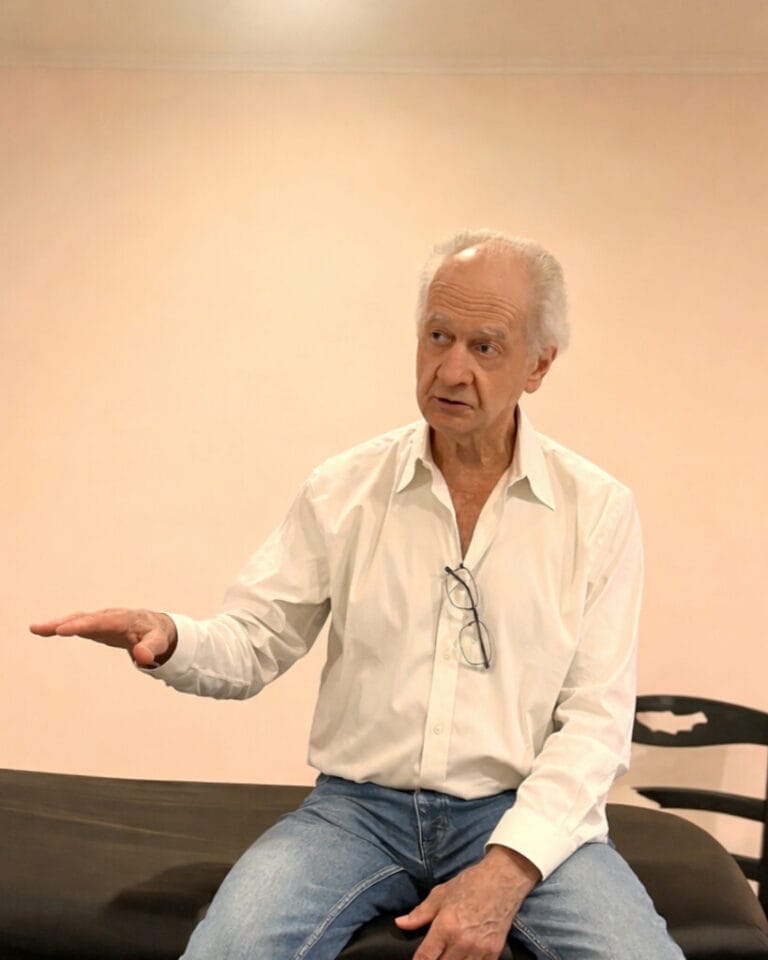
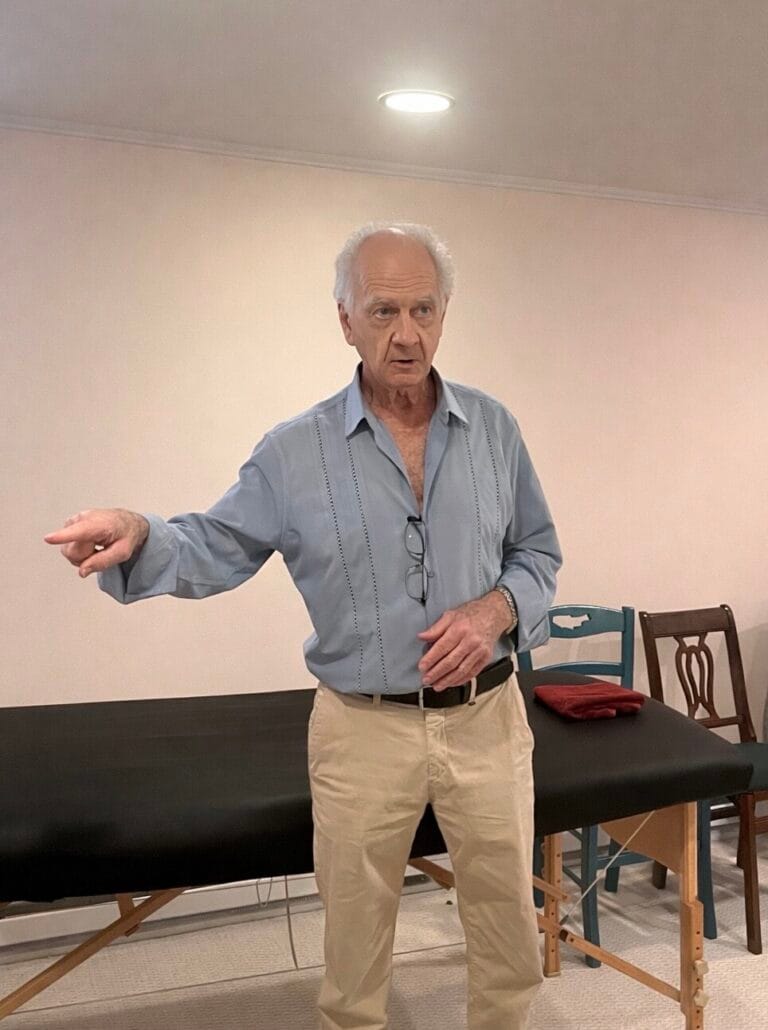
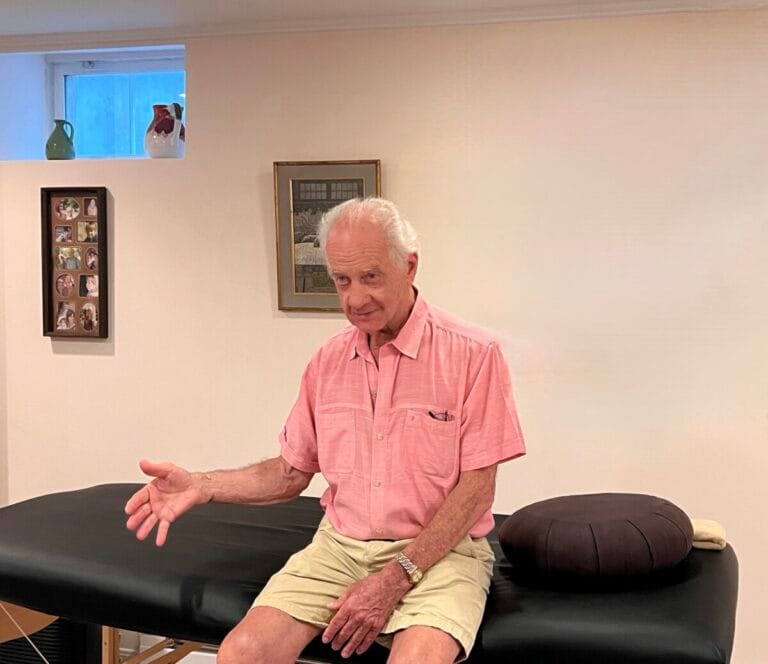
On October 14, 2025, in Boston, Massachusetts, USA, Tommy Thompson led a class in the Alexander Technique teacher training course, guiding us into a striking exploration of the palm’s reflexes, its sensory intelligence, and how touch reorganizes the entire system. What emerged was not mere anatomy, but an understanding of why connection heals—and why presence begins long before movement.
This class asked a simple but disruptive question:
What opens in you when the hand opens?
Key Objectives of the Class:
- To explore how the hand functions as a primary organ of awareness in the Alexander Technique
- To investigate the relationship between touch, perception, compassion, and connection
- To understand how the palm’s sensory receptors influence the cervical spine and whole-body coordination
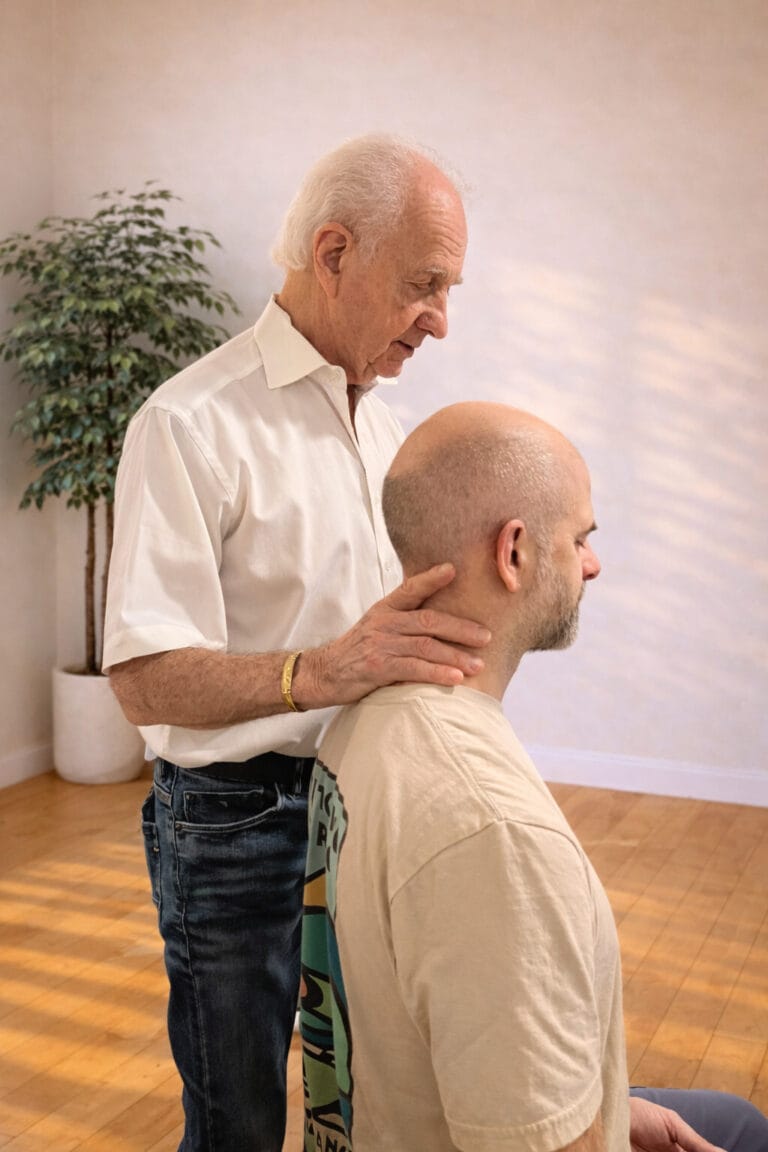
- To experience how non-doing contact transforms both teacher and student in hands-on work
This blog series is based on Tommy Thompson’s Alexander Technique classes. Each post follows the flow and insights of the class to expand both self-awareness and practical consciousness applicable to everyday life.
New here?
If you’re new to the Alexander Technique, you can start with the resources below.
Alexander Technique Class Flow at a Glance
1. The Opening Question
❝ What if the hand reveals you—your history, your habits, your wounds, your longing to be met—before you ever make a single choice in the Alexander Technique? ❞
We tend to think change begins with thought or intention.
But Tommy points to something far more intimate: the hand speaks first.
Before you adjust your head-neck relationship, before any idea of ease or direction arises, the hand quietly discloses how you brace against life, how you reach for safety, and how willing—or unwilling—you are to be touched by the world.
This matters because when the hand opens, it isn’t just the palm that opens.
It’s your story loosening.
It’s your nervous system listening.
It’s your whole self reconsidering how to be in the presence of another.
Tommy’s Word
“When you hold my hand, I know all is forgiven.”
Tommy wasn’t describing sentiment.
He was naming physiology—how the receptors of the palm speak directly to the brain, shaping safety, compassion, and availability.
When the hand becomes present, the person becomes present.
And from that presence, the real work begins.
2. Core Learnings from This Class
Core Concepts
- The hand reveals the whole person.
How the hand opens, closes, or braces shows how a person meets experience—habitually, emotionally, and relationally. Before any verbal cue or thought, the hand already speaks. - The palm is a sensory doorway into coordination.
Dense receptors in the palm influence safety, compassion, and availability—making the hand one of the most powerful entry points in the Alexander Technique. - Anatomical expansion reorganizes the whole system.
When the thenar and hypothenar lines release, the SCM, mastoid region, cervical spine, and trapezius respond without force or manipulation. - Non-doing contact invites natural reorganization.
Coordination changes most deeply when the teacher’s hand asks nothing and offers presence instead of pressure. - Habit unwinds through compassion.
Habits formed for survival cannot be rejected; they must be honored. Change happens when habitual patterns are met with understanding rather than critique.
Five Key Messages
- The hand speaks before intention.
Movement begins with sensory availability, not thought. - Connection precedes improvement.
The nervous system opens when safety is present. - When the hand opens, the spine listens.
Expansion radiates bi-directionally—from palm to neck and through the whole back. - Locate, don’t intervene.
“1–2–3” becomes a way of inviting the organism to reorganize itself. - Presence is the teacher.
The quality of being, not the technique, creates transformation.
Essential Terms
- The Hand
Not merely structure but a perceptual field—revealing how a person meets themselves, others, and the world. - Palmar / Grasping Reflex
Primitive closing responses that shape emotional and physical readiness; central to understanding how habitual defense patterns appear. - Thenar & Hypothenar Expansion
The paired anatomical lines that open the palm; their release influences the SCM, mastoid, trapezius, and upper cervical organization. - Non-Doing Contact
Touch guided by presence rather than pressure—allowing the organism to reorganize from within. - Bi-Directional Expansion
Movement that rises and descends simultaneously—up through the spine and down through gravitational response. - Self-Compassion in Use
Tommy’s core principle: habits are honored, not rejected; change arises through understanding rather than critique.

3. Tommy’s Insights
In Tommy’s words during class, there are not only the core principles of the Alexander Technique, but also practical wisdom that can be applied directly to daily life. His words go beyond simple advice about movement and prompt us to deeply consider how we choose to exist.1. “I started working with people’s hands on the table. They started from when you could just stretch your palm out like that, which is the opposite of this. And this is the grasping reflex—the palmar reflex. This is the one we use all day long in activities—mostly this. So when you shake hands with somebody, it’s already like this.”
➤ He shows how primitive grasping patterns silently dominate everyday coordination, making the opened palm a primary doorway into changing use.
2. “Within the palm of your hand are dense sensory receptors that send powerful signals to the brain—signals that can trigger responses related to love, compassion, and understanding. Dopamine, serotonin, oxytocin—the brain releases them, but the invitation begins right here. So the palm of your hand is like a treasure. It’s not doing something; it’s becoming available to being present with the other.”
➤ The hand is presented as a neurobiological and relational organ of presence, where simply being available initiates connection.
3. “One of the things that has always bothered me about the technique is that it’s critical—critical of use. And my whole thing, throughout all of it, has been to never try to know… and that to make true change in your life, self-compassion is essential.”
➤ He reorients the work away from judgment and toward a stance of non-knowing and kindness, so that change arises from safety rather than criticism.
4. “It’s complex to let go of that habituation. You can’t blame yourself, and whatever habituation you come up with—often, it’s what worked for you. At one point in your life, you needed it, and it was all you had available. So letting go of it means you have to reject that part of yourself—but you don’t. You need to honor that part of yourself.”
➤ Habit is treated as an intelligent response to circumstance, and genuine transformation begins with honoring, not exiling, the patterns that once protected you.
5. “When you hold hands, you’re not holding your hands to get anything from that person. You’re holding your hands to connect.”
➤ Here touch is defined as an ethical, non-instrumental meeting of beings, where the intention is relationship rather than outcome.
6. “It—Triadic Resonance—is just a wave of movement. It really is one wave through the whole of the palm, emptying the palm of what you previously held and making yourself available to what you’re actually holding.”
➤ Triadic Resonance is described as a continuous wave of release in the hand, freeing it from past holding so it can resonate with what is truly present.
7. “If you withhold defining yourself in the way you previously defined yourself, and give the same movement a little bit more space—in other words, you don’t move. I don’t think it helps to take the person completely away from what they’re doing and say, “This is better.” Find a way of letting them do what they do—with more space—and they’ll gradually, gradually, gradually…”
➤ Change is invited by suspending fixed self-definitions and expanding space around action, allowing the nervous system to reorganize from within its own activity.
8. “You can guide the person into what’s possible—which is a way of love—or you can insist the person obey you, which is not love. And why do you feel nothing? Because they’re not tapping into what’s already there. You can’t make adjustments and free a person. You tap into what’s there.”
➤ Effective teaching is framed as loving guidance into possibility by joining what already exists in the person, rather than imposing adjustment or demanding obedience.
4. Practical Tips for Everyday Life
What’s the Goal?
The aim is not to use the hand but to let the hand reveal how available you are.
When the hand softens, the head, neck, and spine reorganize without effort—an essential principle in the Alexander Technique.
How to Practice
1) While walking — sense the “readiness” of the hand
Don’t fix your walk. Notice whether the hand is gripping or open.
An open hand allows the spine to lengthen; a closed hand pulls you inward. Let the hand set the tone before the step begins.
2) Sitting and standing — awaken the palm’s expansion
Before moving, sense a quiet widening through the thenar–hypothenar line. As the palm opens, the neck and back follow with ease. You aren’t improving the movement—you’re creating space for it.
3) In conversation — offer space through the hand
A lightly open hand calms the nervous system and softens your response.
It signals availability, helping you listen without tightening or preparing.
What You’ll Notice
Small changes in the hand ripple through the whole system: easier breathing, a calmer neck, a more responsive spine.
Emotionally, you’ll sense more ease, less guarding, and a fuller capacity to meet others with presence.
“When the hand opens, the whole being opens.”
5. Closing the Class
Key Takeaways
- The way the hand opens or closes reflects how the whole self organizes.
- Touch becomes transformative only when free of demand or correction.
- Anatomical expansion through the palm naturally influences the neck, back, and overall coordination.
- Compassion—toward oneself and toward others—is essential for meaningful change.
Core Insights
- True change in the Alexander Technique begins with the quality of your being, not the shape of your movement.
- The nervous system listens to safety before it listens to direction; availability matters more than intention.
- When the hand opens, it offers a path where presence replaces habit and connection replaces effort.
A Final Invitation
Let the hand become your quiet teacher.
Allow its opening to show you where you are bracing, where you are protecting,
and where you are ready to meet the world with more ease.
And when you place your hands on another—whether in teaching, caring, or simply being together—let the gesture arise from presence rather than purpose.
There is nothing to force.
Nothing to fix.
Only the next moment of availability—carried through the hand, into relationship, and into life.
6. One Key Practice
When you feel yourself tightening, speeding up, or preparing for life instead of meeting it, pause for a moment.
Let the palm soften and widen—just enough to feel yourself becoming available again.
Don’t shape it. Don’t improve it.
Sense the thenar and hypothenar drifting apart, as if opening a small window in the nervous system.
Stay with it for ten seconds.
Let the softening travel into your breath, your neck, and the way you meet the next moment.
This is not a technique—it’s a way of re-entering yourself.
7. Three Questions to Ask Yourself
- Is my hand opening to the world—or preparing against it?
This single question reveals your entire coordination. - What changes in me when I allow the hand to do less?
Notice what the breath, neck, and attitude choose on their own. - Am I meeting this moment with availability—or with an old habit?
Let the hand answer before the mind does.
8. For Those Who Wish to Learn More
Recommended Books
The Hand: How Its Use Shapes the Brain, Language, and Human Culture – Frank R. Wilson
This book mirrors the heart of this class: the hand as a bridge between body, brain, and human experience. Wilson traces how the hand’s evolution and its intimate communication with the nervous system shape perception, emotion, creativity, and culture. It’s an ideal companion for deepening your understanding of why the hand is not just an instrument of action, but a living field of awareness that aligns closely with the explorations in this Alexander Technique class.
Official Website of Tommy Thompson
www.easeofbeing.com
This is the official website personally managed by Tommy Thompson, offering a wide range of resources and programs to deepen your understanding and practice of the Alexander Technique:
- Private session reservations and inquiries
- Workshop and seminar schedules
- Overview of international teacher training programs
- Essays and articles on the Alexander Technique
9. Next Class Sneak Peek
The next class asks whether you have ever truly seen another person, or only the memory you carry of them. We will step into the subtle gap between looking and seeing, where receiving replaces judgment and a whole person begins to appear in front of you in real time.
In Class 81 we’ll explore:
how perception changes when you stop defining and allow yourself to be met—and quietly altered—by what you see.
10. Join the Alexander Technique Journey
Did this class leave a small resonance within you? Feel free to quietly hold it in your heart or share it in just a sentence or two. The comments are always open. Your one simple word may leave a gentle ripple in this ongoing journey.The journey of Resonance Flow continues across social media as well. Let’s continue this journey together.
 YouTube
 Instagram
 Threads
 Facebook