Triadic Resonance: Hands-On Transformation in the Alexander Technique | Tommy Thompson Class 03
❝ What might change if we could free our tense bodies and minds—and discover new possibilities? ❞
On September 19, 2024, in Boston, Massachusetts, USA, Tommy Thomson led an Alexander Technique class centered on how hands-on work can harmonize the body and the mind—ultimately enhancing the quality of life.
This blog series follows the flow and insight of each of Tommy Thomson’s classes, one session at a time.
Hands-on work and Triadic Resonance help release physical tension, interrupt habitual patterns, and restore the connection between body and mind. This is not a corrective method, but a way of reclaiming balance in one’s whole way of being. In this post, we explore the principles behind the practice—and how to apply them.
This blog series is based on Tommy Thompson’s Alexander Technique classes. Each post follows the flow and insights of the class to expand both self-awareness and practical consciousness applicable to everyday life.
New here?
If you’re new to the Alexander Technique, you can start with the resources below.
Alexander Technique Class Flow at a Glance

1. The Opening Question
❝ Why is hands-on work necessary? ❞
If we could stop the tension and habits we’ve grown used to, how much more freedom might we find in our body and mind?
Tommy says:
“The beginning of hands-on work is listening. You must perceive how the other person’s body is responding to gravity.”
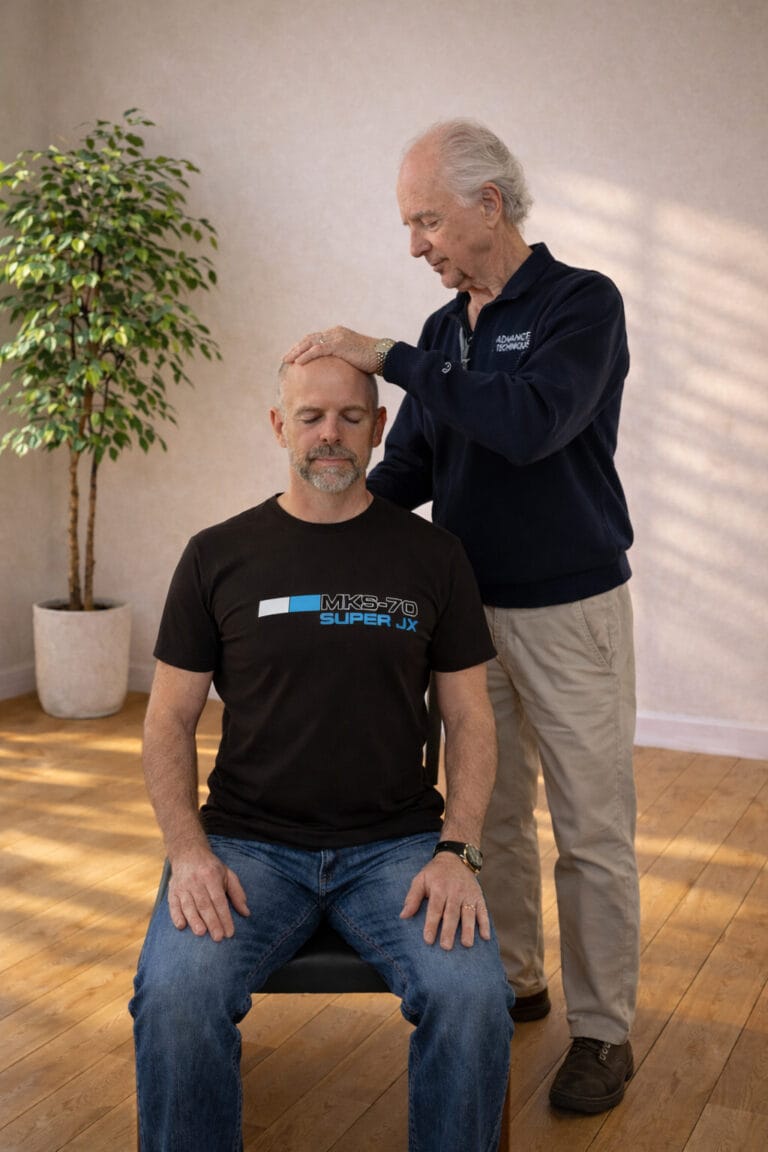
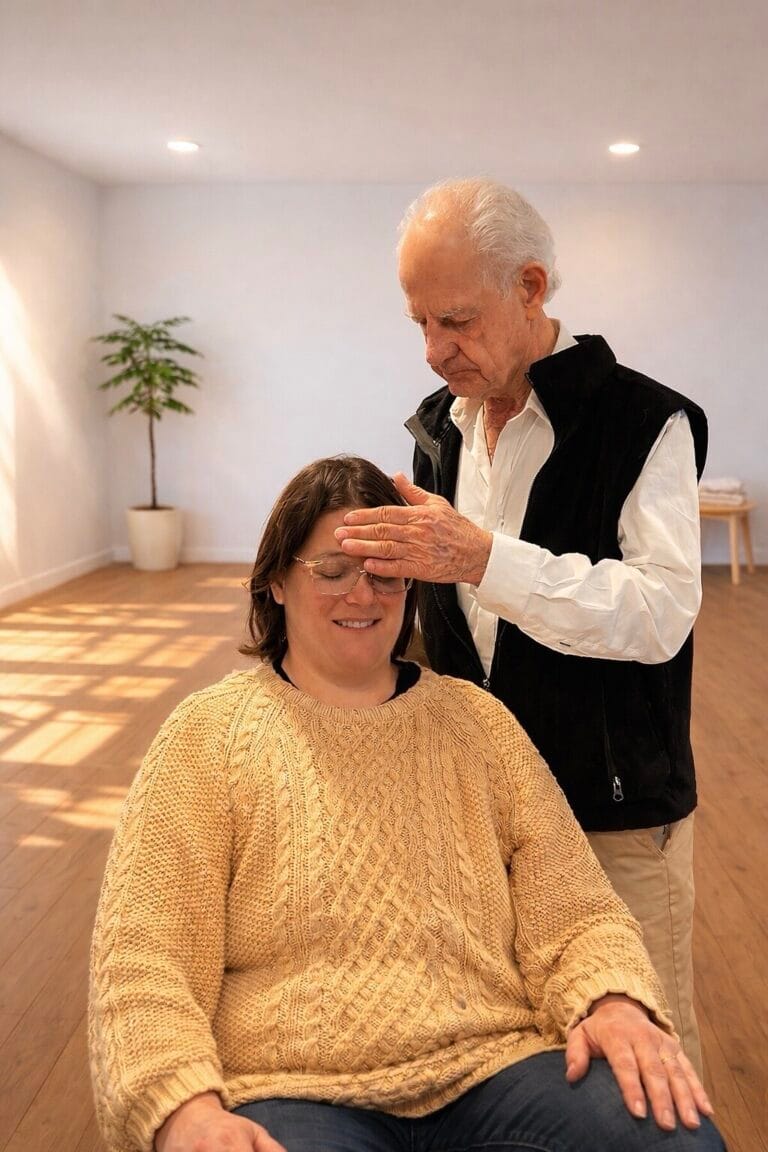
Hands-on work begins with listening—not analyzing another’s body, but attending to how we ourselves are using ours: posture, reaction, habitual pattern. That awareness alone creates a space where old responses pause and new choices can emerge.
Based on this awareness, hands-on work activates the flow of energy through gentle touch and restores balance and harmony in the body through the interaction of the hands, spine, and feet—Triadic Resonance. This is not an approach that forces correction or imposes change, but a process of consciously pausing established tension patterns and allowing better possibilities to emerge.
Building on this awareness, hands-on work uses gentle touch to activate the flow of energy, and through the interaction of the hands, spine, and feet—Triadic Resonance—it supports the restoration of balance and coordination in the body. This is not about forcing correction or imposing change, but about consciously pausing established tension patterns and allowing better possibilities to emerge.
Hands-on work goes beyond simple relaxation. It fosters emotional stability and renewed self-awareness, helping to cultivate a life in which body and mind move in harmony.
2. Core Learnings from This Class
Core Concepts
- Hands-on is not mere physical contact. It is a refined technique that reconnects thought and body through the “listening hand” and restores the flow of energy.
- Triadic Resonance is a mechanism of integrated body coordination in which the hands, spine, and feet are interconnected, allowing energy to flow vertically in a balanced and unified way.
- Inhibition is the conscious choice to interrupt an unconscious tension response, while Direction is the process of allowing movement through intention rather than force.
- Hands-on work serves as a sensory means of directly experiencing both inhibition and direction, supporting the refinement of self-awareness and perception.
- This is not merely about relaxing muscles—it is a process of reorganizing patterns in the nervous system and perception.
Principles and Techniques of Hands-on Work
- Listening as the Starting Point of Hands-on Work
- Hands-on work begins not with what we do, but with how we listen.
- The hand becomes more than a tactile tool—it functions as a sensory organ that reflectively reads the state of the other’s body.
- Listening also means sensing what we ourselves are doing in the process.
- The Moment of Inhibition
- Inhibition is the conscious choice to interrupt a familiar, automatic response.
- This pause becomes the entry point for allowing freedom in the head, neck, and spine.
- It creates space and flexibility for the brain and body to reorganize habitual patterns.
- Allowing Direction
- Direction is not about performing a movement, but about thinking the direction and allowing it to unfold.
- Movement is gently guided through imagery or thought, such as “the head forward, the spine to lengthen.”
- This can be seen as a form of intentional non-doing—a way of releasing tension without losing direction.
- Touch and the Flow of Energy
- Touch in hands-on work is like casting a subtle light of awareness on each part of the body.
- The hands sense the body’s relationship to gravity, its structural support, and areas where energy is blocked.
This touch is not about pressure or adjustment, but about sharing perceptive space.
- Applying Triadic Resonance
- Triadic Resonance is the integrated vertical response that arises through the interaction of hands, spine, and feet.
- Through this resonance, the spine lengthens, the feet deepen support, and the hands expand sensory awareness.
- Triadic Resonance is a key to restoring the use of the body as a whole
Five Key Messages
- Listening is the foundation of hands-on work.
- Inhibition creates space to pause habitual responses and open new choices.
- Direction is a way of allowing possibility, not forcing movement.
- Touch is a sensory connection that perceives and restores structural flow.
- Triadic Resonance links the entire vertical axis of the body, supporting full-body integration.
Essential Terms
- Hands-on
In the Alexander Technique, hands-on refers to a sensory-guided method conveyed through the teacher’s hands. It is not mere physical contact, but a tool of awareness that listens to the body, senses its relationship with gravity, and opens space for new movement possibilities. - Triadic Resonance
A state of integrated vertical response through the interaction of hands, spine, and feet. As a core technique of hands-on work, it helps restore energy flow, balance, and harmony throughout the body. - Inhibition
The conscious choice to pause a habitual, unconscious reaction. By interrupting these ingrained tension patterns, the body becomes available for more natural and free movement. - Direction
A process of allowing direction through thought alone, without initiating movement. By thinking images such as “head forward, spine to lengthen,” we create space for the body to organize itself spontaneously. - Listening Hand
A key concept in hands-on work, describing a receptive touch that perceives both the other’s body and one’s own use. It is not about judgment, but about shared awareness of energy flow and coordination. - The Use of the Self
A foundational principle in the Alexander Technique referring to how we use our body and mind as a whole. It encompasses not only physical patterns, but also attention, reaction, and way of being. - Space Between Reaction
The subtle internal pause where inhibition and direction take place. By not reacting immediately, we create a space where the nervous system can reset and sensory awareness can return.
3. Tommy’s Insights
In Tommy’s words during class, there are not only the core principles of the Alexander Technique, but also practical wisdom that can be applied directly to daily life. His words go beyond simple advice about movement and prompt us to deeply consider how we choose to exist.“You’re letting it be free to lengthen, but you don’t do it. You simply have stopped doing what you usually do when you let your neck be free. So, it’s an intention.”
Allowing the neck to be free means not doing something new, but ceasing what we habitually do. It’s not effort—it’s an intentional non-doing that permits natural lengthening and balance.
“So, giving direction means prolonging that moment of inhibition—but it’s about allowing, not forcing.”
Giving direction doesn’t mean controlling the body—it means staying with the pause, and gently allowing the body’s natural coordination to emerge on its own.
“I registered the intention. Now, when you register the intention, the brain has already done it before you can even feel yourself doing it. So, I’m playing partner with the brain, and as I do that, I feel length to some degree—or I don’t—and then I add just a tiny bit more pressure.”
Intention is not something we execute—it’s something we recognize. By simply registering it, the brain responds before we act, making change possible without effort or interference.
“The first thing I do is listen. I hear, and I perceive to what degree the person is exhibiting an evolutionary response to gravitational force.”
Hands-on work begins with listening—not with the ears, but with attentive presence. It’s about sensing how the body responds to gravity as an intelligent, expressive system.
“The inhibitive moment is crucial because, once you bear witness to yourself—which is inhibition for a brief moment—you temporarily stop doing what you usually do.”
Inhibition is a pivotal pause where new movement choices can surface.
“If you let your neck be free, the superficial muscles of the neck responsible for uprightness are the trapezius and sternocleidomastoid, always working in conjunction with other muscles.”
Neck freedom is not isolated; it enables harmony throughout the body.
“The reason I talk about that withholding definition is because it’s not about your body—it’s about the person that lives within the body. Your use reflects your commitment to who you feel you are.”
The way we use ourselves expresses who we believe we are. Our physical patterns are inseparable from our sense of self.
4. Practical Tips for Everyday Life
1. Noticing Bodily Tension
What’s the Goal?
To recognize unconscious physical tension and develop the ability to gently release it.
How to Practice
Sit comfortably and place your palms on your thighs. Gently observe the tension in your neck, shoulders, and jaw. As you slowly inhale and exhale, consciously allow those areas to soften.
What You’ll Notice
- Unnecessary effort begins to release, and breathing and movement become more natural.
- Your sensitivity to bodily sensations will increase.
- You’ll gain the ability to notice your tension levels throughout daily life.
2. Connecting Body and Mind Through Small Movements
What’s the Goal?
To reconnect body and mind through subtle movement and recover sensory awareness.
How to Practice
Slowly raise one hand. Notice how this simple motion affects your shoulder, spine, and neck. If possible, slowly lower it back down while paying attention to the lingering sensation of movement.
What You’ll Notice
- You’ll become more attuned to internal shifts.
- You’ll experience what it means to move consciously, rather than automatically.
- You’ll begin to trust that movement can happen without tension.
3. Practicing Triadic Resonance Awareness
What’s the Goal?
To sense the connection between hands, spine, and feet, and restore full-body balance and energetic flow.
How to Practice
Stand lightly without lifting your arms, and let your hands rest naturally by your sides. Gently open your hands so that your fingertips point toward the floor. Imagine that your hands, spine, and feet are aligned along a single axis, and focus on the sensation of energy flowing vertically through that connection.
What You’ll Notice
- You’ll perceive the structural link between hands, spine, and feet.
- You’ll experience both groundedness and expansion in your body.
- Even in stillness, you may feel subtle movement and aliveness.
※ Triadic Resonance is a unique approach discovered and systematized by Tommy Thomson through years of exploration. It can be professionally taught only by those who have completed certified Alexander Technique teacher training. This article offers a brief introduction to part of the concept.
5. Closing the Class
Key Takeaways
- Hands-on practice helps release physical tension, restores freedom of movement, and supports a harmonious integration of body and mind.
- Change begins by interrupting familiar habits and allowing new possibilities to emerge.
Core Insights
- Inhibition and Direction shift unconscious reactions into conscious awareness, creating space and choice within movement.
- Triadic Resonance connects the hands, spine, and feet into a single stream of coordination, restoring whole-body integration.
Motivation
- Hands-on work is not merely about physical correction—it is a way of becoming aware of and caring for oneself.
Key Hashtags
#TriadicResonance #HandsOnTouch #Inhibition #Direction #UseOfTheSelf #ListeningHand #BodyIntegration #SensoryReawakening #SpaceBetweenReaction #EmbodiedAwareness
6. One Key Practice
Today, sit comfortably and gently place your palms on your chest. As you inhale, feel the soft rise of your chest beneath your hands. As you exhale, allow your whole body to release downward with ease.
Key Points:
- Be mindful not to let unnecessary tension build up in your neck and shoulders.
- Focus on the feeling of letting your breath move you, rather than trying to control the movement.
Why this practice?
Noticing how even a small sensation can affect the entire body is where meaningful change begins.
7. Three Questions to Ask Yourself
- Can you recall a moment today when your body wanted to stop on its own?
(Did you allow that pause—or did you move past it out of habit?) - When someone touched or looked at you, how did your body respond with tension?
(Can you identify where that tension began or what emotion it might be connected to?) - When today did you feel that you were using your body consciously?
(Take a moment to recall your breath, the direction of your gaze, or the position of your center at that time.)
These questions are not about doing, but about noticing.
There are no right answers. Let sensations, impressions, and images guide your reflection.
8. For Those Who Wish to Learn More
Recommended Reading
- The Use of the Self – F. M. Alexander
A foundational text written by the founder of the Alexander Technique. Through the key concepts of “use of the self” and “inhibition,” Alexander reexamines the relationship between movement, attention, and reaction. This philosophical classic explores how the way we use our bodies directly influences the quality of our lives. - Body Learning –Michael J. Gelb
A widely respected introduction to the Alexander Technique, this book connects its core principles to everyday movement. Through kinaesthetic awareness, body consciousness, and natural alignment, it offers a practical approach to regaining self-awareness and rethinking the mind–body connection.
Official Website of Tommy Thompson
www.easeofbeing.com
This is the official website personally managed by Tommy Thompson, offering a wide range of resources and programs to deepen your understanding and practice of the Alexander Technique:
- Private session reservations and inquiries
- Workshop and seminar schedules
- Overview of international teacher training programs
- Essays and articles on the Alexander Technique
9. Next Class Sneak Peek
“How often—and how quickly—do we define ourselves?”
In the instant we decide something too quickly, the body tightens and the mind closes off possibility.
In the next class, we’ll explore a concept that Tommy Thomson has uniquely emphasized and developed: Withholding Definition.
This is not simply about delaying judgment—it’s a practice of observing our reactions and allowing space for the body and emotions to move on their own, beyond habitual thinking.
Withholding definition leaves a lasting impression—on movement, and on identity.
Stepping out of familiar tension, this lesson invites us not just into a new technique, but into a fundamental inquiry into how we live and perceive ourselves.
10. Join the Alexander Technique Journey
Did this class leave a small resonance within you? Feel free to quietly hold it in your heart or share it in just a sentence or two. The comments are always open. Your one simple word may leave a gentle ripple in this ongoing journey.The journey of Resonance Flow continues across social media as well. Let’s continue this journey together.
 YouTube
 Instagram
 Threads
 Facebook