Triadic Resonance in the Alexander Technique: Sensory Flow and Hand-Led Integration | Tommy Thompson Class 02
❝ What if a single touch of the hand could bring your body and mind into balance and harmony? Would you be curious to explore that possibility? ❞
This question is not a matter of imagination—it reflects a real and evolving approach to embodied awareness.
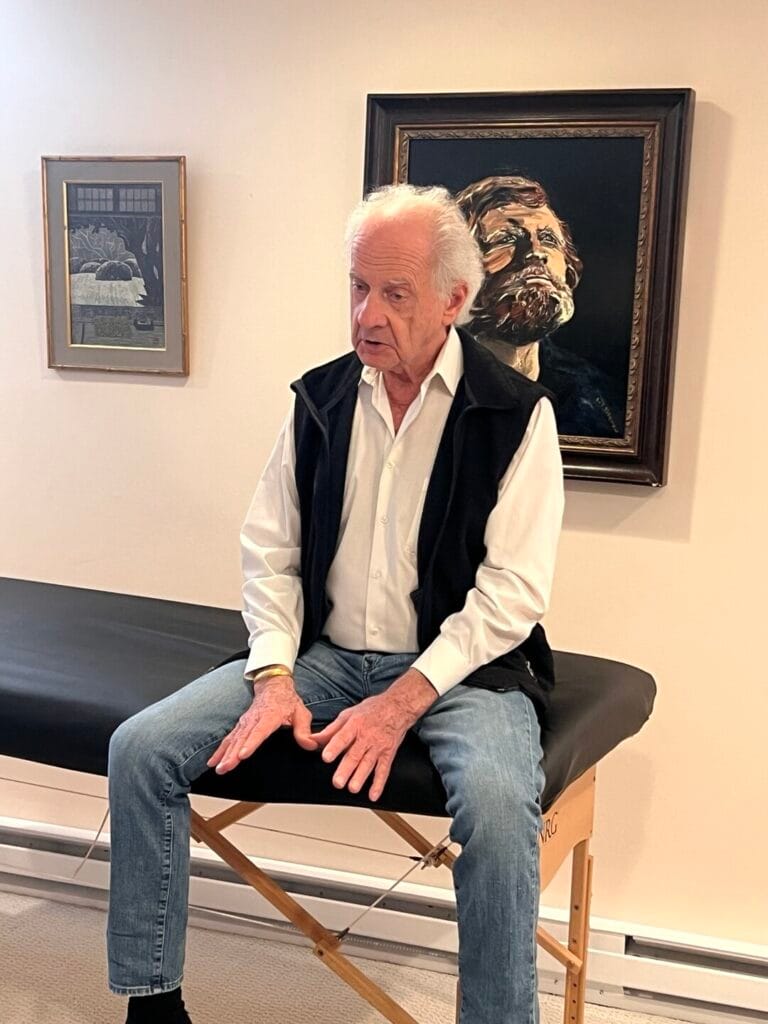
On September 18, 2024, in Boston, Massachusetts, USA, Tommy Thompson led a class in the Alexander Technique teacher training course, where he opened a new path toward the integration of body and mind through his signature hands-on method, Triadic Resonance.
Core Objectives of This Class:
- To experience the deep connection between the hands and the body, and to learn how to apply it in everyday life.
- To practice techniques that release tension and regulate energy flow through hand movement.
- To recognize the link between touch and emotional balance, and to cultivate integrated emotional presence.
Triadic Resonance is more than a physical technique—it is a sensory principle that can be applied across all areas of life.
When body and mind are connected, we access movement that is more free, more honest. This technique offers a starting point for exploring that potential.
This blog series is based on Tommy Thompson’s Alexander Technique classes. Each post follows the flow and insights of the class to expand both self-awareness and practical consciousness applicable to everyday life.
New here?
If you’re new to the Alexander Technique, you can start with the resources below.
Alexander Technique Class Flow at a Glance

1. The Opening Question
“Where do you feel your hand begins?”
– Tommy Thompson
This question is not simply asking about the anatomical location of your hand. It’s an invitation from Tommy Thompson, posed during class, to reawaken your felt sense of what a hand truly is. Many people assume the hand begins at the wrist, the end of the arm. But as the class unfolds, one begins to sense that the hand might actually begin at the shoulder, the spine, or perhaps somewhere deeper—within awareness itself.
This question encourages us to perceive the body not as fragmented parts, but as one integrated structure. The exploration of where the hand begins expands into a deeper awareness of the body’s overall movement, sensation, and emotional flow. In the end, it’s not just a question about your hand—it’s a question about you. And that question becomes the first key to opening the class.
2. Core Learnings from This Class
Core Concepts
Connection Between the Hand and the Body Structure
The movement of the hand is not limited to the fingers alone—it is intricately connected to the whole body. For instance, the area between the thumb and index finger can influence major muscles like the trapezius and sternocleidomastoid, and the orientation of the hand affects the flow of movement all the way through the spine and into the feet.
Integration of Energy and Tension Through Hands-On Triadic Resonance
Triadic Resonance is a sensory-based technique that uses the triangular structure of the hand to release tension and regulate the flow of energy in the body. Through precise placement and rhythmic movement of the hand, tension in specific areas is gently released, expanding along the spine to support overall coordination throughout the body.
Emotional Aspects of Touch
The palm contains receptors for oxytocin, serotonin, and other neurochemicals that support emotional well-being. Intentional touch goes beyond physical contact—it acts as a powerful medium for emotional connection.
Five Key Messages
- Hands-on Triadic Resonance enables deep integration of body and mind.
- The movement and touch of the hand are key tools in regulating energy and emotion.
- Triadic Resonance helps transcend physical and emotional limitation and open new possibilities.
- Awareness of bodily sensation is the starting point of meaningful change.
- Understanding bodily connection can shift how we move—and how we live.
Essential Terms
- Triadic Resonance
A principle of integration developed by Tommy Thompson, where subtle, intentional touch from the hand initiates a sensory wave through the spine and entire system. It supports not just postural change but a deepened presence—physical, emotional, and perceptual.
- Hands-On
As taught by Tommy Thompson, hands-on is not merely about physical correction but about relational presence. The hands become instruments of trust, resonance, and spacious listening—supporting release not by doing, but by being.
- Primary Movement
A term favored by Tommy, highlighting that the body is not a stack of aligned parts, but a living, breathing system in constant reorientation. Primary movement refers to the spontaneous, natural coordination of head, neck, and spine when the person does not interfere.
- Direction
A conscious, non-forceful thought that creates space for the body to reorganize with greater ease. It’s not a command but a mental orientation—a way of saying “yes” to freedom before movement happens.
- Inhibition
Not suppression, but a pause that creates the possibility for true freedom. Inhibition allows one to step outside of habit and meet the present moment with new attention and self-trust.
- Spiraling Movement
A natural pattern of motion arising from the body’s design. When unnecessary control is released, the body moves not in straight lines but in organic spirals—reflecting unity and flow.
- Palmar Reflex
A primitive grasp reflex that becomes, in hands-on work, a door into early sensory memory and trust. It reminds us that coordination begins with contact, even before intention.
3. Tommy’s Insights

“I would have the person think of the fingers releasing out of the wrists, which are the carpal bones, moving away from the palm toward the back of the head. If you do that, your palm will open.”
This instruction emphasizes the anatomical and energetic extension of the fingers. Encouraging release from the carpal bones activates a sense of openness and dynamic flow, enabling a fuller, more receptive quality in the hand. It reflects the nuanced coordination at the root of body-wide integration.
“I realized that the area of the carpal bones, where the pinky and ring finger meet at the ‘fork in the road,’ was positioned toward the center of the person.”
Tommy notes a sensory discovery in the palm that links structural touch with the body’s central axis. This “fork in the road” becomes a key tactile point connecting the hand to the torso, underlining how localized contact can influence central balance and alignment.
“Triadic Resonance works through the rhythm of 1-2-3, releasing tension and linking the entire body.”
Here, Tommy describes the internal cadence of Triadic Resonance. The 1-2-3 rhythm activates a wave-like progression of release and alignment, promoting whole-body integration through structured, rhythmic touch.
“The palm contains receptors for oxytocin and serotonin. Through touch, we can transmit positive emotions like love and compassion.”
This statement expands the role of touch beyond biomechanics. By highlighting the neurochemical pathways of the palm, Tommy identifies touch as a medium for emotional connection and healing—essential to embodied presence and trust in hands-on work.
“Placing your hands on your chest or pelvis while in bed can release tension and support freer movement during sleep.”
A simple, restorative practice. Tommy connects gentle, intentional touch to the parasympathetic nervous system, enabling a reduction in muscular holding patterns and enhancing restful movement during sleep.
“Facial expression has the same impact as the whole body. Every part of the body reflects the main expression of the face.”
This highlights the reciprocal influence between the face and body. Tension or softness in the face informs and is informed by full-body states. It suggests that working with facial expression can be a gateway to somatic change.
“If you let your neck be free, the superficial muscles of the neck responsible for uprightness are the trapezius and sternocleidomastoid, always working in conjunction with other muscles. The neck extends into the back all the way to the twelfth thoracic vertebra.”
These insights reframe the neck not just as a static column but as a dynamic, integrative structure. Freedom in the neck involves both awareness and release throughout a broader anatomical span, which is key for postural freedom and primary control in the Alexander Technique.
4. Practical Tips for Everyday Life
What’s the Goal?
The core of this practice is to sense the connection between your hands and body, and based on that sensory awareness, release tension and generate more organic movement.
It’s a simple practice that can be done right in your daily life—no special tools required.
How to Practice
- Get into a Neutral Position
Sit upright in a chair or lie comfortably on the floor. Gently lengthen your spine and allow tension throughout your body to release naturally. - Explore Hand Movement
Raise one hand and slowly move each finger one at a time—
thumb, index, middle, ring, and pinky. Observe how these movements affect the sensations in your arms, shoulders, neck, and spine.- Example: Do you notice a subtle response in your shoulders when you curl or extend a finger?
- Notice the Palm’s Sensation
Place your palm on your chest, abdomen, or thigh, and feel for sensations such as warmth, pressure, or subtle vibration in the contact area. - Connect with the Breath
Focus on the sensation in your hand while breathing slowly. Gently observe how your hands, body, and emotions respond to each inhale and exhale.
What You’ll Notice
- You’ll begin to feel a more organic connection between your hands and your body.
- Physical tension releases gently, and emotional stability naturally follows.
- You’ll experience sharper sensory awareness and more refined movement.
5. Closing the Class
Key Takeaways
Triadic Resonance is not merely a technique for releasing physical tension; it is a way of reintroducing conscious coordination into the relationship between body and self. Through the quiet intelligence of the hands, we learn to reorganize our movement from within, without force, and without correction. It is an invitation to move with integrity, not to fix, but to restore what is already innately whole.
This work brings us back to a place before habit—before effort—where we can begin again, not as a doing but as a sensing.
Core Insights
- The hand is not separate from the body. It is an extension of attention, a mirror of intention, and a gateway to deeper integration.
- Releasing tension through the hands reorganizes the spine, breath, and emotional tone—not mechanically, but systemically.
- Regular, quiet application of Triadic Resonance can transform not only posture or performance, but the quality of presence you bring into your life.
Motivation
Let Triadic Resonance become a daily pause—a moment when you remember there is another way to be. Not the conditioned doing, not the habitual tension, but a return to clarity and quiet within your structure.
Every time you place your hand on yourself with awareness, you are not correcting—you are listening.
You are allowing the design of your being to function as intended.
This is not about doing more. It’s about doing differently. And that difference begins when you choose to direct, rather than react.
6. One Key Practice
At some point today, place your palm over your chest and take a few deep breaths. This simple action not only relaxes your body but also opens the door to rediscovering your own sense of self.
Just a brief moment each day with your hand resting on your chest and your breath moving slowly can help you experience a gentle shift— in physical tension and even in the pace of your mind.
7. Three Questions to Ask Yourself
To integrate the sense of Triadic Resonance into your life, quietly ask yourself the following questions. These questions can serve as guides for better movement, and also as windows through which to re-examine your body and mind.
- Where do my hands begin, and where do they connect to?
- When I move, what emotion flows with that movement?
- What habitual pattern must I pause now to allow for a lighter, more natural state of being?
These questions aren’t just reflective exercises—they can be starting points to redesign how you move through daily life.
8. For Those Who Wish to Learn More
- Anatomy Trains – Tom Myers
A book that reimagines the body’s structure and movement through the lens of fascia. It’s a helpful anatomical complement to the Alexander Technique’s view of whole-body connectivity and tension release. - The Use of the Self – F. M. Alexander
A foundational text written by the creator of the Alexander Technique. Based on his personal experience, it explores how the use of the self profoundly influences all aspects of life. This is one of the purest expressions of the technique’s essence.
Official Website of Tommy Thompson
www.easeofbeing.com
This is the official website personally managed by Tommy Thompson, offering a wide range of resources and programs to deepen your understanding and practice of the Alexander Technique:
- Private session reservations and inquiries
- Workshop and seminar schedules
- Overview of international teacher training programs
- Essays and articles on the Alexander Technique
9. Next Class Sneak Peek

In the next class, we’ll explore more deeply how the rhythm and directionality of Triadic Resonance influence real movement. You’ll apply its principles to everyday actions like walking, sitting, and standing, experiencing how the harmonious connection between the hands, spine, and feet affects your whole-body sensation and movement.
You’ll also learn practical ways to release physical tension and restore emotional balance through the principles of Direction and Inhibition.
This class will be a time to relearn how to ‘be’ through the senses of the body.
In the next class, your movement and perception can become even more free. Are you ready?
10. Join the Alexander Technique Journey
Did this class leave a small resonance within you? Feel free to quietly hold it in your heart or share it in just a sentence or two. The comments are always open. Your one simple word may leave a gentle ripple in this ongoing journey.The journey of Resonance Flow continues across social media as well. Let’s continue this journey together.
 YouTube
 Instagram
 Threads
 Facebook