What If Nothing Needs Fixing? Possibility in the Alexander Technique | Tommy Thompson Class 84

❝ What if nothing about you needs fixing—and what the Alexander Technique offers is simply the possibility to experiencing yourself differently, while you’re already living your life? ❞
Most approaches to movement, posture, or wellbeing begin with an assumption:
that something is wrong and needs to be fixed.
The Alexander Technique does not begin there.
It does not begin with correction.
It does not begin with improvement.
It begins with perception—with how a person is already using themselves as life is already happening.
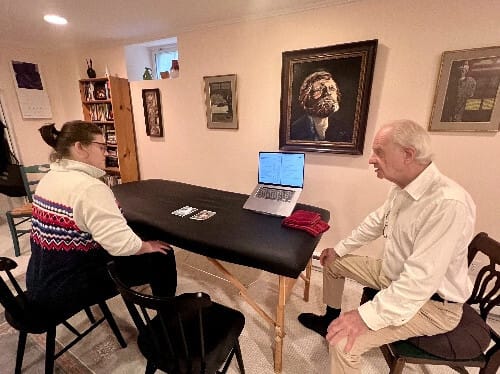
On October 22, 2025, in Boston, Massachusetts, Tommy Thompson led a class in the Alexander Technique teacher training course that quietly but decisively reframed what it means to teach, to learn, and to help another human being. Through the simple act of observing two people reading—a young girl and a young woman—he revealed something essential: human functioning is governed not by intention or desire, but by long-established patterns of behavior. And the teacher’s role is not to change those patterns, but to introduce the possibility of being different within them.
In this class, reading was not treated as a mental task, nor cooking as a chore, nor mothering as a role. Each ordinary activity became a living field in which a person might—or might not—encounter themselves anew. The work was not about posture, behavior, or fixing use, but about whether another way of being with oneself can appear while life continues as it is.
Key Objectives of the Class:
- To clarify why habitual patterns of behavior function independently of intention or desire
- To distinguish education from correction in the Alexander Technique
- To redefine the teacher’s role as one who introduces possibility, not change
- To explore how ordinary activities become sites of self-discovery through perception rather than effort
This blog series is based on Tommy Thompson’s Alexander Technique classes. Each post follows the flow and insights of the class to expand both self-awareness and practical consciousness applicable to everyday life.
New here?
If you’re new to the Alexander Technique, you can start with the resources below.
Alexander Technique Class Flow at a Glance
1. The Opening Question
❝ If you’re not trying to change a person, not fixing their use, and not correcting their behavior—what are you actually doing as an Alexander Technique teacher? ❞
This question does not ask for a technique. It asks for orientation.
If habit governs how people function, then effort, instruction, and correction cannot be the primary tools of teaching.
When change is no longer the goal, teaching itself must be redefined.
Throughout the class, this question returned again and again—not as a theoretical problem, but as a lived inquiry into what teaching becomes when outcome-driven thinking is set aside.
Here, possibility is not improvement, progress, or a future promise.
It is the immediate condition that allows perception to shift while activity continues.
The work does not interrupt life; it enters it. Reading, cooking, washing dishes, or caring for another person remain exactly as they are. What may change emerges only from whether a person can perceive themselves differently in the midst of doing what they are already doing.
Tommy’s Word
“You cultivate your patterns of behavior. They have little to do with where you want to function.”
→ With this statement, Tommy grounded the class in a foundational principle of the Alexander Technique: human function is shaped by habituation rather than aspiration. From this perspective, the teacher’s role is not to direct a person toward a better outcome, but to illuminate the conditions in which the possibility of being different can be perceived—without force, correction, or demand.
2. Core Learnings from This Class
Core Concepts
- Function is governed by habituation, not intention.
Tommy repeatedly emphasized that how a person actually functions has little to do with what they want or intend. Use is shaped by long-established patterns of behavior that operate independently of conscious desire. - Good use is already present, especially in the young.
In a child, effective coordination is not something to be created or corrected. The teacher’s role is to introduce awareness of a functional state that already exists. - Perception, not effort, is the gateway to change.
The class made clear that effort reinforces habit. Only when perception shifts does a different way of functioning become available. - Activity is not separate from the work—it is the work.
Reading, cooking, washing dishes, or mothering are not interruptions. They are the precise contexts in which use, perception, and habituation can be observed. - Teaching is the act of introducing possibility, not correction.
Hands-on work and verbal guidance are educational encounters that make another way of being perceptible, without trying to fix or change the person.
Five Key Messages
- Habit determines function more reliably than intention.
- Awareness can be introduced without changing anything.
- Comfort often reflects familiarity, not freedom.
- Ordinary activities are sufficient sites for self-exploration.
- When perception changes, possibility appears.
Essential Terms
- Patterns of behavior
The habitual ways a person organizes themselves, cultivated over time, which shape function regardless of conscious intention. As Tommy stated, these patterns often have little to do with how a person wants to function. - Use
The total organization of the self—physical, perceptual, and psychological—while engaging in any activity. In this class, use was observed rather than corrected. - Habituation
The process through which patterns of behavior become automatic and familiar, influencing how information is taken in and how the self is experienced during activity. - Possibility
The immediate availability of experiencing oneself differently, introduced through awareness rather than effort. In Tommy’s teaching, possibility is not a future outcome but a present condition. - Education (Alexander Technique)
An experiential process in which perception is clarified so that choice can emerge where habit once operated automatically. This stands in contrast to therapy, treatment, or correction.
3. Tommy’s Insights
In Tommy’s words during class, there are not only the core principles of the Alexander Technique, but also practical wisdom that can be applied directly to daily life. His words go beyond simple advice about movement and prompt us to deeply consider how we choose to exist.1. “You cultivate your patterns of behavior. They have little to do with where you want to function.”
➤ This articulates the Alexander principle that function is governed by habit, not by aspiration, and that misuse persists regardless of good intentions.
2. “You’re simply introducing the child to the conscious awareness that she’s actually using herself well. She doesn’t even know it. On some metaphysical level, maybe she does. On some soul level, maybe she does. But on her developing story of who she is in her life, she just has good use, because you’re born with it.”
➤ Here, use is understood as innate and pre-conceptual, with teaching serving to uncover an embodied intelligence that precedes self-image.
3. “They’re not just reading. When you’re reading a book, you’re reading all the books that you read. You are obviously exploring who you might be given what you’re reading, with an accompanying pattern of use, which means you’re taking in information from your habituation.”
➤ This frames reading as a whole-body activity in which perception is filtered through accumulated habits of use.
4. “The little girl has little habituation, yet she’s taking in information in a kind of a signature way. I don’t know if any of it can be true. The other one’s taking information, having lived a life, and there are patterns of behavior that lead her to drop into herself while she reads. For her, it’s probably a comfortable place to be.”
➤ Comfort here is shown not as neutrality, but as the felt familiarity of long-established coordination and self-use.
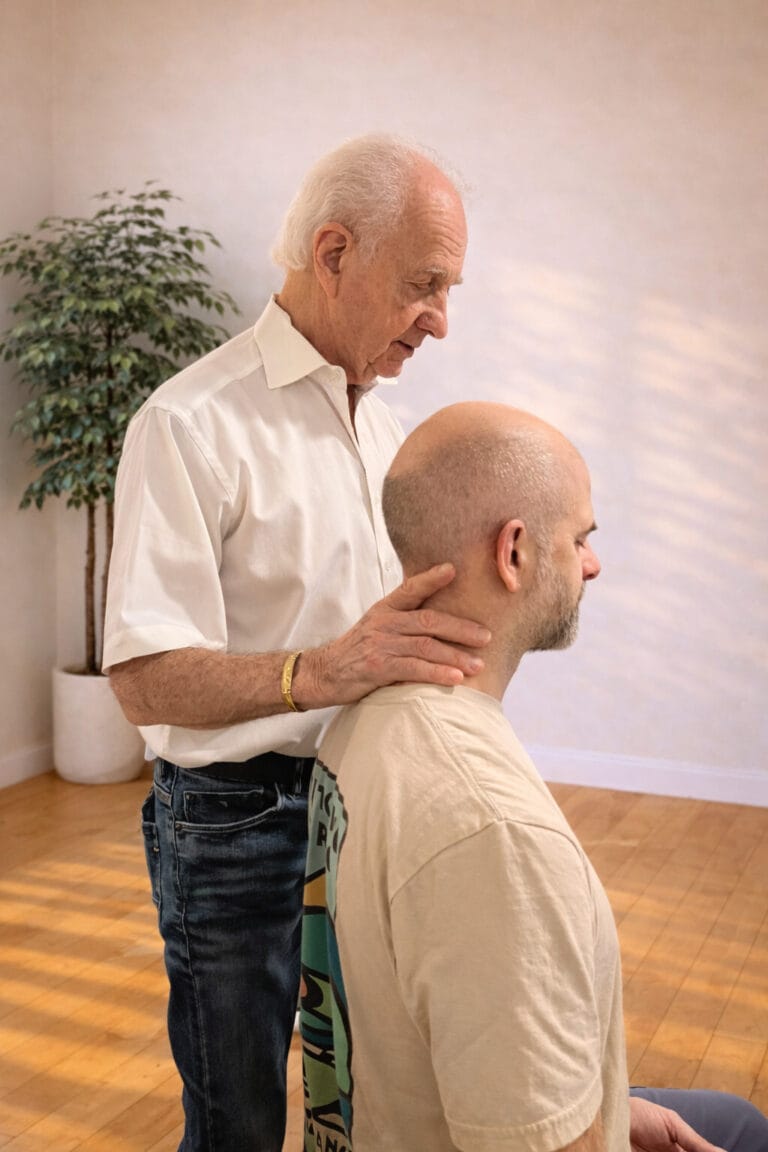
5. “You’re suggesting that when you put your hands on the person, you’re not trying to change the person’s use. You’re introducing another way of being with oneself, given what the person is doing. That includes maladaptive behavior, inappropriate use—inappropriate given the design of the body—and it also includes personal narrative.”
➤ Hands-on work is described as an educational encounter that broadens perception without correcting or overriding the student’s experience.
6. “It means that both of you are not seeing this work as an attempt to change a person. You both are talking about introducing, in different ways, the possibility of being different while they’re doing what they do, because it might affect the way they perceive what they’re reading.”
➤ Change is positioned as an emergent outcome of altered perception rather than a goal imposed on behavior.
7. “You want to introduce enough of a possibility so that while they are cooking, they might explore who they are—rather than satisfying what they think they need to satisfy while they’re cooking or washing dishes or mothering—because you are exploring who you are, always.”
➤ Ordinary activities become sites of inquiry when attention shifts from task completion to ongoing self-use.
8. “You’re not a therapist. You’re not a physician. You’re not a neurologist. You’re not any of these things. You’re an Alexander Technique teacher. And what does the teacher do? The teacher illuminates. The teacher brings light into your brain.”
➤ The teacher’s role is to clarify perception, allowing choice and coordination to emerge where habit once operated automatically.
4. Practical Tips for Everyday Life
What’s the Goal?
The goal is not to do daily activities better.
It is to introduce the possibility of being with yourself differently while you are already doing them.
In Tommy’s teaching, the work does not wait for special conditions. The activity you are already engaged in—reading, cooking, working—is enough. What matters is whether you can perceive yourself within it.
How to Practice
Choose one simple activity you will do today anyway—washing dishes, making tea, reading a few lines, or beginning your work.
Start exactly as you always do. Do not adjust posture or try to improve anything.
As the activity continues, let your attention widen just enough to include yourself. Notice how you are experiencing yourself while doing the task.
If you sense an urge to hurry, fix something, or get it right, do nothing about it. Let that impulse pass, and continue with the activity for a few more seconds than feels familiar.
What You’ll Notice
You may notice very little at first, or you may notice how quickly habit takes over. Both are part of the work.
Occasionally, you may sense a small shift—less effort, more space, or a clearer sense of yourself while doing something ordinary.
The work is not to hold on to these moments, but to recognize that they are possible—right in the middle of life.
From there, as Tommy’s work suggests, change does not need to be made to happen. It emerges, if it emerges, through clearer perception.
5. Closing the Class
This class did not aim to conclude with answers. Instead, it returned everyone to a more essential recognition: in the Alexander Technique, education is not about producing change, but about clarifying experience.
Again and again, the focus moved away from outcomes and back toward perception—toward how a person is already meeting themselves in activity. In that sense, the class did not truly end. It simply widened the field in which the work continues.
Key Takeaways
Tommy said, “You cultivate your patterns of behavior. They have little to do with where you want to function.”
This was not presented as a problem to fix, but as a fact to understand. Habit does not yield to intention, and wanting to function differently does not alter how one actually functions.
As Tommy often reminded the class, this recognition is not limiting. It is freeing. When effort is no longer mistaken for change, attention can return to what is actually happening.
Core Insights
Tommy said, “You’re not trying to change her use. You’re introducing another way of being with herself, given what she’s doing.”
With this, the meaning of teaching shifted throughout the class.
As Tommy often emphasized, the teacher does not correct or intervene. The work is educational: to illuminate what is already present so that perception may reorganize. From there, change may occur—or it may not.
A Final Invitation
Tommy said, “The teacher illuminates. The teacher brings light into the brain.”
This was not offered as poetry, but as a precise description of the work.
As Tommy often reminded the class, this illumination does not happen apart from life. It happens in reading, cooking, working, and relating—exactly as life is already unfolding.
The invitation at the close was simple: to remain with yourself as you are, and to allow the possibility of being different to appear without force, correction, or demand.

6. One Key Practice
The single most important practice from this class is this:
Stay with yourself as you are, in the middle of what you are already doing.
Choose an ordinary moment—reading a sentence, washing a cup, opening a door. Do not change anything. Simply notice how you are present within the activity.
The practice is not to improve or correct.
It is to recognize, even briefly, that another way of being with yourself is possible right there. That recognition is enough.
7. Three Questions to Ask Yourself
These questions are meant to be asked while you are in the activity, not afterward.
- What am I actually doing right now, beyond the task itself?
- Am I trying to fix something, or can I simply notice what is happening?
- Is there room, even briefly, to experience myself differently here?
Asked gently, these questions function as Tommy’s teaching does: not to produce answers, but to invite awareness into the present moment.
8. For Those Who Wish to Learn More
Recommended Books
Touching Presence – Tommy Thompson
This book deepens the heart of what this class explored: teaching not as correction, but as illumination. Tommy shows how touch, attention, and presence can offer the possibility of exploring yourself without imposing change—especially in the middle of ordinary activity.
If this class opened a new question for you—how perception can shift while you are reading, cooking, working, or caring for someone—Touching Presence gives a grounded path into that lived inquiry.
Official Website of Tommy Thompson
www.easeofbeing.com
This is the official website personally managed by Tommy Thompson, offering a wide range of resources and programs to deepen your understanding and practice of the Alexander Technique:
- Private session reservations and inquiries
- Workshop and seminar schedules
- Overview of international teacher training programs
- Essays and articles on the Alexander Technique
9. Next Class Sneak Peek
A quieter layer begins to come into view—where perception is shaped before choice, and habit forms before action. The next class turns toward Personal Narrative, revealing how meaning and interpretation subtly guide use without being noticed.
It invites a sharper inquiry: not into what you do, but into the story already shaping the moment.
In Class 85, we’ll explore:
Personal Narrative as the unseen organizer of experience.
10. Join the Alexander Technique Journey
Did this class leave a small resonance within you? Feel free to quietly hold it in your heart or share it in just a sentence or two. The comments are always open. Your one simple word may leave a gentle ripple in this ongoing journey.The journey of Resonance Flow continues across social media as well. Let’s continue this journey together.
 YouTube
 Instagram
 Threads
 Facebook