Stillness Before Movement: The Hidden Power Within | Tommy Thompson Class 56
❝ What if the body already knows… and all you have to do is stop, and listen? ❞
Not fix.
Not guide.
Not adjust.
Just stop.
Let your hand rest.
Let your seeing soften.
Let your agenda fall quiet.
And in that pause—in that still point of flow—something happens. Not because you made it happen,
but because you finally got out of the way.
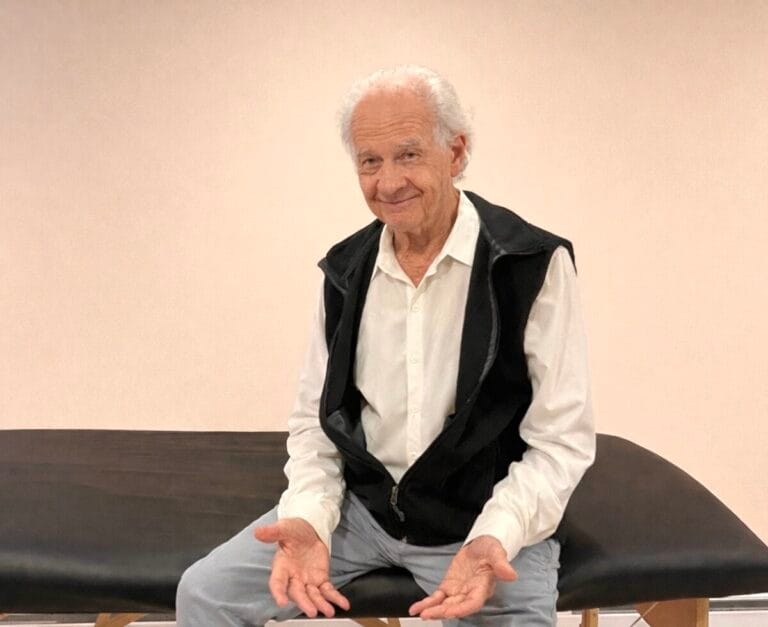
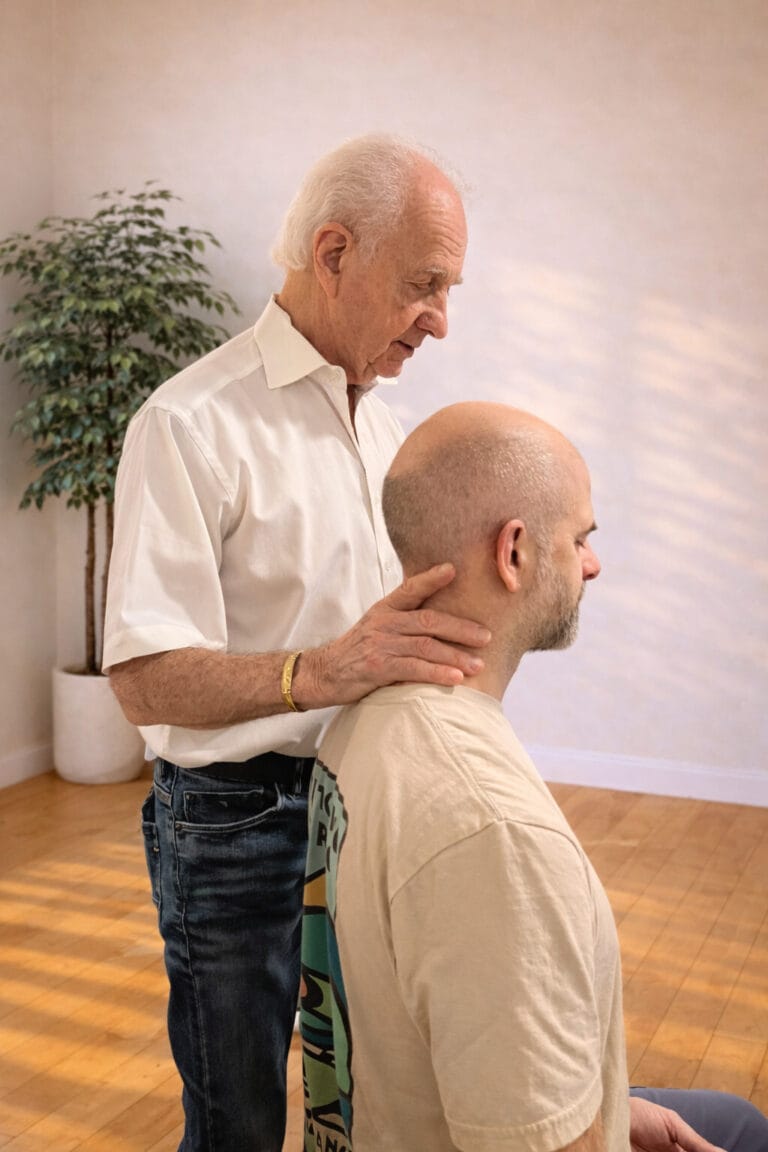
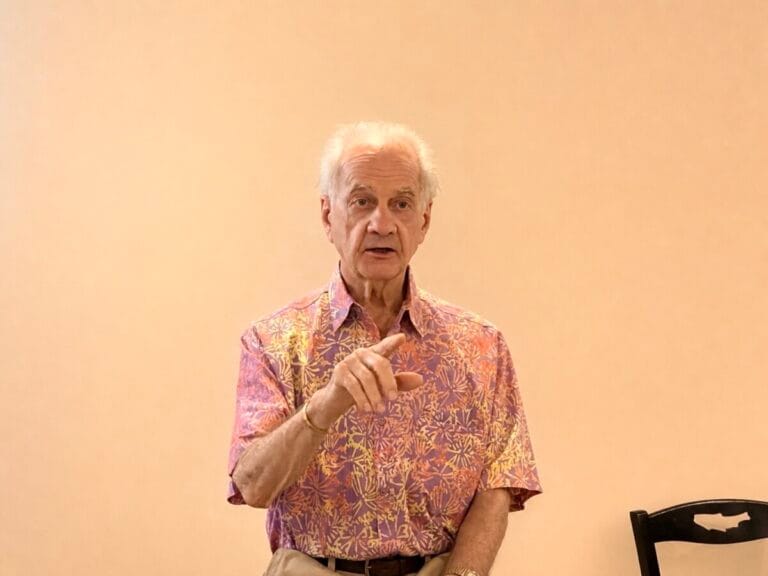
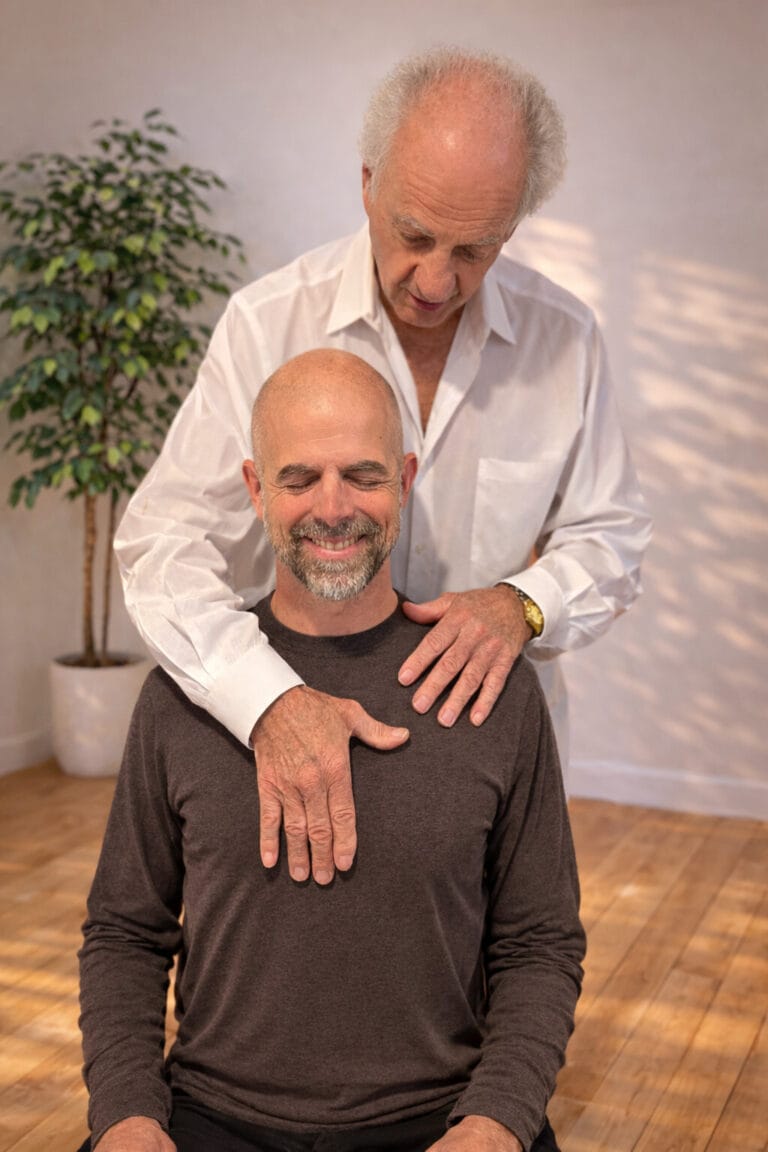
On April 2, 2025, in Boston, Massachusetts, USA, Tommy Thompson led a class in the Alexander Technique teacher training course that began not with movement—but with a pause.
With the question:
“What if your presence does more than your pressure?”
This wasn’t about helping someone move better.
It was about learning how to be with them, exactly where they are, and to feel what unfolds when you stop trying to make anything happen at all.
Because in the Alexander Technique, what reorganizes us isn’t force. It’s attention. Permission. Presence. And beneath all of it—stillness.
Key Objectives of the Class:
- To experience stillness not as absence, but as the organizing center of change
- To explore touch as a perceptual act, not mechanical technique
- To practice withholding definition in order to see what’s actually there
- To understand that all true support begins with your own inner state
- To encounter triadic resonance as a physical, emotional, and relational language
This blog series is based on Tommy Thompson’s Alexander Technique classes. Each post follows the flow and insights of the class to expand both self-awareness and practical consciousness applicable to everyday life.
New here?
If you’re new to the Alexander Technique, you can start with the resources below.
Alexander Technique Class Flow at a Glance

1. The Opening Question
❝ What if your greatest impact came not from what you do—but from how you wait? ❞
In this class, we weren’t learning how to correct, guide, or even improve someone. We were learning how to wait. How to suspend the impulse to act—just long enough to feel what’s already there.
That space… between intention and action, between breath in and breath out, between reaching and actually touching—that space is where everything reorganizes.
It’s not a technique.
It’s not a posture.
It’s not something you add.
It’s stillness—and it’s already moving inside you.
The question Tommy posed was not how to teach better.
It was how to meet more truthfully.
How to stand in the moment without moving it forward.
How to touch someone without needing to shift them.
How to hold the moment long enough for it to teach you something.
“Change happens in the pause—not in the doing.”
→ This captures Tommy’s core philosophy: it is the suspension, not the action, that holds the power to transform. The pause is not a gap; it’s the medium of the Alexander Technique itself.
2. Core Learnings from This Class
Core Concepts
- Touch is perception, not correction
In this class, touch was taught not as a method of adjusting, but as a perceptual act—a way to listen, witness, and recognize what the body already reveals. - Stillness is where transformation begins
Stillness is not passive. It’s a dynamic pause—a moment charged with potential. This is the still point of flow, where nothing is forced and everything reorganizes itself. - You are the work
Change doesn’t begin in the trainee. It begins in you. Your posture, breath, tone, and attention are the real instruments—not your hands or your corrections.
Five Key Messages
- Meet, don’t modify.
Don’t pull someone toward a goal. Bring your attention to where they already are. That’s where learning begins. - Change happens in the pause.
The nervous system is most receptive in the still moment before action. Transformation doesn’t begin with the doing—it begins before. - Support from presence, not pressure.
Real help doesn’t come from movement. It comes from your ability to stay, witness, and offer permission without interference. - Withhold definition.
Resist the urge to interpret what you see. The space of not-knowing often reveals more than premature analysis ever could. - Consciously engage your self-use.
In the Alexander Technique, change begins in you. Your coordination—how you stand, breathe, and relate—is your most powerful tool. It’s not your hands that teach, but your presence.
Essential Terms
- Touch
A relational, tactile act of recognition and resonance—not manipulation. In Tommy’s teaching, touch becomes a perceptual language, felt through intention more than technique. - Stillness
A living pause where action has not yet begun or ended. It’s the space between inhale and exhale—the place of deepest receptivity. - Presence
A state of conscious, embodied awareness in the present moment — fully engaged physically, mentally, and spiritually, without distraction or judgment. - Triadic Resonance
A sensory-based method using Tommy Thompson’s signature “1-2-3” palm rhythm to engage the neuromuscular system—inviting deep, non-forceful repatterning through embodied safety and awareness. - Use
A central Alexander Technique concept: how you organize your whole self—body, mind, and attention—in relation to what you’re doing. - Inhibition
The conscious stopping of automatic response. It creates space for something new to emerge from within stillness. - Recognition
The heart of this class. The act of seeing someone not as a problem to solve, but as a person to accompany—with stillness, not agenda.
3. Tommy’s Insight
In Tommy’s words during class, there are not only the core principles of the Alexander Technique, but also practical wisdom that can be applied directly to daily life. His words go beyond simple advice about movement and prompt us to deeply consider how we choose to exist.➝ The act of immediate perception is powerful, but the deeper wisdom lies in the ability to pause—resisting the habitual urge to categorize, and instead allowing contact to reveal meaning.
➝ Transformation doesn’t begin in the student. It starts in you—your perception, your organization, your presence. The complexity lies in holding this while staying responsive.
➝ The most essential space in teaching is the pause between impulse and action. It’s not suppression—it’s freedom born from choosing to stay in awareness.
➝ Withholding doesn’t reject clarity—it delays it in service of deeper truth. The pause before definition is where perceptual precision is born.
➝ The integrity of learning arises from being met exactly as you are. The teacher’s role is not to generate experience but to hold space for self-discovery.
➝ This is not a poetic metaphor—it’s a physiological and perceptual event. The still point of flow is where intelligence reorganizes before movement ever begins.
➝ Teaching isn’t intervention—it’s resonance. When your own stillness meets hers, the body finds its way without being directed.
➝ The purest form of transmission is presence. The moment you are fully yourself, the invitation becomes clear, and the teaching lands where it belongs.

4. Practical Tips for Everyday Life
What’s the Goal?
To bring the awareness cultivated in the Alexander Technique into real-life presence—especially in moments when you’re tempted to rush, fix, or fill the silence.
This class showed us that transformation doesn’t require effort.
It asks for a different kind of attention, shaped by stillness.
How to Practice
- Pause before reaching
Before you reach to pick something up or touch someone, pause. Notice what arises before movement. This isn’t hesitation—it’s presence in its purest form. - Hold space in conversation
When someone stops speaking, don’t fill the gap.
Let the moment breathe. Rest your attention in the pause—it’s a still point in relationship. - Stand still with yourself
Stand without fixing or performing.
Drop the urge to correct.
Listen to what’s already aligning.
Your body organizes you—if you let it.
What You’ll Notice
As you practice conscious pausing, you’ll realize you don’t need force to move or tension to feel present.
What you’ve been trying to create has been quietly available all along—beneath the doing.
5. Closing the Class
Key Takeaways
This class wasn’t about doing more. It was about entering a state of non-doing—where presence replaces correction, and stillness becomes the source of action.
It reminded us that withholding is not absence—it’s attention without interference. Can you stay long enough with what you see, without rushing to change or define it?
In the Alexander Technique, the pause before movement isn’t neutral.
It’s alive.
It listens.
It reorganizes without effort—because the body already knows.
Core Insights
What Tommy revealed again and again was this:
You don’t need to reorganize or instruct. You need to be still enough, aware enough, to meet the person where they already are.
When your own stillness is present, it speaks before words do.
And in that shared pause, something essential aligns—without force.
Stillness isn’t where movement ends—it’s where true movement begins. It’s the point between inhale and exhale, where knowing arises without being named.
A Final Invitation
As you leave this class, don’t try to carry a method. Carry a way of being.
Ask yourself:
Can I stay present inside non-doing, long enough for the body to show what’s already true?
That’s where the Alexander Technique becomes more than form.
it becomes relationship.
It becomes perception.
It becomes a way of meeting life.
6. One Key Practice
Let your touch begin before your hands move
Before your fingers reach, before your body leans in,
let awareness arrive first. Let the space between you and the other become full—not with intention, but with attention.
You don’t need to add anything. You just need to let something that’s already there be known—quietly.
This is non-doing in action.
The act becomes an invitation.
The pause becomes a teacher.
7. Three Questions to Ask Yourself
- Where does movement begin—before I move?
➝ Can I sense the shift—before it becomes motion?
Not muscle, not idea. Just the body preparing to begin. - Am I offering stillness, or reaching for change?
➝ In my touch, is there a need to guide—or a willingness to meet?
What happens if I let stillness do the listening? - Can I stay present with what I don’t yet know?
➝ Can I stay with the pause—without filling it?
That’s where the Alexander Technique lives:
Not in what I do, but in how I wait.
8. For Those Who Wish to Learn More
Recommended Book
Four Quartets – T.S. Eliot
This book isn’t about the Alexander Technique—but it speaks to its deepest heart. In Burnt Norton, Eliot writes:
“At the still point of the turning world… there the dance is.”
Tommy didn’t just borrow this phrase. He expanded it—into what he called “the still point of support.” Later, Ari echoed it as “the still point of flow,” and Tommy agreed: “She was right.”
It was no longer just poetic. It became physical. Perceptual. Trainable.
That stillness is not absence—it’s the beginning of intelligent movement.
It’s what Tommy described as “something already moving quietly within the body… a point where you’re neither moving toward nor away… where motion hasn’t begun, and hasn’t ended. You can’t grasp it—but the body knows it.”
If you’ve ever sensed something quiet and alive in your body before motion begins, you’ve already met the place Eliot described—and the one Tommy taught us to recognize.
This book won’t teach you how to move. But it may show you how to see.
Official Website of Tommy Thompson
www.easeofbeing.com
This is the official website personally managed by Tommy Thompson, offering a wide range of resources and programs to deepen your understanding and practice of the Alexander Technique:
- Private session reservations and inquiries
- Workshop and seminar schedules
- Overview of international teacher training programs
- Essays and articles on the Alexander Technique
9. Next Class Sneak Peek
What if the most powerful change you can make… is to stop making one?
In the next class, Tommy leads us into the heart of the Alexander Technique: the quiet force of inhibition, and the invisible clarity of direction. We’ll explore how true change doesn’t come from effort or correction—but from choosing not to repeat what’s always been done.
When we stop interfering, direction becomes possible.
Not as a command—but as a thought the body can respond to.
In Class 57, we’ll explore:
How inhibition and direction work together to restore natural coordination—without doing.
10. Join the Alexander Technique Journey
Did this class leave a small resonance within you? Feel free to quietly hold it in your heart or share it in just a sentence or two. The comments are always open. Your one simple word may leave a gentle ripple in this ongoing journey.The journey of Resonance Flow continues across social media as well. Let’s continue this journey together.
 YouTube
 Instagram
 Threads
 Facebook