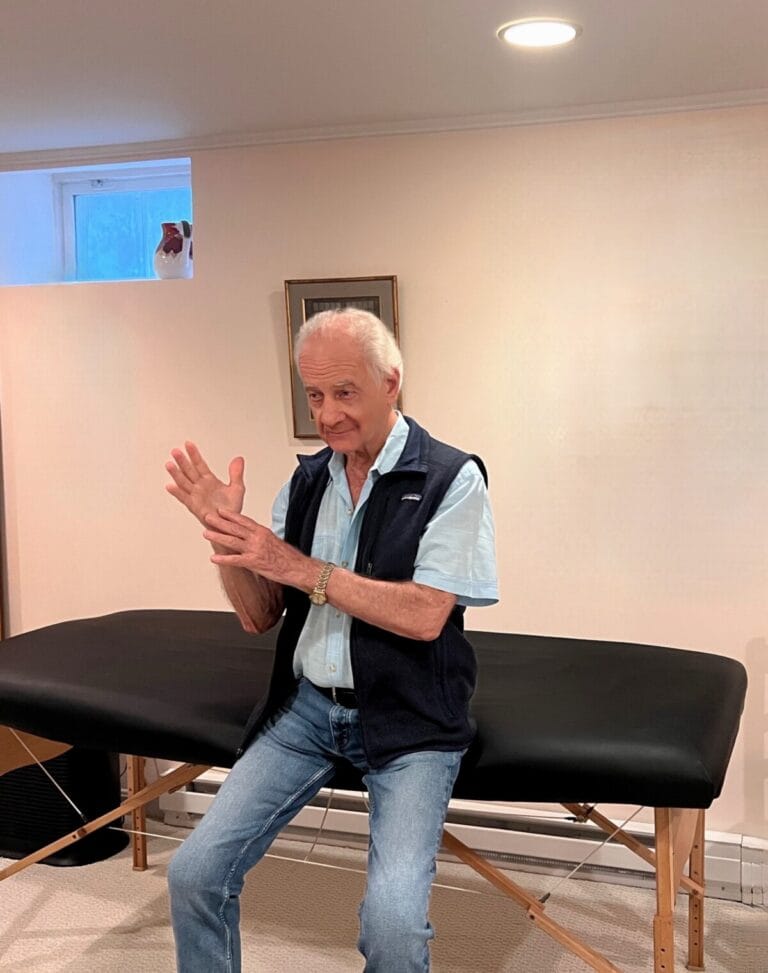
Withholding Definition; What Happens When You Stop Naming Everything? – Tommy Thompson Class 53
❝ What if the moment you name what you’re tasting, you’re no longer actually tasting it? ❞
You think you already know the taste of chocolate. You think you know the person as you look at them in front of you. You think you know the feeling in your hand as you hold your smartphone. But do you really? Or are you just naming it—before you’ve actually felt it?**
That’s the question we explored in this Alexander Technique training class. It wasn’t about trying to be mindful or slowing down just to be kind to yourself. It was a discipline. A perceptual reset. A practice of withholding definition—so that something real, something unfiltered, could actually show up.
On March 26, 2025, in Boston, Massachusetts, Tommy Thompson led the class, inviting trainees to pause—not because they didn’t know, but because they thought they did. And that’s the problem.
We practiced tasting again. Looking again. Touching again.
Not knowing. Just noticing. Letting it show up.
Key Objectives of the Class:
- To experience withholding definition as an embodied form of awareness
- To integrate inhibition not just in movement, but in perception
- To uncover moments of authentic presence in familiar routines
This blog series is based on Tommy Thompson’s Alexander Technique classes. Each post follows the flow and insights of the class to expand both self-awareness and practical consciousness applicable to everyday life.
New here?
If you’re new to the Alexander Technique, you can start with the resources below.
Alexander Technique Class Flow at a Glance

1. The Opening Question
❝ What if you keep missing the person right in front of you—because you already decided who they are? ❞
You reach out. You place your hands. You think you’re sensing the person. But what if you’re not? What if you’re only feeling your own definition—the one you’ve already built, moment after moment, memory after memory?
This particular Alexander Techniqueclass took that question head-on.
Not with theory, but with touch. Not with explanation, but with presence. Each moment, we were invited to withhold what we already “knew” and discover what might be right in front of us.
“You’ve done it so many times. But don’t do it like you know it.”
Tommy’s Word
“When you place your hands on him, you will withhold defining what you perceive. The moment you touch him, you’ve already defined him.”
Tommy doesn’t teach you to define. He teaches you to wait. To feel. To not name too soon. Because real contact doesn’t happen when you know—it happens when you stop needing to.
2. Core Learnings from This Class
Core Concepts
- Withholding definition is not about resisting clarity—it’s about creating space for deeper perception to arise.
→ By not rushing to label what we experience, we allow the present moment to reveal more than habit ever could. - Inhibition is not stopping an action, but interrupting a reaction.
→ It’s the split-second choice to pause automatic behavior, creating room for deliberate coordination. - Sensory integrity returns when we trust the body to function as designed, without interference from fixed ideas.
→ The organism knows how to taste, sense, and relate—when we stop telling it how it should feel.
Five Key Messages
- You don’t always need to define what you perceive.
➝ Withholding opens a pathway to direct, unfiltered contact with experience. - Presence cannot coexist with pre-definition.
➝ The moment you name it, you’re no longer with it. - Inhibition begins as a question: Do I need to do this the way I’ve always done it?
➝ That question disrupts the habitual, and invites something new to emerge. - What you think you know often blocks what you could discover.
➝ Letting go of “knowing” is a skill, not a surrender. - Touch becomes meaningful when it suspends judgment.
➝ In the Alexander Technique, hands-on work isn’t just about placing your hands—it’s about how you deliver attention through contact
Essential Terms
- Withholding Definition
The conscious act of not immediately labeling sensory input or experience, allowing perception to deepen and shift. Not the absence of definition, but a pause in its timing. - Inhibition
A foundational Alexander Technique skill involving the interruption of automatic reactions. It enables new patterns of coordination and perception. - Sensory Integrity
The innate capability of the body to perceive, coordinate, and respond accurately—once freed from habitual interference. - Direction
The intentional, internal cueing used to guide the body toward ease and balance without controlling it mechanically. - Present-Time Inquiry
A continuous process of observation and responsiveness that starts from now, not from memory or expectation. - Embodied Connection
The felt experience of relating—whether to another person or to oneself—without preempting that experience through definition or narrative.
3. Tommy’s Insight
In Tommy’s words during class, there are not only the core principles of the Alexander Technique, but also practical wisdom that can be applied directly to daily life. His words go beyond simple advice about movement and prompt us to deeply consider how we choose to exist.“Inhibition is saying, ‘No, I don’t need to sit at the computer in the way that I’m sitting.’ It’s habitual. That’s an inhibited moment. You couple that with directions to an area of your body that regulates—nanosecond by nanosecond—postural reflexes that position you in the best possible way, given what you’re doing, to accommodate doing it in the easiest, most effective way.”
➝ Inhibition isn’t restraint—it’s a conscious redirection away from habitual reaction, toward dynamic balance in action.
“There’s subtle things in there that you’re not seeing if you’re doing what you know to do. In this work, inquiry is about now.”
➝ True inquiry, in the Alexander Technique, begins the moment you stop relying on what you think you already know.
“So every time that you define what it tastes like, continue to withhold defining it. Let another taste come up. Withhold—another taste will come up, etc. Try it.”
➝ Sensory intelligence deepens when you stop labeling and start listening to the experience as it unfolds.
“Taste buds are tasting more than you taste. So you are—you are letting the integrity of the organism, as it’s designed—the taste buds, the hearing, the smell—function more completely the way they’re designed to function.”
➝ Your body is wiser than your narrative; releasing definition lets perception return to its full design.
“Withholding definition never means that you don’t define. What you do is withhold, and then in the moments when you recognize, ‘Hey, this is really needed right now—’”
➝ Withholding definition is the pause that makes true recognition possible—it’s not about refusal, it’s about readiness.
“When you place your hands on partner, you will withhold defining what you perceive. The moment you touch him, you’ve already defined him.”
➝ The hands don’t just make contact—they interpret. Unless you pause, you’re not touching the person—you’re touching your assumptions.
“So there’s a lot to practicing this stuff—withholding definition. And at the same time, you have to know where you’re putting your hands, why you have your hands there, why you moved to another place at a particular moment—you have to know exactly what to do to engender a free release from this particular area of the body—wherever you have your hands. But if you only do that, you’ve limited true connection with the person you’re working—”
➝ Technique without presence becomes routine; presence without withholding becomes projection.
“Can’t let himself feel better. So it’s me withholding defining him, in a way that he insists on defining himself. I let you do it—it lets you—outside of teaching, because there is that you—outside of teaching, know when to withhold defining yourself the way that you are defining yourself.”
➝ Transformation begins when neither teacher nor student holds the other in a fixed identity—not even their own.

4. Practical Tips for Everyday Life
What’s the Goal?
To pause the urge to define before sensation even arrives—and let the moment reveal itself.
This chocolate practice was done live with trainees in a class led by Tommy Thompson. It’s not about eating differently. It’s about perceiving newly—before your habits rush in. From taste and smell to people’s personalities, we often assume we already know what we’re encountering. But the act of withholding definition gives experience space to show up on its own.
How to Practice

Chocolate Practice: 5 Steps to Withhold Definition
- Before it touches your mouth, the definition comes first
You’re holding the chocolate. Your mind’s already saying:
“It’s probably milk chocolate.” “It’ll be sweet and smooth.”
→ At this point, you’ve already started defining the experience. “That moment, I realized—I’m holding a definition.” - The moment you taste it, expectation takes over
As it hits your tongue, you’re not tasting the actual chocolate—
your memory is supplying the taste instead.
→ You follow anticipated sensation, not actual perception. “I’m telling myself what to taste—and that overrides what the taste buds are actually tasting.” - Withhold that definition
Just when you’re about to name the flavor—pause.
Don’t analyze. Don’t judge.
→ Let sensation lead. “Keep withholding definition. Then another taste will show up. Withhold again—something else comes.” - When a new taste arises, withhold again
Don’t lock into what you first noticed.
→ Let that pass, and let the next sensation arise naturally. “If you don’t define it and just wait, the experience shifts on its own. You’re letting the sensation speak to you.” - Shift from ‘knowing the taste’ to actually tasting
With each round, the same chocolate reveals something new.
→ This isn’t just a taste practice—it’s a way to meet life freshly. “The taste buds are tasting more than what you think you’re tasting. As long as you don’t interfere.”
What You’ll Notice
You might begin to notice subtle acidity, layered textures, or even a temperature contrast you hadn’t felt before.
Time may feel slower—not because you’re doing less, but because you’re sensing more. This isn’t just about taste—it’s a quiet training in attention.
And just like with people, movement, or breath—what happens when you don’t name it right away?
You don’t just recognize it—you actually meet it.
5. Closing the Class
Key Takeaways
In this class, we weren’t told what to do. We were invited to pause what we already do—and in that pause, notice. We practiced staying with the moment without rushing to name, solve, or conclude. That alone began to change how we moved, how we listened, and how we touched.
Withholding definition isn’t a concept—it’s a way of being.
It’s the practice of staying close to experience without boxing it in. This is at the heart of the Alexander Technique:
an invitation to experience life not by controlling it, but by meeting it.
Core Insights
- You don’t need to define what you feel to be with it.
- The moment you stop predicting, sensation returns.
- Support comes from presence, not posture.
- Connection is not given—it’s cultivated by not rushing to know.
Each of these is not just a concept—it’s a real-time skill you can use in daily life, whether you’re moving, listening, speaking, or simply being. And when practiced, this way of attending supports wellness in the deepest, least performative sense of the word.
A Final Invitation
What if you began each movement or word as if it were the first time?
What would happen if you stopped telling the moment what it is—and let it tell you instead?
That’s what this class asked of you.
Not to improve. Not to perfect.
But to be here—without the pressure to already know.
6. One Key Practice
Pause before naming. Let the moment name itself.
Whether it’s a taste, a thought, a movement, or a person—hold back your definition, just long enough to notice what’s actually there.
This is the muscle we’re building: presence before pattern.
One breath. One moment.
That’s all it takes—for the world to meet you before you rush to define it.
7. Three Questions to Ask Yourself
Ask these not to analyze the past, but to enter the present:
- What am I already defining before I even begin?
➝ Notice how quickly the mind assigns names, roles, meanings. - Where do I feel a need to finish before I’ve fully sensed?
➝ Ask this mid-action—not after. It brings you back to now. - Can I stay in not-knowing long enough for something real to show up?
➝ That’s where the Alexander Technique begins—not as a form, but as experience.
8. For Those Who Wish to Learn More
Touching Presence – Tommy Thompson
This is not a book of instructions—it’s a book of invitations.
Drawing on over 50 years of teaching the Alexander Technique, Tommy shares vivid stories, teaching dialogues, and distilled moments that reveal how presence becomes touchable.
His approach isn’t about fixing posture—it’s about creating the conditions for someone to remember themselves.
In the same way we practiced withholding definition in class, Touching Presence encourages us to pause, notice, and meet each moment—without assumption. It’s less about technique, and more about encounter: a quiet return to what’s already whole.
If today’s class stayed with you, this book will stay with you longer.
Official Website of Tommy Thompson
www.easeofbeing.com
This is the official website personally managed by Tommy Thompson, offering a wide range of resources and programs to deepen your understanding and practice of the Alexander Technique:
- Private session reservations and inquiries
- Workshop and seminar schedules
- Overview of international teacher training programs
- Essays and articles on the Alexander Technique
9. Next Class Sneak Peek
What happens when we stop trying to fix movement—and start noticing the direction of attention that shapes it?
In the next class, Tommy shifts the focus to how attention precedes action, and how the way we prepare—mentally, physically, emotionally—becomes the shape of what follows.
This isn’t about “thinking before moving.” It’s about learning to think with the body, in real time, without rush, without control.
We’ll step into the space between intention and execution—
where habit usually takes over— and ask: What else could begin here, if we didn’t do what we always do?
In Class 54, we’ll explore:
- The invisible moment of preparation before movement
- How to sense and trust the shift in attention
- Why your coordination follows your direction—not your muscles
10. Join the Alexander Technique Journey
Did this class leave a small resonance within you? Feel free to quietly hold it in your heart or share it in just a sentence or two. The comments are always open. Your one simple word may leave a gentle ripple in this ongoing journey.The journey of Resonance Flow continues across social media as well. Let’s continue this journey together.
 YouTube
 Instagram
 Threads
 Facebook