Relational Self: The Missing Key in How You Move and Connect | Tommy Thompson Class 69

❝ What if changing your posture matters less than remembering who you are while you move? ❞
We don’t come to the Alexander Technique to fix ourselves—we come to remember ourselves. Not as isolated bodies trying to stand up straighter, but as whole beings, already in relationship with gravity, space, and the people around us.
And that’s the shift Tommy Thompson invites us into—not from bad use to good use, but from automatic doing into a deeper being in support. In his teaching, movement is never just mechanical. It’s a question of identity, of presence, and of how we relate from the inside out.
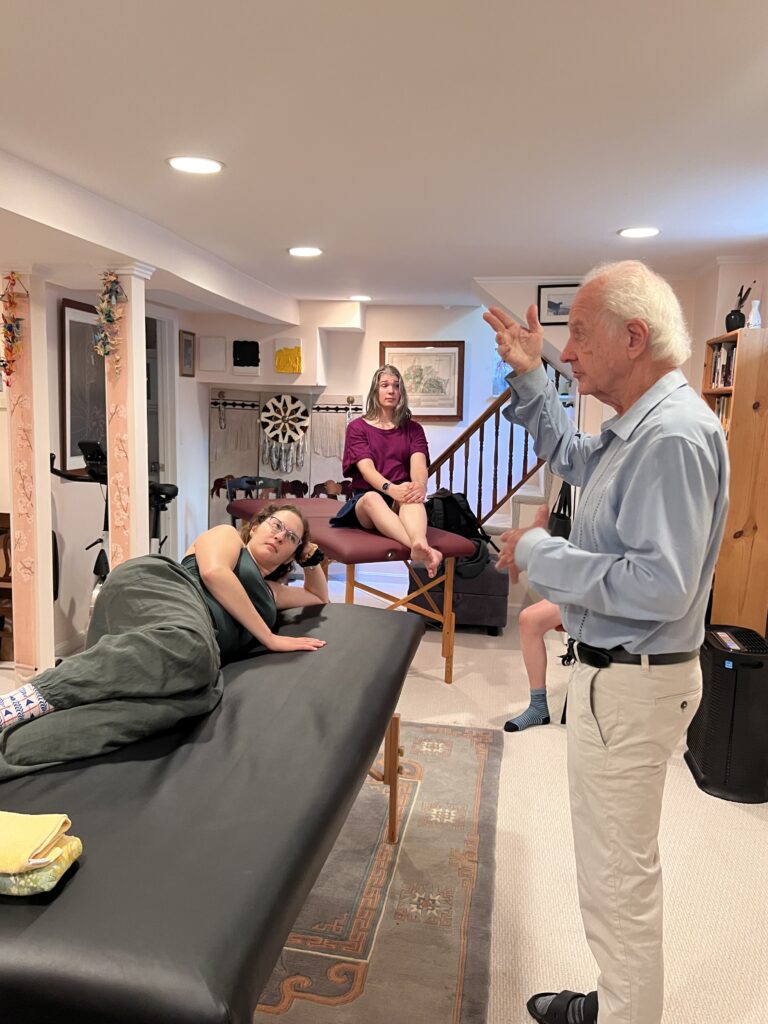
On September 2, 2025, in Boston, Massachusetts, USA, Tommy Thompson led a class in the Alexander Technique teacher training course that unfolded more like a philosophical inquiry than a lesson on movement. But every question came back to the body. And every answer lived in sensation.
This wasn’t a class about how to “do” the Alexander Technique. It was about how to live it—in your kitchen, on a table, in dialogue with a student, or alone with your breath. A class where “the self” wasn’t just a concept, but something you could feel, moment by moment.
Key Objectives of the Class:
- Reframe the Alexander Technique as a path to reclaiming the relational self, not just optimizing use
- Explore how support arises through letting go, not control
- Cultivate perception and presence as the real instruments of transformation
This blog series is based on Tommy Thompson’s Alexander Technique classes. Each post follows the flow and insights of the class to expand both self-awareness and practical consciousness applicable to everyday life.
New here?
If you’re new to the Alexander Technique, you can start with the resources below.
Alexander Technique Class Flow at a Glance
1. The Opening Question
❝ What part of you is actually learning—your body, your mind, or your ability to relate? ❞
In many training methods, we aim to improve something—how we stand, how we move, how we look. But in this Alexander Technique class with Tommy Thompson, the invitation was different: not to adjust ourselves, but to become aware of the part of us that is in relationship.
Are you learning a technique? Or are you learning how to be in contact with yourself—and through that contact, with the world?
This wasn’t a class in better use. It was a class in self-recognition, in learning how to listen for what’s underneath the doing, and how to let that presence guide your next move.
Tommy’s Words
“You’re giving the person the opportunity to simply experience being, in relation to whatever they’re having as an experience, without trying to accomplish something.”
Tommy doesn’t teach us to fix or perform. He guides us toward a space where being becomes the source of action, not the other way around.
In that shift, we stop working on ourselves—and begin working with ourselves, relationally, consciously, moment to moment.
2. Core Learnings from This Class
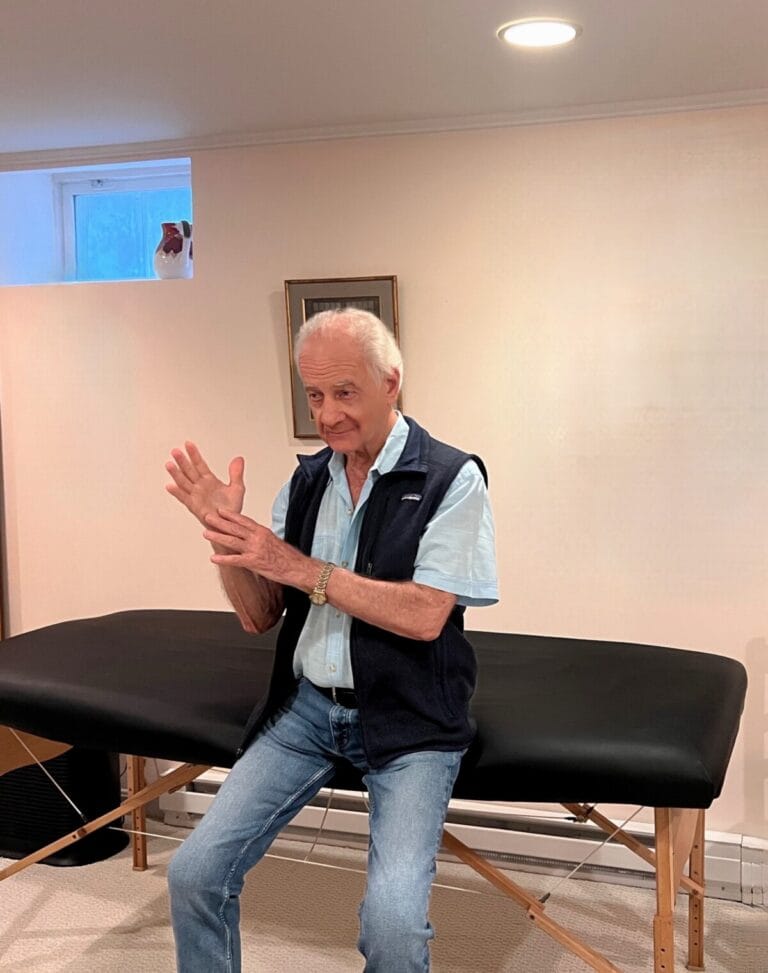
In this moment from Tommy Thompson’s class, trainees explore the idea of the relational self—how the organism organizes itself through relationship rather than control.
Instead of trying to perform “forward and up” correctly, the work invites a shift in attention where effort and fixed ideas begin to drop away.
Watch how movement reorganizes when the body is allowed to respond through trust and relationship.
Alexander Technique: Your Body Already Knows
Class 69 · September 2, 2025 · Boston, MA
Core Concepts
- Relational Self over Correct Use
The class redirected attention from “doing it right” to discovering who is moving and how that self is relating—to gravity, to others, and to space. - Support as Being, not Effort
Rather than building strength, students explored how support arises naturally when the body is not interfered with—especially through slow-twitch muscle fibers. - Awareness Before Technique
Change begins not through willpower, but through kinesthetic recognition—a felt noticing of habitual patterns in thought, posture, and perception.
Five Key Messages
- “Use” is not the whole story. The self, in relationship, is what transforms use into meaning.
- You don’t “bring in” the Alexander Technique—you return to what was always supporting you.
- Inhibition is not about stopping. It’s about leaving space for something new to emerge.
- Your body already knows. The brain will take you back—if you don’t get in the way.
- Relating to yourself, others, and gravity is not the result—it is the work.
Essential Terms
- Relational Self
Not a fixed identity, but a living process of being in connection—with gravity, with others, and with presence. Tommy returns to this again and again. - Being in Support
Support isn’t something you create—it’s something you uncover by letting go of fast-twitch striving. It’s felt, not forced. - Kinesthetic Recognition
The body knows before the mind explains. This is the starting point for all meaningful transformation in the Alexander Technique. - Inhibition
Less about stopping, more about not continuing. Tommy redefines inhibition as a soft refusal to repeat the known pattern, leaving room for the unexpected. - Cellular Consciousness
Tommy’s unique term, referring to the intelligence of the body itself. It’s not metaphor—it’s where real dialogue begins.
3. Tommy’s Insights
In Tommy’s words during class, there are not only the core principles of the Alexander Technique, but also practical wisdom that can be applied directly to daily life. His words go beyond simple advice about movement and prompt us to deeply consider how we choose to exist.“The emphasis is not entirely on use; the emphasis is now more on self, which is what we talk about. And there’s a combination of the two that takes care of the whole.”
“Early teaching focused on using yourself as closely aligned as possible with the way Alexander looked and behaved. But the emphasis on self, and especially on self in relationship to each other, was less obvious.”
→ The Technique matures when form and function meet the lived experience of self in relationship.
“You bring it into your life by recognizing it in others. You don’t notice the absence of good or appropriate use so much as you notice some kind of light burning inside,” beginning to flicker, to illuminate.
→ What draws us isn’t correctness—it’s vitality, the felt presence of someone being themselves.
“When you’re working with the person, you’re listening to yourself as much as you’re listening to them. Don’t go into conversations about various things.”
“Really focus on, ‘What am I really doing? What am I really trying to convey to another person, apart from the way they normally live their lives?’”
→ Deep work begins when you speak through your touch and listen through your whole self.
“And what we talked about was how you bring this into your life, and what you’re really bringing in is a stronger sense of being, rather than always carrying with you the concept and the reality of doing. We get totally caught up in doing.”
→ The shift is from performing movement to inhabiting being—less control, more connection.
“Both fibers are absolutely essential to life, but we tend to focus more on the fast-twitch. Here, you’re giving the person the opportunity to simply experience being, in relation to whatever they’re experiencing, without trying to accomplish something.”
→ In letting go of effort, the slower, supportive systems get a chance to speak and reorganize.
“And then, when you get off the table, you transition into using both fibers—but you have support more available to you than you had before.”
“And you want to understand—and help them understand—that what you’re bringing in is not ‘the Alexander Technique’ per se, but a series of discoveries Alexander made. That acknowledges the fact that you are in support, in complete and total support.”
→ You’re not giving them a method—you’re reminding them they’re already built for support.
“We have goals throughout the day. There’s nothing wrong with a goal, and there’s nothing wrong with being goal-oriented. But when you give yourself over to it completely, without regard for where you are—your relationship to it—you lose that sense of how you were working.”
“But—you can catch yourself. And over the years, you catch yourself more quickly. Without judgment. Totally without judgment.”
→ The gift of the work is not perfection—it’s the capacity to return, gently, without shame.
“We move in the direction of the focus of our intention.”
“There’s nothing wrong with that. Except—it does this. It does that. And there’s still nothing wrong with it—if you can catch it.”
“If you don’t catch it, you train the body, the nervous system, and the brain to comply with what you think is appropriate—and it’s not.”
→ Intention shapes us—unless we’re aware, it turns into unconscious instruction the body obeys.
“And again, if I’m working with this—trying to get this movement—and I force it, I’ve defined how I think it should be done.”
“If I withhold from defining it, I give the brain room to say, ‘Don’t do that,’ because I’m not doing what I usually do.”
“I leave room for the brain to do it, and the brain will take me back.”
“So trust that.”
“All you’re doing is having a dialog with the cellular consciousness that’s you.”
“So take your time with it.”
→ Movement unfolds when we stop imposing and start listening at a cellular level.
“Beneath the habituation, beneath the patterns of behavior we’ve taken on—given the way we’ve lived our lives, with all the complexity of it—there is a neuromuscular movement, a cellular movement, that is designed to keep the body in support.”
“That’s what you’re working with. That’s who you’re touching.”
→ You’re not correcting patterns—you’re contacting the original intelligence beneath them.
4. Practical Tips for Everyday Life
What’s the Goal?
To embody the Alexander Technique not as something you “do” in formal practice, but something you remember throughout your everyday life. These are not exercises. They’re invitations into awareness.
How to Practice
1. At the sink, pause.
Let your hands be still for just a moment before you wash that dish or peel that egg. Allow your spine to rest in this moment. Sense the whole of yourself—not as a mover of objects, but as someone being moved by support.
2. In conversation, listen both ways.
As you’re speaking or listening, soften your gaze. Feel the weight of your pelvis in the chair. And notice not just what the other person is saying—but what quality of voice you’re using. Can you notice your voice the way another person in the room might hear it?
3. At the end of your day, lie down.
Five minutes. On the floor. With a few books under your head. Let the ground support you—no striving, no fixing. Just sensing what it feels like to be held. Allow yourself to be supported by the floor.
What You’ll Notice
- You may begin to sense space between stimulus and response.
- Your perception may expand—from inside your body to include the room, the other person, the earth.
- You might not “move better” right away—but you’ll begin to notice who’s moving. And that makes all the difference.
5. Closing the Class
Key Takeaways
This class wasn’t about fixing movement—it was about waking up to who’s moving. Through Tommy Thompson’s guidance, trainees weren’t taught what to do with their necks or spines. They were invited into a deeper kind of knowing—a sensory conversation between self and environment, one that lives in the pause before doing.
Here, support was not presented as something to build or strengthen, but something to notice and receive. The class moved through table work, conversation, story, silence—all in service of one direction: coming back to the relational self.
Core Insights
- The body doesn’t need to be fixed. It needs to be listened to.
- “Use” is not a standard to achieve—it’s a byproduct of being present.
- We are not separate from gravity, space, or others. We are in relation, always.
- What you bring to the table is not a technique—it’s yourself.
“And you want them to understand that what you’re bringing in is not ‘the Alexander Technique’ per se. You’re bringing in a series of discoveries Alexander made… That’s to acknowledge the fact that you are in support, in complete and total support.”
Tommy’s teaching lives in this subtle shift—from controlling form to trusting presence. From getting things right to letting the organism reveal its own intelligence.
A Final Invitation
If you forget everything else, remember this:
“All you’re doing is having a dialogue with the cellular consciousness that’s you. So take your time with it.”
This work takes time. But not time in hours or weeks. Time in breath. In noticing. In allowing the ground support to meet you before you respond.
6. One Key Practice
Let the relationship come first
Before posture, before doing—sense your connection. To the ground. To space. To the person across from you.
That’s where support lives.
“If I withhold from defining it, I give the brain room.”
You’re not trying to fix. You’re listening. And in that pause, something more intelligent than effort can emerge.
7. Three Questions to Ask Yourself
These aren’t questions meant to improve you.
They’re portals—into presence, into relationship, into sensing the self that’s already here.
As Tommy might say, “Let your curiosity lead, not your effort.”
1. Where is my attention leading me—outward, inward, or into relationship?
→ Noticing the direction of your attention shifts you from doing to being aware of doing—which changes everything.
2. Can I feel the ground already supporting me?
→ Support doesn’t need to be created; it needs to be recognized. The ground is already holding you—now.
3. Am I relating—or am I correcting?
→ When you notice a pattern, are you trying to fix it—or are you listening for what it’s trying to tell you?
8. For Those Who Wish to Learn More
Recommended Books
The Act of Living — Walter Carrington
More than a manual, this book is a living conversation—one that echoes the very heart of Tommy Thompson’s teaching. Carrington doesn’t just explain the Alexander Technique; he reveals how awareness, presence, and relational being shift the way we live in our bodies. For anyone moved by the idea that support begins with listening, this book is not just a supplement—it’s a continuation.
Official Website of Tommy Thompson
www.easeofbeing.com
This is the official website personally managed by Tommy Thompson, offering a wide range of resources and programs to deepen your understanding and practice of the Alexander Technique:
- Private session reservations and inquiries
- Workshop and seminar schedules
- Overview of international teacher training programs
- Essays and articles on the Alexander Technique
9. Next Class Sneak Peek
10. Join the Alexander Technique Journey
Did this class leave a small resonance within you? Feel free to quietly hold it in your heart or share it in just a sentence or two. The comments are always open. Your one simple word may leave a gentle ripple in this ongoing journey.The journey of Resonance Flow continues across social media as well. Let’s continue this journey together.
 YouTube
 Instagram
 Threads
 Facebook