Unbreakable Body and the Art of Being-Tommy Thompson’s Class 30
❝ Could the way you use yourself—this very moment—be shaping not just your posture, but your presence in the world? ❞
Most people think posture is about pulling yourself together. Fixing what’s broken. Standing tall. Sitting straight.
But in the Alexander Technique, and especially in Tommy Thompson’s class, that belief gets turned inside out.
This work isn’t about adding effort or form. It’s about releasing what’s unnecessary—patterns of compression, tension, collapse—and allowing something essential to return: your length.
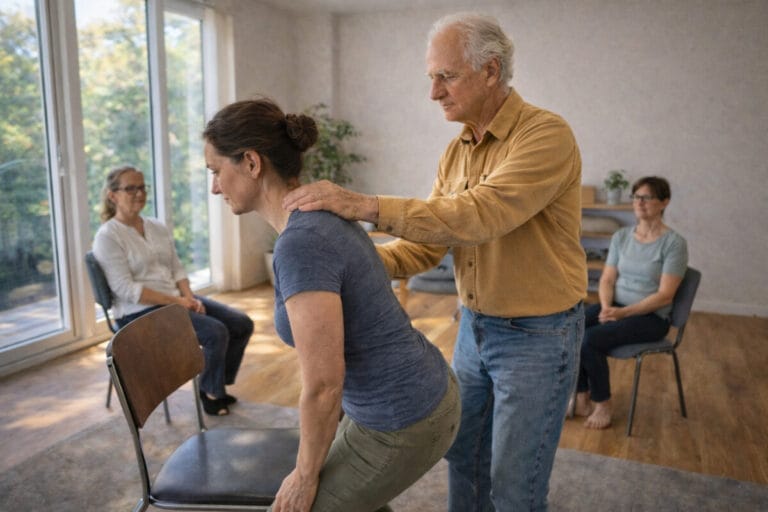
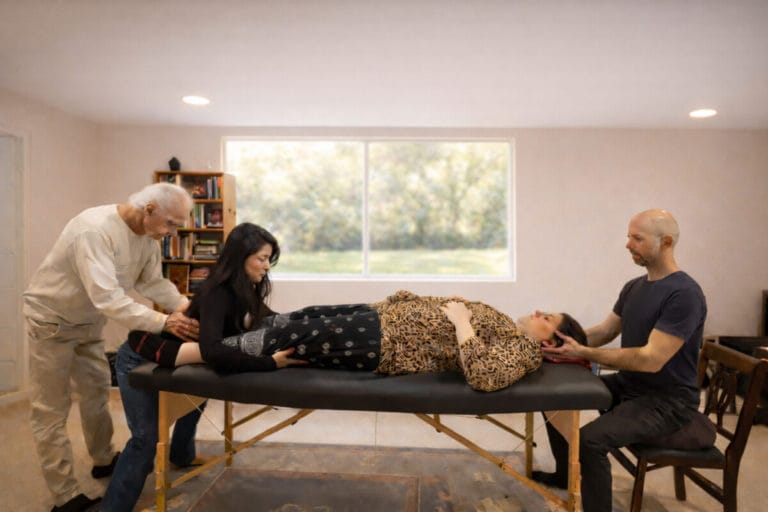
On November 22, 2024, in Boston, Massachusetts, USA, Tommy guided a group of teacher trainees into a space of deeper listening. Not just to the students in front of them—but to themselves.
Because in his words, you can’t teach what you’re not embodying.
This blog dives into the core of that day’s class. You’ll hear Tommy’s voice, feel the rhythm of the room, and discover how something as simple as sitting down can become a gateway into presence, coordination, and living as you were designed to move.
Key Objectives of the Class:
- Releasing unconscious habits of use and compression
- Rediscovering length and upward direction through the spine
- Reorganizing the whole self in relation to gravity
- Teaching not by fixing, but by embodying
- Cultivating presence that transfers through touch, breath, and attention
This blog series is based on Tommy Thompson’s Alexander Technique classes. Each post follows the flow and insights of the class to expand both self-awareness and practical consciousness applicable to everyday life.
New here?
If you’re new to the Alexander Technique, you can start with the resources below.
Alexander Technique Class Flow at a Glance
1. The Opening Question
❝ What happens when you move without length—and what becomes possible when you don’t? ❞
At the heart of Tommy’s teaching is this simple, vital fact: without length, collapse is inevitable. But this “length” isn’t something you create. It’s something you allow. It’s already there—if you stop interfering.
This class wasn’t about correcting a body. It was about restoring the innate coordination the body is built for. And that begins with the spine’s relationship to gravity—how we rise in space, how we allow upward direction, how we stop doing the thing that’s pulling us down.
Tommy’s Word
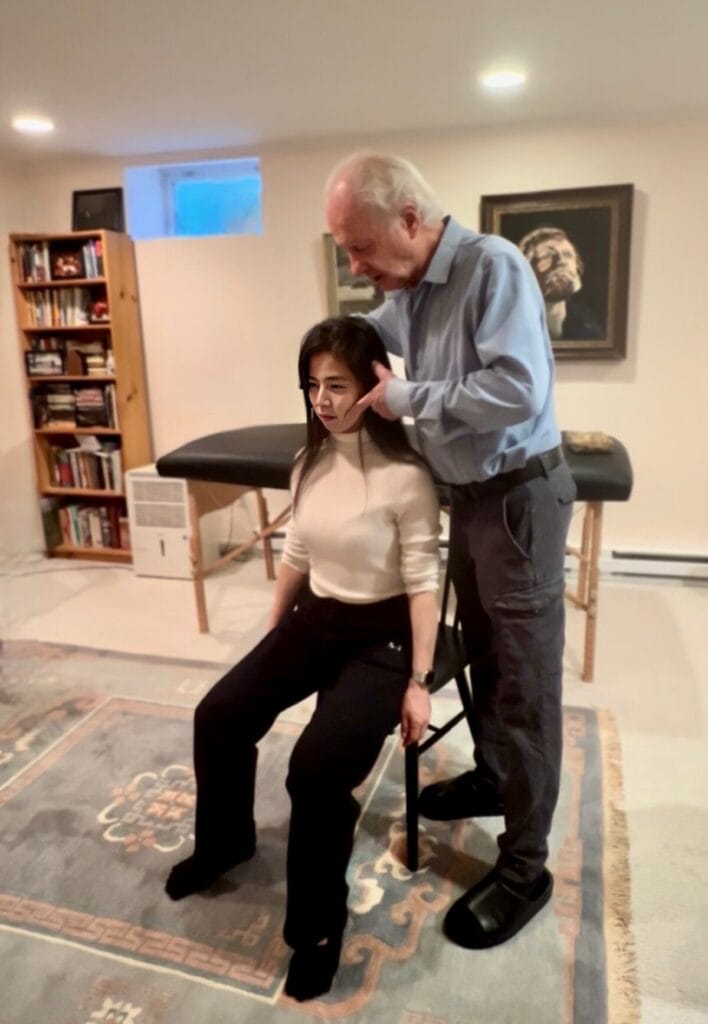
“If you don’t have length, they will collapse. You bring them back up to a sitting position. It’s still releasing the person, but if I have the length, then you don’t go down, because I’ve got the length.”
→ This isn’t metaphor. It’s mechanics and presence all at once. If you have the length, they don’t fall. That’s the teaching. You become the direction. You become the support.
As Tommy reminds us, length is not posture—it’s relationship. To gravity. To yourself. To the other. And it begins inside.
2. Core Learnings from This Class
Core Concepts
- Length is something you receive, not something you do.
In Tommy’s words, you don’t create length—you get it by no longer interfering. It’s not about fixing posture; it’s about restoring the natural direction the body already knows. - Release is the first threshold.
Before any change can happen in your student, it must be happening in you. That means releasing the unconscious patterns that pull you down—and keep pulling others down with you. - Use determines outcome.
You’re always using yourself—either in accord or out of accord with your design. And that use affects every movement, every relationship, every choice. - The AO joint(Atlanto-Occipital joint) is the silent command center.
When the relationship between the head and spine is free, the whole organism responds. This point of articulation isn’t just anatomical—it’s the key to length, coordination, and clarity. - Teaching begins with being.
It’s not about what you do with your hands—it’s about what’s going on in you. If there’s no direction in you, there will be none in them. As Tommy says: you can’t give what you don’t have.
Five Key Messages
- Without length, they collapse.
That’s not metaphor—it’s mechanical and relational. Length is the living support system. - Releasing is how learning begins.
If you’re not releasing, you’re not receiving. Teaching starts with internal undoing. - The spine organizes everything.
When it lengthens upward from the AO joint, the body reorients toward freedom. - Your use shapes the student’s experience.
You don’t have to say a word. Your use speaks volumes. - Support is transmitted, not imposed.
The moment you’re in length, the other person feels held—even if you’re silent.
Essential Terms
- Length
The natural upward movement through the spine—not held, but released into. It’s how the body supports itself without tension or collapse. - Use
The way you engage your entire self in activity. In the Alexander Technique, how you do something is more important than what you do. - Release
The letting go of unnecessary tension and patterned control. It’s not going limp—it’s recovering freedom. - Direction
A conscious invitation toward upward movement, particularly of the head going forward and up. Direction isn’t movement—it’s the intention that organizes it. - AO Joint (Atlanto-Occipital joint)
The atlas-occipital junction, where the head meets the spine. Free coordination here affects every part of the organism. - Coordination
The integrated, responsive functioning of the whole self in space and gravity. When length, release, and direction are present, coordination naturally emerges.
3. Tommy’s Insights
In Tommy’s words during class, there are not only the core principles of the Alexander Technique, but also practical wisdom that can be applied directly to daily life. His words go beyond simple advice about movement and prompt us to deeply consider how we choose to exist.“If you don’t have length, they will collapse. It’s still releasing the person, but if I have the length, then you don’t go down, because I’ve got the length.”
→ Length is not posture—it’s the internal integrity that keeps both you and the student from falling into habit.
“The body is attempting to support you, moment by moment, as you move through your life. You are never, ever, ever without movement. There’s so much movement going on in us right now that’s not observable.”
→ Movement is not optional; it’s the silent vitality behind every gesture, breath, and thought.
“But one of the first things I noticed is that when a person has length in the spine and has a strong enough communication with the AO joint, relative to the length of the spine—”
→ The AO joint isn’t just anatomical—it’s the keystone of living coordination and presence.
“When you replace what they’re accustomed to with movement that travels upward through the spine, you begin to establish a relationship with gravitational force—a force pulling the body toward the earth.”
→ We don’t escape gravity—we organize with it, and length is how the body says yes to that pull.
“The person has to get through that transition, because the first thing you do is learn how to release. If it’s not going on in you first—and during the process of teaching—then you’re not going to sustain the length in the other person.”
→ Your inner release is the ground for their change—what you embody, they receive.
“You are constantly alert and alive when you teach. You have to be—and then it just becomes a way of relating to another person.”
→ Real teaching is a shared state of being—attention becomes the medium of transformation.
“You use yourself—either in accord or out of accord with the way you are designed to function.”
→ Every action expresses use; and every use either honors design or interferes with it.
4. Practical Tips for Everyday Life
What’s the Goal?
To live the way you’re built to move.
Not to fix posture, but to free presence.
In the Alexander Technique, we don’t correct—we connect.
With gravity. With direction. With the quiet support already within.
This isn’t about being upright. It’s about undoing what’s in the way, so your natural length can return.
How to Practice
1. Before Movement, Do Less
Pause before you get up, sit down, or reach.
Let yourself notice: Am I rushing? Am I pulling down?
Wait. In that space, length has a chance to appear.
2. Think the Direction
Whisper to yourself, Let my head go forward and up.
Don’t do it—just invite it.
That invitation lets the spine rise without effort, without holding.
3. Turn Actions Into Awareness
Brushing your teeth, drinking water, typing—can you do it with less?
Less tension. Less pressure.
Let your use become your Wellness.
What You’ll Notice
- A quieter, steadier length through your spine.
- Less effort, more coordination.
- A shift from automatic motion to conscious use.
- Others may feel the difference in you, even if they can’t name it.
- And you may feel more supported—not by muscle, but by design.
5. Closing the Class
Key Takeaways
What did we actually explore in this class? Not how to move better. Not how to align yourself into some ideal. But how to stop interfering with what already wants to move well in you.
We’re not building posture—we’re removing what shortens us. We’re not creating presence—we’re uncovering the one that’s always there.
This class was about letting your design work for you, not against you. And that design begins with length.
Core Insights
Tommy didn’t tell the class what to fix. He asked us to notice what was already trying to support us. He didn’t correct people—he invited their systems to reorganize.
In the Alexander Technique, that invitation comes through attention, direction, and the willingness to let go. You’re not asked to change. You’re asked to stop holding back what’s already built to support you.
As Tommy said,
“The body is attempting to support you, moment by moment, as you move through your life.”
A Final Invitation
So what happens now?
You don’t need to remember every word. But you can remember the feeling—when your spine seemed to lift on its own, when you paused and something reorganized without effort, when your body felt like a friend, not a problem to fix.
That’s not just movement—it’s a kind of wellness you carry in how you live. Carry that with you. In your walking, teaching, parenting, dancing, resting.
And when in doubt, return to the most honest thing you can do:
Stop. And wait long enough for your design to remember itself.
6. One Key Practice
Pause long enough for something other than habit to begin.
That’s it.
Not a pose. Not an instruction.
Just enough space for direction to find you again.
Tommy never asked us to fix anything. He asked us to stop just long enough that the thing holding us down could let go of its own.
This is how the Alexander Technique begins—not with what you do,
but with what you’re finally willing to stop doing.
7. Three Questions to Ask Yourself
These aren’t questions to fix yourself. They’re questions to find yourself—in motion, in the moment.
Ask them softly. Mid-step. Without needing answers.
- Am I letting the ground support me—or am I pulling away?
Just notice what you’re doing. - Where does movement begin in me?
Did I allow it, or did I rush? - Is there space in me for something new to happen?
Not by effort—by stopping.
These aren’t for the mirror. They’re for walking, reaching, breathing.
8. For Those Who Wish to Learn More
Recommended Book
The Use of the Self – F. M. Alexander
If you want to understand where this work truly begins, start here.
In this book, Alexander didn’t teach a technique—he uncovered a principle: that how we use ourselves in the simplest acts of life shapes everything about how we function.
Tommy’s lesson on length lives inside these pages.
Not as a set of movements, but as a shift in how you relate to direction, effort, and attention.
It’s not about posture. It’s about not interfering with the support already built into you.
This book invites you to pause, notice, and participate in a design that was never broken—just forgotten.
Official Website of Tommy Thompson
www.easeofbeing.com
This is the official website personally managed by Tommy Thompson, offering a wide range of resources and programs to deepen your understanding and practice of the Alexander Technique:
- Private session reservations and inquiries
- Workshop and seminar schedules
- Overview of international teacher training programs
- Essays and articles on the Alexander Technique
9. Next Class Sneak Peek
In Class 30, we explored how length isn’t something you build—it’s something you stop interrupting. You began to sense what happens when direction emerges not from effort, but from design. But what happens to that length when you start to move?
In Class 31, we’ll turn our attention to the relationship between movement and presence. Tommy will lead us into the paradox of Stillness in Motion—how stillness can stay with you even as your body moves, shifts, walks, and acts.
We’ll explore how direction, breath, and gravity meet inside dynamic coordination, and ask: What if stillness isn’t the absence of motion—but the quality that gives motion its clarity?
In Class 31, we’ll explore:
Stillness in Motion: How presence continues when movement begins.
10. Join the Alexander Technique Journey
Did this class leave a small resonance within you? Feel free to quietly hold it in your heart or share it in just a sentence or two. The comments are always open. Your one simple word may leave a gentle ripple in this ongoing journey.The journey of Resonance Flow continues across social media as well. Let’s continue this journey together.
 YouTube
 Instagram
 Threads
 Facebook