Wave-Like Movement: One Shift That Frees Your Body and Rewires How You Move | Tommy Thompson Class 18
❝ What if your body already knows how to move better than your mind does? ❞
Imagine the possibility that every attempt to “fix” your posture—every effort to sit up straight or hold yourself “correctly”—might actually be interrupting something deeper: your body’s natural intelligence. What if stillness, as we’ve been taught to understand it, is the very thing that disrupts true ease?
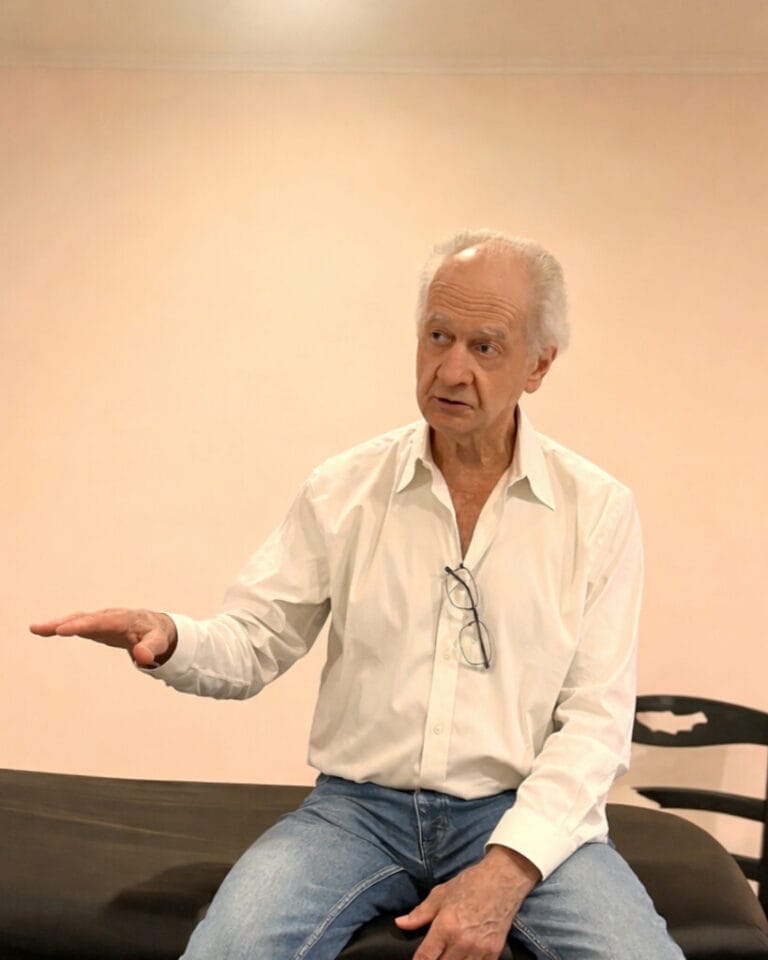
On October 24, 2024, in Boston, Massachusetts, USA, Tommy Thompson led a class in the Alexander Technique teacher training course that challenged some of our most deeply ingrained assumptions about posture, control, and movement. His core proposal was both radical and refreshingly intuitive:
What happens when we stop trying to direct the body and instead allow it to move as a single, wave-like organism?
Tommy reminded the trainees in this class: your body is already doing it. The movement is already there. The intelligence is built-in. You don’t create it—you notice it. You ride it. And, when necessary, you guide it.
Tommy’s Word
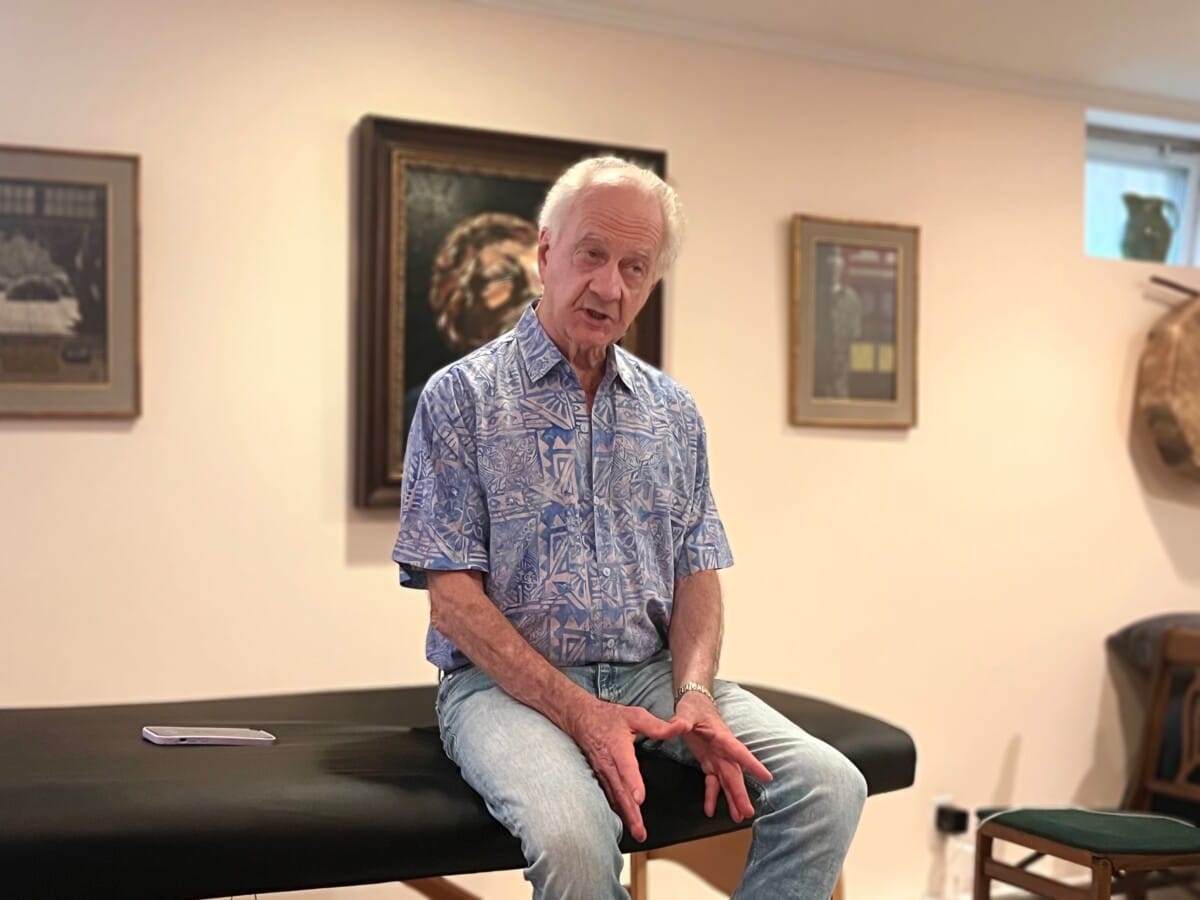
“The undulatory movement happens in everybody, like this. It waves, constantly moving through your body, and your body is a single wave. Alexander work captures that wave and gives it direction.”
This wasn’t just metaphor. For Tommy, it was neurology, embodiment, attention, and care—all rolled into the wave-like movement that the Alexander Technique can help us reawaken. When you allow this undulation to move through you, something changes. You shift from holding yourself together to allowing yourself to cohere.
This blog series is based on Tommy Thompson’s Alexander Technique classes. Each post follows the flow and insights of the class to expand both self-awareness and practical consciousness applicable to everyday life.
New here?
If you’re new to the Alexander Technique, you can start with the resources below.
Alexander Technique Class Flow at a Glance

1. The Opening Question
❝ What is wave-like movement, and why might it matter more than posture? ❞
In most movement or body awareness practices, posture is treated as a static ideal: something to correct, to maintain, to hold. But Tommy Thompson’s teaching flips that entirely.
What if posture isn’t something you do, but simply a phase in an ongoing, flowing process? What if holding your posture actually interrupts the deeper, more intelligent coordination that’s already happening underneath?
This is the heart of Tommy’s teaching in this class: posture is not the goal—it’s a moment in motion. The Alexander Technique, as taught here, is about letting go of control so that you can become aware of the wave you already are.
Tommy’s Word
“Posture is a phase of movement. People usually try to hold or adopt a certain posture, but in reality, posture is nothing more than a phase of movement.”
When we try to “lock in” posture, we’re interrupting a natural event. In this class, Tommy urged the trainees not to capture or perfect posture, but to sense it in context—as something that emerges, fades, and shifts, like one point on a wave that never stops moving.
This, he explained, is the true essence of Alexander Technique: restoring our relationship with the movement that precedes and sustains every action we take.
2. Core Learnings from This Class
Core Concepts
- The body is not a machine. It’s a wave.
Tommy made this unmistakably clear. Your body isn’t something to fix or hold in place. It is a living, moving wave, constantly adjusting itself in ways you cannot predict or control. The job of the Alexander Technique is to help you stop interrupting that wave. - Withholding definition creates room for life.
Most of us live by constantly reinforcing a fixed sense of who we are—mentally, physically, emotionally. But Tommy taught us that if we stop doing that even for a second—if we stop trying to define ourselves—our organism will begin to move in ways we never thought possible. A moment of not knowing can be a doorway to profound reorganization. - Inhibition is a gift to your nervous system.
Inhibition is not about holding still. It’s about pausing long enough to notice what you’re doing, and choosing not to follow the same old groove. As Tommy said, inhibition gives your nervous system a break from your identity. That’s not restriction. That’s liberation. - Posture is a phase, not a position.
If you try to “have good posture,” you’re already interfering. Because posture isn’t a goal—it’s a momentary configuration inside the wave-like movement that is always unfolding. Tommy urged us to stop chasing form and start sensing the flow. - The organism is already smarter than you.
“You don’t need to direct the wave,” Tommy said. “You just need to stop interrupting it.” That’s the core of this work. Alexander Technique isn’t about correction. It’s about letting go of what stops the body from doing what it knows how to do.
Five Key Messages
- You don’t have to direct the wave—you have to stop interrupting it.
→ Tommy constantly reminded us that the most intelligent movement comes from stopping interference, not adding effort. - Withholding definition is the most generous act of trust you can offer your system.
→ The body thrives when it is not boxed in by habitual self-concepts. - True coordination happens when you’re not trying to make it happen.
→ The wave only becomes visible when you let go of trying to produce or manage it. - Freedom of the neck is not a technique. It’s a recognition.
→ “Let the neck be free” is not a command—it’s an invitation to realize possibility. - Letting the wave move through you is the most honest way to be present.
→ Presence begins with allowing, not doing.
Essential Terms
- Wave-like movement
The body isn’t something you move—it is movement. Always undulating, adjusting, never static. Tommy Thompson described the entire structure as behaving like a single wave in motion. The Alexander Technique, as he teaches it, allows you to sense this wave—rather than interrupt it or try to control it. - Withholding definition
Tommy* often emphasized that we habitually define ourselves—through roles, reactions, or self-image—and in doing so, limit how we move and function. But when that definition is suspended, even briefly, the body begins to reorganize itself. It’s not about becoming someone else. It’s about creating space for a more truthful coordination to emerge. - Inhibition
Not effort. Not suppression. Just the choice to pause instead of repeat. That single moment—of doing nothing extra—gives the nervous system room to operate with greater freedom and clarity. It’s a kind of conscious stillness that opens space for change. - Posture as phase
Posture isn’t a fixed position. It’s a passing moment in a larger stream of movement. When it’s no longer something to hold or fix, it becomes something you can observe, ride, and release—like any other part of the wave. - Organismal intelligence
The body is designed to self-organize. When we stop imposing control, that intelligence reveals itself. The Alexander Technique provides a way to recognize and support that natural functioning, rather than override it.
3. Tommy’s Insight
In Tommy’s words during class, there are not only the core principles of the Alexander Technique, but also practical wisdom that can be applied directly to daily life. His words go beyond simple advice about movement and prompt us to deeply consider how we choose to exist.“The undulatory movement happens in everybody, like this. It waves, constantly moving through your body, and your body is a single wave. Alexander work captures that wave and gives it direction.”
→ Movement isn’t something to produce—it’s something to notice. When sensed as a wave, the body reveals its natural direction without force.
“Let the neck be free is just a thought. It’s an intention. It’s not something you do; it’s something you become aware is possible.”
→ Freedom begins not with action, but with recognizing that less interference is possible. Awareness—not effort—invites release.
“By inhibiting, by simply taking a moment and not doing what you usually do, you step out of the command of the nervous system and let it function as it was designed to over three million years.”
→ By pausing before habit kicks in, you give the nervous system a rare chance to operate freely, as it was evolutionarily designed to.
“Posture is a phase of movement. People usually try to hold or adopt a certain posture, but in reality, posture is nothing more than a phase of movement.”
→ Posture isn’t a position to hold—it’s a momentary shape in the larger wave of movement.
“By withholding definition, you give the body a chance to completely reorganize itself. If I just withhold defining myself, that’s why I’m a great believer in withholding definition.”
→ When you stop defining yourself the usual way, the body begins to reorganize from within—without instruction, without pressure.
“Catch yourself in a given moment and ask yourself: Am I aware of where I am, given what I’m doing? The simplest version of this work is: you do what you do. But—you pay attention to where you are and how you use yourself to do it.”
→ Noticing where you are in the act invites a shift—not by changing what you do, but by relating differently to how you’re doing it.
“And when you pass along whatever knowledge you have to another, it’s done so for them to receive it. You will not lose what you have given by sharing it. You don’t have to contain it.”
→ When knowledge is offered without holding back, it doesn’t diminish—it deepens, both in the one who shares and the one who receives.
“When they separate, both are still burning. Truth is not something that leaves. Truth is not even Alexander. Truth exists in the space where two people come together and connect. Pass along what you know. You’re not going to lose anything. You’ll only gain. And the more you share, the brighter it burns.”
→ Truth doesn’t fade—it intensifies through connection. What we share doesn’t deplete; it ignites further light in both.
4. Practical Tips for Everyday Life
What’s the Goal?
The aim isn’t to fix posture or move “correctly.” The real goal is to stop getting in your own way. By reducing interference, you make space for your body’s built-in intelligence to guide the movement. When you interrupt your usual habits, even slightly, a more natural and efficient coordination begins to show up. These shifts are part of reclaiming a more wave-like movement—organic, continuous, and guided from within.
How to Practice
- Notice before you move. Before you get up, reach for your phone, or open a door, ask yourself: “Where am I in relation to this action?” That moment of awareness is the start.
- Take a micro-pause. Right in the middle of doing something—walking, brushing your teeth, answering email—pause for just a second. Don’t change what you’re doing. Just stop the automatic part.
- Let go of your usual self-definition. Drop your ideas about how you’re supposed to move, perform, or show up. When you withhold definition, something more fluid and honest can emerge.
What You’ll Notice
Less tension. Less rushing. A little more clarity in how you move and relate to the moment. You might feel lighter, steadier—as if the ground meets you a little more clearly beneath your feet. These shifts often feel small—but they’re powerful.
This isn’t about doing more. It’s about doing less of what blocks you. The Alexander Technique isn’t something you perform—it’s something you allow. You don’t force it. You create the conditions, and it meets you there.
These practices are real. You can try them in line at the grocery store, during your commute, or right now, reading this sentence. They’re not tricks. They’re truths—small, repeatable moments that return you to yourself.
5. Closing the Class
Key Takeaways
Letting go is not passive. It’s one of the most dynamic things you can do. In this class, we practiced giving the body a break from being managed. The wave of movement is always present—but we tend to block it with intention, identity, and control. When we withhold all that, we don’t lose ourselves. We meet ourselves.
Core Insights
The Alexander Technique isn’t about becoming someone new. It’s about letting the person you already are move freely. That includes your thoughts, your breath, your structure, and your sense of timing. Wellness isn’t achieved by holding still—it’s revealed in the ability to ride the wave.
Tommy didn’t teach “techniques.” He guided us into experiences—experiences where you discover that your body is far more capable, subtle, and resilient than you thought. And that you can trust it—if you listen.
A Final Invitation
As you leave the class, notice what stays with you. Maybe it’s a phrase. Maybe it’s a sense of ease. Maybe it’s simply the idea that movement can be honest.
The work doesn’t end with the last moment of class. That’s exactly when it begins.
6. One Key Practice
Let the wave move through.
That’s it. Don’t manage it. Don’t try to improve it. Don’t even try to feel it. Just stop interrupting it. Let it show up in your breath, in your walk, in the way you reach for a glass.
This is not a task. It’s a permission. Let the wave move through you, and trust that your body knows what to do next.
7. Three Questions to Ask Yourself
These are not questions for judgment or fixing. They are questions for awareness. Designed to help you return to presence—in your body, your choices, your attention.
- Where am I, given what I’m doing?
- → Ask this not just with your mind, but with your body. Feel your location—not just in space, but in yourself.
- What am I doing extra right now?
- → Are you adding effort, tightening, anticipating? Often, simply asking this will reduce the strain.
- If I didn’t define myself in this moment, what would be available?
- → Let this question suspend your usual patterns. It opens the door to something unexpected—something more honest.
You don’t need to answer these questions with words. Let the answers come in sensation, movement, or quiet recognition.
These are doorways, not demands. Use them as often as you like, and let them return you to the wave that’s already moving through you.
8. For Those Who Wish to Learn More
Recommended Books
- The Alexander Technique: A Skill for Life – by Pedro de Alcantara
A comprehensive and practical introduction that explores the interplay of movement, awareness, and self-perception. Written by a musician and longtime practitioner, it brings a uniquely artistic and somatic perspective—especially helpful for understanding wave-like movement and how withholding definition invites natural reorganization. - Alexander Technique: A Practical Introduction – by Richard Brennan
A clear, step-by-step guide to applying the work in everyday life. Brennan emphasizes practical awareness tools, making this ideal for beginners exploring inhibition, posture habits, and movement re-education in daily tasks.
Official Website of Tommy Thompson
www.easeofbeing.com
This is the official website personally managed by Tommy Thompson, offering a wide range of resources and programs to deepen your understanding and practice of the Alexander Technique:
- Private session reservations and inquiries
- Workshop and seminar schedules
- Overview of international teacher training programs
- Essays and articles on the Alexander Technique
9. Next Class Sneak Peek
What if you didn’t have to manage your movement—but simply meet it as it unfolds?
In the next class, we’ll explore what happens when you stop shaping your body from the outside and begin to listen from within. Topics include spontaneous movement, fascial release, and the body’s capacity for self-regulation when allowed to function on its own terms.
What you’ll explore:
- Why the body finds balance more naturally when movement is followed, not controlled
- How movement expands in all directions, and what that feels like in real time
- Why fascial release alone doesn’t ensure full freedom, and how to meet what’s left
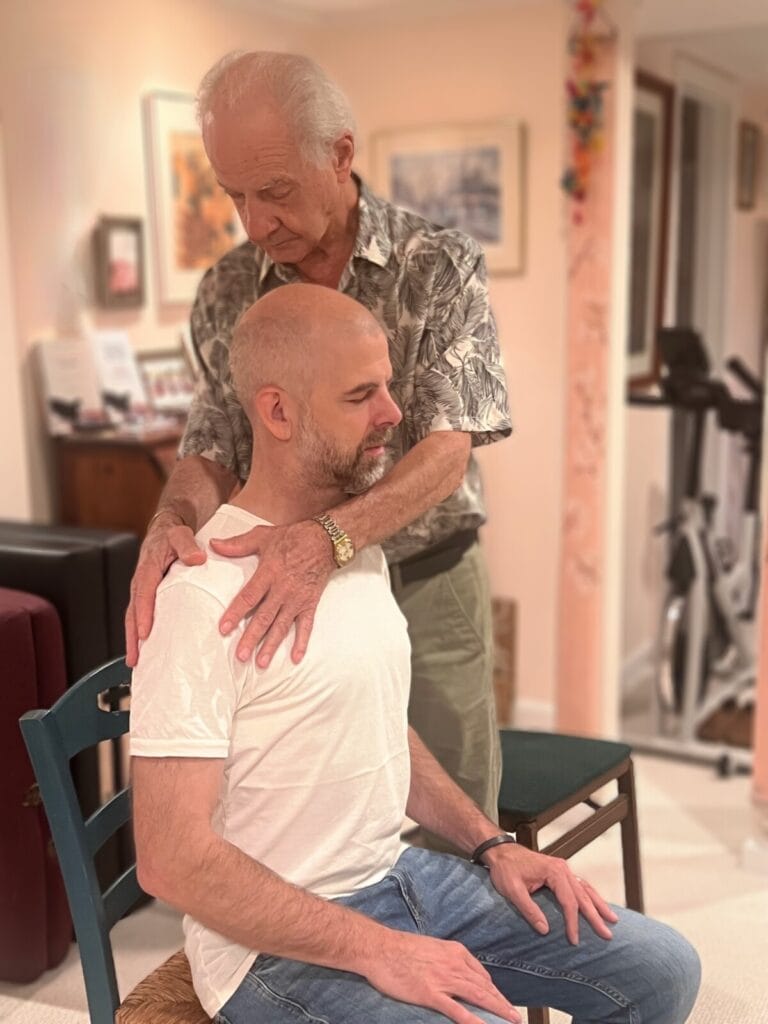
- How the placement of your hands can guide without correcting
- The subtle link between physical motion and emotional expression
You’ll also receive practical explorations to try on your own—ways to sense and support this process in your daily life.
Next class isn’t about getting better. It’s about becoming more available—to yourself, to sensation, to something deeper. Step in. The wave is already moving. Let’s follow it further.
10. Join the Alexander Technique Journey
Did this class leave a small resonance within you? Feel free to quietly hold it in your heart or share it in just a sentence or two. The comments are always open. Your one simple word may leave a gentle ripple in this ongoing journey.The journey of Resonance Flow continues across social media as well. Let’s continue this journey together.
 YouTube
 Instagram
 Threads
 Facebook