Presence in Motion: What If the Way You Move Shapes Who You Are? | Tommy Thompson Class 48
❝ How can you bring the person who is doing the activity into being present, given what they do? ❞
That’s what Tommy Thompson asked in the room—not to test them, but to open something up.
Because in the Alexander Technique, we’re not adjusting the body like a machine. We’re inviting something subtler: a return to the person inside the movement. Presence doesn’t wait for perfection. It appears the moment we stop trying to correct, and start letting something real happen.
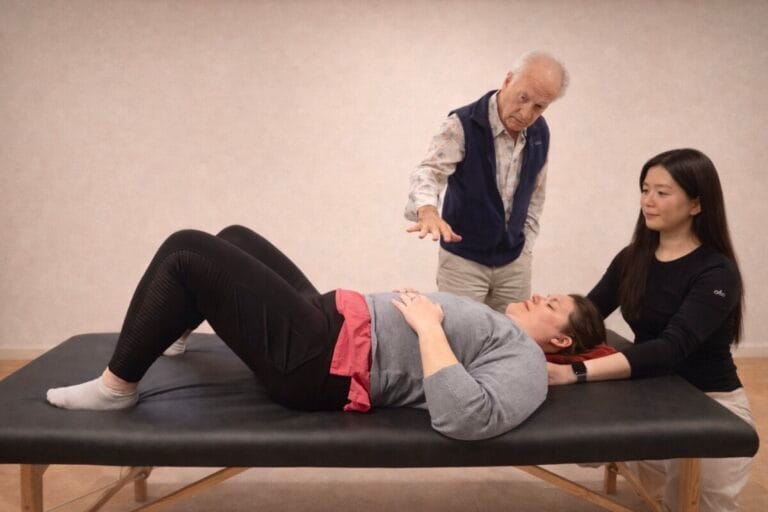
On March 13, 2025, in Boston, Massachusetts, USA, Tommy Thompson led a class in the Alexander Technique teacher training course centered on this exact question.
Not “how do you move better,” but:
Who is the one moving, right now?
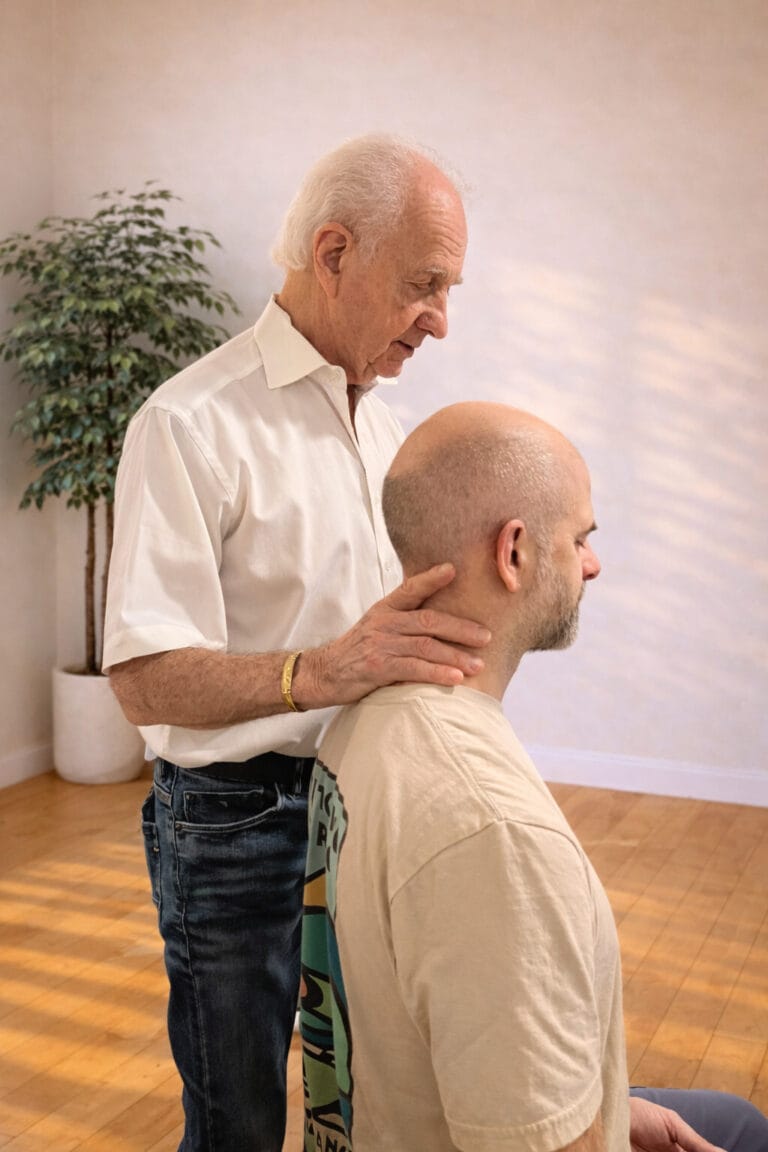
That’s when coordination shifts—not from control, but from recognition. Sometimes, all it takes is the quiet release of the neck—and suddenly, they’re back in themselves. That’s when wellness is no longer a goal, but a felt experience.
Key Objectives of the Class:
- To explore how presence emerges through the activity itself—not after it
- To shift focus from external correction to internal recognition
- To support trainees in guiding others toward embodied awareness through subtle, relational work
This blog series is based on Tommy Thompson’s Alexander Technique classes. Each post follows the flow and insights of the class to expand both self-awareness and practical consciousness applicable to everyday life.
New here?
If you’re new to the Alexander Technique, you can start with the resources below.
Alexander Technique Class Flow at a Glance
1. The Opening Question
❝ What’s the difference between improving someone’s use, and supporting them in discovering who they are through what they do? ❞
Most techniques aim to fix something: a posture, a gesture, a habit. But the Alexander Technique doesn’t begin with correction. It begins with a question of identity. When someone stands, walks, sings—is it just about doing it better, or is it about discovering who’s doing it at all?
This shift changes everything. Because the moment we stop adjusting and begin listening, presence has a place to land. We move from manipulating the body to supporting the person. We’re no longer just refining function—we’re making space for awareness to emerge.
Tommy’s Word
“I didn’t give that experience to you. I just touched you in a way that your body gave you that experience, supporting you. So if that’s true, potentially this is available to you.”
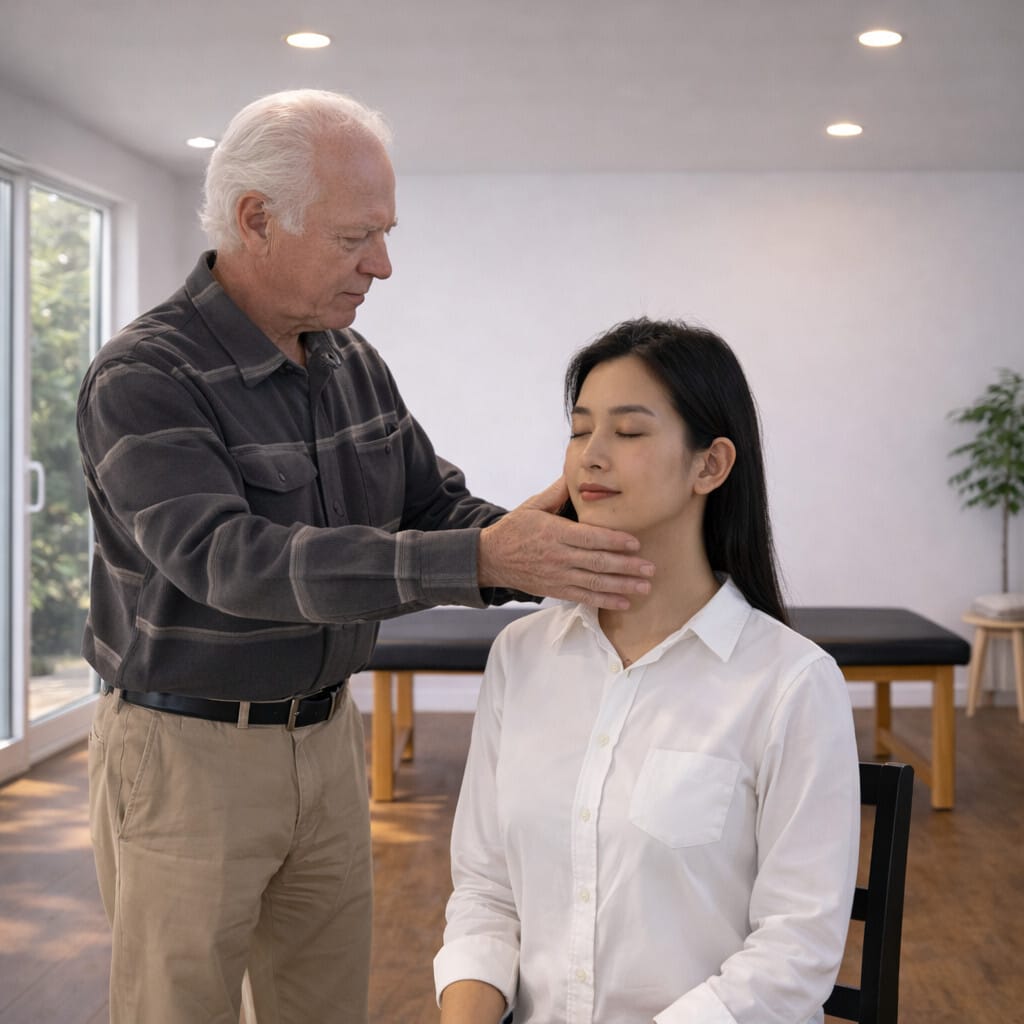
This is the heart of Tommy’s teaching. Change doesn’t come from fixing someone—it comes from reminding them that the possibility is already within them. His touch doesn’t impose. It invites. In the Alexander Technique, presence isn’t delivered—it’s remembered, through a quiet moment of support.
2. Core Learnings from This Class
Core Concepts
- Presence isn’t something you put on. It’s something you uncover when you stop doing so much.
Tommy didn’t ask trainees to “fix” how they stood or moved. Instead, he created conditions for them to notice when they were actually there—when the self quietly returned. - The head and neck are not just structural—they’re perceptual.
“It all begins at the top,” Tommy said. When the neck is free, the head can find its balance. And when the head organizes, the whole system follows—not because it’s been corrected, but because it’s been allowed. - Support is more powerful than instruction.
A subtle touch can say: “You’re not broken. You’re supported.” From this place, the person—not the body—begins to reorganize. - Use is a doorway into selfhood.
Movement is never just mechanical. It carries the imprint of our story, our self-perception. Tommy’s question was never “how are you standing?” but “who is standing?” - The body remembers what the mind forgets.
When a trainee experiences freedom even briefly, that moment isn’t fleeting—it’s a reference point. “If it was possible once,” Tommy said, “then it’s already yours.”
Five Key Messages
- You don’t teach someone how to move. You create the conditions for them to arrive.
Presence doesn’t come from doing—it comes from undoing just enough to be. - The neck isn’t just anatomy—it’s access.
Freedom here opens perception, balance, breath, and ultimately, identity. - Stop fixing. Start listening.
The work begins when you trust that the student already knows what to do. - The activity isn’t the problem. It’s the portal.
Walking, acting, singing—these aren’t tasks to master. They’re invitations to presence. - Every shift, no matter how subtle, is a vote for who you’re becoming.
Transformation is not dramatic. It’s quiet, and it’s already underway.
Essential Terms
Presence
A state where attention, movement, and identity align. “Presence isn’t something you add—it’s something you remember.” Not a fixed form, but a return to self through availability.
Support
The subtle condition that allows the person—not the posture—to emerge. We don’t fix bodies. We offer space, trust, and contact for change to arise. Support makes presence possible.
Head–Neck Relationship
The central principle that organizes the whole self. When the neck is free to lengthen, the head moves away from the body—forward and up. As a result, the spine lengthens and the back widens. In that moment, the whole person reorganizes. This isn’t about making adjustments—it’s about giving permission.
Embodied Awareness
The felt sense of being inside your own experience. Not watching the body, but inhabiting it. Where you are is what makes change sustainable.
Personal Narrative
The lived story behind how you use yourself. Our habits are not just mechanical—they reflect who we believe we are.
Every shift in use rewrites that story.
3. Tommy’s Insight
In Tommy’s words during class, there are not only the core principles of the Alexander Technique, but also practical wisdom that can be applied directly to daily life. His words go beyond simple advice about movement and prompt us to deeply consider how we choose to exist.“I almost always ask, ‘What did you come for? What would you like from this work?’ While some don’t know, most want relief—a cure, to feel better, to have the pain gone—and sometimes they explain how it began.”
Every lesson starts with understanding the student’s intention—pain is often the entry point, not the purpose.
“You look at a person and their use is sloppy—they bring all kinds of stuff. But you’re not just seeing that; you’re seeing potential. And when the individual becomes truly present in the moment, given the circumstance, they stand out. You look at them, not the others—especially if they’re exploring who they are through what they’re doing.”
Presence reveals itself in use. Even flawed coordination holds a thread of potential when awareness enters the room.
“The reason you would start with the head and neck is because that’s pretty much what you want to introduce to them: the cervical and the occipital reflexes are reflexive responses that affect you nanosecond by nanosecond during the course of your day.”
The head-neck relationship is central—these reflexes shape our coordination moment by moment, even unconsciously.
“So the reason for starting with the head and neck—whether on the table, in a chair, standing, or during activity—is to help the individual understand that if the neck is relatively free from contraction, the head moves more freely because you’re releasing the sternocleidomastoid and trapezius.”
Freedom in the neck leads to dynamic organization in the whole body—an anatomical and perceptual gateway.
“How can you bring the person who is doing the activity into being present, given what they do? What’s the difference between changing their use for the better and working with a person exploring who they are, given the activity?”
There is a profound shift between fixing ‘use’ and guiding self-inquiry. One corrects; the other awakens.
“Exploring who someone is, given what they’re doing—taking care of themselves? That’s different. That’s what most teachers don’t touch. That’s the personal narrative.”
Self-care is not only a physical act—it’s a window into identity and meaning, and often overlooked in teaching.
“And I do that with my scenes of learning, remember? The person might say, ‘How can I have this experience again?’ I say, ‘Well, I didn’t give that experience to you. I just touched you in a way that your body gave you that experience, supporting you. So if that’s true, potentially this is available to you.'”
Transformation arises not from the teacher’s hands, but from the student’s system when it is invited to reorganize.
“Let’s try it: walk as if what you just experienced is available to you again—walk through that potential. If that’s true, that must be who you are. You’re not the person who walked the first way. Consider that. Walk from who you are. Now—walk from who you are.”
Embodiment is not something we visit—it’s a return to who we already are, revealed through conscious direction.
4. Practical Tips for Everyday Life
What’s the Goal?
Not to move better. Not to hold yourself straighter. The goal is to make space for the one who’s moving to show up. When you’re present, coordination becomes the side effect—not the aim.
How to Practice
- Soften Your Eyes
Let your eyes release their grip on the world. Without fixing or focusing, just allow them to widen.
As your visual system softens, so do you. This simple shift brings you into the present—without effort. - Pause Before the Activity
Before you walk, speak, type, or lift—don’t correct yourself. Just stop. Feel the ground. Notice the support under your feet.
Ask: Can I show up for this, instead of just getting it right? - Directing the Head Forward and Up
Imagine your head gently moving away from the spine—forward and up, with ease. Even a subtle image like this can initiate a shift in your whole system’s coordination. The thoughts you entertain often become the direction your body begins to trust and follow.
What You’ll Notice
- You’ll stop “doing the doing.” Instead, you’ll start being in the doing.
- You may feel lighter, slower, or more available.
- The activity becomes a mirror—not of your posture, but of your presence.
- And sometimes, that’s all it takes to change everything.
5. Closing the Class
Key Takeaways
The Alexander Technique is not about fixing posture. It’s a language of presence—a subtle but powerful shift from doing something better to being someone real in the moment. When we allow coordination to reorganize from the inside out, what emerges is not just functional improvement, but a reawakened sense of self.
Core Insights
- Support precedes change.
Without inner safety, no sustainable shift can occur. - Presence is not effort—it’s availability. The more we push, the more we lose it.
- Identity moves with use.
How you act reflects how you believe yourself to be. - Awareness is not observation.
It’s being in the experience as it unfolds. - Movement isn’t just motion—it’s communication.
It says: “Here I am.”
A Final Invitation
As Tommy says:
“You’re not here to fix people. You’re here to offer them back to themselves.”
This work isn’t about improving posture or erasing pain—it’s about restoring the human being inside the motion. What if your next step, breath, or voice could say more than ‘I’m doing it right’? What if it could say, “I’m here”?
6. One Key Practice
“Walk from who you are.”
Not from how you were trained, not from what you think is right, and not from the memory of how you’ve always done it.
Walk as if your presence is available to you again.
As if the support you just experienced is still here.
As if the person who moved with that awareness… is the one who’s moving now.
As Tommy says:
“You’re not the person who walked the first way. Consider that. Walk from who you are. Now—walk from who you are.”
This practice is not about technique. It’s about permission—to move from a different center. To live the Alexander Technique not as a correction, but as a return.
7. Three Questions to Ask Yourself
These questions aren’t for self-judgment.
They are invitations—open doors into your embodied awareness.
Use them in moments of transition: before stepping on stage, before speaking, before taking your next step. Let them bring you back—not to perfection, but to presence.
1. Am I here, or just doing it right?
➤ Check if your attention is with the doing… or with the one who’s doing it.
2. What kind of support am I allowing right now?
➤ Not what you’re holding up—but what you’re letting hold you.
3. If this is who I am, how would I move?
➤ Let identity shape coordination, not the other way around.
8. For Those Who Wish to Learn More
If something in you stirred during this class—if you felt even a brief return to yourself—don’t stop there. Let these resources guide you further, not into doing more, but into being more present.
Recommended Books
Touching Presence – Tommy Thompson
This is not a book of instructions—it’s a book of invitations. Drawing on over 50 years of teaching the Alexander Technique, Tommy offers vivid stories, teaching dialogues, and distilled moments that reveal how presence becomes touchable. His work isn’t about fixing or improving posture—it’s about creating the conditions where someone can remember themselves. Touching Presence is less about technique and more about encounter—a return to what’s already whole.
Body Learning – Michael J. Gelb
A highly accessible introduction to the principles of the Alexander Technique, blending clear explanations with engaging stories. Gelb’s writing speaks to both beginners and experienced practitioners, offering a wide-angle view of how embodied awareness transforms movement, perception, and life itself.
Official Website of Tommy Thompson
www.easeofbeing.com
This is the official website personally managed by Tommy Thompson, offering a wide range of resources and programs to deepen your understanding and practice of the Alexander Technique:
- Private session reservations and inquiries
- Workshop and seminar schedules
- Overview of international teacher training programs
- Essays and articles on the Alexander Technique
9. Next Class Sneak Peek
What if support isn’t something you build… but something revealed in the still point?
In our next class, Tommy leads us into the space where movement doesn’t begin with muscle, but with a pause so alive, it holds you.
We’ll look at how reactive tension interrupts connection—and how the still point restores it.
This won’t be about posture. It’ll be about discovering:
“What changes when support begins before movement?”
10. Join the Alexander Technique Journey
Did this class leave a small resonance within you? Feel free to quietly hold it in your heart or share it in just a sentence or two. The comments are always open. Your one simple word may leave a gentle ripple in this ongoing journey.The journey of Resonance Flow continues across social media as well. Let’s continue this journey together.
 YouTube
 Instagram
 Threads
 Facebook