What If Support Is the Missing Piece in the Alexander Technique? | Tommy Thompson Class 83
❝ When everything feels unstable, what does it actually mean to be supported in the Alexander Technique? ❞
In moments of difficulty, people don’t lose capacity first.
They lose a bodily sense of support.
In the Alexander Technique, support is not reassurance or encouragement. It is a physical condition in which the organism no longer has to hold itself together through effort. When that condition is absent, reactions become sharp and habitual. When it returns, change can happen without force.
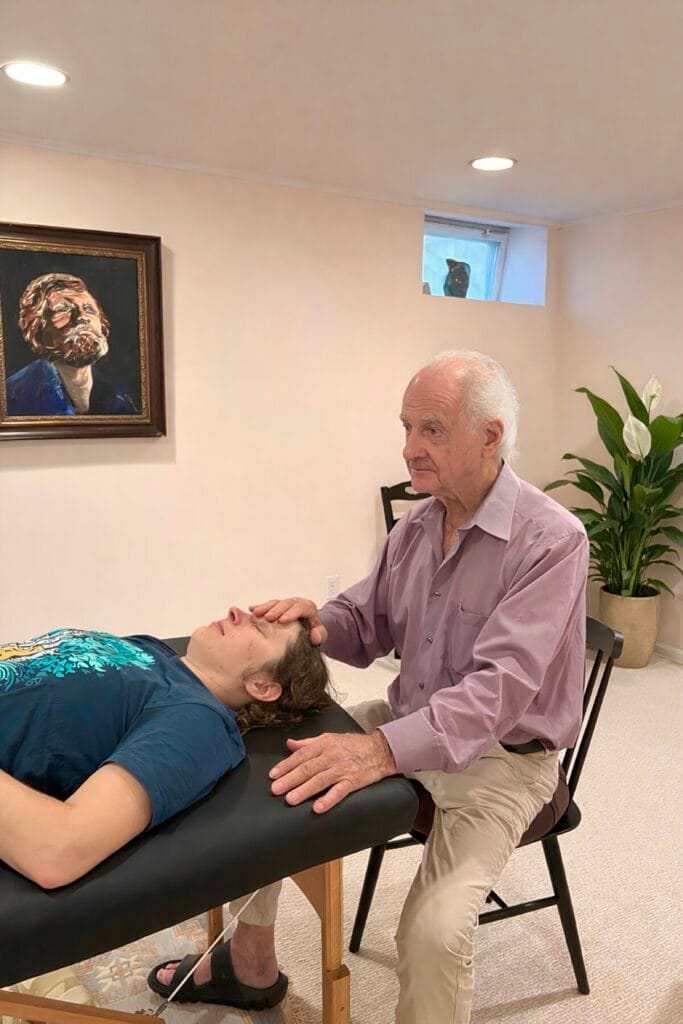
On October 21, 2025, in Boston, Massachusetts, USA, Tommy Thompson led a class in the Alexander Technique teacher training course where the work returned again and again to one essential inquiry: how support is recovered, not applied. Through table work, mechanical advantage, and the simple act of sitting and standing, the distinction between inspansion and expansion was learned through direct experience rather than explanation.
What emerged was clear: support is not something you do to a person—it is something you help them regain within themselves. Teaching, then, is not correction, but the preservation of integrity while life is actively unfolding.
Key Objectives of the Class:
- To experience the difference between inspansion and expansion through direct bodily engagement
- To understand how the position of mechanical advantage and equal pressure organize whole-body use
- To explore front–back energy pathways as expressions of expansion, not force
- To clarify support as the central ethical and practical aim of teaching in the Alexander Technique
This blog series is based on Tommy Thompson’s Alexander Technique classes. Each post follows the flow and insights of the class to expand both self-awareness and practical consciousness applicable to everyday life.
New here?
If you’re new to the Alexander Technique, you can start with the resources below.
Alexander Technique Class Flow at a Glance
1. The Opening Question
❝ Are you trying to help—or are you helping someone stay supported enough to change? ❞
This is the distinction Tommy Thompson returns to again and again. In the Alexander Technique, change does not come from instruction or correction. It comes from whether the person feels sufficiently supported to remain present with themselves while something unfamiliar is happening.
Much of what appears as “helping” actually destabilizes the organism—too much explanation, too much intention, too much doing. Tommy redirects the teacher’s attention away from intervention and toward a quieter responsibility: maintaining support so the system does not collapse into habit.
This question becomes visible through demonstration. On the table or in sit-to-stand, the issue is never whether the movement looks better, but whether the person feels more organized in gravity, space, and use. If support is present, learning unfolds. If it is not, effort replaces perception.
Tommy’s Word
“I think the word really is support.”
What Tommy names here is not emotional reassurance, but a physical condition. When support is lost, the organism reaches and reacts. When it is restored, effort diminishes and coordination reorganizes itself. The teacher’s task is precise: to keep the person supported enough to think, feel, and move without abandoning themselves.
2. Core Learnings from This Class
Core Concepts
- Inspansion and expansion are learned through experience, not explanation.
Inspansion arises as an inward readiness when contact meets gravity; expansion appears when use organizes into space through **the position of mechanical advantage and equal pressure. - The position of mechanical advantage organizes the whole back without effort.
Equal pressure between hands and feet does not activate muscles deliberately—it creates the conditions in which coordination distributes itself through the entire system. - Expansion changes direction, not principle.
Pushing and pulling the table are both expansion; the distinction lies in whether support organizes predominantly through the front line or the back line of the body. - Demonstration replaces interpretation.
Sitting and standing function as primary teaching tools, revealing changes in total neuromuscular use without relying on explanation. - Support is the ethical center of teaching.
The work preserves a person’s capacity to remain with themselves while life is happening, rather than driving change through correction or force.
Five Key Messages
- Support must be maintained, not added.
- Expansion emerges from organization, not effort.
- Direction clarifies use; force obscures it.
- Demonstration teaches what explanation cannot.
- Learning depends on staying supported while thinking.
Essential Terms
- Inspansion
An inward state of readiness that arises when contact meets gravity, before any outward action occurs. Inspansion is not a preparatory technique but a physiological recognition of support—the organism allowing gravity’s presence to organize tissue and attention from within. - Expansion
Whole-body organization into space that emerges when use is coordinated through the positon of mechanical advantage and equal pressure. Expansion is not something one does; it appears as a consequence of support being maintained, allowing movement and direction to unfold without muscular push. - The Position of Mechanical Advantage
A relational condition in which the body is organized so weight can distribute through the whole back in cooperation with gravity. Mechanical advantage is not a posture or position to achieve, but a state that permits coordinated action without localized effort or strain. - Equal Pressure
Balanced contact between hands and feet that supports use and prevents collapse into localized doing. Equal pressure does not create force; it provides a stable relational field in which the organism can trust support and allow coordination to emerge. - Support
A physical and perceptual condition in which the organism experiences being held in gravity, space, and relationship. Support allows thinking, feeling, and movement to occur without reactive collapse, making it possible to remain present with oneself even while life is difficult.
3. Tommy’s Insights
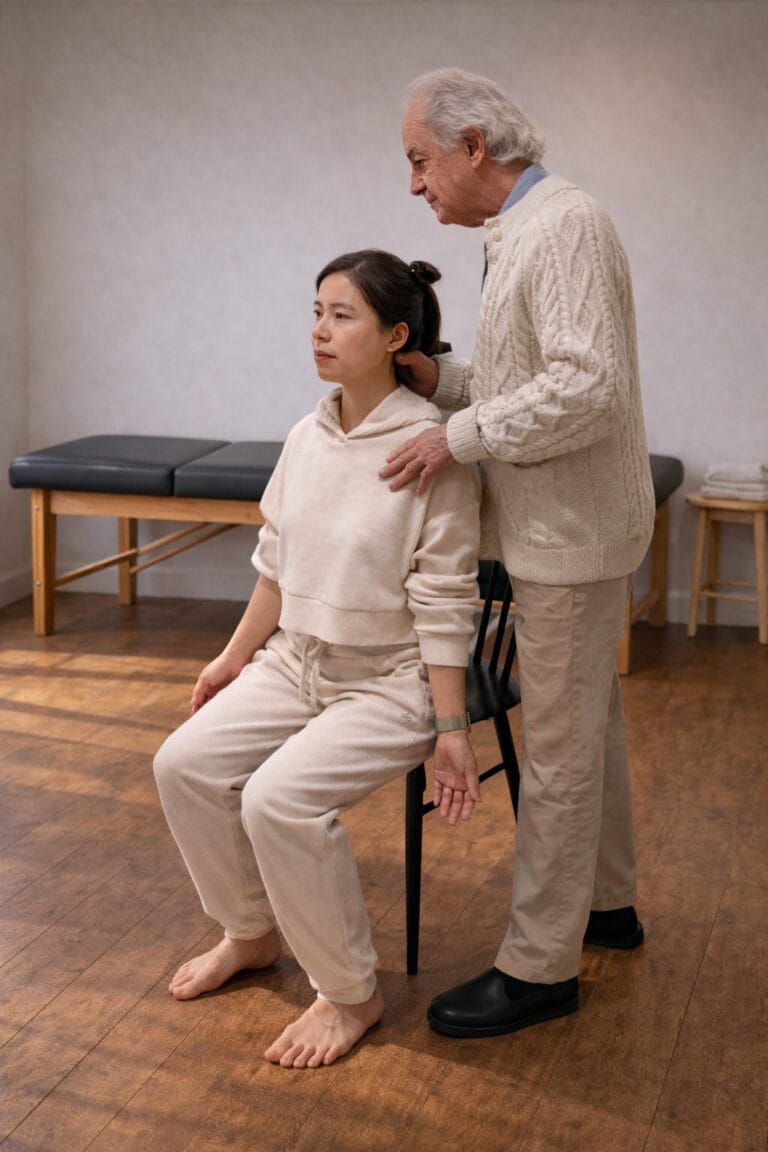
In Tommy’s words during class, there are not only the core principles of the Alexander Technique, but also practical wisdom that can be applied directly to daily life. His words go beyond simple advice about movement and prompt us to deeply consider how we choose to exist.“When you transfer what you do on the table with that exercise to what you’re doing in teaching, it’s a way of learning the difference between inspansion and expansion. When I have my hands on you—when I’m doing this—that’s inspansion. And if I go into the position of mechanical advantage and I do that—there’s equal pressure between my feet and my hands, so that I’m really using my whole back—when I do this, that’s expansion. I’m taking you out.”
➤ This names the craft: inspansion as the organism’s inner readiness, and expansion as the teacher’s whole-self delivery—support arising from intelligent use, not muscular doing.
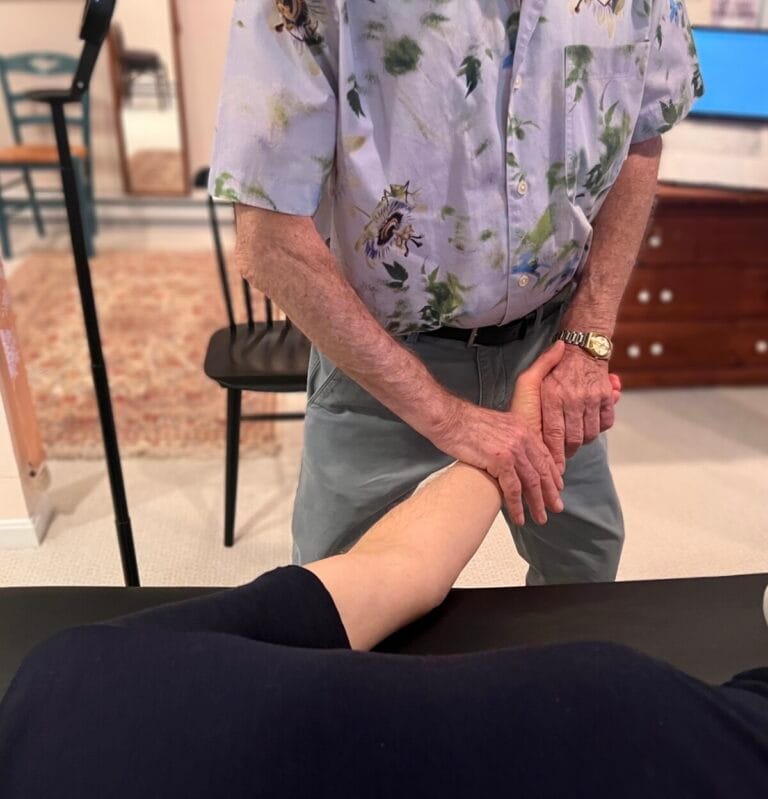
“If I push the table away from me, it’s expansion. If I pull the table towards me, it’s also expansion. And I’m doing this, bringing the table towards me, with equal pressure from hands and feet. I come in—it’s really coming up from… it’s coming up into the spine, but it’s actually coming up from the perineum.”
➤ The direction changes, but the principle doesn’t: expansion is an embodied pathway of support that organizes from below, letting the whole spine participate without force.
“If I push the table away, I come up more through my front. If I bring the table towards me, I come up through my back. Very important.”
➤ This is sensory literacy in action—tracking where support is rising through you so your hands can communicate clarity rather than effort.
“You might have pushed the table away, and that brings you up your front, from the perineum all the way up the front. When you bring the table towards you and have equal pressure with your feet, it tends to bring you up your back, from your sacrum all the way.”
➤ The table becomes a diagnostic mirror: front-line lift and back-line lift are distinct experiences that train non-verbal precision in contact.
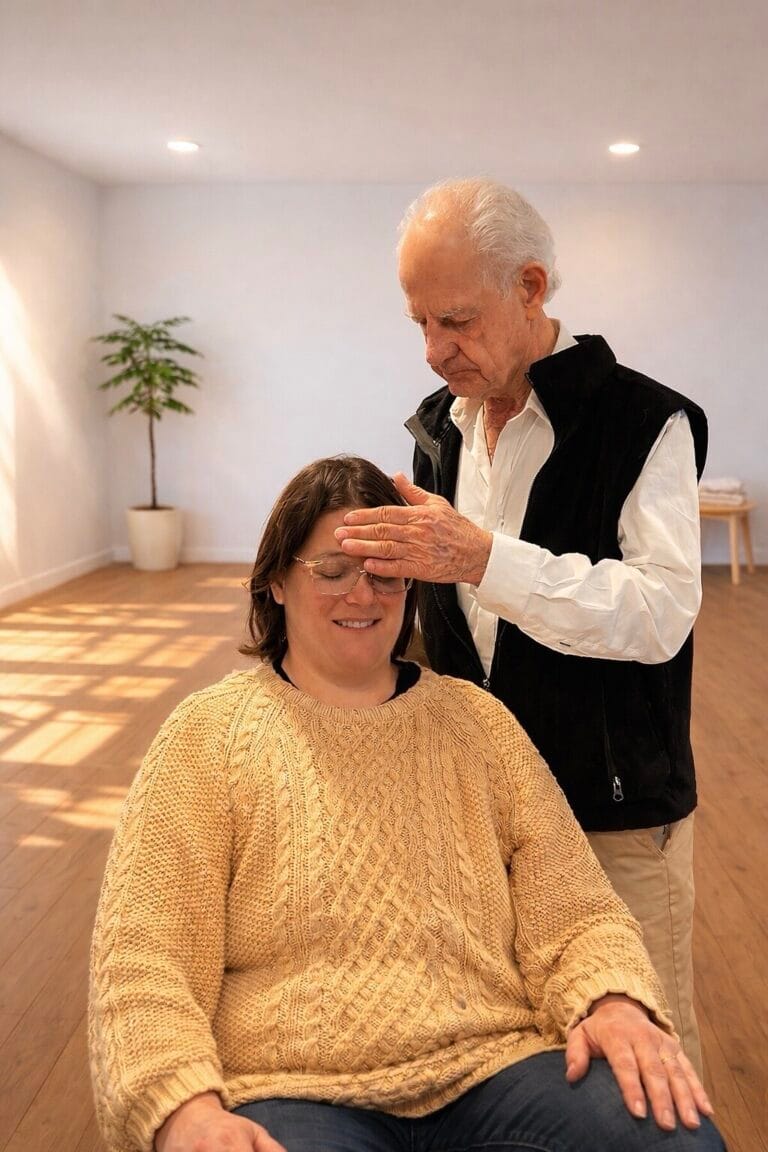
“What you’re doing is preserving a homeostatic integrity, so that even if they feel their life is falling apart, they’re not having a stark reaction, which would make them reach for something. And what they really want to reach for is a deeper sense of who they are—really themselves.”
➤ The teacher’s ethics live here: you don’t interpret their story—you stabilize their system so they can meet it without collapsing into reflex.
“The job is to bring them as closely aligned with who they might be and who they think they are becoming.”
➤ This is education, not correction—creating conditions where potential can become perceptible, and self-image can soften into something truer.
“What you’re demonstrating to the person, relative to the concept of use, is that I’m going to take you in and out of a chair, as opposed to working with you while you’re playing a guitar. This is to illustrate how the axial relationship of your head relative to the rest of your body will change your whole body.”
➤ Chair work strips the lesson to essentials, revealing that “use” is a whole-body coordination organized by the head–spine relationship.
“We’re going to give you a demonstration to point out how changing the axial relationship of the head relative to the organism affects the total pattern of neuromuscular use, and we will do it through a demonstration of sitting and standing.”
➤ Demonstration is proof by experience: a simple task becomes a laboratory for showing how thought, direction, and support reorganize the entire self.
“I think the term—the word—really is support. When you’re going through stuff, you lose a sense of being in support. And what we’re doing is helping the person reclaim—physically, on a real, deeply physical level—a sense of being in support while going through things I wish I never had to go through.”
➤ Support is not reassurance—it’s restoring embodied ground so the person can stay with themselves while life moves through them.
4. Practical Tips for Everyday Life
What’s the Goal?
The aim is not to practice exercises or improve performance.
It is to carry a sense of support into ordinary moments, especially when nothing feels ideal. When support is present, inspansion and expansion are not applied—they emerge as life asks something of you.
This work does not add tasks to your day.
It meets what you are already doing from a supported ground.
How to Practice
- Choose one ordinary transition
Pick a moment you already do every day—standing up, sitting down, reaching for something. Do not try to improve it. Allow the idea of moving away rather than “doing the action,” and let support organize first. - Let support come from contact, not effort
When you push or pull, notice whether equal pressure between hands and feet is present. Do nothing to create it. If support is there, expansion appears. If not, wait. The waiting is the practice. - When thinking becomes heavy, keep yourself
Instead of changing the thought, ask whether you are still supported in gravity and space. Let the body stay organized while thoughts move. Your task is not to resolve the moment, but to remain with yourself.
What You’ll Notice
Actions may feel lighter and reactions less abrupt. More importantly, even in difficulty, you may notice an increased capacity to stay in relationship with yourself. This is the practical ground of Wellness—not control, but a recoverable state of support.
5. Closing the Class
Key Takeaways
- Inspansion and expansion are not techniques to apply, but experiences that emerge when support is maintained.
- The position of mechanical advantage and equal pressure create conditions for coordination, not effort.
- Demonstration—especially sit-to-stand—reveals changes in use more clearly than explanation.
- Teaching is not about solving a person’s life, but about helping them remain supported while it unfolds.
Core Insights
At the heart of this class is a simple but demanding ethic: do not take the person away from themselves.
When support is preserved, the organism can reorganize without force. When it is lost, even well-intended help becomes interference. The Alexander Technique, as Tommy teaches it, is not a method of correction but a practice of maintaining integrity—physical, perceptual, and relational.
A Final Invitation
This work does not ask you to change who you are.
It asks you to stay with yourself, especially when things are unclear or difficult. If support can be recovered in those moments, then learning continues—not as effort, but as a natural response of a living system.
That is the invitation of this class:
to let support do the work, and to trust what emerges from there.
6. One Key Practice
For the next moment today, do less—and stay supported
Choose one simple moment—standing up, sitting down, reaching for an object.
Pause for just a few seconds before you move. Do not prepare. Do not correct.
Let your feet meet the floor.
Allow your body to recognize support in gravity and space.
Then let the movement happen, without trying to make it better.
If nothing changes, that is fine.
If something changes, let it be small.
The practice is not the movement.
The practice is remaining supported while the movement occurs.
7. Three Questions to Ask Yourself
These are not questions to answer.
They are questions to stay with.
- Am I supported right now, or am I trying to manage myself?
- Can I allow this moment to unfold without stepping away from myself?
- What happens if I do less and stay here a little longer?
Asked this way, the questions do not demand improvement. They invite presence.
This is how the Alexander Technique enters daily life—not as a method to apply, but as a way of remaining in relationship with yourself while living.
8. For Those Who Wish to Learn More
Recommended Book
Touching Presence – Tommy Thompson
This book brings the reader directly into the teaching room and reveals the Alexander Technique as an ethic rather than a method. Through lived classroom moments, it shows how support, not correction, allows change to occur—the same continuity this class explores from table work into teaching. Rather than offering answers, the book clarifies how withholding premature definition and maintaining relationship enable a person to remain with themselves while life is unfolding.
Official Website of Tommy Thompson
www.easeofbeing.com
This is the official website personally managed by Tommy Thompson, offering a wide range of resources and programs to deepen your understanding and practice of the Alexander Technique:
- Private session reservations and inquiries
- Workshop and seminar schedules
- Overview of international teacher training programs
- Essays and articles on the Alexander Technique
9. Next Class Sneak Peek
In the next class, the inquiry deepens into the nature of possibility itself—not as an idea, but as a lived condition.
What allows possibility to appear in the middle of habit, and what closes it before we even notice?
This class begins to examine how perception, history, and attention quietly determine whether something new can emerge.
In Class 84, we’ll explore:
what makes possibility available—or unavailable—within lived experience.
10. Join the Alexander Technique Journey
Did this class leave a small resonance within you? Feel free to quietly hold it in your heart or share it in just a sentence or two. The comments are always open. Your one simple word may leave a gentle ripple in this ongoing journey.The journey of Resonance Flow continues across social media as well. Let’s continue this journey together.
 YouTube
 Instagram
 Threads
 Facebook