Triadic Resonance Will Change How You Move Forever | Tommy Thompson Class 26
❝ What if support isn’t something you add, but something you uncover? ❞
Most people think they need to hold themselves up—shoulders back, core tight, mind in control. But in reality, that very effort often disrupts the balance and fluidity they’re striving for. What if your body already knows how to move with grace—and it’s your interference that’s getting in the way?
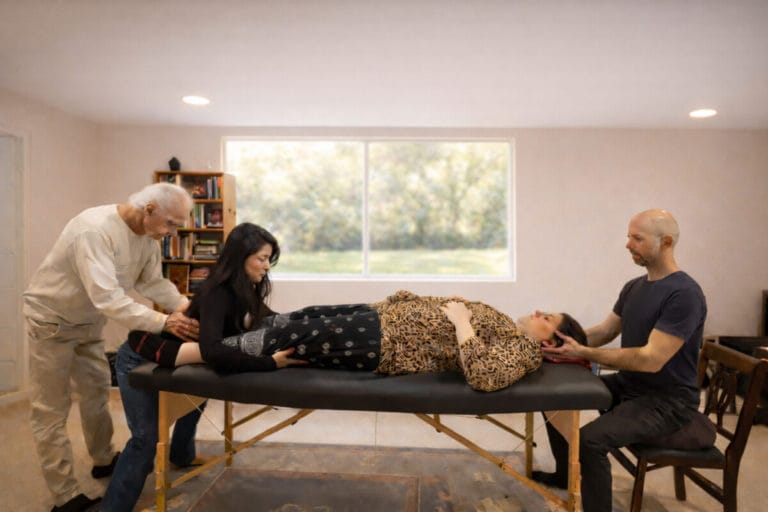
On November 13, 2024, in Boston, Massachusetts, USA,, Tommy Thompson led a class in the Alexander Technique teacher training course that dove straight into this radical shift in perception. This was not about fixing your posture. It was about letting the system reawaken its own intelligence.
Central to the class was the experience of Triadic Resonance—a spontaneous, living coordination of breath, spine, and neural timing that only becomes available when the body feels genuinely supported. This wasn’t metaphorical support. It was physiological, emotional, and perceptual all at once.
The class didn’t offer solutions—it created conditions. And in those conditions, movement began to reorganize. The spine expanded, the breath responded, and effort began to dissolve. No correction. Just recognition.
Key Objectives of the Class:
- To explore how support—when deeply perceived—becomes the foundation of all efficient movement
- To experience Triadic Resonance as the natural outcome of spinal, respiratory, and cognitive coherence
- To examine how Alexander Technique work reveals the subtle interference patterns between intention, habit, and the brain’s natural regulatory systems
This blog series is based on Tommy Thompson’s Alexander Technique classes. Each post follows the flow and insights of the class to expand both self-awareness and practical consciousness applicable to everyday life.
New here?
If you’re new to the Alexander Technique, you can start with the resources below.
Alexander Technique Class Flow at a Glance
1. The Opening Question
❝ What is moving you—your intention, or your habit? ❞
In every gesture, something is already underway before we become aware of it. But what’s truly initiating that motion? Is it our intention, or the echo of a habit?
In this Alexander Technique class, trainees were invited to examine that exact moment—the still point before action—where Triadic Resonance can arise. Not as a strategy or control mechanism, but as an unfolding of support, already present and waiting to be noticed.
This wasn’t a class about making something happen. It was about allowing what is already happening to become clear.
Between trying and trusting lies the space where true coordination emerges.
Tommy reminds us through his teaching that support isn’t something we generate through effort. It’s something we remember and uncover through awareness. And from that state, the body moves not with effort, but with precision.
Tommy’s Word
“If I decide to work with my intention—if my hand is here and I want to do something—I consciously register that intention. But in reality, the brain has already registered the intention before I do so consciously. The closer I get to not acting impulsively on my intention but instead maintaining awareness of it, the more precisely the brain executes it. In other words, when I refrain from interference and allow the brain to function naturally, everything happens with greater ease and efficiency.”
Tommy reminds us: your brain is already doing the job—if you stop interrupting it. What if intelligence doesn’t need to be applied, but released? That is the principle of Triadic Resonance: a return to natural timing, free of interference, full of presence.
2. Core Learnings from This Class
Core Concepts
- Support precedes action.
When the system experiences real support—not just structural, but emotional and perceptual—movement becomes organized without being managed. - Triadic Resonance is a living rhythm.
This is not a method to apply, but a resonance that emerges when breath, spine, and timing harmonize through non-interference. - Inhibition is not suppression—it’s sacred timing.
To inhibit in the Alexander Technique is to create a living pause—a space where awareness replaces reflex, and coordination becomes possible.
Five Key Messages
- The body organizes itself best when we stop trying to organize it.
- Support is not added—it is uncovered.
- Intention happens before we consciously know it.
- Awareness and timing matter more than control.
- Habit lives in the nervous system—and so does the possibility of change.
Essential Terms
- Alexander Technique: A process of undoing habitual interference with the body’s innate coordination. It restores natural movement not through correction, but through recognition and presence.
- Triadic Resonance: A term used by Tommy Thompson to describe the natural coordination of breath, spine, and neural response that arises when the body is fully supported and the mind ceases to interfere. It is felt, not done.
- Support: The internal sense of being held from within. This isn’t something imposed, but a condition discovered. Support allows the system to expand, respond, and release into motion.
- Inhibition: The conscious practice of not acting out of habit. It is a moment of dynamic stillness in which the nervous system reorients toward clarity, not compulsion. As Tommy says, “just wait, and stay.”
- Habit: A protective neural pattern that once served a need, but often becomes a limitation. In Tommy’s words, “the brain adapts to your habituation”—until awareness interrupts the loop.
- Intention: The underlying desire that moves us, often before we become conscious of it. As Tommy puts it, “the brain registers the intention before we do.” Real freedom comes when we learn to stay with the intention, rather than act on it too soon.
These principles form the spine of this class, and the beating heart of the Alexander Technique: to move, to breathe, and to choose—without tension, and with full awareness.
3. Tommy’s Insight
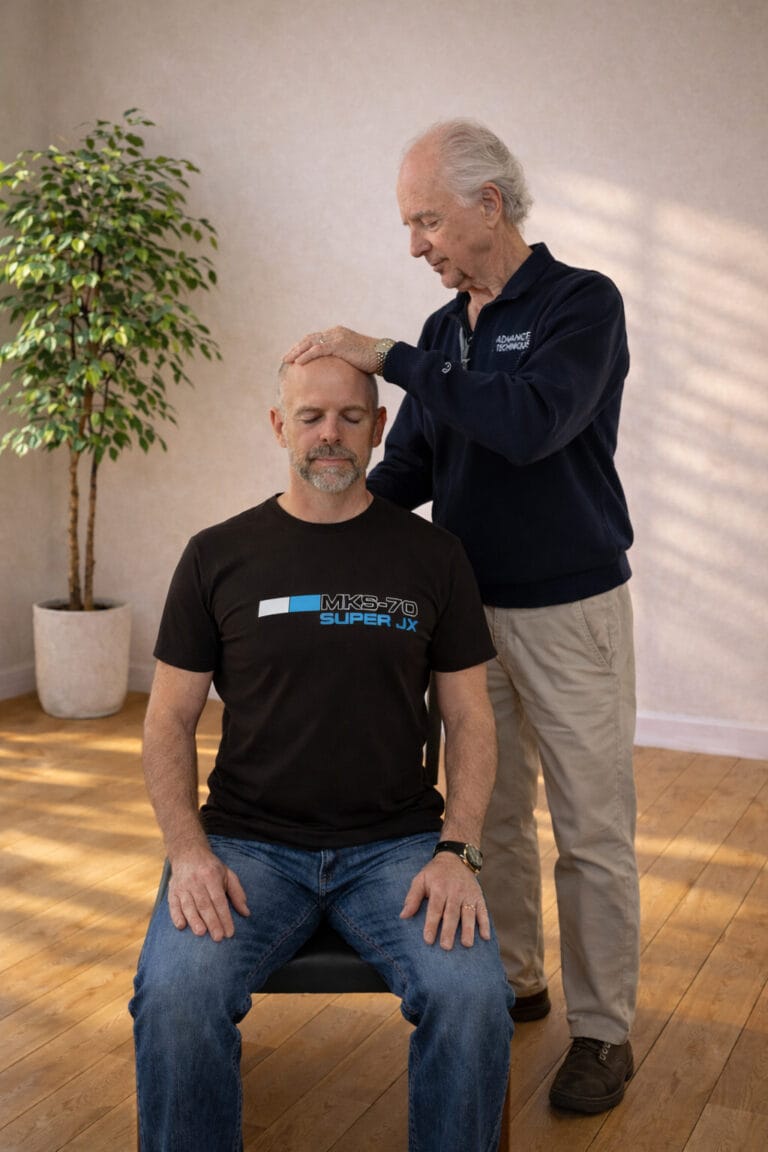
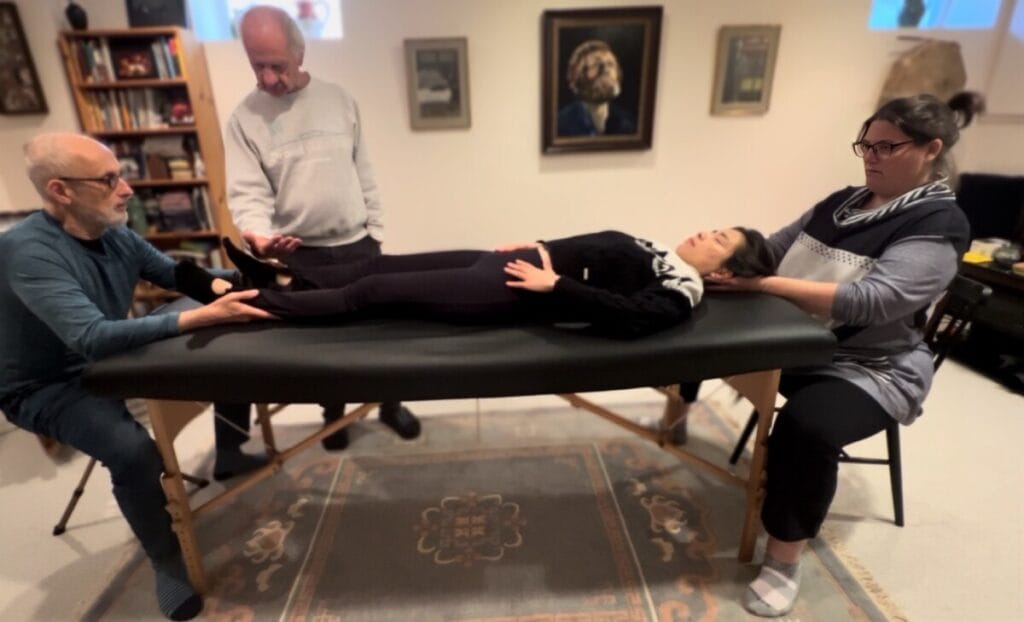
In Tommy’s words during class, there are not only the core principles of the Alexander Technique, but also practical wisdom that can be applied directly to daily life. His words go beyond simple advice about movement and prompt us to deeply consider how we choose to exist.“Each time I place my hands, I remain there fully. And when I lift them, the person still seeks that sense of support. They want to feel it. They want to experience this natural movement. That’s what’s happening—I’m following their movement because it’s part of a natural release.”
→ When you remain fully with your hand, you’re not doing the release—the release finds you. That’s presence as support.
“Triadic Resonance allows the neck to remain free, so the head can move forward and away from the body, enabling the spine to lengthen. As the movement continues downward through the entire spine, the back naturally expands during exhalation.”
→ When the neck is free, the whole spine listens. Movement unfolds downward like breath—effortless, continuous.
“During inhalation, the spine slightly compresses, and during exhalation, it decompresses. Or, as it’s often described now, the spine gathers on the inhale and lengthens on the exhale.”
→ The spine breathes too—gathering on the inhale, lengthening on the exhale. This rhythm is already built in. You just stop getting in the way.
“Whatever habitual patterns a person has developed, they arose as a way to protect themselves within their own thinking. But in that moment, in that experience, they were not fully supported. That’s why, the first time I place my hands on someone, they must feel truly supported. Right now, the state is neutral. And at that moment, they simply exist as they are, where they are.”
→ Habit forms when support was missing. But in this moment, with touch that truly stays, the system remembers it can let go.
“We are not always conscious of it, but an internal intention drives us to act. Or perhaps, there was a strong inner desire for something. Desire precedes everything—it shapes and moves the world. That desire existed within me, and then I became aware of my intention.”
→ Desire moves before intention forms. And intention whispers before you hear it. Your body follows both—until awareness steps in.
“If I decide to work with my intention—if my hand is here and I want to do something—I consciously register that intention. But in reality, the brain has already registered the intention before I do so consciously. The closer I get to not acting impulsively on my intention but instead maintaining awareness of it, the more precisely the brain executes it. In other words, when I refrain from interference and allow the brain to function naturally, everything happens with greater ease and efficiency.”
→ The brain knows the path. The less you interfere, the clearer the action. Precision is not from control, but from trust.
“The brain adapts to your habitual patterns. You already know this, but the brain performs this role exceptionally well—if not better than we consciously do. The brain is designed to function in a way that ensures support. That support is homeostasis.”
→ Your brain is already working to support you. Homeostasis is its design. The shift begins when you stop fighting its rhythm.
4. Practical Tips for Everyday Life
What’s the Goal?
To bring the principles of the Alexander Technique—and specifically the experience of Triadic Resonance—into your everyday life, not just in practice or in class. The goal is to cultivate a state where support is felt, not fabricated. Where movement doesn’t need to be performed, but simply allowed.
How to Practice
- Let your breath lift you
The next time you get up from a chair, stay with your breath. Let your inhale gather you, let your exhale release you forward and up. Don’t instruct the movement—let the breath show the way. You may find your spine lengthening without needing to try. - Stay one moment longer
When you touch something—a doorknob, a teacup, your own hand—pause. Let your hand truly arrive. Don’t rush on. Stay with the contact. Let presence become your first action. - Wait before you act
Just before you reach, turn, or speak—pause. Even for half a breath. In that stillness, ask: Is this habit, or is this awareness? Let the movement form on its own—the brain already knows how.
What You’ll Notice
- Movements may start to feel quieter, more fluent—like they’re happening through you, not from you.
- You’ll begin to catch the moment before things begin—and that’s the space where change lives.
- A sense of calm might appear in the most ordinary actions. And in that calm, something new can happen.
These aren’t techniques to master. They’re invitations to return. To listen again. To let your life breathe with you.
5. Closing the Class
Key Takeaways
This class wasn’t about acquiring new skills. It was about returning—returning to the possibility that movement begins with support, not effort.
We didn’t rehearse better posture. We practiced the discipline of allowing. Allowing breath to guide, allowing support to arrive, allowing movement to emerge without command.
Through Triadic Resonance, we experienced that when support is felt, action becomes inevitable—and no longer needs to be forced.
Core Insights
- Support isn’t something we create—it’s something we come into contact with.
- Ease doesn’t result from control, but from the absence of interference.
- Awareness is not the director. It’s the witness that allows movement to find its own rhythm.
These are not tools to add to your life. They are reminders that life, as it is, already holds the coordination you’re looking for.
Tommy didn’t offer us strategies. He offered conditions—for listening, for staying, for realizing we are never separate from the support we seek.
A Final Invitation
Let the learning move with you now. Not by trying. But by pausing.
By letting a single moment of awareness be enough. And in that moment—you may no longer feel like the one moving, but the one being moved.
6. One Key Practice
Stay long enough to feel supported—before you move
Not think about support. Not imagine it. But actually feel it, right now, under you.
If you can wait long enough for that to happen, movement won’t need to be planned.
It will just happen—because it’s already waiting.
7. Three Questions to Ask Yourself
- Did I move because I was ready—or because I was in a hurry?
→ Ask this gently, not to correct, but to notice the difference. - Where did I feel support just before the movement began?
→ Even if you didn’t notice it then, you can invite yourself to feel it next time. - Was I aware of my intention—or did I skip over it?
→ Often, the body acts before the mind catches up. What happens if you wait?
These are not questions for judgment. They are openings.
Invitations to dwell in the moment before, where awareness lives and movement begins.
8. For Those Who Wish to Learn More
Recommended Book
How You Stand, How You Move, How You Live: Learning the Alexander Technique – Missy Vineyard
This book offers a rare synthesis of intellectual depth and practical wisdom, reflecting much of what Tommy Thompson brings into his teaching. Vineyard’s language is precise, embodied, and richly human—making complex ideas like Triadic Resonance and deep support both accessible and deeply felt.
Especially relevant to teacher trainees and serious students, this book explores movement not as behavior to fix, but as a living process that can be noticed, trusted, and transformed. It’s not just a how-to—it’s a how-to-be.
Official Website of Tommy Thompson
www.easeofbeing.com
This is the official website personally managed by Tommy Thompson, offering a wide range of resources and programs to deepen your understanding and practice of the Alexander Technique:
- Private session reservations and inquiries
- Workshop and seminar schedules
- Overview of international teacher training programs
- Essays and articles on the Alexander Technique
9. Next Class Sneak Peek
What if posture wasn’t something you hold—but something that holds you?
In the next class, we’ll explore how the Alexander Technique reveals movement not as correction, but as connection. Not as control, but as coordination.
➤ Posture emerges when the parts begin to speak to each other
➤ Awareness is the first condition for change
➤ Reflexes and presence shape natural movement—not effort
You won’t be asked to improve your body—you’ll be invited to listen to it—deeply, clearly, without rush. Come prepared not to try harder—but to allow more.
10. Join the Alexander Technique Journey
Did this class leave a small resonance within you? Feel free to quietly hold it in your heart or share it in just a sentence or two. The comments are always open. Your one simple word may leave a gentle ripple in this ongoing journey.The journey of Resonance Flow continues across social media as well. Let’s continue this journey together.
 YouTube
 Instagram
 Threads
 Facebook