Kinesthetic Awareness and Triadic Resonance in the Alexander Technique | Tommy Thompson Class 04
❝ What might change if we began to use ourselves as we were truly designed to? ❞
Kinesthetic awareness is a key to integrating perception and action. When we begin to notice how we use ourselves—not just how we move—we open the possibility of releasing habitual tension and allowing natural coordination to return. This shift doesn’t just improve movement. It transforms how we live.
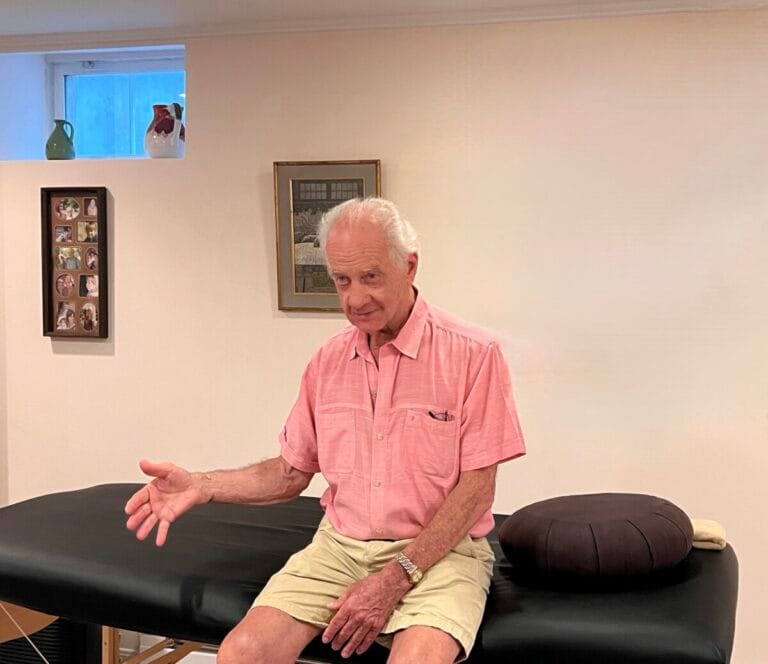
On On September 24, 2024, in Boston, USA, Tommy Thomson led a class in the Alexander Technique teacher training course, exploring how kinesthetic awareness and Triadic Resonance can be used to optimize postural alignment and overall function.
Key Objectives of the Class:
- To explore how kinesthetic sense can be used to recognize and improve the way we use our bodies.
- To explain how the concept of “use” relates to the development of one’s physical identity.
- To understand how the relationship between the head and body influences postural alignment in movement. This blog series is based on Tommy Thomson’s Alexander Technique classes. Each installment follows the flow and insight of the class, expanding both self-awareness and applied practical consciousness in relation to daily life.
This blog series is based on Tommy Thompson’s Alexander Technique classes. Each post follows the flow and insights of the class to expand both self-awareness and practical consciousness applicable to everyday life.
New here?
If you’re new to the Alexander Technique, you can start with the resources below.
Alexander Technique Class Flow at a Glance
1. The Opening Question
❝ What if true alignment begins not with movement—but with how you relate to yourself? ❞
This question reframes alignment not as a physical correction, but as a perceptual shift. In the Alexander Technique, such change begins with how we use ourselves—how we attend, rather than what we do. It is through kinesthetic awareness and triadic resonance that we begin to access this kind of intelligent self-organization.
The central question that captures the essence of the class
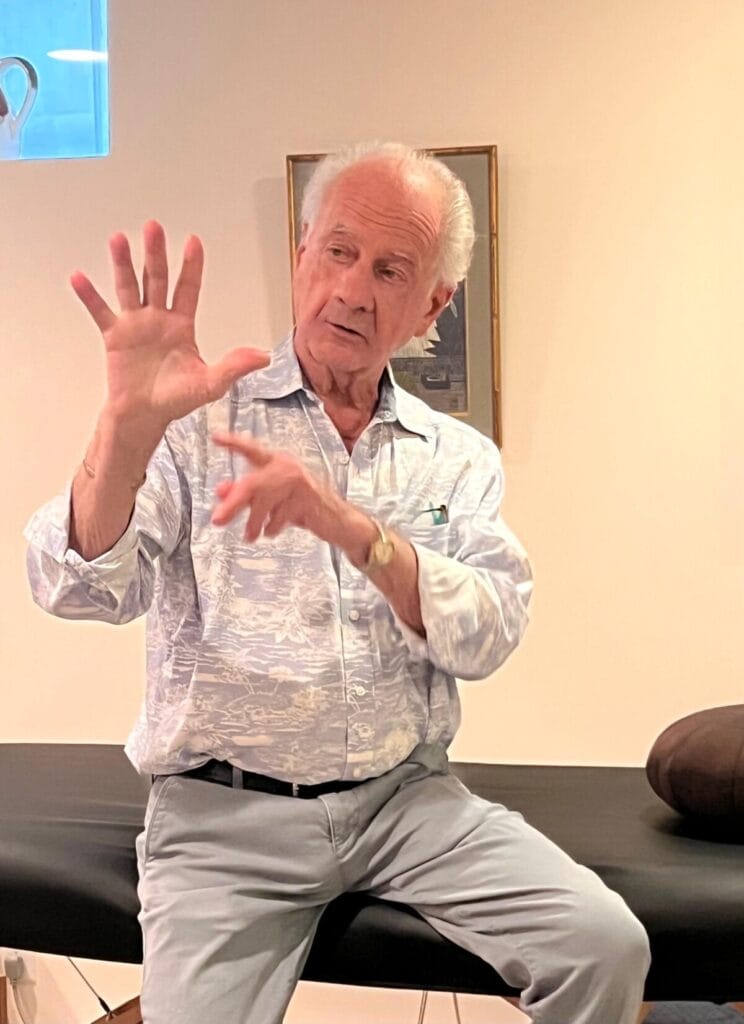
Tommy’s Word
“Kinesthetic awareness is a means of perceiving what you’re doing and how your body is responding. Through this awareness, you can begin to use yourself as you were designed to.”
Tommy doesn’t teach you to fix yourself. He invites you to perceive differently. Kinesthetic awareness in his work isn’t a technique—it’s a shift in how you relate to the whole system of self-use. And triadic resonance, through subtle sensory contact, becomes a way to interrupt habitual doing and allow the system to reorganize itself from within. This is the principle at the heart of the Alexander Technique.
2. Core Learnings from Kinesthetic Awareness and Triadic Resonance
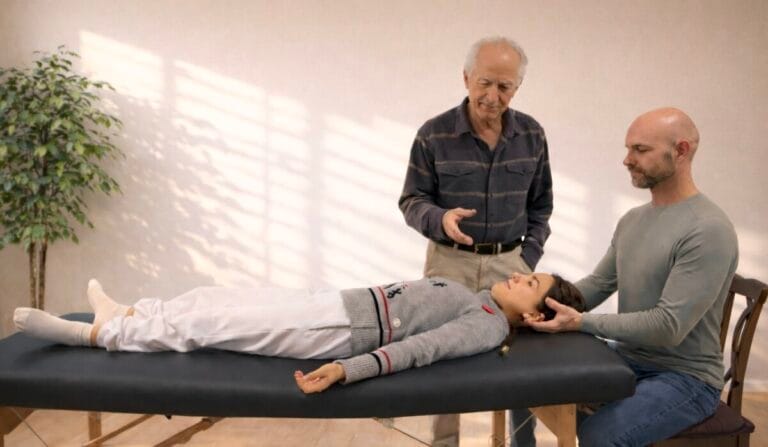
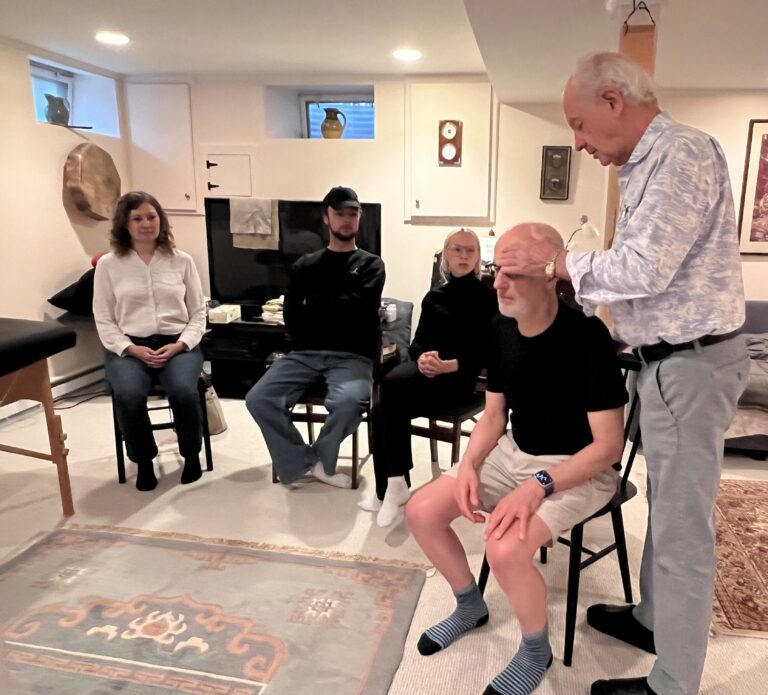
In this moment from Tommy Thompson’s class, trainees explore how Triadic Resonance allows the body to reorganize through light contact. The focus is on sensing rather than doing, allowing coordination to emerge without force.
Watch how a subtle touch influences the whole system and brings the body into greater alignment.
Just a Light Hand Touch—and My Whole Body Aligned?! | Alexander Technique
Class 04 · September 24, 2024 · Boston, MA
Core Concepts
- Kinesthetic Awareness and Self-Use
Kinesthetic awareness is the internal capacity to perceive movement, balance, and spatial orientation. In the Alexander Technique, this awareness supports self-use—how we coordinate perception, intention, and physical response as a unified whole. It allows us to recognize patterns of tension and choice in how we move. - Triadic Resonance and Neuromuscular Reorganization
Triadic resonance refers to the sensory relationship between the hands, spine, and major muscle groups. Through light, intentional contact—often around the head and neck—it encourages the nervous system to reorganize without force. This approach supports ease, clarity, and postural stability. - The Role of the Trapezius and Sternocleidomastoid (SCM)
These muscles form structural connections between the head, spine, and shoulders. When released from habitual effort, they help restore natural alignment and support freer movement. Triadic resonance helps reawaken their function by removing interference through sensory input. - Integration of Being and Doing
In the Alexander Technique, effective movement begins with perception. When being (presence) and doing (intention) are integrated, action arises from clarity—not from correction. This shift allows the whole system to become responsive rather than reactive. - The Synergy of Kinesthetic Awareness and Triadic Resonance
Kinesthetic awareness shows us what’s happening; triadic resonance gives us a way to influence it. Together, they create the foundation for change—not by managing the body, but by restoring the conditions for it to align itself. This is the essence of embodied learning in the Alexander Technique.
Five Key Messages
- When the body is used according to its original design, movement flows naturally and harmoniously.
- Kinesthetic awareness reduces excessive tension and enables efficient movement.
- Triadic Resonance balances energy distribution and enhances physical stability.
- Muscular alignment is key to improving function and reducing pain.
- When being and doing are integrated, it becomes possible to live a life where body and mind are harmoniously connected.
Essential Terms
- Kinesthetic Sense
The innate ability to perceive the position and movement of the body. It plays a vital role in improving posture, refining coordination, and releas
ing unnecessary tension. - Triadic Resonance
A sensory-based technique that uses the interaction between the hands, spine, and muscle groups to release tension and optimize structural alignment and overall function. - Fit
A concept that describes the harmonious relationship between the body and its environment, where ease, balance, and alignment arise naturally. - Being and Doing
A framework that integrates inner stillness (being) with intentional movement (doing), promoting both emotional presence and physical efficiency. - Trapezius Muscle
A large upper-back muscle that connects the head, spine, and shoulders. It plays a central role in postural support and coordinated movement. - Sternocleidomastoid (SCM)
A major neck muscle that coordinates head movement and helps maintain balance between the head and the spine.
3. Tommy’s Insights
In Tommy’s words during class, there are not only the core principles of the Alexander Technique, but also practical wisdom that can be applied directly to daily life. His words go beyond simple advice about movement and prompt us to deeply consider how we choose to exist.“The concept of use and the kinesthetic sense of perception help identify how you use yourself to perform actions.”
This highlights how kinesthetic awareness isn’t just about sensing your body—it’s a practical tool for recognizing how you engage with yourself in movement. It ties directly into the Alexander Technique principle of “use.”
“Identity develops when you distinguish yourself from the other, but it often prevents alignment with your natural design, which is inherently interactive with everything.”
Tommy points out that our sense of identity—while useful—can interfere with our natural coordination. When identity overrides body intelligence, tension and disconnection follow.
“You either use yourself in alignment with your design or create conflicting ways, which often leads to trouble.”
This makes it clear: we either cooperate with our design or work against it. The latter leads to imbalance, strain, and dysfunction.
“Don’t look inward; remain part of the world, and naturally identify where you are while focusing on what you’re doing.”
Tommy encourages us to avoid over-focusing on ourselves. Awareness that includes our environment supports more balanced, grounded presence.
“A portion of the hand positioned on the trapezius and sternocleidomastoid impacts their alignment and relaxation. Focusing on specific areas of the carpal bones extends the fingers, empties the palm, and releases muscle groups through triadic resonance.”
These two insights explain how triadic resonance works. Subtle hand placement and finger orientation influence deep muscular release. It’s not about force—it’s about opening and realigning through connection.
4. Practical Tips for Kinesthetic Awareness and Triadic Resonance
What’s the Goal?
To restore your sensory awareness of how you use your body in daily life, reduce unnecessary tension, and experience natural alignment.
Through simple everyday movements, you can begin to notice the connection between body and mind, and gently adjust how you are being.
How to Practice
- Slowly sitting down and standing up from a chair
- Pay attention to the alignment of your head and spine as you slowly sit and stand.
- Internally give yourself this direction:
“As my neck frees, my head moves away from my body—forward and up.” - Notice that the movement is not led by your legs, but by the direction and balance of your head.
Tip: Keep asking yourself, “Can I move without effort?”
2. Letting go of tension while brushing your teeth
- While brushing, observe any unnecessary tension in your shoulders, neck, or jaw.
- Can your head move freely? Are your elbows lifted? Notice how your whole body is participating.
- Tip: A repetitive daily action is the perfect moment to become aware of how you use yourself.
3. Feeling the soles of your feet while waiting for the elevator
- Focus on the sensation of your feet touching the ground, and check whether your weight is leaning to one side.
- Is your spine lengthening upward? Is your head gently floating? Notice how your body is aligned.
- Tip: This brief moment of stillness is a golden opportunity to practice being present and aligned.
What You’ll Notice
- You’ll become more aware of unconscious tension and learn how to release it.
- Even small movements can help restore whole-body alignment and sensory clarity.
- You’ll build the capacity to recognize and adjust how you use yourself, even in everyday routines.
5. Closing the Class
Key Takeaways: Kinesthetic awareness and triadic resonance
Kinesthetic awareness and triadic resonance are powerful tools for releasing tension, restoring alignment, and improving the quality of everyday movement.
Through them, we begin to understand the body’s original design and learn to use ourselves in a more natural and integrated way.
Core Insights:
- Using the body according to its original design is key to strengthening both identity and physical coordination.
- Kinesthetic awareness is a vital tool for noticing and improving how you use your body.
- Triadic resonance, applied through hands-on contact, supports the recovery of alignment and energy flow in the body.
Motivation
While triadic resonance is most deeply experienced through the hands of a trained Alexander Technique teacher,
you can begin practicing awareness and coordination on your own using your kinesthetic sense.
Start small. As you slowly rise from a chair, feel the flow of your movement.
While brushing your teeth or simply standing, observe how you’re using yourself. That moment of awareness—however brief—can open a new connection between your body and mind.
6. One Key Practice
Today, explore your kinesthetic sense through the simple act of sitting and standing.
- Sit comfortably near the edge of a chair, then slowly rise to a standing position.
- As you move, silently give yourself this direction:
“As my neck releases, my head moves away from my body—forward and up.” - Tune in to the sense that it’s not your legs, but the direction and balance of your head that initiates the movement.
Check-in question:
“Am I pushing with effort, or am I moving through direction?”
Why this practice?
Kinesthetic awareness is about recognizing how you move.
Focusing on this one simple transition helps you notice habitual tension
and take the first step toward using yourself with greater precision and ease.
7. Three Questions to Ask Yourself
- Am I using my body according to its original design through kinesthetic awareness right now?
- If I’ve experienced hands-on work that helped release tension and balance my energy, what did that feel like for me?
- What changes have I noticed within myself through today’s simple practice?
8. For Those Who Wish to Learn More
Recommended Books
- The Use of the Self – F. M. Alexander
A foundational classic written by the founder of the Alexander Technique himself. Alexander shares how the way we use our body affects every aspect of life, drawing from his own experience. The chapter “Evolution of a Technique” offers a powerful starting point for exploring self-awareness and shifting habitual patterns. - Body Learning – Michael Gelb
This is one of the most highly recommended books for beginners in the Alexander Technique. It explains Alexander’s core concepts in modern, accessible language, offering practical insights into kinesthetic awareness and self-use. Rather than focusing on complex theory, it emphasizes real-life application—making it a perfect companion to this class.
Official Website of Tommy Thompson
www.easeofbeing.com
This is the official website personally managed by Tommy Thompson, offering a wide range of resources and programs to deepen your understanding and practice of the Alexander Technique:
- Private session reservations and inquiries
- Workshop and seminar schedules
- Overview of international teacher training programs
- Essays and articles on the Alexander Technique
9. Next Class Sneak Peek
Withholding Definition and Physical & Mental Freedom
In the next class, we will focus on the concept of Withholding Definition, a principle uniquely developed by Tommy Thompson.
Withholding Definition is a way of thinking that involves not immediately judging or reacting in any given situation, but instead observing your emotions and physical state in order to discover better choices.
Through this practice, we can begin to break free from habitual patterns and develop the power to redefine ourselves and make freer, more conscious choices.
This class will include practical exercises and real-life examples to help apply this principle. Join us as we begin a new path toward self-discovery and inner balance.
10. Join the Alexander Technique Journey
Did this class leave a small resonance within you? Feel free to quietly hold it in your heart or share it in just a sentence or two. The comments are always open. Your one simple word may leave a gentle ripple in this ongoing journey.The journey of Resonance Flow continues across social media as well. Let’s continue this journey together.
 YouTube
 Instagram
 Threads
 Facebook