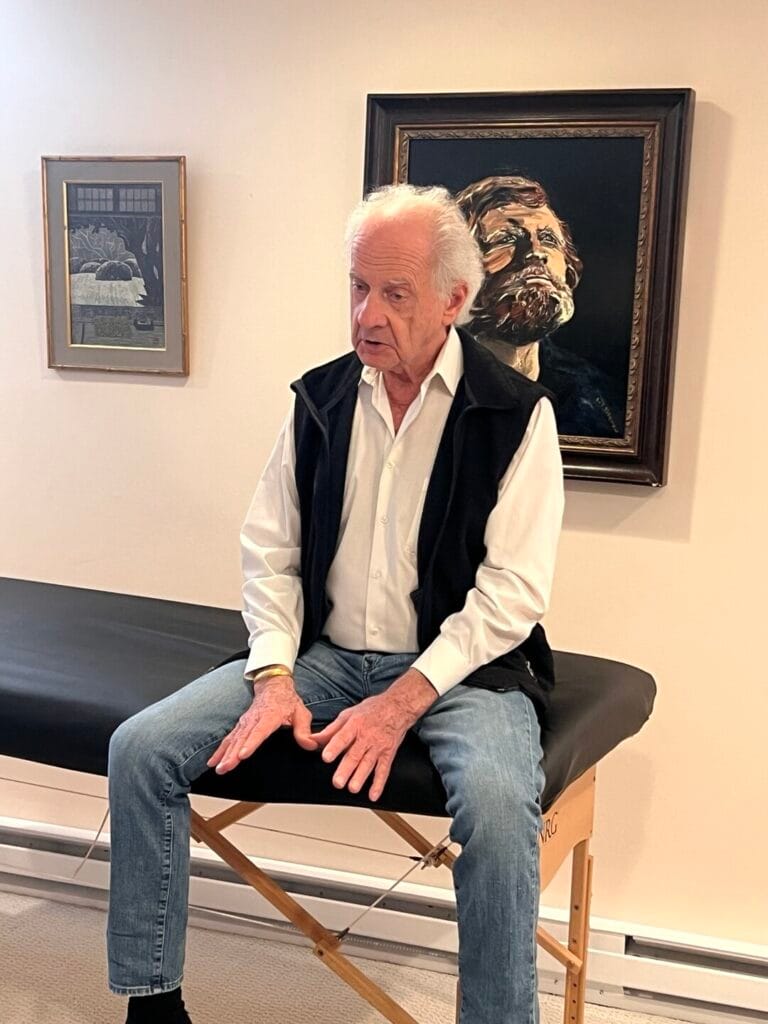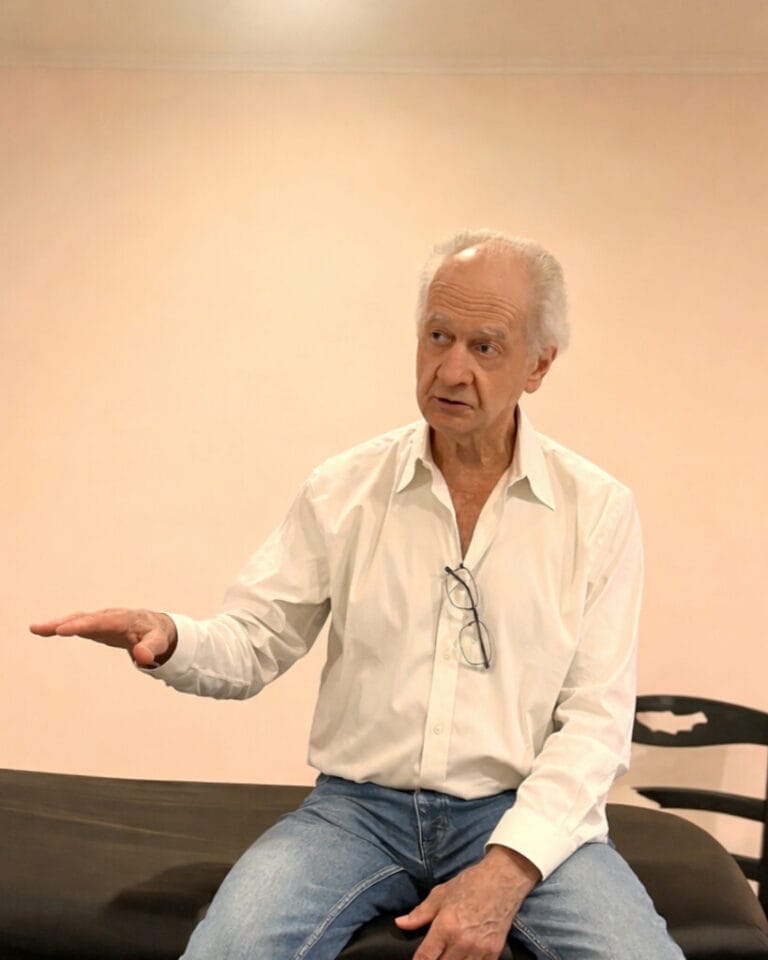
Alexander Technique and Identity: Rewriting the Self Through Inhibition | Tommy Thompson Class 14
❝ What if transformation doesn’t begin with doing more—but with doing nothing at all? ❞
What if the person you think you are is just a reflex you’ve never paused long enough to question?
This was the guiding question at the heart of a class on Alexander Technique and Identity, held on October 16, 2024, in Boston, Massachusetts, USA, led by master teacher Tommy Thompson. But this wasn’t about learning how to move better. It was about meeting yourself more truthfully.
No set routines. No postural corrections. Just one invitation:
Pause. Observe. Do not define.
“To inhibit,” Tommy said, “is not to stop. It’s to stop the stopping. To let something else arise.”
This class centered on two subtle yet radical practices: inhibition and withholding definition. Not to fix the body, but to interrupt the automatic ways we define and use ourselves—physically and mentally.
Tommy’s teaching didn’t push for improvement. It opened space. Not doing, but witnessing. Not effort, but presence. A quiet conversation with the nervous system—and a gentle rebellion against habit.
Key Objectives of the Class:
- To explore inhibition as a doorway to presence that is no longer automatic
- To practice withholding definition and allow a more fluid sense of identity to emerge
- To realize that use of self informs not only posture, but also perception, thought, and decision-making
This blog series is based on Tommy Thompson’s Alexander Technique classes. Each post follows the flow and insights of the class to expand both self-awareness and practical consciousness applicable to everyday life.
New here?
If you’re new to the Alexander Technique, you can start with the resources below.
Alexander Technique Class Flow at a Glance
1. The Opening Question
❝ Who are you… when you stop? ❞
What remains when you stop trying to be who you’ve always been? This question wasn’t rhetorical. It was a doorway. A moment where identity, habit, and presence are held in suspense.
In this class, Tommy Thompson invited each person to linger in the unknown. Not to fix. Not to improve. But to inhabit the gap between reaction and intention—and notice who, or what, emerges.
“The inhibiting moment is when you bear witness to yourself. That is a significant moment—not to question yourself, but to discover something entirely new and unknown.”
In that moment, we are no longer bound by our reflexes. We’re not “doing nothing.” We’re doing something different: We’re pausing the machinery of self-definition—allowing a space for a new configuration of self to unfold.
It’s the foundation of Alexander Technique and identity work—what we might call identity inhibition in motion. When you stop reacting, you don’t disappear. You expand. And in that expansion, you meet a self not shaped by habit, but by choice.
2. Core Learnings from This Class
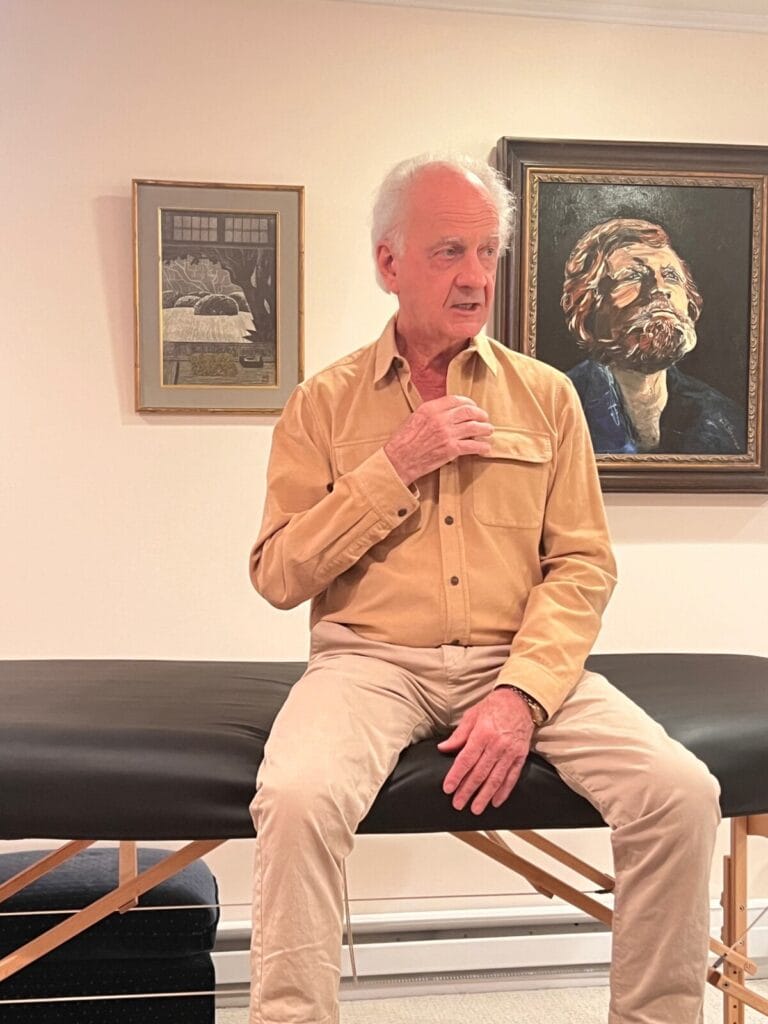
In this moment from Tommy Thompson’s class, trainees explore how identity is shaped through habit. The focus is on inhibition—pausing before action so habitual patterns can be seen and not followed.
Watch how this pause allows movement, breath, and even the sense of self to reorganize.
What If Who You Are Is Just a Habit? | Alexander Technique
Class 14 · October 16, 2024 · Boston, MA
Core Concepts
Most of us move, react, and decide based on patterns we rarely question. In this class, Tommy Thompson invited us to locate the exact moment before that pattern begins—and stay there. Not to fix. Not to perform. But to pause, observe, and not define.
The class revolved around two quiet revolutions in the Alexander Technique and identity work:
- Inhibition: choosing not to follow your automatic reaction—not out of resistance, but out of awareness.
- Withholding Definition: letting go of the need to define yourself in that moment, and allowing something unfamiliar—but more alive—to arise.
Together, they create a living laboratory where transformation becomes possible. Where presence can replace performance, and a new relationship with the self can emerge—one based not on habit, but on conscious choice. This interplay of inhibition and self-reflection is the cornerstone of identity inhibition, where the sense of self begins to shift.
Five Key Messages
- Inhibition is not stopping. It’s stopping the stopping.
We pause—not to control—but to make space for something new. - You can’t define and discover at the same time.
Withholding definition opens a door to who you might be—not who you’ve always assumed you are. - Every pause creates possibility.
When you don’t react immediately, you reclaim agency. - How you use yourself is how you become yourself.
Thought, movement, emotion—they’re all shaped by how you engage your body in the moment. - True change doesn’t need force. It needs awareness.
The nervous system reorganizes when given space, not pressure.
Essential Terms
- Use of Self
The way you engage your body, mind, and attention in any activity. As Tommy often said, you use yourself to become yourself. Your walk, your speech, your stillness—each reflects the quality of how you use yourself. - Inhibition
Not just “stopping,” but pausing the automatic loop of stimulus and reaction. Inhibition is not passive. It’s a deliberate moment of non-reaction—a space where the usual pattern halts and something new is allowed to surface. - Withholding Definition
Releasing the urge to label yourself: “I’m this kind of person” or “I should do it that way.” Tommy showed us that when the brain has space, it re-organizes without clinging to fixed identity. This isn’t confusion—it’s openness. - Non-Doing
The discipline of allowing, not forcing. Instead of trying to “get it right,” we invite coordination to emerge on its own. Tommy described this as a “state of grace”—a moment free from interference. - Witnessing
Showing up to the moment without judgment. To witness isn’t to intervene—it’s to notice, and in noticing, allow transformation to begin. This quiet seeing is the ground of all real change in the Alexander Technique.
3. Tommy’s Insights
“To inhibit is not to stop. There is no stopping. It was meant to stop us from stopping.”
Inhibition isn’t about freezing—it’s about interrupting the automatic urge to halt and control.
“The inhibiting moment is when you bear witness to yourself. That is a significant moment—when you are genuinely able to look at yourself. Not to question yourself, but to discover something entirely new and unknown.”
True inhibition is a conscious pause where observation replaces reaction, making room for something unexpected to arise.
“Alexander’s first principle was: I wish my neck to be free. That’s different from letting the neck be free. Wishing is just a wish. There is less of your habituated response in a wish than in trying to let something be. Because letting something be is a state of grace—a profound acceptance—rather than forcing it into being.”
Letting something be isn’t passive—it’s a radical act of trust that allows the body’s wisdom to unfold.
“My feeling is that when you give a direction, you are still using yourself in the same habitual way you’ve conditioned your brain to use yourself. However, if you withhold the effort to find that moment and replace it with absolutely nothing, you allow the brain—an ongoing process—the opportunity and the chance to change how you are using yourself.”
Non-doing isn’t doing nothing—it’s stepping out of the way so the system can self-correct.
“To some extent, in the evolutionary aspect of your design, in the absence of what you usually do, the brain ultimately takes over. And that is withholding from defining yourself.”
Without the pressure to be a certain way, the nervous system reveals new ways of being.
“You use yourself to become yourself. And you either use yourself according to the way you are designed—or you don’t. This happens because of culture. You grow up in a particular culture and genuinely come to believe that you must behave in a certain way.”
The way you move, think, and relate is not separate from who you are—it is who you are becoming.
“Changing the way you use yourself changes everything. It changes how you think, how you feel, and how you exist in the world.”
Change doesn’t begin with behavior—it begins with how you relate to your own presence in action.
4. Practical Tips for Everyday Life
What’s the Goal?
You don’t need to be better. You just need to be more here—in your body, in your choices, in the next few seconds of your day.
The Alexander Technique and Identity aren’t about fixing what’s wrong. They’re about interrupting what’s automatic—just long
enough to realize you have other options. You don’t practice to reach a goal. You practice to remember: you’re not a machine.
This work doesn’t begin in a workshop. It begins in a hallway. In a conversation. In the way you reach for your bag. Right there—you get to choose who’s moving: the old you, or the one that’s just arriving.

How to Practice
Start small. Stay honest. Let the awkwardness teach you something.
- Pause before you speak
You’re asked a question. You feel the words rushing to your lips. Stop for a breath. Not to find the perfect thing to say—but to feel that you have a body, and that it’s allowed to choose. One second of stillness can rewrite your identity more than a year of self-help books. - Break one pattern on purpose
Brush your teeth with the other hand. Stand on a different foot while waiting. Cross your arms the way that feels weird. Why? Because unfamiliarity wakes you up.
You begin to feel: I’m not locked into one version of myself. - Don’t finish the reaction
You’re about to say yes, apologize, defend, control, please. Just notice the moment right before. Can you stop there—not to replace it, but to witness it? That’s inhibition. That’s where a new “you” quietly begins to form.
What You’ll Notice
You might feel silly. You might forget halfway through. You might want to quit because nothing “big” is happening. But over time, you’ll notice:
- You’re no longer racing to keep up with your own behavior
- You’re less fused with the voice that says, “this is just how I am”
- You’re responding from space, not survival
This is how the work of the Alexander Technique and Identity begins to reshape you—not by adding effort, but by removing pressure. And in that soft, awkward, beautiful space? You start to remember who you actually are. This is the beginning of identity inhibition—noticing before reacting, allowing space before defining.
5. Closing the Class
Key Takeaways
You’re not here to improve a habit—you’re here to notice what you always do, and not do it. That’s inhibition: the sacred pause. From that pause, space appears, and in that space, something more honest begins to move. The Alexander Technique doesn’t ask you to become someone new. It invites you to stop assuming you already know who you are.
Core Insights
Inhibition isn’t about stopping—it’s about waiting long enough for your nervous system to loosen its grip on the automatic. Withholding definition lets identity remain fluid—alive—without needing to prove or perform.
Use of self isn’t a method. It’s how you relate to gravity, to others, to sensation, to meaning. Tommy didn’t teach you how to move—he revealed what moves you when control drops away. This is identity work through the lens of the Alexander Technique nervous system: quiet, embodied, interruptive—and real.
A Final Invitation
If you leave this class eager to fix yourself, the learning hasn’t landed. But if, just once, you pause before reacting, you’ve already shifted. That moment of not defining yourself—not correcting, not collapsing—is the true beginning of change. You don’t have to know what you are. You just have to stop telling the old story and let something new begin.
6. One Key Practice
Pause. Just once today.
Before you speak, before you reach, before you react—stop.
Not to control the moment, not to do it better, but to let yourself be present without rushing to become someone.
That single pause is the gateway to the Alexander Technique and Identity. It’s where habit loosens, presence enters, and identity begins to shift—not by force, but by space. Nothing more is required.
Let the outcome go. That one breath reminds you: you are not your reaction—you are the space that chooses. That pause is the entry point to identity inhibition—the moment where identity meets awareness.
7. Three Questions to Ask Yourself
- When do I react before I notice?
In your daily routines—reaching for your phone, answering too quickly, tensing before standing—where do you move without choosing? - What version of me shows up when I pause?
When you don’t finish the reaction, when you stop trying to be “yourself,” who starts to emerge in that space? - Am I willing to be undefended, just for a moment?
Can you let go of the story, the explanation, the performance—and be still enough to feel something unknown rise?
These are not questions to answer. They’re questions to carry.
They live at the heart of the Alexander Technique and Identity:
not to fix, but to notice—so that something else becomes possible.
8. For Those Who Wish to Learn More
Recommended Books
- Touching Presence – Tommy Thompson
A rare and deeply personal account of the Alexander Technique from one of its most influential 21st-century teachers. Through stories, teachings, and reflections, Tommy expands the work beyond physical form into the realm of relationship, identity, and what it means to truly be. - Body Learning – Michael Gelb
A clear and practical introduction to the Alexander Technique that weaves together theory and real-life application. Gelb’s writing helps readers understand how habitual reactions affect not only posture and movement but self-image and personal growth.
Official Website of Tommy Thompson
www.easeofbeing.com
This is the official website personally managed by Tommy Thompson, offering a wide range of resources and programs to deepen your understanding and practice of the Alexander Technique:
- Private session reservations and inquiries
- Workshop and seminar schedules
- Overview of international teacher training programs
- Essays and articles on the Alexander Technique
9. Next Class Sneak Peek
What happens when the nervous system stops bracing? What shifts when we release effort—not just in movement, but in meaning?
In the next session of the Alexander Technique and Identity, we’ll explore not just how you move, but how your nervous system shapes who you think you are.
Topics include:
- Nervous system and alignment: how sensory patterns affect posture, and how ease in the spine can lead to ease in thought
- Chronic tension: how tightness may be your system’s way of protecting an outdated identity
- Rebuilding movement from within: not by effort, but by listening—so coordination arises from clarity
- Triadic resonance: how freeing the hands can rewire the body’s overall sense of support and energy
This is not anatomy as technique—it’s anatomy as identity. You’ll begin to feel how shifts in tone and attention can shift how you experience yourself. And how every movement becomes an invitation:
Am I willing to be different right now?
10. Join the Alexander Technique Journey
Did this class leave a small resonance within you? Feel free to quietly hold it in your heart or share it in just a sentence or two. The comments are always open. Your one simple word may leave a gentle ripple in this ongoing journey.The journey of Resonance Flow continues across social media as well. Let’s continue this journey together.
 YouTube
 Instagram
 Threads
 Facebook