Personal Narrative: The Story That Shapes How You Use Yourself | Tommy Thompson Class 100
❝ What story about yourself are you living right now—and how does the Alexander Technique begin to reveal the personal narrative shaping that story? ❞
In the Alexander Technique, change rarely begins with posture or movement. It begins with a realization: the way you use yourself is inseparable from the story you believe about who you are.
Sooner or later, deeper questions begin to appear.
What am I doing with my life and?
Who am I becoming?
Beneath the exploration of coordination and awareness lies something more fundamental: the personal narrative each person carries.
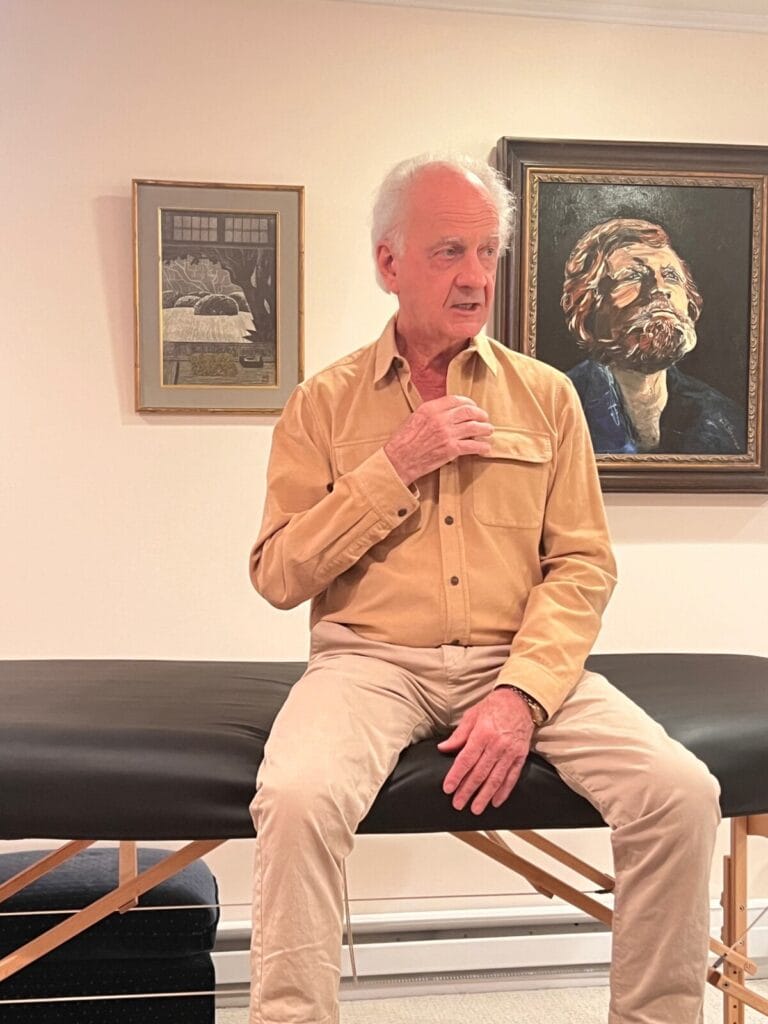
On December 4, 2025, in Boston, Massachusetts, USA, Tommy Thompson led a class in the Alexander Technique teacher training course where a simple question opened an unexpected discussion. As trainees reflected on their experiences after several months of training, the conversation turned toward how a person’s Personal Narrative shapes the way they learn, teach, and live the work.
Learning the Alexander Technique is not simply about improving coordination; it is often the beginning of rewriting the story we live by.
Key Objectives of the Class:
- To explore how a trainee’s personal narrative influences their experience of learning the Alexander Technique
- To understand why validation is essential when working with another person
- To examine the relationship between use, identity, and the story a person believes about themselves
- To recognize how moments of uncertainty can become opportunities for deeper awareness and wellness
This blog series is based on Tommy Thompson’s Alexander Technique classes. Each post follows the flow and insights of the class to expand both self-awareness and practical consciousness applicable to everyday life.
New here?
If you’re new to the Alexander Technique, you can start with the resources below.
Alexander Technique Class Flow at a Glance
1. The Opening Question
❝ What happens when the Personal Narrative you have been living begins to shape how you learn the Alexander Technique—and how you use yourself in life? ❞
At the beginning of the class, Ari asked one trainee a simple question: what had he been experiencing during his first months of studying the Alexander Technique?
The question seemed ordinary, but as he spoke, something deeper appeared. His reflections were not only about coordination or technique. They touched the larger questions that often arise when someone begins this work: What am I doing with my life? What am I becoming?
This moment revealed something essential about the Alexander Technique. Students often arrive expecting improvements in posture or movement. But over time they begin to notice that their patterns of use are connected to something deeper—the story they carry about themselves and their possibilities in life.
Learning the Alexander Technique often reveals the story we have been living inside our use.
In other words, the work gradually exposes the personal narrative shaping how a person thinks, acts, and responds to experience.
Tommy’s Word
“Use is a reflection of how you are connected with who you actually feel you possibly can be.”
Tommy’s insight points directly to the relationship between use and identity. The way a person uses themselves is not simply mechanical behavior; it reflects the possibilities they sense for their own life.
When this becomes visible, the Alexander Technique begins to function differently. It is no longer only a study of coordination, but a process of recognizing—and sometimes reshaping—the personal narrative through which a person lives.
2. Core Learnings from This Class
Core Concepts
- Use reflects identity.
In the Alexander Technique, the way a person uses themselves expresses how they perceive their possibilities and their relationship to life. - Personal narrative influences how we organize our reactions.
As Tommy noted during the class, people often move, think, and respond according to the story they believe about themselves. - Validation opens the door to change.
When a student’s experience is acknowledged rather than corrected immediately, awareness can deepen and new coordination becomes possible. - The teacher’s thinking shapes the lesson.
As Tommy often reminded the class, hands alone do not teach; the teacher’s thinking is communicated through contact. - Moments of uncertainty may signal a transitional state.
What appears as confusion or questioning can mark a liminal moment in which a person is reorganizing how they understand themselves and their use.
Five Key Messages
- The way you use yourself often reflects the story you believe about who you are.
- Validation of experience allows awareness to deepen without resistance.
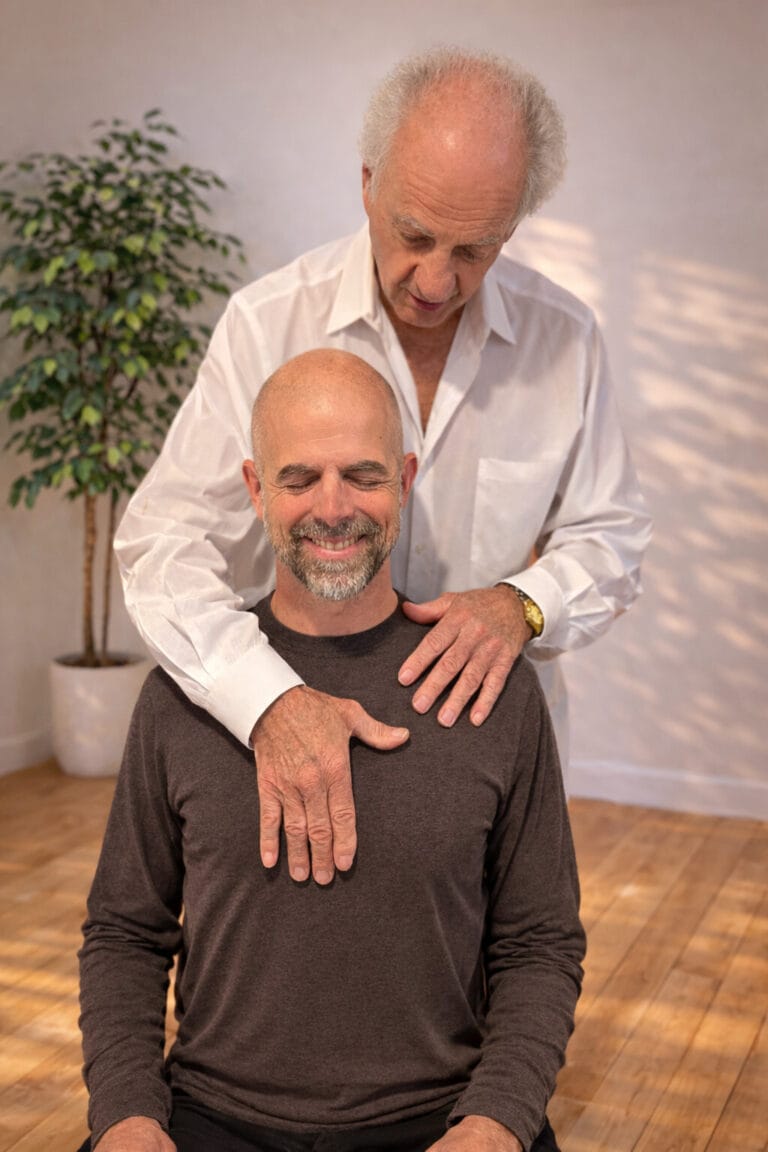
- The teacher’s thinking is transmitted through their hands.
- Periods of uncertainty can mark a transition in personal narrative.
- A lesson may reveal a clearer sense of self beyond habitual patterns.
Essential Terms
Use
In the Alexander Technique, use describes the overall manner in which a person coordinates their body, attention, and reactions in response to life.
Personal Narrative
The internal story through which a person understands their life and identity, often shaping patterns of reaction, tension, and behavior.
Validation
Acknowledging and respecting a student’s lived experience as the starting point for awareness and learning.
Liminal Moment
A transitional state described by Tommy in which a person stands between familiar habits and emerging possibilities.
Shared Life
A phrase Tommy used to describe the relational nature of teaching, where genuine presence with another person becomes part of the learning process.
3. Tommy’s Insights
In Tommy’s words during class, there are not only the core principles of the Alexander Technique, but also practical wisdom that can be applied directly to daily life. His words go beyond simple advice about movement and prompt us to deeply consider how we choose to exist.“Use is a reflection of how you are connected with who you actually feel you can be.”
➤ In the Alexander Technique, the way a person uses themselves reveals the possibilities they sense are available in their life.
“If you want to communicate to him right this moment and validate his questioning of himself, how would you work with him? That’s exactly what you want to do in a lesson.”
➤ A lesson begins by meeting the student’s questioning directly, allowing their experience to be acknowledged and clarified through the work.
“You learn how to put your hands on someone. And the only justification for putting your hands on someone is that you must be reasonably in touch with yourself, and that was the head–neck relationship. And direction was primary—the giving of direction—and that’s the tradition. But in trainings, the personal narrative was simply never introduced.”
➤ Tommy points out that traditional training emphasized direction and coordination, while deeper teaching also recognizes the personal narrative that shapes a person’s use.
“I think you look at how to validate what the person describes themselves as, and then go into use. How would you use your hands—yourself—to take him into a moment of self-validation, given how he’s described himself? Now, it might be that you don’t do anything different from what you normally do. It’s just that you’re thinking differently, and your thoughts—whatever you are thinking—are going to come through your contact with the person.”
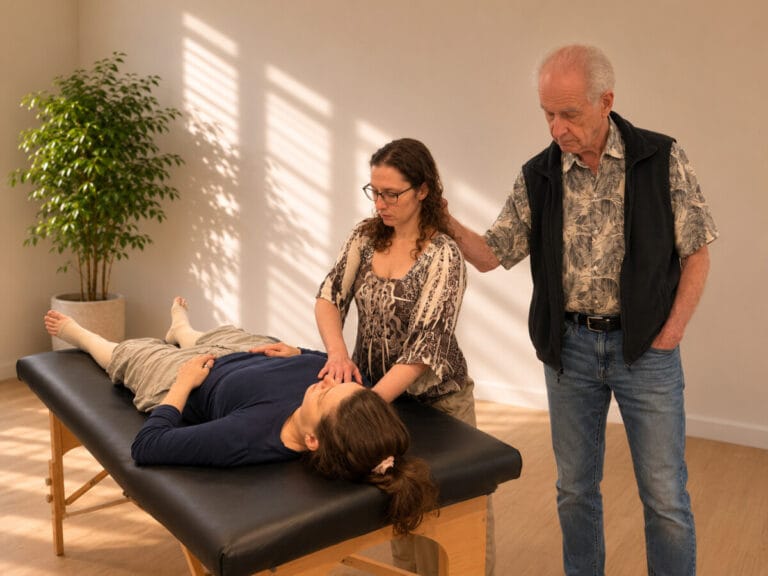
➤ In hands-on work, the teacher’s thinking is communicated through contact, guiding the student toward a clearer experience of their use.
“What you could do—and I’ll try—we could go over and just give him the generic lesson. There is a generic lesson. You change the relationship that we have relative to the organism. You take them off. The non-generic lesson is to speak to who you feel they are, as best you’re able to do.”
➤ The art of teaching lies in perceiving the individual organism and responding to the person in front of the teacher rather than relying solely on a generic procedure.
“The teacher’s work with you is assisting in letting the brain just take over and orient you right now. That’s its job—rather than you using yourself from the past to identify yourself in the present. It’s hard to do that, but that’s what we do. You’re talking about identifying yourself. So the teacher is taking you into the present.”
➤ The work restores the organism’s natural ability to orient in the present instead of reacting through patterns formed in the past.
“A shared life is better than a life not shared. When they come in, you’re completely with them. For someone else, that means you are enhancing your capacity to be available for the person you’re with—whether it’s a student, a business associate, or anyone.”
➤ Teaching develops the capacity to be fully present with another person and to meet life with greater availability.
“It’s like—you want to see it as an opportunity. Why an opportunity? Because it is a rewrite of your personal narrative—a rewrite of the story you’ve been living. ‘This is the only way you’re going to get through this: see it as an opportunity.‘ ‘An opportunity to lose your wife? That’s an opportunity?!’ Exactly right. Because it’s for growth. The opportunity was to review my entire life—to look at what I had, to look at what I do have. And I would say that I learned more from that loss than anything I’ve learned in my life.”
➤ Tommy reframes life’s difficulties as moments that invite a reinterpretation of the story through which we understand our lives.
“When you give a lesson, you’re giving the person the absence of the commitment to the false aspects of themselves. They have an experience: ‘If this is me, and I leave and behave as usual—that’s not me. I’ve just seen my own beauty.'”
➤ A lesson offers a direct experience of the self free from habitual identification, revealing a clearer sense of one’s inherent coordination and possibility.
4. Practical Tips for Everyday Life
What’s the Goal?
The goal is not to fix yourself but to notice how you are using yourself in the moment. In the Alexander Technique, change often begins when a person recognizes the story shaping their reactions. A lesson offers a brief experience of yourself without that story directing your response.
How to Practice
- Pause before reacting.
When you feel tension or urgency, allow a short pause. This moment interrupts the habitual response and creates space for awareness. - Notice the story you are living in the moment.
Ask yourself what assumption or expectation is shaping your reaction. Often the body reflects the personal narrative you are carrying. - Treat difficulty as an opportunity.
Instead of trying to eliminate tension immediately, approach the moment with curiosity. As Tommy suggested, challenges can become opportunities to see yourself differently.
What You’ll Notice
You may begin to notice moments when your reactions are less automatic. Situations that once created tension may start to feel like opportunities for awareness. Over time, the Alexander Technique becomes something you bring into ordinary life rather than something practiced only in lessons.
5. Closing the Class
Key Takeaways
- The way you use yourself often reflects the story you believe about who you are.
- Validation allows a student’s awareness to develop without resistance.
- Teaching in the Alexander Technique responds to the individual organism rather than applying a generic lesson.
- Moments of uncertainty may mark a liminal moment, where a person begins to see their life differently.
Core Insights
This class revealed that learning the Alexander Technique often reaches beyond physical coordination. As the discussion unfolded, many trainees began to recognize the personal narrative shaping how they respond to life.
When that narrative becomes visible, something important happens. A person briefly experiences themselves outside the familiar story guiding their reactions.
In that moment, a different possibility for action begins to appear.
A Final Invitation
Instead of immediately trying to fix every difficulty, begin by noticing how you are using yourself within the situation.
From the perspective explored in this class, challenges are not only obstacles. They can also become opportunities to observe the personal narrative shaping your reactions.
That moment of seeing the narrative is already the beginning of change.
In this way, the Alexander Technique becomes more than something practiced in lessons. It becomes a way of approaching everyday life with awareness and choice.
6. One Key Practice
The most important practice from this class is simple.
Pause and notice the story shaping your reaction.
When tension or frustration appears, allow a brief pause. Instead of trying to fix the situation immediately, observe how you are organizing yourself in that moment.
Often what feels like a problem is connected to the narrative you are living inside. Even a few seconds of awareness can interrupt the pattern and open the possibility for a different response.
7. Three Questions to Ask Yourself
- When tension or uncertainty appears, what personal narrative might be shaping the way you are responding?
- If you pause for a moment before reacting, what do you begin to notice about how you are using yourself?
- What might change if you approached this situation as an opportunity rather than a problem?
8. For Those Who Wish to Learn More
Recommended Books
Touching Presence — Tommy Thompson
In this reflective book, Tommy Thompson invites readers into the living space of the Alexander Technique training course. Through stories and classroom insights, he explores how people often define themselves through habit and identity, and how awareness can open the possibility of meeting each moment differently.
Rather than presenting the Alexander Technique as a set of mechanical instructions, the book reveals it as a path toward presence, relationship, and personal transformation.
Official Website of Tommy Thompson
www.easeofbeing.com
This is the official website personally managed by Tommy Thompson, offering a wide range of resources and programs to deepen your understanding and practice of the Alexander Technique:
- Private session reservations and inquiries
- Workshop and seminar schedules
- Overview of international teacher training programs
- Essays and articles on the Alexander Technique
9. Next Class Sneak Peek
A Glimpse into the Next Class
In the next class, Tommy Thompson introduces a discovery that reshapes how the hands work in the Alexander Technique: Triadic Resonance.
Rather than directing the body through force, the teacher begins to work through a subtle coordination between the hand, the organism, and the field of relationship. When these three elements interact, the organism can reorganize itself in ways that feel almost spontaneous.
How can a small opening in the hand influence the head, the spine, and the whole pattern of support?
And what happens when the teacher stops trying to control the outcome and allows the organism to respond through resonance?
The next class begins to explore these questions.
10. Join the Alexander Technique Journey
Did this class leave a small resonance within you? Feel free to quietly hold it in your heart or share it in just a sentence or two. The comments are always open. Your one simple word may leave a gentle ripple in this ongoing journey.The journey of Resonance Flow continues across social media as well. Let’s continue this journey together.
 YouTube
 Instagram
 Threads
 Facebook