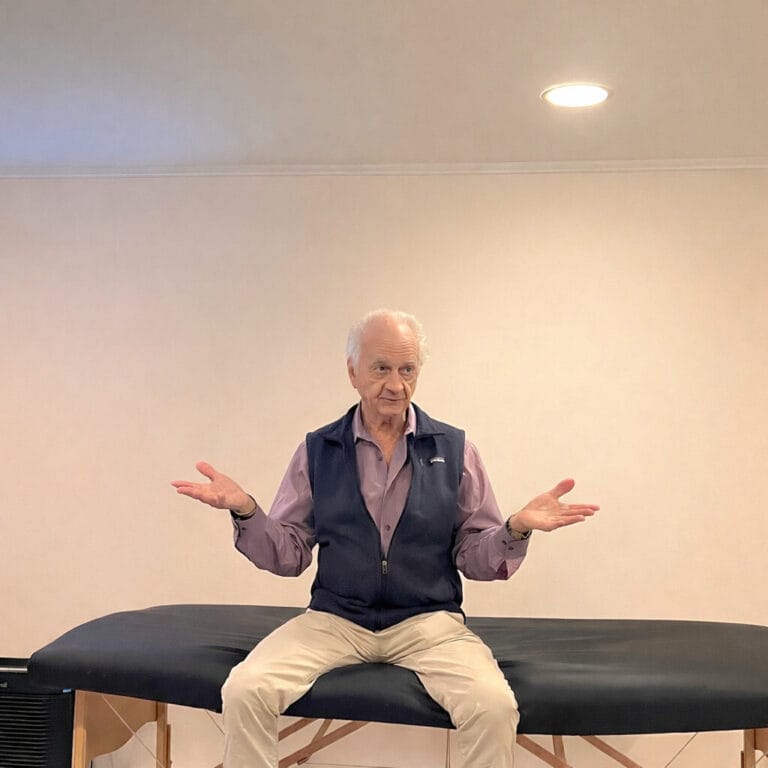
Triadic Resonance: How a Small Opening in the Hand Reorganizes the Whole Body | Tommy Thompson Class 101
❝ What actually happens in the organism when the neck lengthens and the head moves forward and up? ❞
Many people first encounter the Alexander Technique through the familiar direction forward and up. Yet in practice this direction is not something we do to the body. It is something the organism begins to allow. When the muscles of the neck lengthen, the head moves slightly away from the body, the spine naturally decompresses, and the back widens with the breath. Gradually, the whole organism begins to reorganize itself without force.
On December 9, 2025, in Boston, Massachusetts, USA, Tommy Thompson led a class in the Alexander Technique teacher training course exploring how this classical principle unfolds through the living coordination he calls Triadic Resonance.
Rather than manipulating the body, the trainee learns to sense subtle openings through the hands, spine, and breath. Through this relationship, something begins to organize itself within the organism. The work becomes less about correcting posture and more about allowing a deeper pattern of support and expansion to emerge.
Key Objectives of the Class:
- To explore how neck lengthening allows the head to move naturally forward and up, decompressing the spine
- To understand how touch initiates coordinated opening through the hands, spine, and breath
- To investigate the role of Triadic Resonance in hands-on work
- To remain connected to one’s own sense of being while working within another person’s existing pattern of tension
This blog series is based on Tommy Thompson’s Alexander Technique classes. Each post follows the flow and insights of the class to expand both self-awareness and practical consciousness applicable to everyday life.
New here?
If you’re new to the Alexander Technique, you can start with the resources below.
Alexander Technique Class Flow at a Glance
1. The Opening Question
❝ What changes in the organism when the hands begin to work through Triadic Resonance rather than force? ❞
In the Alexander Technique, the direction forward and up is often misunderstood as something we actively do to the body. Tommy Thompson invites trainees to look more closely.
When the neck lengthens and the head moves slightly away from the body, the spine decompresses and the back widens with the breath. But the real discovery in this class is how this coordination can be awakened through the hands.
Through Triadic Resonance, subtle openings in the hand influence the head, spine, and musculature without manipulation. Instead of correcting the body, the teacher participates in a relationship that allows the organism to reorganize itself.
Tommy’s Word
“When the muscles in the neck lengthen, the purpose is to allow a movement of the head away from the body, forward and up, which then, in turn, decompresses the spine.”
This observation reflects one of the central discoveries of the Alexander Technique. As the head releases forward and away, compression in the spine decreases and a wider pattern of support begins to appear throughout the organism.
2. Core Learnings from This Class
Core Concepts
- Neck lengthening reorganizes the whole organism
When the muscles of the neck lengthen, the head can move slightly forward and up, allowing the spine to decompress and the back to widen with the breath. This change is not local; it reorganizes the coordination of the entire organism. - Direction replaces mechanical effort
In the Alexander Technique, improvement does not come from forcing posture into place. When habitual pulling in the neck and head releases, a natural pattern of support begins to emerge. - The hand awakens organization through resonance
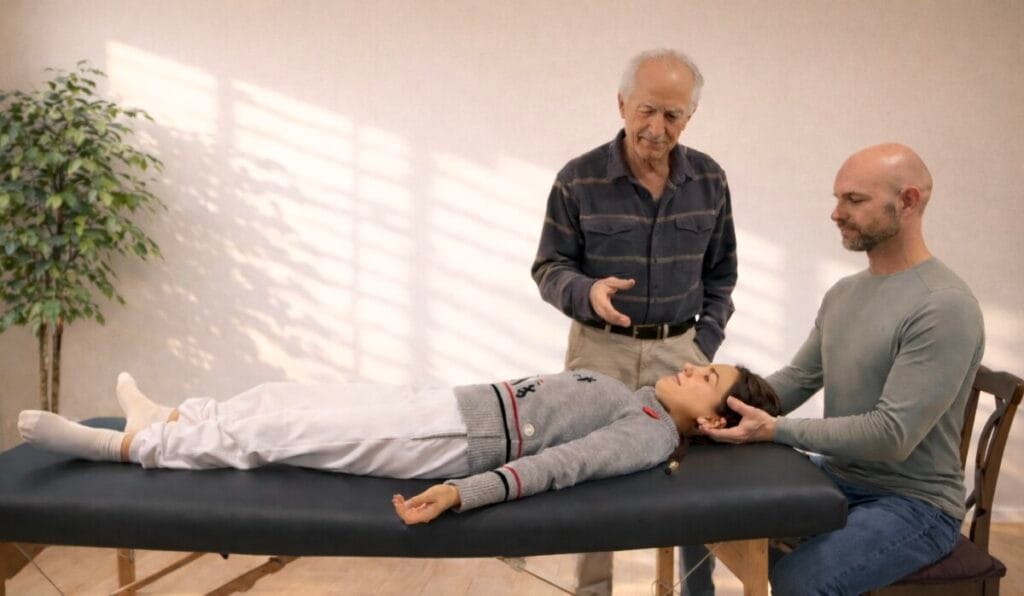
Through Triadic Resonance, subtle openings in the hand influence the head, spine, and musculature without manipulation. Rather than correcting the body, the practitioner creates the conditions in which the organism can reorganize itself. - The practitioner’s own use shapes the quality of touch
The neck, wrists, and elbows of the practitioner directly influence the relationship with the student. When the teacher allows their own neck to lengthen and avoids pulling downward, the contact becomes more responsive and expansive. - Change occurs within an existing pattern of tension
The teacher does not impose a new structure on the body. Instead, the work proceeds within an existing pattern of tension, allowing the organism to release gradually until a deeper sense of support becomes perceptible.
Five Key Messages
- Allow the neck to lengthen so the head can move forward and away.
This change begins the process of decompression and widening throughout the spine. - Real coordination emerges when unnecessary effort stops.
When the organism stops pulling inward, a broader pattern of support begins to organize itself. - Touch should awaken resonance rather than impose correction.
Through Triadic Resonance, the hands help reveal coordination that already exists within the organism. - Your own coordination shapes the lesson.
The quality of the practitioner’s use determines the sensitivity and effectiveness of the work. - Transformation happens through relationship.
The interaction between teacher, student, and environment allows new organization to appear within the organism.
Essential Terms
Triadic Resonance
A principle articulated in Tommy Thompson’s teaching in which the hand, the practitioner, and the student enter a coordinated relationship. Through this resonance, subtle directional openings awaken organization throughout the organism without force.
Forward and Up
A classical direction in the Alexander Technique describing the natural relationship of the head moving slightly forward and away from the body when the neck lengthens.
Neck Lengthening
The release of unnecessary tension in the neck that allows the head to move freely relative to the spine, initiating decompression and improved coordination throughout the body.
Existing Pattern of Tension
The habitual muscular organization already present in the body. Alexander Technique work enters these patterns gently, allowing them to reorganize rather than forcibly correcting them.
Organism
A central concept in the Alexander Technique referring to the integrated unity of body, mind, and nervous system. Change occurs when the organism reorganizes itself as a whole rather than through isolated muscular correction.
3. Tommy’s Insights
In Tommy’s words during class, there are not only the core principles of the Alexander Technique, but also practical wisdom that can be applied directly to daily life. His words go beyond simple advice about movement and prompt us to deeply consider how we choose to exist.Where you live—the deepest part of you—lives within you, beyond external circumstance. You retreat from the world as we are experiencing it today. You come back to your own sense of being.
➤ In the Alexander Technique, genuine change begins when the teacher returns to the inner ground of being, allowing action to arise from presence rather than reaction.
Practice the sequences. You let the muscles in the neck—which extend through here and in the back all the way down to here—lengthen. When the muscles in the neck lengthen, the purpose is to allow a movement of the head away from the body, forward and up, which then, in turn, decompresses the spine. That allows the spine to lengthen. And then, on your breath—on the inhalation—your back widens. The muscles of the back widen. That’s what happens.
➤ The direction forward and up reflects the organism’s natural relationship with gravity, allowing spinal length and widening to emerge through coordinated support rather than muscular effort.
You’re not moving. Your sense is going deeper into her. It’s both energetic and physical. You’re moving into an existing pattern of tension. And so you’re separating like the water until you get to the point where the tension is released enough for you to feel the support of the water.
➤ Hands-on work proceeds through refined sensory intention, entering an existing pattern of tension until the organism reorganizes and deeper support emerges.
Triadic Resonance occurs when frequency matching… now let me give you formulas… wave vector matching… When these conditions are satisfied, the three waves form a resonance triad, allowing strong nonlinear interactions. When you do it with Triadic Resonance in your hands, you sense the difference between your uprightness.
➤ In teaching, triadic resonance describes the dynamic relationship between teacher, student, and environment through which upright coordination is amplified.
I’m here. For me. This is where I am right this moment. This is what I’ve elected to do, and who I’ve elected to be as a teacher. And what else is happening right now is not immaterial—but it has to be over here rather than here.
➤ Effective teaching depends on steady present-moment presence, where the teacher’s attention remains grounded in the living relationship rather than scattered by outside concerns.
Once you really commit yourself, you carry it through the rest of your life. On the days when your whole world is falling apart—you still have to rally. And so you work with yourself in order to work with them in as complete a way as possible.
➤ The discipline of teaching requires lifelong commitment, continually working on one’s self-use so the quality of presence offered to the student remains whole.
All you’re really doing is pretending you’re gravity, because gravity right now is pulling me down—it’s exerting a force down within me. But every muscle in my body that’s designed to support me is lifting me up.
➤ By organizing touch as if one were gravity, the teacher invites the organism’s intrinsic support to emerge rather than imposing force.
Frank Jones is the one who added “let the neck be free to lengthen.” Alexander: “neck free, head forward and up, to lengthen.” But the sequence is: if the head is tight, if the muscles are tight—if you’re tight here, if you’re tight here—it will affect the relationship of your head relative to the rest of the organism.
➤ This highlights that tension in the head and neck directly affects the relationship of the head to the whole organism.
4. Practical Tips for Everyday Life
What’s the Goal?
The goal is not to correct posture. It is to allow the organism to reorganize itself. When the neck lengthens, the head can move slightly forward and up, and the spine begins to release unnecessary compression. In this class, Tommy shows that through Triadic Resonance, even subtle contact through the hands can awaken this natural coordination without force.
How to Practice
1. Before You Move
Pause for a moment before standing or walking. Allow the neck to lengthen and let the head move gently forward and up. Notice what begins to change in the organism when you stop pulling inward.
2. When Using Your Hands
During simple actions—opening a door, lifting an object, touching another person—allow a soft opening through the palm and fingers. Often the neck and spine respond immediately when the hand stops gripping.
3. In Moments of Tension
When you feel pressure or hurry, notice the impulse to tighten the neck and shoulders. Pause briefly and allow the neck to release upward. Sometimes the whole organism reorganizes when that habitual contraction stops.
What You’ll Notice
Movements begin to feel lighter and less forced. The back widens with the breath, and the head feels less compressed into the spine. Over time, these small pauses reveal a deeper sense of support and coordination in everyday life.
5. Closing the Class
Key Takeaways
- Neck lengthening allows the head to move forward and up, reducing compression throughout the spine.
- Through Triadic Resonance, the hands can awaken coordinated responses in the head, spine, and musculature without force.
- Real change appears when the practitioner allows the organism to reorganize itself rather than trying to correct posture mechanically.
- The teacher works within an existing pattern of tension, allowing release and support to emerge gradually.
Core Insights
This class shows that the Alexander Technique is not primarily about fixing the body. It is about allowing the organism to reorganize itself through relationship and awareness.
When unnecessary effort stops, a broader pattern of coordination begins to emerge naturally. The practitioner’s own use—especially the freedom of the neck and the quality of attention—shapes the entire interaction.
In this way, the work becomes less about doing and more about allowing organization to appear through Triadic Resonance.
A Final Invitation
The invitation of this work is simple.
Pause for a moment.
Allow the neck to lengthen.
Let the head move gently forward and up.
Then notice what begins to happen in the organism.
6. One Key Practice
Pause for a moment before you move.
Before standing, reaching, or beginning any action, pause briefly. Allow the neck to lengthen and let the head move gently forward and up. Instead of forcing the movement, notice what begins to organize itself in the organism when the habitual pulling inward stops.
Even a few seconds of this pause can reveal a different quality of coordination and support.
7. Three Questions to Ask Yourself
- Am I pulling my head back into my body, or allowing it to move forward and up?
- What happens in the organism when I stop trying to control?
- Can I allow a moment of pause before reacting or moving?
8. For Those Who Wish to Learn More
Recommended Books
Vibrations and Waves – A. P. French
This classic physics text introduces the principles of vibration, resonance, and wave interaction. It explains how energy moves through oscillating systems and how waves influence one another through resonance.
Understanding these principles offers an illuminating perspective on Triadic Resonance. In physics, waves can interact and exchange energy when their timing and structure align, allowing coordinated patterns to emerge within a system.
In a similar way, the hands of the teacher, the student’s organism, and the relational field can begin to function as a resonant system—where subtle changes propagate through the organism rather than being imposed mechanically.
Official Website of Tommy Thompson
www.easeofbeing.com
This is the official website personally managed by Tommy Thompson, offering a wide range of resources and programs to deepen your understanding and practice of the Alexander Technique:
- Private session reservations and inquiries
- Workshop and seminar schedules
- Overview of international teacher training programs
- Essays and articles on the Alexander Technique
9. Next Class Sneak Peek
In the next class, Tommy explores a discovery that changes how we understand coordination: support in gravity.
Most of us try to hold ourselves up against gravity. But what if the organism is already organizing itself to be supported by it?
If gravity is constant, what happens when we stop interfering and begin to sense the support already there?
In Class 102, we’ll explore:
how discovering support in gravity changes our experience of balance, touch, and the natural organization of the body.
10. Join the Alexander Technique Journey
Did this class leave a small resonance within you? Feel free to quietly hold it in your heart or share it in just a sentence or two. The comments are always open. Your one simple word may leave a gentle ripple in this ongoing journey.The journey of Resonance Flow continues across social media as well. Let’s continue this journey together.
 YouTube
 Instagram
 Threads
 Facebook