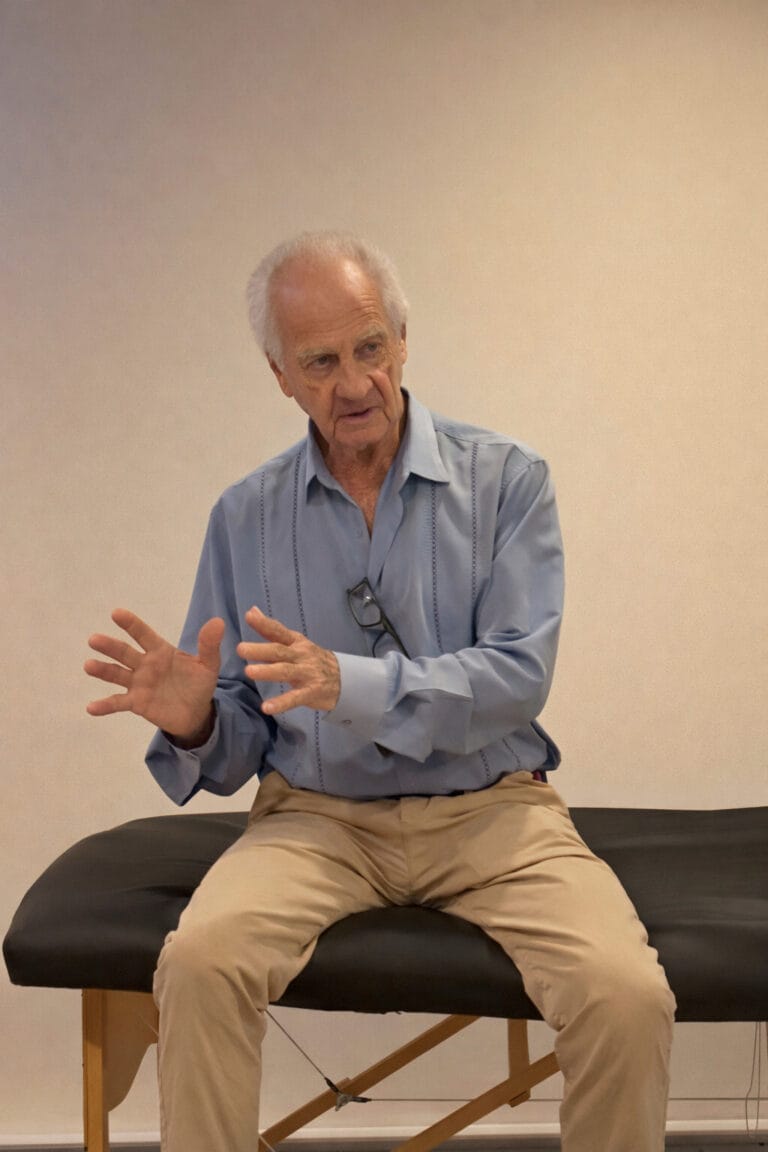
Dialogue: How to Meet Another Person Without Losing Yourself | Tommy Thompson Class 113
❝ Can there be true dialogue in the Alexander Technique if you lose yourself in the other person? ❞
Most people assume that helping another person requires entering into their experience—feeling what they feel, understanding their story, and responding to what is happening within them. Yet in the process, something subtle often occurs: the helper begins to disappear.
What if the quality of your teaching, your hands-on work, and even your relationships depends not on becoming the other person, but on remaining fully yourself?
On May 7, 2026, in Boston, Massachusetts, USA, Tommy Thompson led a class in the Alexander Technique teacher training course that explored the deeper meaning of Dialogue. Through discussions of hands-on work, embodiment, inhibition, breathing, and relationship, Tommy challenged a common assumption: meaningful change does not arise from taking on another person’s experience. It emerges when two people meet without either losing themselves.
The quality of the dialogue depends on the quality of your relationship with yourself.
Whether working with a student, practicing the Whispered “Ah,” or simply listening to another human being, the invitation was the same—to remain present, clear, and available without becoming absorbed in someone else’s story.
This class revealed that Alexander Technique is not merely a method of change, but a practice of remaining fully yourself while meeting another human being—with greater freedom, connection, and wellness.
Key Objectives of the Class:
- Explore why dialogue is fundamental to teaching and learning in the Alexander Technique.
- Understand how to remain fully present with yourself while working with another person.
- Discover how the Whispered “Ah” functions as a practical lesson in inhibition.
- Learn why relationship, awareness, and self-observation support lasting change and wellness.
This blog series is based on Tommy Thompson’s Alexander Technique classes. Each post follows the flow and insights of the class to expand both self-awareness and practical consciousness applicable to everyday life.
New here?
If you’re new to the Alexander Technique, you can start with the resources below.
Alexander Technique Class Flow at a Glance
1. The Opening Question
❝ How do you meet another person without disappearing into them? ❞
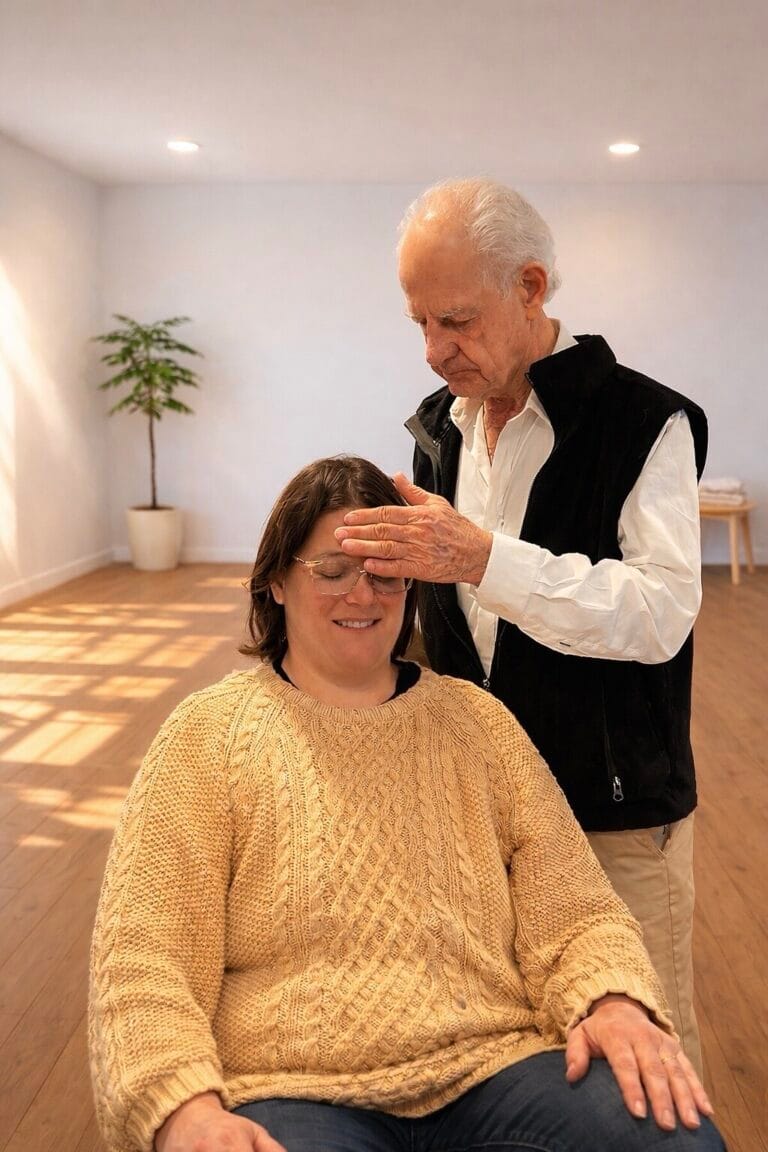
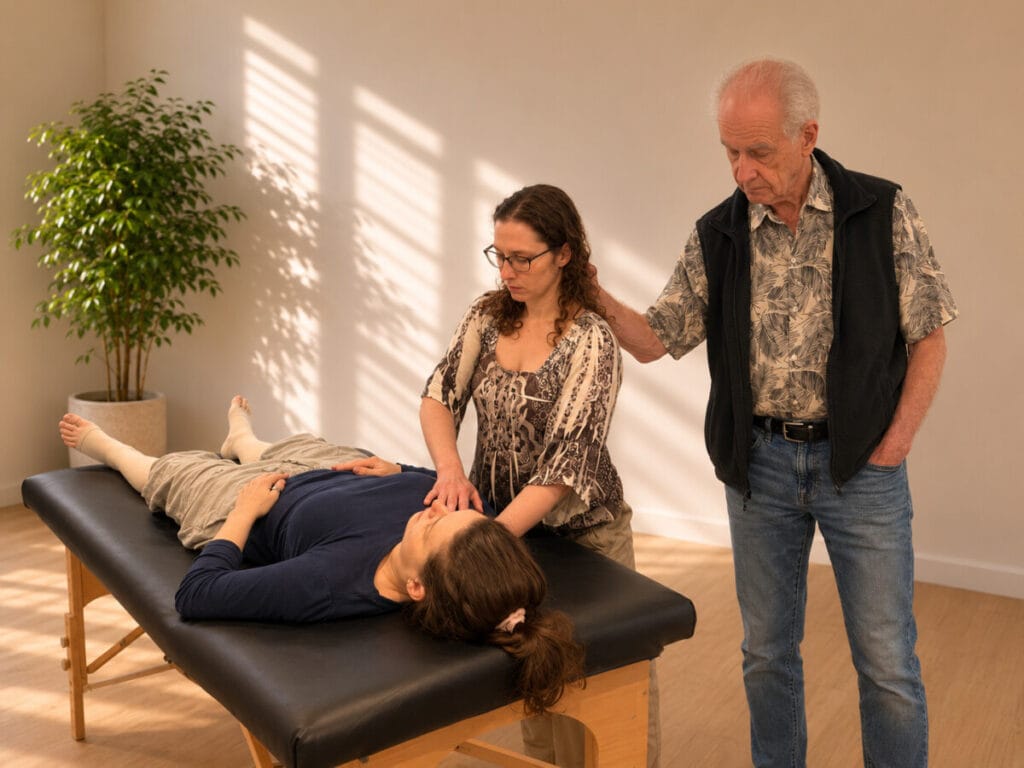
In hands-on work, many trainees eventually encounter the same dilemma. The more interested they become in another person’s experience, the easier it becomes to lose contact with their own.
This question sits at the heart of Dialogue and one of the most important principles in the Alexander Technique. If meaningful change depends on relationship, how do we remain fully available to another person without abandoning ourselves in the process?
Throughout this class, Tommy emphasized that genuine dialogue does not arise from taking on another person’s experience. It emerges when two people meet while each remains fully themselves.
Tommy’s Word
“You’re not taking on her system. It’s her system, your system.”
“Don’t lose yourself in the other.”
“You’re working with yourself while you work with her.”
You’re working with yourself while you work with another person.
These statements reveal a profound shift in how we understand teaching and relationship. Rather than absorbing or carrying another person, the teacher remains grounded in their own experience while creating conditions in which the other person can discover theirs.
From an Alexander Technique perspective, genuine dialogue does not arise when two people merge. It arises when two distinct individuals meet with presence and respect for each other’s experience.
2. Core Learnings from This Class
Core Concepts
- You work with yourself while working with another person.
Meaningful change begins with your own use, awareness, and presence rather than taking on another person’s experience. - Dialogue requires two distinct people.
Genuine dialogue emerges when both individuals remain themselves instead of becoming absorbed in each other’s stories. - The Whispered “Ah” is a lesson in inhibition.
More than a breathing exercise, it creates an opportunity to pause habitual reactions and allow a different response to emerge. - The organism knows more than conscious control.
Rather than forcing change, the Alexander Technique invites conditions in which the nervous system can organize itself. - Giving and receiving are part of the same process.
Just as exhalation creates space for inhalation, letting go creates space for something new.
Five Key Messages
- Stay with yourself while working with another person.
- Dialogue begins with presence, not technique.
- Do not lose yourself in the other.
- Allow change rather than trying to create it.
- Give fully, then allow yourself to receive.
Essential Terms
Dialogue
A living exchange in which two people meet without either losing themselves.
For Tommy, dialogue is not merely conversation but the foundation of meaningful teaching, learning, and relationship.
Inhibition
The ability to pause habitual reactions and create space for a different response.
Tommy presents the Whispered “Ah” primarily as an exploration of inhibition rather than a breathing exercise.
Use
Lasting change begins with improving use rather than fixing individual parts.
Use refers to the manner in which a person coordinates thought, feeling, and movement in activity.
Organism
Trusting the organism is more important than trying to control every outcome.
The organism is the integrated whole of body, mind, and nervous system functioning as one interconnected process.
Relationship
Meaningful change emerges through relationship rather than force.
For Tommy, relationship includes your connection with another person, your environment, and your own experience.
3. Tommy’s Insights
In Tommy’s words during class, there are not only the core principles of the Alexander Technique, but also practical wisdom that can be applied directly to daily life. His words go beyond simple advice about movement and prompt us to deeply consider how we choose to exist.1. “You’re not taking on her system. It’s her system, your system. You’re 100% with yourself, and she’s 100% herself. You’re giving her that assurance, and so you stay clear within yourself the whole time. Don’t lose yourself in the other.“
➤ Hands-on work begins by remaining fully present in yourself rather than merging with another person.
2. “You’re working with yourself while you work with her; you’re staying clear within yourself. You’re providing her with a window. She’s not doing it for you. In our process, you remain 100% yourself.“
➤ Self-awareness and awareness of the other must develop together, not in opposition.
3. “Frank saw the Whispered “Ah” as an exercise in inhibition. Most people see it as changing the jaw or changing their breath. Both, I think, are accurate, because without the inhibited moment, all it is is an exercise. But it’s the inhibited moment that lets it all happen.”
➤ The essential change occurs in the moment of inhibition, not in the mechanical action itself.
4. “The very first thing that happens when you come out is that you are breathed. You don’t go, “Oh, morning.” You don’t make yourself do that. There’s an exchange of gases. You didn’t have that inside. Outside, you’re given breath, and there’s a beauty to that.”
➤ Life begins through participation in a process greater than conscious effort.
5. “You’ve got that the rest of your life. And then you take your last breath, and you don’t have life. So the moment you’re given life, you give back. And for me, it’s a metaphor. Breath is a metaphor for change, because people are waiting for that next breath. They’re not fully expelling it.”
➤ Breathing reveals the continual exchange through which change becomes possible.
6. “Don’t hold on to what you’ve been given. Immediately give back, and you will have more room within you to take in that which is new, unknown, which is another breath. And then you give back more. And that’s a whole way of life, a life-related way, and it’s part of the wisdom, I think.”
➤ New possibilities emerge when we stop holding on to what has already been given.
7. “I think what we’re talking about is that you need to dialogue with a person, verbally or nonverbally, especially if you feel something happening. It does several things. It cues you into what they’re experiencing. When they verbalize what they’re experiencing, it may not have anything to do with what you’re experiencing, and then you’ve got to figure out what’s going on.”
➤ Teaching becomes an exploration when communication remains open and responsive.
8. “It would be valuable for everybody to go through the same thing, seeing the work as a dialogue. The old way of teaching was to sit there with your hands on a person and give directions over and over again. That’s one way of doing it, but I don’t think that’s enough.
If you want to focus on use and use alone, you can put your hands on somebody and simply run through the directions. And it’s going to work. It will. It will. It will free the neck, and it will let you give a non-manipulative series of directions to the person, and it will change their use. But it’s not going to include them.“
➤ Technical change may alter use, but real teaching includes the person.
4. Practical Tips for Everyday Life
What’s the Goal?
The goal is not to become better at helping other people. The goal is to remain fully yourself while being with another person.
The quality of the dialogue depends on the quality of your relationship with yourself.
Whether you are teaching, listening, or supporting someone, the practice is the same: stay present without losing yourself in the other.
How to Practice
When Someone Needs Your Help
Notice the urge to fix, advise, or solve.
Before responding, pause.
Can you remain with yourself while listening? Can you allow the other person to have their experience without taking it on as your own?
When You Feel Pulled Into Another Person’s Experience
Pause and return to your own experience.
Notice your feet, your breathing, and your contact with the ground. Allow yourself to become present again.
You may discover that the most supportive thing you can offer is not advice, but presence.
During the Whispered “Ah”
Treat it as an experiment in inhibition.
Instead of trying to make something happen, allow the jaw to release and let the breath come.
Observe what changes when you stop trying to improve the experience and simply allow it to unfold.
What You’ll Notice
You may find that conversations feel less exhausting and more genuine.
You may feel less responsible for carrying another person’s experience.
Over time, dialogue becomes more natural, attention becomes quieter, and relationships become more meaningful.
From a wellness perspective, this often brings a greater sense of freedom, connection, and trust in the organism’s ability to respond to life.
5. Closing the Class
Key Takeaways
- Meaningful dialogue begins with your relationship with yourself.
- You do not need to take on another person’s experience in order to help them.
- The Whispered “Ah” is not merely a breathing exercise but a practical exploration of inhibition.
- Trusting the organism creates space for more appropriate and natural responses.
Core Insights
You cannot enter into a genuine dialogue if you have left yourself behind.
For Tommy, the quality of teaching, hands-on work, and relationship is inseparable from the quality of your own presence.
Dialogue is not something you do. It is something that emerges when two people remain fully themselves.
When we stop trying to control, fix, or manage experience, we create conditions in which the organism can express its own wisdom.
A Final Invitation
The next time you find yourself listening to someone, helping someone, or simply sitting with another human being, notice the impulse to leave yourself behind.
Pause for a moment.
Can you remain with your own experience while staying available to theirs?
Perhaps genuine dialogue begins there.
6. One Key Practice
The next time someone speaks to you about a problem, do nothing for a few seconds.
Do not rush to fix, advise, explain, or comfort.
Simply stay with yourself while listening.
You’re working with yourself while working with another person.
Try this for just ten seconds today.
Notice what happens when you stay with yourself.
7. Three Questions to Ask Yourself
- When I am with another person, am I staying with my own experience, or am I disappearing into theirs?
- What happens when I stop trying to fix anything?
- Can I trust the organism enough to allow a response to emerge rather than trying to create one?
8. For Those Who Wish to Learn More
Recommended Books
The Wisdom of the Body – Walter B. Cannon
Tommy directly connects Frank Jones’s understanding of the Alexander Technique to this book. Its central idea—that the organism possesses an inherent wisdom for regulation, balance, and response—illuminates why this class moved beyond technique into inhibition, dialogue, and trust.
Meaningful change is not something we force onto the body. It emerges when we stop interfering and allow the organism to respond as it needs to.
For readers exploring Class 113, this book provides a deeper foundation for understanding the relationship between self-regulation, awareness, and the organism’s innate capacity for adaptation.
Official Website of Tommy Thompson
www.easeofbeing.com
This is the official website personally managed by Tommy Thompson, offering a wide range of resources and programs to deepen your understanding and practice of the Alexander Technique:
- Private session reservations and inquiries
- Workshop and seminar schedules
- Overview of international teacher training programs
- Essays and articles on the Alexander Technique
9. Next Class Sneak Peek
We often assume that choice begins when we make a decision.
But what if the most important choices are happening before we are even aware of them?
What makes genuine choice possible?
The next class explores why we so often return to familiar patterns, even when we sincerely want something different.
In Class 114, we’ll explore: what lies beneath choice itself.
10. Join the Alexander Technique Journey
Did this class leave a small resonance within you? Feel free to quietly hold it in your heart or share it in just a sentence or two. The comments are always open. Your one simple word may leave a gentle ripple in this ongoing journey.The journey of Resonance Flow continues across social media as well. Let’s continue this journey together.
 YouTube
 Instagram
 Threads
 Facebook