Can You Really Encounter Yourself Mid-Reaction? | Tommy Thompson Class 64

❝ What if this moment is your one chance to encounter yourself—before you explain it away again? ❞
Not in theory. Not in reflection. Right here. Right now.
This moment. This body. This you, before the definition.
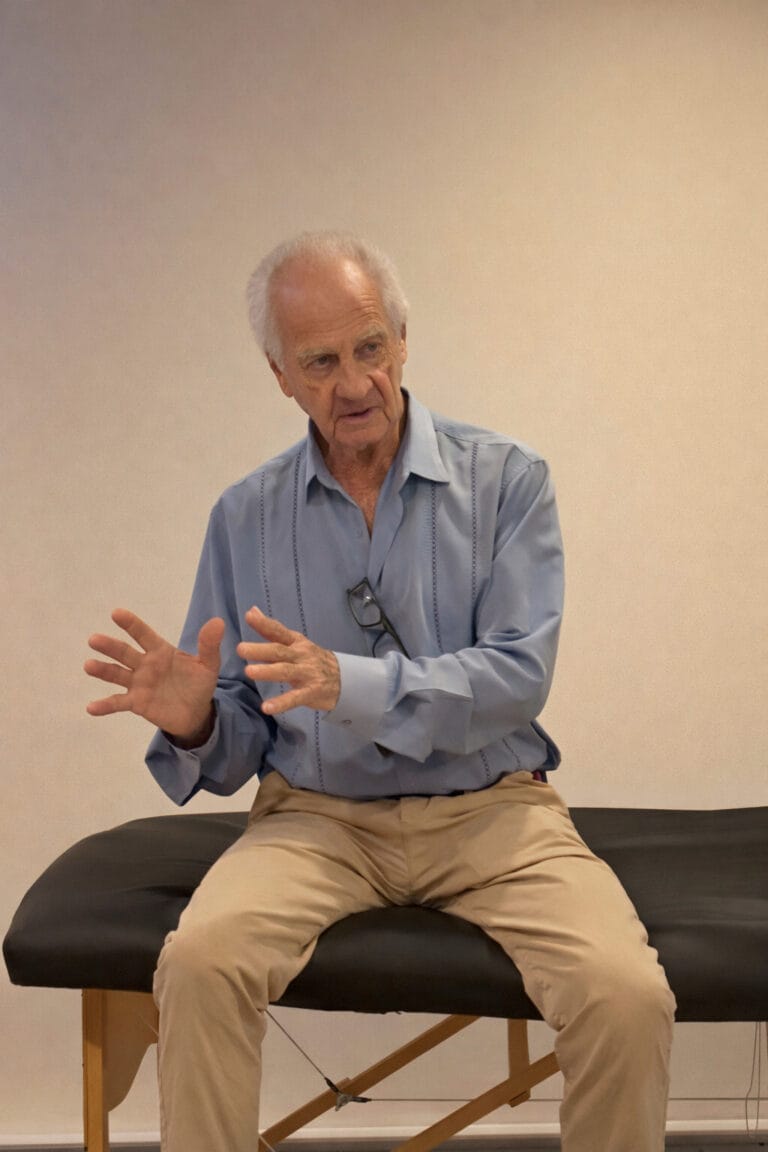
On April 22, 2025, in Boston, Massachusetts, USA, Tommy Thompson led a class in the Alexander Technique teacher training course that turned one word into a doorway: encounter.
Not an idea. A felt event. A meeting with yourself so immediate, it doesn’t wait for your story to catch up. This was not about fixing posture. It was about learning how to stop using yourself the way you always have, so you can finally meet who’s really here.
Tommy didn’t teach what to do. He invited trainees to notice what’s already happening, and to meet it—fully supported, completely present, entirely available.
Because in this work, change begins when you stop chasing it.
Key Objectives of the Class:
- To experience the encounter as a real-time, physical gateway to deeper self-awareness
- To recognize how habitual patterns conceal what’s already available through the Alexander Technique
- To train one’s perceptive field to receive unfiltered information by altering use and vibration
This blog series is based on Tommy Thompson’s Alexander Technique classes. Each post follows the flow and insights of the class to expand both self-awareness and practical consciousness applicable to everyday life.
New here?
If you’re new to the Alexander Technique, you can start with the resources below.
Alexander Technique Class Flow at a Glance
1. The Opening Question
❝ What’s the difference between a casual encounter—and the one that changes everything? ❞
Most encounters pass through like weather—brief, unnoticed, gone. But some shift how you sit, how you hear, how you meet your breath. And in that moment, you don’t just experience. You encounter yourself.
The Alexander Technique isn’t about doing something new. It’s about meeting what’s already happening—with attention, not habit. Because change doesn’t start with effort. It starts with how present you are.
Tommy’s Word
“The difference you want to see between a casual encounter and a mind-blowing encounter is your self-discovery, something else about yourself. When you engage in this kind of discipline, because it is a disciplined way of life locked into perpetual self-discovery, it is, indeed, perpetual.”
→ A true encounter isn’t rare. It’s available—if you stop using yourself the old way, and let support meet awareness.
2. Core Learnings from This Class
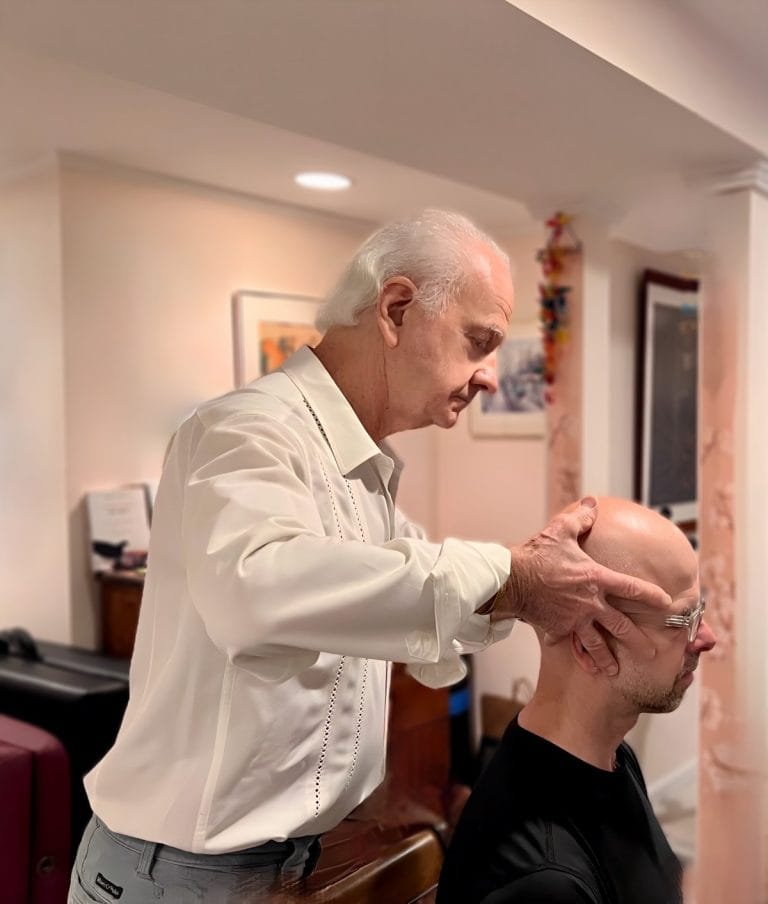
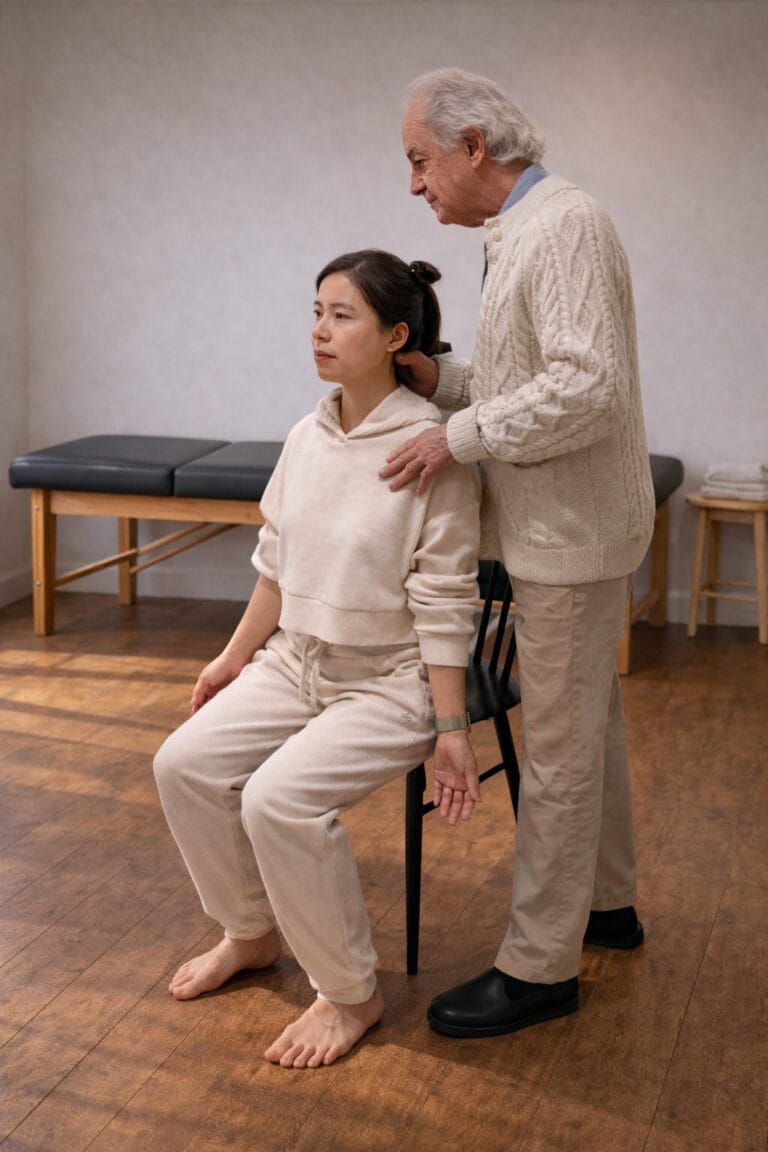
In this moment from Tommy Thompson’s class, trainees explore what happens when the habitual holding in the neck begins to release.
Watch how freeing the neck allows the organism to reorganize and move with greater ease.
This Is What Happens When You Stop Holding Your Neck | Alexander Technique
Class 64 · April 23, 2025 · Boston, MA
Core Concepts
- An encounter isn’t something you make happen. It’s something you let meet you.
In the Alexander Technique, change isn’t something you pursue. It’s something that arrives when you’re supported enough to notice. - Habit filters perception. Encounter begins the moment you stop explaining.
Tommy reminded us: when you pause the pattern, you don’t just interrupt a habit—you discover what’s underneath it. - Insight doesn’t happen apart from the body. How you use yourself reveals what you can know.
In this work, awareness is physical. The quality of your use becomes the quality of your perception.
Five Key Messages
- The moment of encounter begins when you stop defining and start experiencing.
As long as you hold on to who you think you are, you miss who’s actually here. - Perception shifts when you don’t interfere.
Letting go of your usual response reveals something that was always available—but unseen. - Touch raises vibration—and with it, your ability to receive what was already waiting.
The body speaks when the field is quiet enough to listen. - Support reshapes the meaning of what you meet.
Even difficulty becomes discovery when you’re not collapsing into it. - The encounter doesn’t wait for you to make it happen. It waits for you to notice.
The work isn’t to create experience, but to become available to it.
Essential Terms
- Encounter
A direct, embodied meeting with the self in real time. It’s not a metaphor. It’s a shift in how available you are to what’s already happening.
As Tommy often reminded the class: “you encounter what you didn’t expect, but always carried.” - Self-Discovery
In this work, discovery is not an event. It’s a way of being. The Alexander Technique, as Tommy taught it, is a disciplined life locked into perpetual self-discovery. - Habitual Use
The automatic patterns—of movement, reaction, thought—that shape our experience without awareness.
“If you’re using yourself habitually, it’s filtered through that habit,” Tommy said. Encounter begins where habit ends. - Non-Habitual Response
The pause that lets something new arise. Not doing more, but withholding what you’re most likely to do.
Tommy called this the moment where accuracy in experience becomes possible. - Complete Support
The natural organization of the self—posture, breathing, head-spine relationship—when you’re no longer interfering.
It’s not something you add. It’s what becomes available when tension recedes. - Receiving Information
What happens when attention opens and vibration changes.
Through hands-on contact, Tommy explained, “you increase the frequency of their vibration… and receive information that belongs to you.”
3. Tommy’s Insight
In Tommy’s words during class, there are not only the core principles of the Alexander Technique, but also practical wisdom that can be applied directly to daily life. His words go beyond simple advice about movement and prompt us to deeply consider how we choose to exist.“In the midst of the life that you’re leading, and the accustomed way of that life, something about the way you’re responding perceptively—given the circumstance—creates a different encounter with yourself.”
→ This highlights how subtle shifts in perception within habitual living open pathways to new self-awareness essential for transformation.
“The difference you want to see between a casual encounter and a mind-blowing encounter is your self-discovery, something else about yourself. When you engage in this kind of discipline, because it is a disciplined way of life locked into perpetual self-discovery, it is, indeed, perpetual.”
→ True change in the Alexander Technique is ongoing self-exploration, not a finite achievement.
“So, I think the best way to encounter is to use yourself in the most complete way possible. The encounter you have with yourself about yourself happens at the exact moment you need to receive that information.”
→ The practice demands full presence and openness at the precise moment of insight for genuine change.
“If you’re using yourself habitually, it’s filtered through that habit. The more you use yourself—Tommy’s phrase—the inner core, the way you’re designed to function with complete support.”
→ Habitual self-use limits awareness, whereas accessing the core design enables optimal functioning.
“You focus on: this is happening to me right now for a reason, not just this is happening to me. It makes sense to me. You focus on this, not simply on the fact that it is happening.”
→ Conscious focus on purpose deepens the experience beyond mere occurrence.
“Several things happen when you put your hands on a person: first of all, you increase the frequency of their vibration. The higher the frequency of their vibration, the more inclined you are to receive information that belongs to you. By changing the actual relationship of your head relative to anything else about it, you increase the frequency of the field of matter.”
→ Hands-on work amplifies neuromuscular and energetic responsiveness, crucial for embodied awareness.
“If you feel support in what you encounter about yourself and your realization, you’ll probably walk away a different person, more secure with what you come up with—which is what you did. This is not therapy. This is something else. It’s all discovery, and you never, ever need to stop discovering yourself.”
→ The Alexander Technique is a lifelong journey of self-discovery, not clinical treatment.
“The work is about altering your need to define yourself in the way you have previously defined yourself in this moment. Because that moment—if you can withhold the way you’re most likely to walk away from this moment, from this prayer, from what you describe, from what everybody describes—you’re more likely to be accurate in your experience. You let it change, and consequently, your relationship to the rest of your life and others.”
→ True freedom arises when you suspend habitual self-definitions, allowing authentic presence to reshape your life and relationships.
4. Practical Tips for Everyday Life
What’s the Goal?
To bring the Alexander Technique into ordinary life—so the encounter isn’t limited to the table, but becomes how you meet yourself throughout the day.
How to Practice
1. Upon waking, don’t rush into motion.
Stay where you are. Let your head rest, back widen, breath arrive. No goal—just meet the shape you’re in before habit takes over.
2. When correcting posture, pause instead.
Don’t fix yourself. Let your head lead and spine follow.
Ask yourself: Where am I already supported right now?
Shift from effort to awareness.
3. When touched, let yourself feel it.
Whether someone hands you something or places a hand on your shoulder, don’t override the contact.
Even your own hand—placed gently—can remind you you’re here.
What You’ll Notice
Habit loses its grip. Breath returns. Ground feels closer.
You stop managing yourself and start receiving the moment. And in that receiving, encounter becomes lived experience.
5. Closing the Class
Key Takeaways
We didn’t learn new moves. We learned new ways of meeting ourselves. What shaped this class wasn’t instruction—it was attention.
As Tommy said,
“You don’t need to do something new. You just need to be present to what’s already happening.”
This class showed us that the work isn’t about fixing, improving, or arriving. It’s about recognizing the moment you’re in—and choosing to meet it fully.
Core Insights
As Tommy often reminded the class, the encounter doesn’t depend on effort—it depends on availability.
What changes you isn’t how much you try, but how clearly you notice.
The body is never separate from the process.
“How you use yourself becomes how you experience everything else.”
In that sense, this work isn’t just about the self—it’s about your entire way of relating.
Real support—internal, environmental, relational—doesn’t push. It makes space for discovery.
A Final Invitation
So now, outside this class, as you stand at your kitchen sink, or answer your phone, or feel the weight of your day:
Don’t try to remember the technique.
Just pause.
Free your neck so that the muscles can lengthen, allowing your head to move away from your body, directing forward and up. Then your spine can lengthen, your back can widen, and the ground can support you.
“The encounter is already happening. You just need to be present enough to catch it.”
6. One Key Practice
Pause before you move
Not to choose. Not to fix.
Just to notice—what’s here?
Free your neck so your head can move forward and up.
Let your spine lengthen and your torso open.
Feel the ground meeting you from below.
Then move.
The pause isn’t stillness. It’s arrival.
7. Three Questions to Ask Yourself
1. Am I letting something lead, or am I pushing through?
→ In walking, reaching, speaking—what’s moving first?
2. Where is support already here, and am I receiving it?
→ In this chair. This breath. This silence.
3. What am I aware of that I didn’t make?
→ Let the moment come forward. Let it inform you.
8. For Those Who Wish to Learn More
Recommended Book
Body Learning – Michael J. Gelb
A clear, experience-based introduction to the Alexander Technique. Rather than teaching positions or corrections, it invites you to explore how awareness, use, and supportchange the way you meet each moment.
If this class helped you feel the encounter rather than understand it—this book will help you live it.
Accessible, practical, and rooted in the same principles Tommy teaches.
Official Website of Tommy Thompson
www.easeofbeing.com
This is the official website personally managed by Tommy Thompson, offering a wide range of resources and programs to deepen your understanding and practice of the Alexander Technique:
- Private session reservations and inquiries
- Workshop and seminar schedules
- Overview of international teacher training programs
- Essays and articles on the Alexander Technique
9. Next Class Sneak Peek
Before every movement, there’s a choice: do you move from habit—or from presence?
In the next class, we’ll pause at the edge of action. We’ll explore what happens when you stand without reacting, and how your entire system begins to reorganize from the present moment.
This is where real movement begins—not from memory, not from conditioning, but from who you are now.
In Class 65, we’ll explore:
Embodied Initiation—how presence itself becomes the source of movement, perception, and touch in the Alexander Technique.
10. Join the Alexander Technique Journey
Did this class leave a small resonance within you? Feel free to quietly hold it in your heart or share it in just a sentence or two. The comments are always open. Your one simple word may leave a gentle ripple in this ongoing journey.The journey of Resonance Flow continues across social media as well. Let’s continue this journey together.
 YouTube
 Instagram
 Threads
 Facebook