How You Use Yourself Is Who You Are: Why Every Movement Tells Your Story | Tommy Thompson Class 22
❝ Why do you keep moving the same way—even when it hurts you? ❞
You wake up, make your coffee, look at your phone, maybe slouch a little in your chair. Nothing unusual—except everything about the way you’re sitting, moving, reacting, even thinking, is shaped by how you’ve learned to use yourself. But… is it natural? Is it you?
We don’t often stop to ask how we’re doing what we’re doing. We just do it. Yet, behind every habitual movement is a deeper story—one that shapes the body, and is shaped by it in return. That’s where the Alexander Technique comes in—not as a posture-fixing method, but as a way of becoming conscious of how you meet the world, moment by moment.
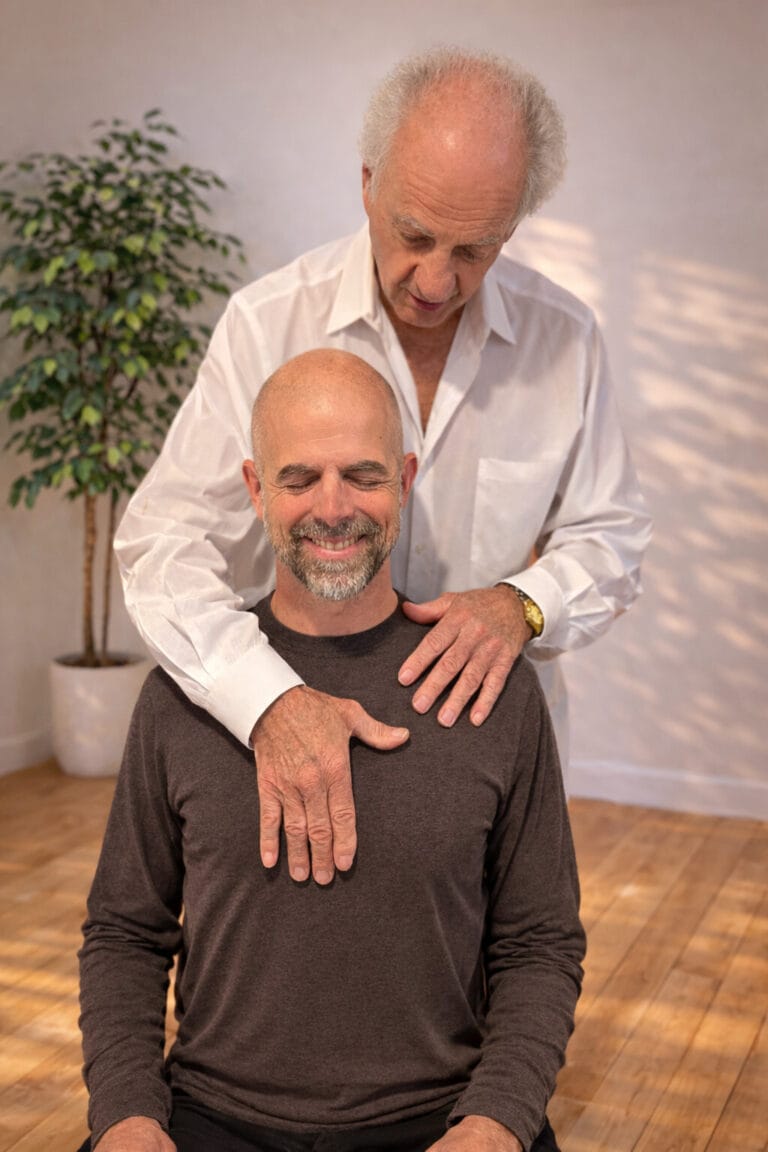
On November 5, 2024, in Boston, Massachusetts, USA, Tommy Thompson led a class in the Alexander Technique teacher training course that pulled this idea into sharp focus. This wasn’t a lecture. It was a living, breathing exploration—through movement, stillness, story, and touch. The room held trainees, each discovering what it means to change not just how you move, but how you live.
Key Objectives of the Class:
- To explore how use is not just about movement, but a reflection of your identity and way of living.
- To recognize habitual patterns and reactions, and experience the potential of inhibition as a gateway to change.
- To deepen self-awareness through movement, story, and touch, embodying the core philosophy of the Alexander Technique in practice.
This blog series is based on Tommy Thompson’s Alexander Technique classes. Each post follows the flow and insights of the class to expand both self-awareness and practical consciousness applicable to everyday life.
New here?
If you’re new to the Alexander Technique, you can start with the resources below.
Alexander Technique Class Flow at a Glance
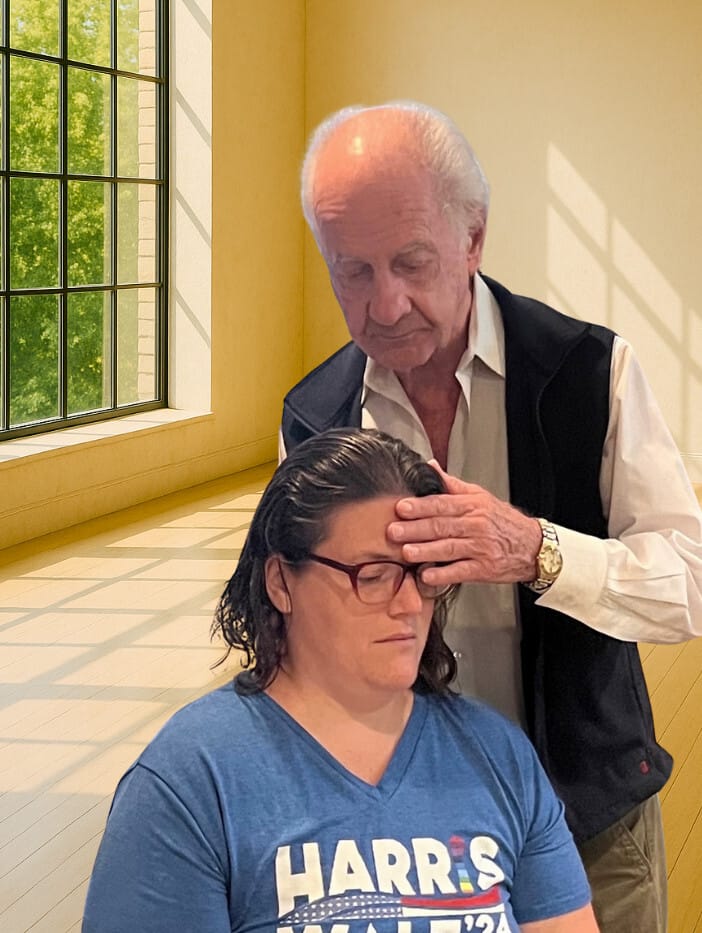
a trainee through embodied awareness of use.
1. The Opening Question
❝ Could the way you think be the reason you keep sitting, walking, or reacting the same way—over and over again? ❞
Not just your body—but your habits, your tone, your presence. Most people assume movement patterns are physical problems. Something to correct. Something to stretch out or hold in. But in this class, we look closer.
Your thoughts, your feelings, your perceptions—they shape the way you sit, walk, speak, and even pause. You may believe you’re just “standing up” or “getting through the day,” but your entire system is repeating something it learned a long time ago. A pattern. A strategy. A story.
This question lies at the center of this class. Because the way you think and the way you use yourself are not separate—they are a single loop.
And if you’re not aware of that loop, it keeps repeating—physically, emotionally, unconsciously.
And then, Tommy Thompson said something that stopped the room cold:
“It’s pretty hard to think without feelings, and it’s pretty hard to have a feeling without the way you perceive reality. So you’re thinking and you’re feeling and you’re perceiving the reality you’re accustomed to.”
He wasn’t offering a theory. He was naming the mechanism. Your body, your thoughts, your emotions—they’re all reflecting the same internal map. And if that map was drawn in survival, fear, or habit, then your body keeps acting it out—even when it no longer serves you.
That’s why in the Alexander Technique, we don’t just “fix” posture. We relearn how to notice ourselves in motion. We pay attention to the space between reaction and response. We explore how use reflects identity—and how it can shift.
The shift begins with a single realization.
You are always using yourself. The only real question is—how?
2. Core Learnings from This Class
Core Concepts
- Use reveals who you are, not just how you move.
The Alexander Technique, as Tommy Thompson teaches it, is not just about fixing posture—it’s a way of observing how you’re using yourself in the flow of your life. Every habit, every gesture, every breath is tied to the story you’re living. - Your story lives in your body—and the body wants to respond.
Tommy reminds us that we’re not static beings. We are designed to move, spiral, and shift like water. But when we cling to old stories, we interrupt the body’s natural wave-like motion. That interruption becomes tension. Releasing the story opens the flow. - Inhibition is the door to freedom.
The moment you pause—really pause—you make space for something else to emerge. That pause is not passive. It’s a creative refusal to repeat the past. It’s where learning happens. That’s what makes the Alexander Technique a conscious practice—more than just a physical technique for posture or movement.
Five Key Messages
- Your habits are the body’s memory of your beliefs.
The way you hold your phone, your shoulders, your breath—it’s all part of a pattern that once made sense to you. You can’t change the habit until you see the belief behind it. - Wave-like motion is your natural state.
Movement isn’t something you do. It’s something you allow. When touched with presence—not force—the body remembers how to move without effort, and reorganizes from within. - Every reaction is a chance to redirect your use.
Someone cuts you off in traffic. Your child doesn’t listen. Your back starts to ache. These aren’t just moments of frustration—they’re invitations to respond from presence, not pattern. - Touch becomes transformation when it’s free of judgment.
The body recognizes love. When hands make contact without trying to fix, they awaken something far more intelligent than correction—they remind the body of what it already knows. - Stillness isn’t the absence of movement—it’s awareness in motion.
In Tommy’s class, standing still often revealed more wave, more shift, more life than any visible motion. That’s because stillness is not freezing. It’s sensing. Listening. Integrating.
Essential Terms
- Use of the Self
The total expression of how you engage thought, feeling, and movement—moment to moment. Not just physical, but deeply personal. The central concept of the Alexander Technique. - Inhibition
The conscious practice of stopping automatic reaction. It creates space for new patterns of use to emerge. - Wave-like Motion
The body’s inherent rhythm when not restricted by habit or control. Tommy uses this to describe how movement unfolds naturally when the system is clear and responsive. - Primary Movement
A phrase often used by Tommy, referring to the origin point of living movement among the head, neck, and torso. This concept expands on the traditional idea of ‘Primary Control,’ shifting focus from structural correction to movement within waves and flow. This movement awakens when the body naturally responds and reorganizes itself within gravity. - Story
The internal narrative that shapes your perception of the world—and therefore, how you use yourself. Your story takes shape in your body. - Postural Muscle / Doing Muscle
Postural muscles support you with minimal effort over time; doing muscles are meant for action, not stability. Misusing the latter for standing or sitting leads to fatigue and strain. - Primary Control
The dynamic coordination of head, neck, and torso. When free, it allows the entire system to self-organize efficiently. - Touch without Judgment
A way of meeting another person through the hands—offering support, not direction; presence, not correction.
As Tommy put it: “Touch with your eyes first, then with your hands. And when you speak, let your voice touch too.” - Constructive Conscious Control
F.M. Alexander’s term for choosing how to respond rather than reacting blindly. It’s not control over the body—it’s relationship with self.
These weren’t just words in Tommy’s class. They were experiences—alive in the room, felt through movement, and anchored through attention.
3. Tommy’s Insight
In Tommy’s words during class, there are not only the core principles of the Alexander Technique, but also practical wisdom that can be applied directly to daily life. His words go beyond simple advice about movement and prompt us to deeply consider how we choose to exist.“Your patterns of behavior are shaped by your story, and at the same time, your story is influenced by the way you use yourself.”
→ You don’t just carry your story—you live it through your use, and when that use shifts, the story starts to rewrite itself.
“If you solidify certain behavioral patterns and isolate yourself from what you could be learning in this moment, you are not truly living through what is happening right now.”
→ When you’re locked in your pattern, you’re not in the moment—you’re reacting to a past that may not even be yours anymore.
“The body seeks to support everything you think and feel, always striving to maintain homeostasis.”
→ Your body listens—it organizes itself around whatever you’re believing, even when that belief no longer serves you.
“Touch is not meant to judge you—it is an act filled with pure love.”
→ Real touch doesn’t fix—it meets, it listens, and it lets the body remember it was never broken to begin with.
“Posture is not just about body alignment; it is the way the body as a whole responds within a gravitational field.”
→ Posture is not a pose—it’s your relationship with gravity, moment by moment, breath by breath.
“We are beings who exist within Earth’s gravity. To truly stand means to root yourself.”
→ Standing isn’t about holding up—it’s about allowing yourself to be held.
“When you adjust your head and neck (postural adjustment), you activate the postural muscles.”
→ A small release at the top can change the whole system—because presence always begins at the head.
4. Practical Tips for Everyday Life
What’s the Goal?
To bring the Alexander Technique into moments when you’d normally go on autopilot. Not to “correct” yourself—but to wake up. Even briefly.
As Tommy often said:
“This isn’t about fixing anything. It’s about noticing how you’re living—and choosing to participate differently.”
How to Practice
1. Let the ground meet you before you move.
Before standing or walking, stop. Don’t brace. Don’t prepare.
Just ask: Can I let the ground support me?
Feel your weight drop. Let your body respond. Then move.
2. Say what you need—without pushing.
Before speaking, notice: Are you stiffening? Holding breath? Let your neck soften. Let your breath come. Then speak from that.
As Tommy says, “Let your voice touch, not hit.”
3. See it before you do it.
Before reaching, typing, or turning—pause and actually see. Your hand, the door, the space, yourself.
That moment of seeing changes everything.
What You’ll Notice
Your body won’t be in a rush. Your words may feel slower—but they’ll land. You’ll feel just a bit more choice. And over time, you won’t just move differently—you’ll be different.
5. Closing the Class
Key Takeaways
You didn’t just learn about posture today. You began to see how you meet life.
The Alexander Technique isn’t a set of corrections. It’s a practice of attention—of choosing how to relate to yourself moment by moment. As Tommy often reminds us:
“It’s not about doing the right thing. It’s about not doing the thing that keeps you from noticing.”
You don’t have to fix yourself. You just have to show up to how you’re using yourself—right now. That’s where everything starts.
Core Insights
- Use of the Self is more than a movement pattern. It reflects how you think, feel, and choose to respond.
- Your body is not separate from your thoughts—it’s always responding to what you believe.
- Stillness is not the absence of movement—it’s where you meet choice.
- Change doesn’t start with doing—it starts with noticing. That pause is where something new begins.
When you shift your use, the world may not change—but your way of being in it does.
And that’s enough to change everything.
A Final Invitation
Tommy didn’t close the class with a summary. Instead, he demonstrated what he had taught all along: presence, not performance. He touched someone lightly, adjusted his awareness, and simply said:
“Now, just stay right there and think through what you’re thinking. I’m going to make a very subtle adjustment.”
He didn’t wrap the class in conclusions. He stayed with the process.
So as you leave this page, don’t rush to apply or change anything. Pause. Feel the ground. Sense your breath. Notice how you’re about to act. Then ask yourself: Am I being held? Let that question stay with you.
6. One Key Practice
Practice: Pause Before You Move
Before you get up—pause.
Before you reach—pause.
Before you speak—pause.
Not to stop yourself, but to notice how you’re about to use yourself. That moment is your chance to choose something different.
Tommy would say:
“If you don’t pause, you’ve already repeated the past.”
So today, try just this:
Before you move, pause. And ask: What am I about to do—and how?
7. Three Questions to Ask Yourself
These aren’t questions to answer. They’re questions to live in. Tommy didn’t ask us to analyze. He asked us to notice.
Here are three questions he might whisper,
just before you move, speak, or decide:
- Am I rushing toward something—or allowing myself to arrive where I already am?
→ Notice if you’re chasing forward, or if you’re letting yourself be here now. - What part of me is working harder than it needs to?
→ In your voice? Your shoulders? Your breath? Ask gently. Something might release. - Is my use supporting what I truly intend—or just what I always do?
→ Let this question soften the moment. Habit isn’t wrong—but it might not be true.
You don’t have to fix anything. Just ask.
And listen—not with your head, but with your whole self.
8. For Those Who Wish to Learn More
Recommended Book
- The Use of the Self – F. M. Alexander
→ This is the foundational text where Alexander first explores the idea that how we use ourselves affects everything—from posture to perception.
It’s not a technique manual. It’s a quiet revolution—about attention, inhibition, and the moment you choose not to do what you always do.
What Tommy teaches begins here: the realization that your use shapes your experience, and that noticing—not fixing—is the real doorway to change.
Official Website of Tommy Thompson
www.easeofbeing.com
This is the official website personally managed by Tommy Thompson, offering a wide range of resources and programs to deepen your understanding and practice of the Alexander Technique:
- Private session reservations and inquiries
- Workshop and seminar schedules
- Overview of international teacher training programs
- Essays and articles on the Alexander Technique
9. Next Class Sneak Peek
Could the way your head balances affect the way you think?
What if a small joint—just beneath your skull—held the key to balance, ease, and presence?
In the next class, we’ll explore how the body and mind shape each other—through movement, awareness, and the subtle intelligence of the AO joint (Atlanto-Occipital Joint — where your spine meets your skull)
This isn’t about fixing your stance—it’s about sensing your whole self in motion. It’s about noticing how movement mirrors thought—and how changing your use can change your experience.
🔎 In Class 23, we’ll explore:
➤ How thought influences coordination
➤ The AO joint’s role in nervous system balance
➤ Why “relaxation” isn’t enough—and what real integration feels like
➤ How to release tension without effort
➤ Everyday ways to move—and think—differently
10. Join the Alexander Technique Journey
Did this class leave a small resonance within you? Feel free to quietly hold it in your heart or share it in just a sentence or two. The comments are always open. Your one simple word may leave a gentle ripple in this ongoing journey.The journey of Resonance Flow continues across social media as well. Let’s continue this journey together.
 YouTube
 Instagram
 Threads
 Facebook