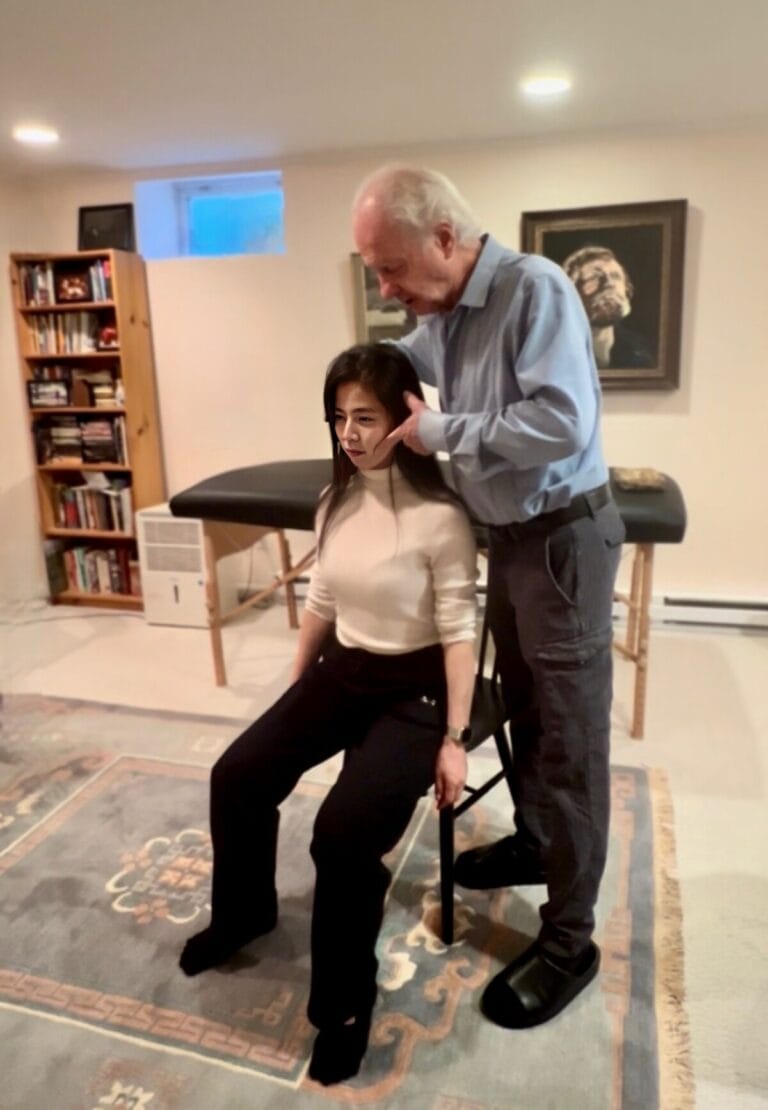
Triadic Resonance: The Alexander Technique Breakthrough for Instant Postural Freedom | Tommy Thompson Class 67

❝ What if the way you touch your own hand could free your neck, change your posture, and re-write the way your whole body moves? ❞
Most people think of posture as something to fix, or movement as something to train — but what if the real key was in stopping what you usually do, long enough for your system to reorganize itself? In this Alexander Technique class, Triadic Resonance became the doorway into that shift. It’s not part of the mainstream Alexander world — Tommy developed it through decades of hands-on teaching — yet it works seamlessly alongside the classic directions.
On April 30, 2025, in Boston, Massachusetts, USA, Tommy Thompson led a class in the Alexander Technique teacher training course that wove together inhibition, withholding definition, freeing the head–neck relationship, and releasing the hand in three resonant points so freedom travels through the whole body. As Tommy tells his trainees, “You can’t impose freedom — you can only make room for it to arrive.”
This cass was about finding the instant when awareness becomes your reference point. That is where coordination shifts, and where wellness begins — not from trying to ‘be right,’ but from letting go of the demand to define yourself in the old way.
Key Objectives of the Class:
- Understand why inhibition is the primary moment in the Alexander Technique.
- Explore Triadic Resonance as a tactile pathway to head–neck freedom.
- Learn when to begin with classic head–neck directions or the hands-first approach.
- Experience “touch and be touched” as a mutual exchange.
This blog series is based on Tommy Thompson’s Alexander Technique classes. Each post follows the flow and insights of the class to expand both self-awareness and practical consciousness applicable to everyday life.
New here?
If you’re new to the Alexander Technique, you can start with the resources below.
Alexander Technique Class Flow at a Glance
1. The Opening Question
❝ When was the last time you caught yourself in the middle of moving — and chose not to do what you usually do, for the sake of your coordination, your ease, your wellness? ❞
That pause — not a correction, not a better version of your habit — is where the Alexander Technique truly begins. In this class, Tommy asked us to look for that exact instant when awareness interrupts the automatic pattern. Sometimes that moment came through a subtle shift in the head–neck relationship; sometimes through the surprising gateway of Triadic Resonance, releasing three points in the hand so the change travels upward through the whole self.
Tommy’s Word
“Inhibition is primary — the moment when you decide not to continue reinforcing a given pattern of behavior.”
In Tommy’s teaching, it’s not about ‘fixing’ posture. It’s the refusal to feed an old pattern, creating the space for your system to rediscover its natural coordination.
2. Core Learnings from This Class
In this moment from Tommy Thompson’s class, trainees explore Triadic Resonance as a practice of awareness rather than something to apply.Through simple experiments with the hands, they begin to sense differences in quality, relationship, and contact.
Watch how coordination emerges naturally as perception becomes clearer.
You’re Touching Too Hard — Try This Instead | Alexander Technique
Class 67 · April 30, 2025 · Boston, MA
Core Concepts
- Inhibition as the primary moment
The conscious choice not to continue a habitual pattern, creating space for the body’s natural coordination to emerge. - Triadic Resonance as an indirect path to freedom
When you become aware of three key points in the palm, the fingers extend outward, the palm opens and empties. This frees the hand from the restrictions of the carpal bones, allowing a flow of energy and subtle sensation to travel upward through the head, neck, and back. - The withholding definition moment
Suspending self-definition to allow the nervous system to reset, rather than instructing it into habitual directions. - Choosing the right entry point
Starting with classic head–neck directions or the hands-first approach depending on the trainee’s state. - The attitude of “touch and be touched”
Cultivating mutual receptivity in every physical or verbal interaction.
Five Key Messages
- The moment you choose not to act as usual is the moment change begins.
- The body’s inherent directions are revealed when you stop asking it to follow habitual ones.
- Hand release can transform the whole self when approached without force or manipulation.
- Awareness is your reference point — not the “result” you want.
- Real wellness grows from letting go of the past pattern, not from adding new tension.
Essential Terms
Inhibition
The conscious prevention of a habitual reaction before it begins — the primary moment in which choice replaces automatic repetition.
Withholding Definition
Suspending the usual self-image or self-definition to give the nervous system a moment to find new possibilities, free from imposed directions.
Triadic Resonance
Tommy’s original method of releasing three resonant points in the palm to free the hand from carpal bone restrictions, sending energy and subtle sensation upward through the head, neck, and back.
Primary Directions
The classic Alexander Technique prompts that restore optimal head–neck–back coordination, engaging the vestibular system, vision, and reflex integration.
Touch and Be Touched
The practice of mutual receptivity in every interaction, allowing both giver and receiver to be influenced and changed by the moment.
n this moment from Tommy Thompson’s class, trainees explore the subtle habit of holding.
Rather than preparing, correcting, or trying to make something happen, the work invites the organism to release what is no longer needed.
Watch how letting go of unnecessary holding allows the body to reorganize with greater freedom, clarity, and responsiveness.
What Are You Still Holding? | Alexander Technique
Class 67 · April 30, 2025 · Boston, MA
3. Tommy’s Insights
In Tommy’s words during class, there are not only the core principles of the Alexander Technique, but also practical wisdom that can be applied directly to daily life. His words go beyond simple advice about movement and prompt us to deeply consider how we choose to exist.“I generally introduce a new person to Alexander’s directions, since that’s what he did, and I explain the concept of directions in the context of inhibition, because the directions are given in the inhibitive moment. That’s important. Inhibition is primary — the moment when you decide not to continue reinforcing a given pattern of behavior.”
→ This establishes inhibition as the foundational moment in which conscious choice replaces automatic repetition, anchoring all subsequent direction work.
“You substitute behaving in the way you usually do, and then your neck can be free to lengthen so that the head moves away from the body, forward and up, bringing length with it to the back. That’s why directions are given in the context of the inhibitive moment.”
→ The shift from habitual reaction to non-doing allows natural postural expansion to emerge, embodying the essence of primary control.
“Directions can also be given in the context of the withholding definition moment. I suggest that directions are already inherent within the organism, so if you choose not to define yourself in the manner you usually do, you’re not asking the nervous system to give you habitual directions — you’re letting the nervous system have a moment of its own to free the neck.”
→ By suspending self-definition, you allow the organism’s inherent intelligence to reassert balance without imposed instruction.
“If I am down like this, and I choose not to define myself like that, I’m not asking my nervous system to ‘do this.’ Over time, if I don’t ask my nervous system, this happens instead. The brain will give you freedom of the neck to lengthen if you don’t ask it to do otherwise. Ultimately, freedom in your head, neck, and upper back will free your grasp over time. You can free your neck with your hands by focusing on Triadic Resonance.”
→ Release through non-interference is gradual, but Triadic Resonance offers a tactile catalyst to expedite unlearning ingrained holding.
“I generally explain Triadic Resonance in the context of elementary directions, but if someone is especially ‘grabby,’ I can introduce that first, which then leads into Alexander directions.”
→ Teaching sequence adapts to the trainee’s dominant pattern, using hand release as an entry point to head–neck integration when necessary.
“You could say, ‘Back to lengthen and widen’ or ‘Spine to lengthen, back to widen.’ So I’ve caught you in the middle of what you’re doing. Your job is to catch yourself in the middle of your habitual actions and decide: Do I want to let myself do what I usually do, or do I want to let my neck be free so my head moves away from my body forward and up? That’s Alexander’s primary direction — the inhibitive moment.”
→ The work is not theoretical but interruptive, requiring real-time self-observation and a conscious pivot toward freedom.
“Alexander’s work is primary — involving the vestibular system, the inner ear, the eyes, and the head–neck reflexes — all functioning together to maintain uprightness. It affects the total neuromusculoskeletal pattern, frees the vestibular system, and frees your eyes if you let them be free.”
→ Primary control is a systemic integration, with sensory freedom serving as both a sign and a driver of postural coherence.
“When you change the axial — if you want to truly change the axial relationship of your head relative to the rest of the organism — then his directions work, but they only work to the extent that your commitment to the inhibitive moment, or the withholding definition, works. Because the withholding definition is another version of — I think, a deeper version of — the inhibiting moment.”
→ The depth of change in primary control is proportional to the depth of one’s engagement in withholding automatic self-definition.
What Your Hands Are Doing to Your Neck | Alexander Technique
Class 67 · April 30, 2025 · Boston, MA
4. Practical Tips for Everyday Life
What’s the Goal?
To create deliberate pauses in daily life where you interrupt habit and invite your body’s natural coordination. In the Alexander Technique, this is not about “fixing” but about allowing change.
How to Practice
- Catch Yourself in the Middle
While brushing your teeth, reaching for your phone, or typing, stop mid-action. Ask: Do I want to do what I usually do, or can I allow my neck to be free? - Open Your Palm and Let It Empty
Pause for a moment, gently open your palm as if it could breathe. Notice your fingers softly lengthening outward and your hand feeling lighter. Let that subtle sensation flow upward into your head and neck. - Withhold Definition in Transitions
Moving from sitting to standing, or stepping through a doorway, drop your usual self-definition. Let your nervous system find its own balance.
What You’ll Notice
- Lightness and length in posture without effort.
- Movements that feel connected and easy.
- Habitual tension caught — and released — before it takes hold.
5. Closing the Class
Key Takeaways
The Alexander Technique is less about adding something new and more about making the deliberate choice not to reinforce what you always do. That single moment of non-doing opens the way for your body’s inherent coordination and wellness to reassert themselves.
Whether you enter through classic head–neck directions or the tactile release of Triadic Resonance, the essence remains: meet the moment without rushing to define yourself.
Core Insights
“You are your awareness in motion.” For Tommy, this is not metaphor but reality. The work begins in noticing, deepens in not-doing, and transforms in allowing. Stillness here is not absence of movement but the presence of conscious choice.
A Final Invitation
As you step into your next movement — walking, reaching, speaking — let the floor meet your foot without pushing, let your neck be free without ordering it so. And if you catch yourself mid-habit, pause long enough to smile. That pause is the door opening.
6. One Key Practice
If you take one thing from this class, let it be this:
“Catch yourself in the middle, and choose not to continue as usual.”
It might be in the lift of your toothbrush, the moment your hand reaches for a door handle, or the instant before you speak. That pause — the inhibitive moment — is the opening. From there, let your neck be free without telling it how, and allow your body to respond in its own way.
7. Three Questions to Ask Yourself
These questions are not for reviewing the past but for meeting yourself in the present moment. Ask them while you are in the middle of moving, not after you’ve stopped.
- “What am I about to do next?”
This shifts you from automatic reaction to conscious choice before the action is completed. - “Am I defining myself right now?”
If you are, pause. Let your nervous system have a moment without that definition. - “Can I allow my neck to be free without telling it how?”
This question invites freedom without adding effort, letting coordination reorganize on its own.
8. For Those Who Wish to Learn More
Recommended Books
Touching Presence – Tommy Thompson
Written by the very teacher who led this class, this book explores how presence, touch, and awareness intertwine in the practice of the Alexander Technique. It offers practical pathways into concepts like the inhibitive moment and withholding definition. Reading it is like having Tommy’s voice beside you — guiding you to bring the work into daily life, one conscious moment at a time
9. Next Class Sneak Peek
What if the heart of the Alexander Technique isn’t how you move—but who is moving, and how that self is already in relationship?
In the next class, Tommy Thompson shifts focus from doing to being in support—not by effort, but through recognition. Presence becomes relational. Awareness becomes the ground.
We won’t try to fix ourselves.
We’ll learn to listen, relate, and be supported.
In Class 69, we’ll explore:
How the relational self becomes the true source of change.
10. Join the Alexander Technique Journey
Did this class leave a small resonance within you? Feel free to quietly hold it in your heart or share it in just a sentence or two. The comments are always open. Your one simple word may leave a gentle ripple in this ongoing journey.The journey of Resonance Flow continues across social media as well. Let’s continue this journey together.
 YouTube
 Instagram
 Threads
 Facebook