AO Joint Freedom: How Letting Go Unlocks Movement You Didn’t Know You Had | Tommy Thompson Class 23
❝ What if a tiny joint at the top of your spine could unlock not just movement—but how you think and feel? ❞
Most people don’t even know it exists. But the AO joint—where your skull rests on your spine—is one of the most powerful gateways to coordination, perception, and ease.
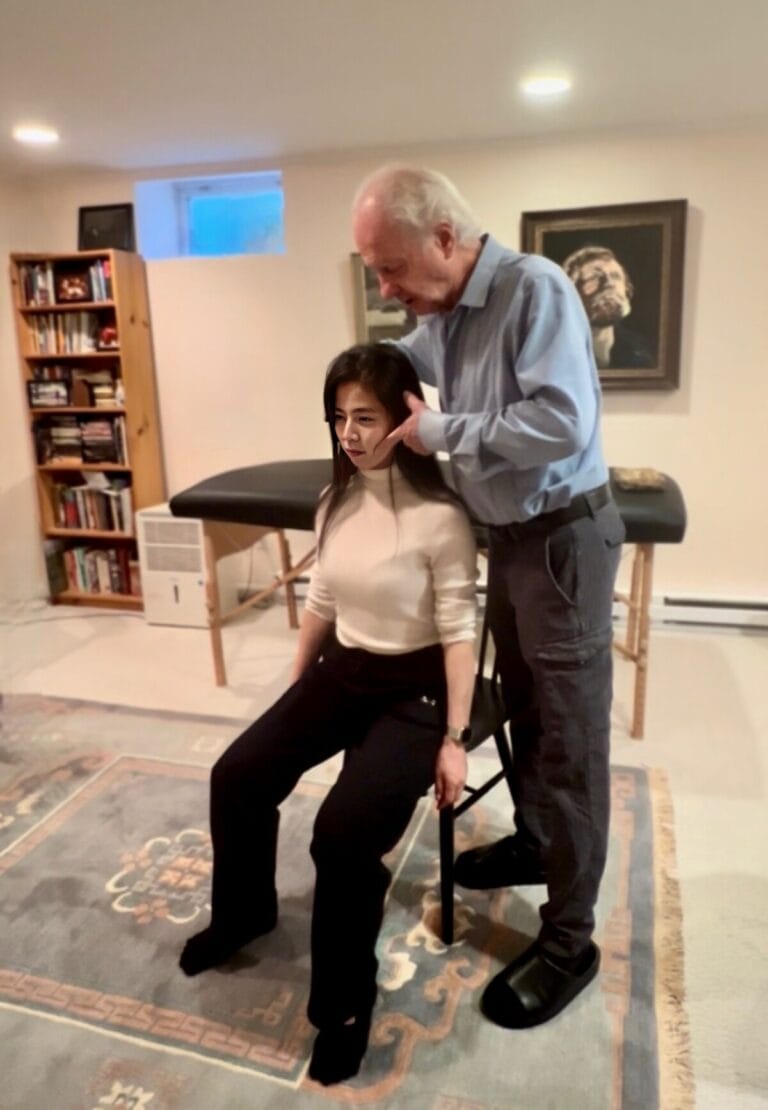
On November 6, 2024, in Boston, Massachusetts, USA, Tommy Thompson led a class in the Alexander Technique teacher training course that placed this tiny joint at the center of a profound inquiry: Can we experience true movement freedom by unblocking the very top of the spine?
The answer, according to Tommy, isn’t found in doing more. It’s found in unwinding what you’re holding, in listening rather than directing, in restoring the body’s ability to organize itself.
At the core of this class was the concept of AO Joint Freedom—not just as a biomechanical condition, but as a pathway to presence and deeper awareness.
As Tommy often says, “You think you’re moving your head—but actually, you’re only allowed to move it when the tissues let you.”
Key Objectives of the Class:
- To explore how freedom in the AO joint(Atlanto-Occipital Joint) restores natural coordination without mechanical correction
- To observe the relationship between neuromuscular release and shifts in attention, emotion, and identity
- To offer trainees an experiential understanding of unwinding, presence, and integrated movement
This blog series is based on Tommy Thompson’s Alexander Technique classes. Each post follows the flow and insights of the class to expand both self-awareness and practical consciousness applicable to everyday life.
New here?
If you’re new to the Alexander Technique, you can start with the resources below.
Alexander Technique Class Flow at a Glance

1. The Opening Question
❝ What does it really mean to allow the head to move—rather than make it move? ❞
In the Alexander Technique, the question isn’t how to hold yourself “right.” It’s how to stop interfering. During this class, Tommy Thompson invited trainees to step away from mechanical correction and asked: What if true movement begins not in what we do—but in what we stop doing?
The AO Joint—the meeting point of skull and spine—is not just a hinge. It’s a mirror. It reflects how we think, how we hold ourselves emotionally, and how deeply we trust the body to function without conscious force. In this class, AO Joint Freedom wasn’t presented as a technique or goal to master, but as a byproduct of allowing the body to self-regulate. It arises when we release interference—neurological, muscular, and perceptual—and listen for what’s already trying to happen.
This question—“Do you allow or do you direct?”—became the quiet engine of the class. It shifted the room. Because to feel well, to move with ease, to embody awareness—we must reconnect with the primary coordination the body already knows. Not impose something new, but rediscover something forgotten.
Tommy’s Word
“The head cannot move on its own. It can only turn when the muscles designed for its movement—the trapezius and sternocleidomastoid—are free.”
This isn’t just anatomy—it’s a reflection of attention.
Tommy isn’t telling trainees what to stretch, release, or fix. Instead, he’s pointing to a deeper principle: freedom doesn’t begin in the joint—it begins in how we relate to the joint. The muscles around the AO Joint don’t just hold tension—they hold habit, reaction, and identity. They tighten not because we choose to tighten them, but because we’ve learned to move through the world with effort and self-definition.
As Tommy often reminds us, “Most people think their head is moving—but often, it’s just being carried by what’s stuck.”
By highlighting that movement is only possible when the surrounding tissues are free, he brings us back to the interdependence of structure, perception, and intention.
This is the heart of the Alexander Technique. Wellness doesn’t arise from correcting the body, but from releasing the need to control it—and allowing something far more intelligent to organize us from within.
2. Core Learnings from This Class
Core Concepts
- AO Joint Freedom is not a technique—it’s a condition that emerges when we stop interfering.
Rather than something we create or perform, freedom in the AO joint arises when we allow the body to self-regulate. This freedom is not passive; it’s intelligent, subtle, and often discovered through stillness. - Movement patterns mirror thought patterns.
Every shift in physical coordination reflects a shift in intention, emotion, or belief. In this class, trainees began to observe how changing how you think about movement can transform how you actually move—without effort. - Integration is more valuable than alignment.
The Alexander Technique isn’t about achieving a fixed shape or ideal posture. It’s about the quality of connection between systems—how the head balances on the spine, how the limbs follow intention, and how support arises from within.
Five Key Messages
- Stop doing the thing before you try to fix the thing.
Before change can occur, the first step is to become aware of interference—and let it go. - The head moves only when the tissues give permission.
Coordination isn’t imposed—it’s revealed through attention and readiness. - What you notice is more important than what you do.
In the Alexander Technique, awareness is primary. Perception shapes coordination. - Unwinding isn’t random—it follows intelligent, patterned directions.
What appears spontaneous is often the body resolving a deeper internal pattern. - You can’t separate movement from meaning.
How we move is how we relate—to ourselves, others, and the world. Every gesture contains intention.
Essential Terms
- AO Joint (Atlanto-Occipital Joint):
The pivotal joint where the skull meets the spine. A central focus in this class, it serves as a physical and perceptual gateway for balance and spatial awareness. - Inhibition:
The intentional pause before a habitual reaction. Practiced as a moment of possibility, inhibition opens space for AO Joint Freedom to arise—not through effort, but through not interfering. - Primary Coordination:
A foundational Alexander Technique principle describing the dynamic relationship of head, neck, and spine. Restoring this coordination was a guiding thread throughout the class. - Unwinding (as used by Tommy):
A self-directed release process in which the body reorients through natural spirals and directional flow. Tommy emphasized that unwinding is not passive—it reveals how the body returns to balance through its own intelligence. - Integration (vs. Alignment):
While alignment refers to external structure, integration speaks to internal unity. A well-integrated system allows for ease, presence, and adaptability—core qualities explored in this training.

3. Tommy’s Insights
In Tommy’s words during class, there are not only the core principles of the Alexander Technique, but also practical wisdom that can be applied directly to daily life. His words go beyond simple advice about movement and prompt us to deeply consider how we choose to exist.“Changing the body doesn’t just create physical shifts—it changes thought patterns. And vice versa. When the mind shifts, the body changes too.”
→ The mind and body mirror each other in change, and freeing one invites natural reorganization in the other.
“The word ‘integration’ is more appropriate than ‘relaxation.’”
→ What matters is not letting go alone but a state where all parts work together in intelligent connection.
“Unwinding is the body’s way of restoring balance. It follows a pattern and direction—it’s never static.”
→ The body self-corrects through patterned motion when interference stops and rhythm is restored.
“The head cannot move on its own. It can only move freely if the muscles designed for its movement are released.”
→ The head moves freely only when the underlying support lets go and effort is replaced by readiness.
“When you let go of certain thought, emotional, or behavioral patterns, your entire body finds harmony. That’s why I tell people: ‘Don’t define yourself in one fixed way.’”
→ How we define ourselves shapes how we move, and freedom begins where fixed identity ends.
“We need to observe how freely the AO joint moves—this affects the whole body.”
→ The AO joint reflects whether the whole self is coordinated through ease or held by excess control.
“Thoughts, emotions, and perception can also restrict the body.”
→ The body holds what the mind grips, and awareness is the first step to releasing that bind.
4. Practical Tips for Everyday Life
What’s the Goal?
To experience AO Joint Freedom not just on the table, but in the middle of life—while walking, reaching, speaking. Tommy invites us to stop correcting and instead begin listening. The goal is to create space for the body’s natural coordination to return, without forcing it.
How to Practice
- Let Direction Happen—Not Effort
As you walk, pause and quietly think:
“Let my neck be free to lengthen, so my head can move away from the body—forward and up—and then my spine lengthens and my back widens.”
No doing, no fixing—just allow.
→ You may feel a sense of quiet lift, softening in your back, and more clarity with each step. - Pause Before You React
Before standing, reaching, or speaking, take one silent second. That moment of non-doing gives the system a chance to reset.
→ You might notice less tension in your chest or jaw, and more grounded presence in your action. - Scan for Holding—and Invite Space
Once or twice a day, notice one area—shoulders, tongue, belly—and ask: “Is there effort here I don’t need?” Don’t change it—just get curious.
→ With awareness, unnecessary tension often fades, and breath flows easier.
What You’ll Notice
These aren’t exercises. They’re invitations.
As you let go of managing yourself, movement becomes clearer, your posture starts to organize itself, and you begin to feel more whole in motion than in stillness.
This is the Alexander Technique in action: not performance, but permission to return to your original coordination.
5. Closing the Class
Key Takeaways
AO Joint Freedom is not a technique to apply—it’s a truth to rediscover. Tommy didn’t ask trainees to correct themselves. He asked them to become available. Available to sensation, to quiet, to the space between thoughts. What changed was not the posture, but the person.Freedom, in this class, wasn’t something you achieved.
It was what surfaced when interference dissolved.
Core Insights
The head is not meant to lead by command.
It moves when it’s supported, not when it’s forced.
The AO joint doesn’t unlock through will—it frees when the whole self returns to unity.
This isn’t about learning how to stand up straight.
It’s about remembering how to be upright without effort.
It’s not about self-control. It’s about self-trust.
Tommy showed that when you stop managing yourself,
something deeper begins to organize you.
A Final Invitation
Next time you move, pause. Let your neck be free. Let your breath arrive. Notice how little you need to do—just to be.
That’s where wellness begins—not in effort, but in presence.
And from that presence, coordination, clarity, and calm return on their own.
You don’t have to figure out the whole body. You only need to stop interfering with what already knows how to move—and that’s the essence of the Alexander Technique.
6. One Key Practice
Pause. Let go. Feel what’s already moving.
Before you stand, speak, turn, or reach—just pause. Let your neck be free. Don’t adjust. Don’t hold. Just notice.
From that noticing, movement will come. Not from will. Not from form. But from availability.
This is the practice:
In any moment, allow freedom before action.
Let the head float up. Let the spine lengthen.
Not because you made it happen—
but because you stopped doing, and something deeper moved you.
7. Three Questions to Ask Yourself
- Where in my body am I working harder than I need to?
Don’t try to fix it—just invite a little less effort. - Is my head moving freely, or am I trying to lead it?
What shifts if I let it find its own way? - Can I sense where movement wants to start—before I decide to move?
Let that be enough.
8. For Those Who Wish to Learn More
Recommended Books
How You Stand, How You Move, How You Live – Missy Vineyard
This is a clear and practical guide to the Alexander Technique, especially for applying inhibition and direction—two foundational principles of the Alexander Technique—in daily life. Vineyard explains how perception shapes coordination—mirroring Tommy’s insight that AO joint freedom is something to allow, not force. With both theory and practice, the book helps bring class insights into real movement.
Official Website of Tommy Thompson
www.easeofbeing.com
This is the official website personally managed by Tommy Thompson, offering a wide range of resources and programs to deepen your understanding and practice of the Alexander Technique:
- Private session reservations and inquiries
- Workshop and seminar schedules
- Overview of international teacher training programs
- Essays and articles on the Alexander Technique
9. Next Class Sneak Peek
Next time, we go deeper. If this class invited you to sense the possibility of freedom at the AO joint, the next will ask you to move with that freedom—without directing it. It’s not about controlling what happens. It’s about noticing how your system wants to respond when interference drops away.
We’ll explore how subtle shifts in attention can unlock new coordination—not by doing more, but by doing less with more awareness.
In Class 24, we’ll explore:
- What “use of the self” truly means in movement
- How trust replaces control in sustainable coordination
- Where breath fits into the picture—not as a technique, but as a signal of internal permission
10. Join the Alexander Technique Journey
Did this class leave a small resonance within you? Feel free to quietly hold it in your heart or share it in just a sentence or two. The comments are always open. Your one simple word may leave a gentle ripple in this ongoing journey.The journey of Resonance Flow continues across social media as well. Let’s continue this journey together.
 YouTube
 Instagram
 Threads
 Facebook