Still Point of Support in the Alexander Technique – Hands-On Practice for Balance in Body and Mind | Tommy Thompson Class 06
❝ When your body feels stiff or your mind feels scattered in the morning, how do you find your center? ❞
Everyone wants to start the day feeling balanced in both body and mind. But learning how to consciously restore that sense of balance isn’t something that comes easily.
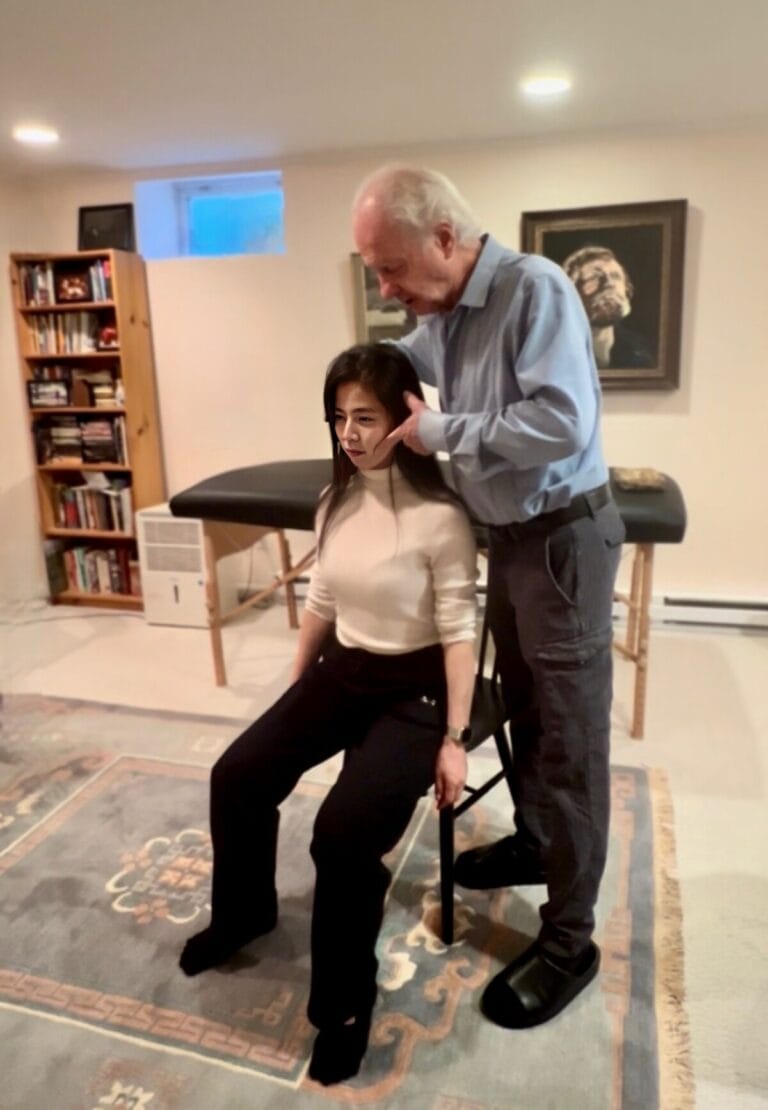
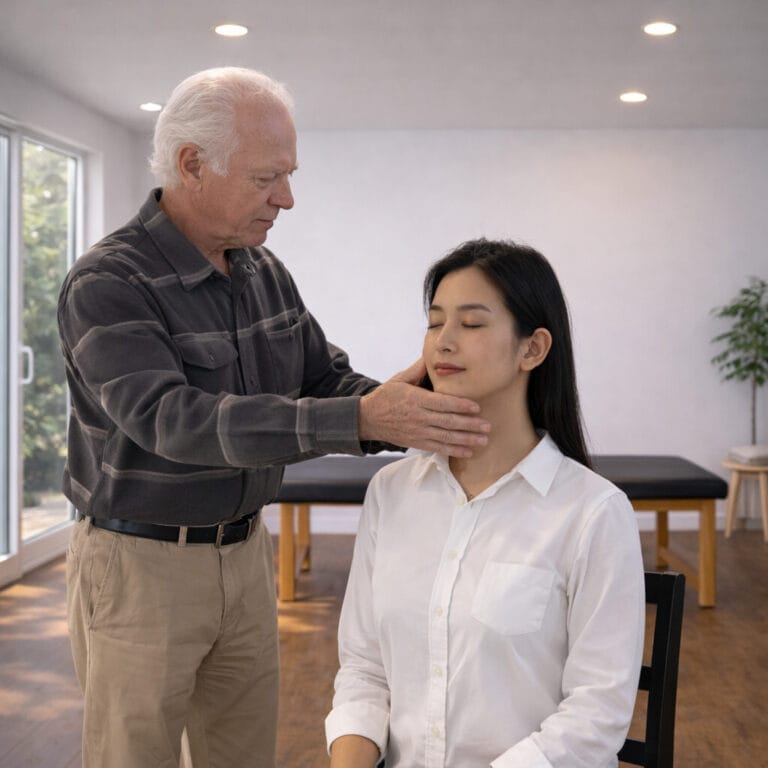
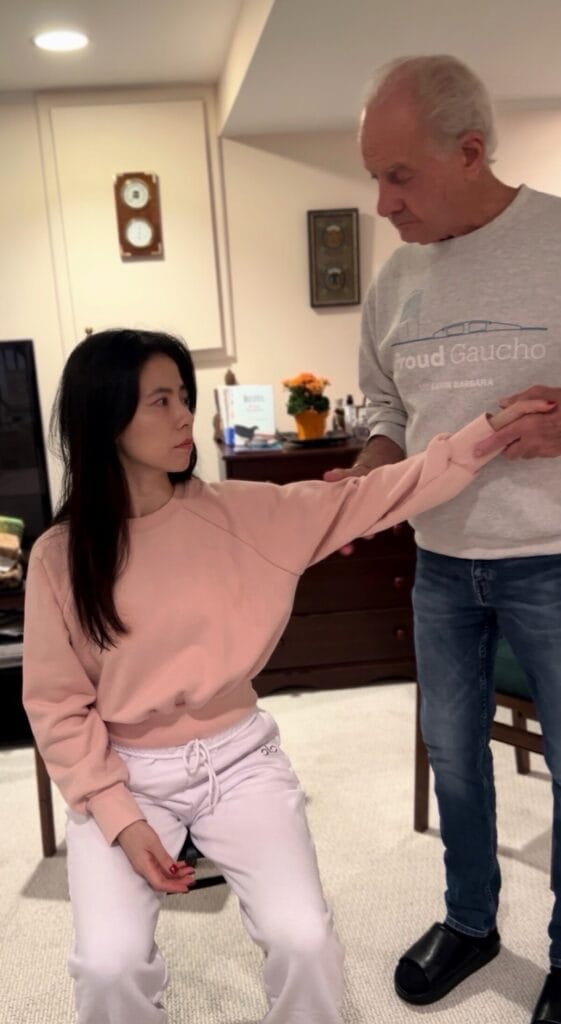
On September 26, 2024, in Boston, Massachusetts, USA, Tommy Thompson led a class in the Alexander Technique teacher training course with a focus on hands-on technique and the Still Point of Support. The class explored the sensory skills needed to restore physical and mental balance, and offered a practical inquiry into how to feel centered within everyday movement
Key Objectives of the Class
- To recognize habitual tension and detect patterns that interfere with balance.
- To restore proprioception and a sense of center through hands-on work.
- To go beyond physical training and move closer to the essence of one’s being. This blog series is based on Tommy Thomson’s Alexander Technique classes. Each installment follows the flow and insight of the class, expanding both self-awareness and applied practical consciousness in relation to daily life.
This blog series is based on Tommy Thompson’s Alexander Technique classes. Each post follows the flow and insights of the class to expand both self-awareness and practical consciousness applicable to everyday life.
New here?
If you’re new to the Alexander Technique, you can start with the resources below.
Alexander Technique Class Flow at a Glance
1. The Opening Question
❝ How can we find a harmonious balance between body and mind? ❞
Tommy’s Words
“The Still Point of Support is a key place within us where we can remain calm and balanced, even in motion. It is not simply a physical arrangement, but a dynamic process of responding organically within the field of gravity.”
Tommy Thompson doesn’t view balance as merely a matter of posture or alignment. He challenges the conventional idea of posture and explains:
“Posture is not a three-dimensional arrangement of body parts which you can ‘fix’ or alter by rearranging yourself. Posture is the organism’s total, sophisticated, and comprehensive response within a gravitational field.”
This understanding moves beyond the idea of correcting movement or alignment. It involves restoring inner stability through sensory awareness, and recognizing that balance is not static. It’s not about holding a fixed position, but about allowing the body and mind to continually respond and coordinate within gravity.
In class, trainees explored how to experience this still point and how to apply it in everyday movement. The key insight was this: balance is not something we achieve by staying still, but something we sustain through dynamic interaction between body, mind, and environment.
2. Core Learnings from This Class
In this moment from Tommy Thompson’s class, trainees explore how the foot organizes support through Triadic Resonance. The focus is on allowing direction through contact rather than applying force.
Watch how subtle changes in the foot influence coordination through the entire leg.
Your Foot Is Smarter Than You Think | Alexander Technique
Class 06 · September 26, 2024 · Boston, MA
Core Concepts
- A facilitative approach does not teach by fixing—it teaches by making space for discovery.
The teacher is not a problem-solver, but a companion in the unfolding of experience. As Tommy often says: “I don’t fix. I enter.”
Throughout the class, his focus is to open a space where awareness arises, movement reorganizes, and the student rediscovers their own way forward. This is the heart of the Alexander Technique: not correction, but relationship.
- The Still Point of Support is an inner center where body and mind remain balanced and quietly composed, even in motion.
This center is not a fixed posture, but a living, responsive sensation that emerges through our relationship with gravity. The moment this point is recognized, a felt sense of stability and harmony becomes accessible—even within ordinary life.
- Hands-on touch is not corrective; it is a relational entry point that opens sensory awareness.
Through intentional, listening contact, the teacher does not impose change but joins the person’s use as it is. The body is not adjusted—it is received. And within that reception, a new organization becomes possible.
- Proprioception is the capacity to sense the body from within—and thus, to meet oneself anew.
It is not simply about spatial awareness or physical function, but the foundation of self-perception and regulation. To feel the body is to return to the self in the most honest and immediate way.
- An organismic response is the body’s inherent capacity to recover balance without external intervention.
It is not activated by force, but by the quiet removal of interference.
As unnecessary effort falls away, the body responds naturally to gravity, and a deeper coordination returns.
Five Key Messages
- Balance is not a static condition; it is a living response.
The body and mind have the inherent ability to continuously coordinate and adjust to maintain balance. - The Still Point of Support exists within everyone.
Finding it is not about changing your posture, but shifting your attention. - Hands-on work is not a tool for delivering sensation, but for awakening it. True change begins in the internal space where one becomes aware of sensation and capable of responding.
- Simply reconnecting with bodily sensation can transform your life. The body remembers. It is tied to emotion, and
restoring that sensory connection is a path to restoring the self. - It’s not about correction—it’s about connection. The Alexander Technique isn’t about doing things “right,” but about reintegrating body, mind, and being.
Essential Terms
- The Still Point of Support
Not a place to find, but a way to enter. It is the lived experience of stability that emerges not from holding still, but from participating in the body’s ongoing relationship with gravity. When recognized, it offers a quiet clarity—a way of being present in movement without bracing or fixing. - Hands-On
A listening form of touch that enters relationship without demand.
It does not instruct the body what to do, but joins what the person is already doing, offering just enough presence to allow a different direction to appear. In Tommy’s work, hands are not tools—they are invitations. - Proprioception
The body’s sense of itself—not just its position in space, but its capacity for wholeness. This internal awareness is not something to be taught, but remembered. It is the ground of embodied identity, where doing gives way to sensing, and sensing allows for conscious response. - Organismic Response
A spontaneous expression of the body’s capacity to coordinate itself in gravity when left undisturbed. This response is not created by the teacher—it is revealed when interference stops. What we call balance is not an achievement; it is what remains when we stop trying to control. - Facilitator
Not a director, but a partner in presence. A facilitator joins the student inside their process—not to fix it, but to appreciate it, to witness it, and to allow something new to unfold from within.
In Tommy’s approach, the teacher does not stand outside the action. They step into it, relationally.
3. Tommy’s Insights
In Tommy’s words during class, there are not only the core principles of the Alexander Technique, but also practical wisdom that can be applied directly to daily life. His words go beyond simple advice about movement and prompt us to deeply consider how we choose to exist.“You can only give what you receive. So the deeper you have the experience that someone helps to give you, the more that you have received, which is available to give to someone else. That’s the training course.”
Teaching begins with receiving—what you’ve embodied becomes the only thing you can genuinely pass on.
“This is truly a unique way of touching someone and being touched. It’s not just ordinary physical contact—it’s a refined and profound interaction. This form of touch directly connects to the evolutionary integrity and essence of the organism. It’s a rare experience.”
Hands-on touch in Alexander work isn’t about technique—it’s a deep, sensory dialogue with the whole being.
“The movement within you never stops. Posture isn’t just a three-dimensional arrangement of body parts; it’s the organism’s total response within a gravitational field.”
Posture is not a fixed shape—it’s a living process of continuous adjustment in relationship to gravity.
“Sometimes, excessive movement makes it difficult to locate the still point. In such moments, finding a still flow of support becomes crucial.”
Stillness can be found not in freezing movement, but in discovering a subtle, continuous flow within it.
“Just work with them as you would with anyone else. Don’t try to fix the problem. They will eventually discover something on their own, and that’s when you can have the appropriate conversation.”
The teacher’s job is not to solve but to create a space where real self-discovery can emerge.
“Your role is to help them reveal who they are. You’re guiding them to discover themselves and understand who they are, so they can make their own decisions.”
True guidance is about uncovering identity, not imposing answers.
“Your work is about their essence. If they feel discomfort with a specific body part, like their chest, that comes from their personal narrative. But that’s not who they truly are. Your focus should be on helping them move beyond their personal narrative to experience who they truly are.”
Transformation happens when students go beyond their story and reconnect with their deeper, embodied self.
4. Practical Tips for Everyday Life
What’s the Goal?
To naturally restore sensory awareness and a sense of center in daily life. The key is to integrate the principles learned in class into everyday actions.
How to Practice
Rather than large or special movements, short and repeatable practices are often more effective.
Within familiar actions, practice consciously sensing your body and feeling your center.
1. Enhancing Proprioception
- 5-Minute Morning Sensory Wake-Up
Stand with your eyes closed and feel the distribution of weight in your feet. Gently scan through your fingers, toes, and muscles beneath the skin to notice where your body is now. - Alignment Check in Front of a Mirror
Observe whether your neck, shoulders, and spine align comfortably. Release tension, breathe naturally, and focus more on sensation than on posture. - One-Leg Balance Practice
Stand on one foot and observe how your center shifts.
Don’t try to stop the wobbling—tune in to how your body self-adjusts.
2. Finding the Still Point of Support
- Walking Meditation
As each foot touches and leaves the ground, notice how your center shifts. Observe how your body responds and adjusts to the rhythm of walking. - Center Awareness While Sitting
Sit upright in a chair and breathe.
Through the connection between your pelvis and the seat, feel how your inner center is supported downward.
It’s not about “sitting correctly,” but rather about “sitting with awareness.”
What You’ll Notice
- You’ll become more finely attuned to your center of gravity and sense of balance.
- Your posture and breathing will adjust naturally and fluidly.
- As you reconnect with inner sensation, you’ll feel more grounded—and your daily rhythm will begin to settle.
5. Closing the Class
Key Takeaways
This class was not about simply “learning how to move well.”
It was about restoring a way of reconnecting with oneself—
and it showed us the possibility that this connection can be made through the body as a pathway.
The hands-on work of the Alexander Technique and the Still Point of Support, as introduced by Tommy Thompson, offered more than just guidance on movement—they opened a deeper sensory doorway to reconnecting with oneself through the body. This class became an experience of that connection, and an invitation to reconsider how we see and live our lives.
Core Learnings
- Balance is not a static condition; it is a living sensation.
Centering is not about holding still—it is an experience of “here and now,” where gravity, sensation, and awareness meet. - The body is not merely a tool for movement.
It is the most honest pathway through which we can reconnect with ourselves. - The smaller the practice, the deeper it goes—especially in daily life. Instead of trying to stand “correctly,” a moment of standing with awareness can reveal so much more. These learnings reflect how the Still Point of Support, central to the Alexander Technique, guides not only movement but also one’s inner alignment with life.
A Final Invitation
Just because the class has ended doesn’t mean the practice has.
In fact, this is where it truly begins.
Even just a few minutes a day is enough— to feel your body, find your center, and allow your body and mind to remain present in the “here and now.” As those moments accumulate, your entire life can begin to shift.
The fact that you’re reading this now means one thing: you already have everything you need to begin.
6. One Key Practice
Experiencing the Still Point of Support in Movement
For just five minutes today, as you walk slowly, observe how your center shifts each time your foot touches the ground. The speed doesn’t matter—what’s important is to sensually notice how your body adjusts and responds.
- The change in pressure beneath your feet
- The movement of your knees and pelvis
- The sense of balance extending upward through your spine
- How your neck and head naturally follow
You don’t need to “do it right.” Simply feel what’s happening, just as it is. Observe how your body quietly finds its own balance. That’s the moment the Still Point of Support begins to reveal itself.
7. Three Questions to Ask Yourself
- In this moment, which part of my body am I aware of?
- Is my movement coming from tension—or from center?
- Am I giving myself enough space to let my body and mind connect naturally?
8. For Those Who Wish to Learn More
Recommended Reading
- Body Learning by Michael J. Gelb
A classic that speaks to both newcomers and seasoned practitioners of the Alexander Technique. This book offers a clear and accessible exploration of the technique’s philosophy and real-life applications, providing deep insight into how the way we use our body influences every aspect of our lives. It’s especially helpful for understanding key concepts covered in class, including self-awareness, sensory restoration, and the shifting of one’s center. The Still Point of Support is one of the most subtle yet transformative aspects of the Alexander Technique, and this book helps illuminate its practical depth. - How You Stand, How You Move, How You Live by Missy Vineyard
Written by Alexander Technique teacher and researcher Missy Vineyard, this book explores hands-on work, the sensory coordination of body and mind, and perceptual transformation through practical, real-world examples. Closely aligned with the flow of Tommy Thompson’s classes, it’s a valuable guide for expanding your experiential understanding of the work.
Official Website of Tommy Thompson
www.easeofbeing.com
This is the official website personally managed by Tommy Thompson, offering a wide range of resources and programs to deepen your understanding and practice of the Alexander Technique:
- Private session reservations and inquiries
- Workshop and seminar schedules
- Overview of international teacher training programs
- Essays and articles on the Alexander Technique
9. Next Class Sneak Peek
In the upcoming class, we will delve into refined practices of inhibition and observation, with a focus on applying hands-on work in a more nuanced and intentional way.
This class will explore how to inhabit the space between stimulus and response, allowing for deeper integration between body and mind.
- How to refine the quality of touch with greater precision
- Sensory practices to observe physical reactions as they arise
- Tools to foster deeper empathy and connection in interpersonal exchanges
Ultimately, this next class will guide us in expanding embodied insight and learning how to integrate the principles of the Alexander Technique into everyday living.
We look forward to sharing it with you!
10. Join the Alexander Technique Journey
Did this class leave a small resonance within you? Feel free to quietly hold it in your heart or share it in just a sentence or two. The comments are always open. Your one simple word may leave a gentle ripple in this ongoing journey.The journey of Resonance Flow continues across social media as well. Let’s continue this journey together.
 YouTube
 Instagram
 Threads
 Facebook