Inspansion: What Happens Before You Move Changes Everything | Tommy Thompson Class 106

❝ What if you are not failing to expand in the Alexander Technique, but simply living on the surface of yourself, never having entered through Inspansion? ❞
Most people believe they need to improve, stand up straighter, lengthen, or fix something that feels wrong. But what if real change does not begin there? On December 23, 2025, in Boston, Massachusetts, USA, Tommy Thompson led a class in the Alexander Technique teacher training course that revealed something more fundamental. The issue is not what you are doing, but where you are doing it from.
Most of us operate at the level of habit, the wave, moving from reaction to reaction and trying to adjust from the surface. But the organism does not reorganize from the surface. It reorganizes from depth, from what Tommy points to as the ocean, the underlying field of support within the self.
This is where Inspansion becomes essential. Not as a technique or an idea, but as a direction of attention inward, into the organizing field of the organism, where coordination is revealed and touch becomes an invitation. Because the organism is already designed to lengthen, the work is not about doing more, but about stopping what interferes.
You are not trying to expand. You are allowing organization to occur. And when that happens, change is no longer something you make—it is something that appears.
As attention shifts from the wave into the ocean, the organism reorganizes, and expansion appears as a natural consequence.
Key Objectives of the Class:
- To understand Inspansion as the inward organizing movement within the Alexander Technique
- To experience touch as an invitation rather than correction
- To recognize that lengthening is a whole-organism response, not a local adjustment
- To move from habitual use (wave) into deeper coordination (ocean) aligned with how the organism is designed to lengthen
This blog series is based on Tommy Thompson’s Alexander Technique classes. Each post follows the flow and insights of the class to expand both self-awareness and practical consciousness applicable to everyday life.
New here?
If you’re new to the Alexander Technique, you can start with the resources below.
Alexander Technique Class Flow at a Glance
1. The Opening Question
❝ If trying to change is what we habitually do, could that very effort be part of what prevents change in the Alexander Technique through Inspansion? ❞
This question goes to the heart of the work. Most people begin from the assumption that change comes from doing something—adjusting, correcting, or improving. But in this approach, it becomes possible to notice that the impulse to do may itself be part of the pattern.
The question shifts from “What should I do?” to something more fundamental: What is happening in me as I am trying to do? This shift invites attention away from outcome and toward the ongoing process of use. From here, coordination is not something to be constructed, but something that may emerge as interference begins to lessen.
This is where Inspansion becomes meaningful. Not as a technique, but as a direction of attention inward, into the organizing field of the organism. As attention moves in this way, the body is no longer managed primarily through habit, and a different quality of response becomes available. Change is not something imposed. It is something that can begin to appear.
Tommy’s Word
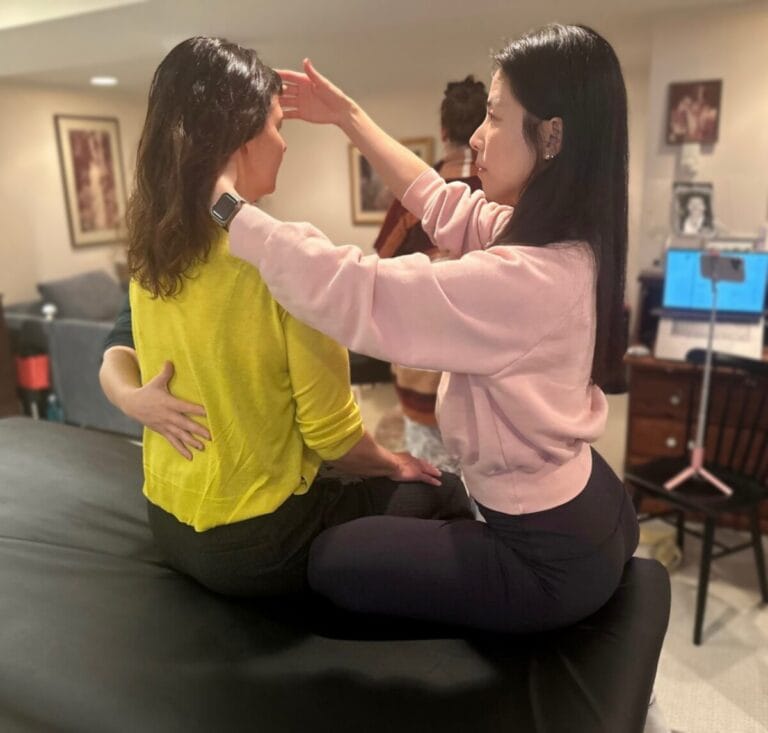
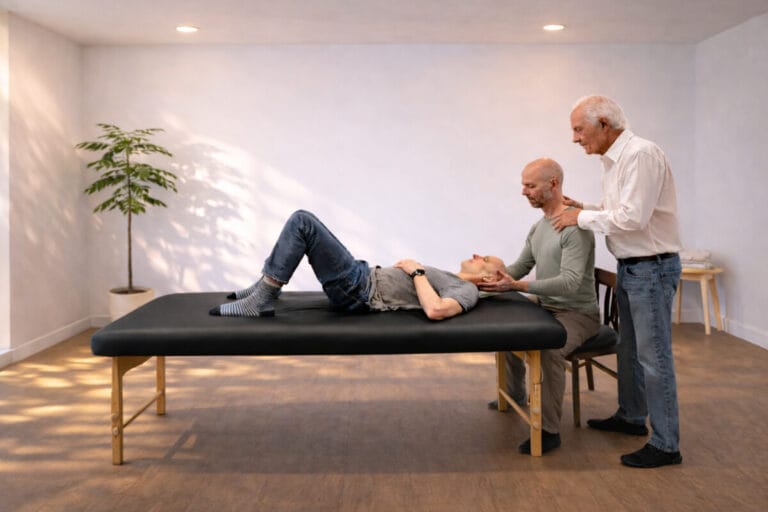
If you see your hand as an invitation rather than something that you’re making happen, you invite them to participate in what’s actually going on within them, moment by moment.
This reflects a central principle in the Alexander Technique. Touch is effective not because of what is done, but because of how it is offered. When it functions as an invitation, the organism is given the possibility to respond, and in that response, coordination can emerge.
2. Core Learnings from This Class
Core Concepts
- Inspansion can be understood as an inward organizing movement rather than a technique.
It reflects a shift of attention into the organism, where coordination is allowed to reorganize from within rather than being directed from the outside. - Touch functions as an invitation rather than a correction.
When contact is offered without forcing an outcome, the organism is given the possibility to respond rather than comply. - Habit operates at the surface, while organization arises from depth.
The distinction between the wave and the ocean helps clarify the difference between reacting from patterns and allowing deeper coordination. - The organism does not need to be fixed, but can be observed more clearly.
As interference lessens, the system begins to respond in a more integrated way. - Expansion may appear as a consequence of deeper organization.
When inward coordination develops, outward lengthening becomes evident without being pursued directly.
Five Key Messages
- Change may occur as interference begins to lessen.
- The way attention is placed influences coordination.
- Touch can invite response rather than direct it.
- What is felt is not always an accurate reflection of what is happening.
- Working from depth can alter the experience of the whole.
Essential Terms
- Inspansion
An inward movement of attention through which the organism may organize itself from within. - Invitation
A quality of contact that allows participation rather than imposing change. - Wave and Ocean
A way of distinguishing between habitual surface activity and the deeper field of organization within the organism. - Designed to Lengthen
The understanding that the organism has an inherent capacity to lengthen without being forced. - Direction
A non-forceful way of giving guidance that supports organization rather than controlling it.
3. Tommy’s Insights
In Tommy’s words during class, there are not only the core principles of the Alexander Technique, but also practical wisdom that can be applied directly to daily life. His words go beyond simple advice about movement and prompt us to deeply consider how we choose to exist.1. “That’s one way. If I’m on the nape, this is a little hard to do because it’s here, but if I’m on the AO joint—I mean the seven cervical—I’m getting inspansion and expansion at the same time. This gives me inspansion and expansion at the same moment.”
→ This reveals that coordination is not directional but relational, where the organism organizes itself inwardly and outwardly at the same time.
2. “When you bring length or expansion around the neck, around the cervical region and the first thoracic, you immediately feel that movement going down into the coccyx, allowing the head to move away from the body.”
→ Lengthening is not local but systemic, as the organism redistributes itself through an integrated field of support.
3. “If you see your hand as an invitation rather than something that you’re making happen, you invite them to participate in what’s actually going on within them, moment by moment. So there is just enough pressure to cause the tissue to lengthen or respond.”
→ Touch becomes effective only when it relinquishes control and enters into a participatory relationship with the organism.
4. “Now that does cause the muscle to lengthen—straight out of Frank Jones. If you wanted to lengthen more, there is a slight expansion that goes on, because you are moving into the ocean and not the wave. The first thing you did was move into a person’s use—their way, their habit—that is the first thing you do. But once you get past that, you are in the ocean, and that is inward—just you going into the subatomic earth, into space. If you just work for five minutes and think about that, it is going to change her.”
→ Real change occurs when attention shifts from habitual use to the deeper organizing field that underlies all movement.
5. “You are creating both inspansion and expansion with your hands. One, two, three creates the process where inspansion deepens and expansion becomes evident.”
→ Expansion is not produced directly but emerges as the observable consequence of deeper internal organization.
6. “You are knocking on the door very gently. You are going to get just enough pressure to stimulate length. It is an invitation. You are inviting her to participate in what is going on within her, moment by moment. And as you feel her respond, you go deeper. You go deeper into the tissue and give a direction. And the direction is this: one, two, three—that is an inspansion.”
→ Direction functions as an internal invitation, allowing the organism to respond rather than be directed or controlled.
7. “It is not going to lengthen the way Tommy thinks it should lengthen. It is going to lengthen the way Tommy knows it is designed to lengthen. And so that is what it is going to do. To lengthen—that is what we teach. That is what we teach. And then when you do that, I know that I have communicated, and then I get a little bit more. That is inspansion. I have already gone out into the habit, into the wave, and now I am in the ocean.”
→ The work rests on trusting the organism’s inherent design, rather than imposing external ideas of correction or improvement.
8. “You are being taken in all directions at once. But there is a verticality to us. There is a verticality, if you look at it in terms of habit, in that we create habitual patterns of behavior as we create our sense of who we believe we are.”
→ Verticality reflects integrated self-use, where physical organization and identity emerge as one unified, ongoing process.
4. Practical Tips for Everyday Life
What’s the Goal?
You are not trying to improve yourself. You are learning to stop interfering.
When that begins to happen, a different kind of organization becomes possible. Through Inspansion, attention moves inward, and coordination begins to emerge rather than being forced.
How to Practice
- When you are about to move
Pause for a moment and notice the impulse before acting. Stay with it briefly. Then allow the movement to happen, without trying to make it better. - When you make contact
Let your hands be an invitation, not a correction. Use just enough pressure to receive a response, and notice how the whole body begins to organize. - When you sit or stand
Do not try to fix your posture. Let your attention move inward and wait. Allow the organization to appear instead of creating it.
What You’ll Notice
Movement begins to feel easier and less forced. There is more connection through the body, and less sense of control. Over time, what changes most is not what you do, but how you are with yourself while you are doing it.
5. Closing the Class
Key Takeaways
- You are not trying to expand. You are allowing organization to occur.
- Touch becomes effective when it is an invitation, not a correction.
- The difference between the wave and the ocean determines how you organize.
- The organism is already designed to lengthen.
Core Insights
The work is not about changing yourself from the outside. It is about recognizing how you are organizing yourself from within. As attention moves inward through Inspansion, the organism begins to respond differently.
Change does not come from what you do. It comes from where you are coming from.
A Final Invitation
Stay with yourself before you act. Notice the impulse, and do not rush to follow it. Allow the movement to come from that awareness.
Let yourself be taken from the wave into the ocean.
6. One Key Practice
Before you move, stop.
Let the impulse be there without following it.
Do not decide what to do next.
Stay with yourself for a moment.
Then allow the movement to happen.
7. Three Questions to Ask Yourself
- Can I stay with the impulse without acting on it?
- Am I trying to make something happen, or can I let it appear?
- Am I moving from the surface, or from something deeper?
8. For Those Who Wish to Learn More
Recommended Books
Body Awareness in Action – Frank Pierce Jones
This book offers one of the clearest explanations of how habitual interference affects coordination and how the organism functions as an integrated whole. Rather than focusing on correction, it shows how change becomes possible when habitual responses are no longer reinforced.
While it does not use the term Inspansion, it clarifies the underlying process—how inward attention and reduced interference allow the organism to reorganize itself. In this way, it provides a conceptual bridge between Alexander Technique principles and the experiential work demonstrated in this class.
9. Next Class Sneak Peek
There is a point where touch is no longer about the body. It becomes something you cannot make happen.
What if real change begins when you stop doing, and simply meet the other as being?
In Class 107, we’ll explore: Being-to-Being Connection, where touch is no longer something you do, but something you are in.
Official Website of Tommy Thompson
www.easeofbeing.com
This is the official website personally managed by Tommy Thompson, offering a wide range of resources and programs to deepen your understanding and practice of the Alexander Technique:
- Private session reservations and inquiries
- Workshop and seminar schedules
- Overview of international teacher training programs
- Essays and articles on the Alexander Technique
10. Join the Alexander Technique Journey
Did this class leave a small resonance within you? Feel free to quietly hold it in your heart or share it in just a sentence or two. The comments are always open. Your one simple word may leave a gentle ripple in this ongoing journey.The journey of Resonance Flow continues across social media as well. Let’s continue this journey together.
 YouTube
 Instagram
 Threads
 Facebook