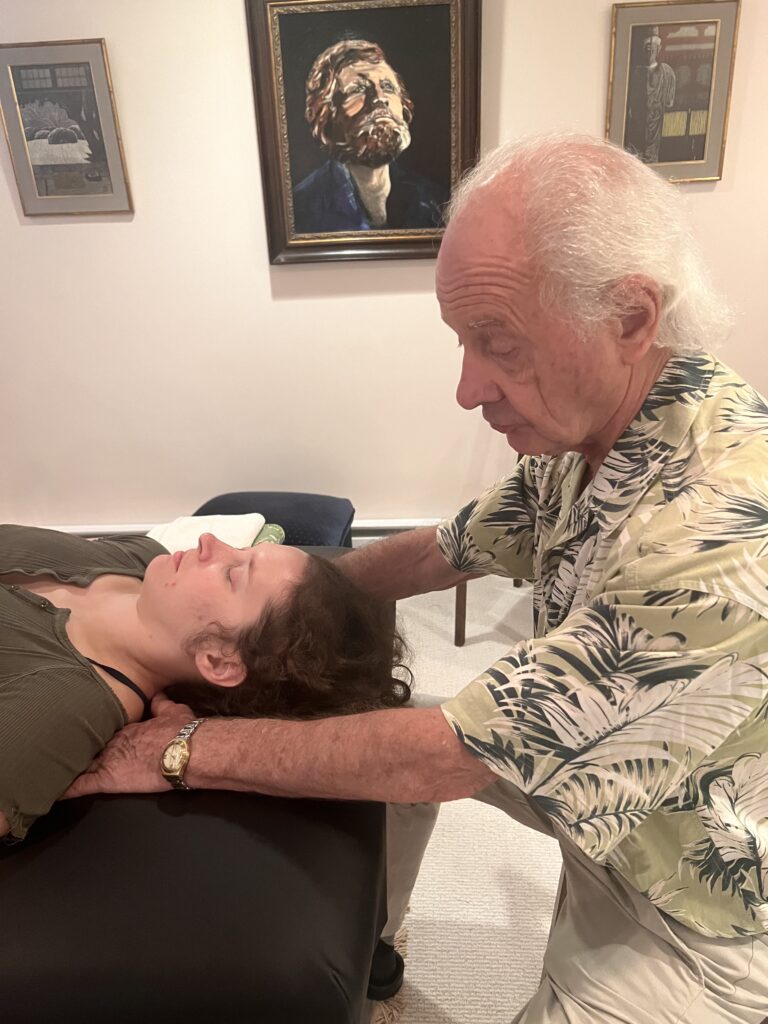
Awareness Before Habit: What Actually Changes in an Alexander Technique Class | Tommy Thompson Class 91

❝ What if the problem isn’t that you don’t know what to do, but that you’re already doing too much before awareness has a chance to enter? ❞
What if the effort you bring to improve your movement is the very thing that keeps you stuck? In the Alexander Technique, change doesn’t begin by adding something new. It begins when you notice what you’re already doing before you’ve had time to sense it. This class didn’t open with corrections or goals. It opened with a pause, long enough for awareness to enter before habit rushed in to take over.
On November 6, 2025, in Boston, Massachusetts, USA, Tommy Thompson led a class in the Alexander Technique teacher training course, and quickly challenged a familiar assumption: you can’t work with a body without working with the person who lives through it. What we call “the body” is never just mechanics. It’s identity in motion, history expressed as use. Without awareness, patterns repeat while we call it progress.
Before direction, before inhibition, before touch, Tommy returned the class to a quieter question: are you awake inside what you’re doing right now? Not fixing it. Not thinking about it. Just sensing it. Because once awareness enters, effort no longer has to lead, and movement begins to reorganize itself from a very different place.
Key Objectives of the Class:
- To show how awareness, rather than effort or correction, initiates real change
- To recognize how use reveals identity and personal narrative
- To experience touch as perceptual listening instead of mechanical doing
This blog series is based on Tommy Thompson’s Alexander Technique classes. Each post follows the flow and insights of the class to expand both self-awareness and practical consciousness applicable to everyday life.
New here?
If you’re new to the Alexander Technique, you can start with the resources below.
Alexander Technique Class Flow at a Glance
1. The Opening Question
❝ When you place your hands on someone, are you working with a body—or with a person living through that body? ❞
Most trainees think the work begins with technique. Where to place the hands. What to release. What to fix. This class asked us to pause before all of that. What are you actually meeting before you try to change anything?
In the Alexander Technique, awareness is not something you add later. It’s where the work begins. The moment awareness enters, the quality of touch, timing, and listening changes. If you think you’re working on a body, you default to fixing. If you recognize a person living through that body, the work reorganizes itself.
Tommy’s Word
“When you’re working with someone, it’s impossible just to work with their body, because they’re living through that body with an awareness of what they’re sensing.”
➤ This single statement reframes the entire class. The Alexander Technique is not mechanical work applied to a body, but perceptual work entered through awareness, where use and identity are already present.
2. Core Learnings from This Class
Core Concepts
Awareness is the entry point.
The class made it clear that change does not begin with correction. It begins the moment awareness is present. Without awareness, direction becomes effort and touch becomes manipulation.
Use reveals identity before intention.
How someone moves, rests, or resists is already telling a story. Use expresses personal narrative long before a trainee decides to “do” anything differently.
Inhibition creates choice.
Pausing is not passive. It’s an active moment where habit loosens and a different response becomes possible.
Five Key Messages
You can’t work with a body without meeting the person. The moment you forget this, the work turns mechanical.
Awareness changes everything before technique does. Awareness reorganizes coordination without force.
Habit isn’t the problem—unseen habit is.
When awareness arrives, habit no longer runs the show.
Cooperation matters more than compliance.
Change depends on a shared willingness to pause and listen.
What you take into life matters more than what happens in class. The work only proves itself in daily activity.
Essential Terms
- Awareness
What is happening while it is happening, before you try to change it.
In this class, awareness is not a background state but the entry point. When awareness is present, use reorganizes without force. - Use
How you are organizing yourself in activity, moment by moment.
Use reveals identity in motion. It shows personal narrative long before conscious intention intervenes. - Inhibition
The moment you do not proceed automatically.
Inhibition creates space. It is the lived pause where habit loosens and a different response becomes possible. - Personal Narrative
The story you are committed to about who you are.
This narrative sustains habitual use. Change is resisted not by the body, but by attachment to identity. - Withholding Definition
Not defining yourself in the moment you usually would.
As Tommy described it, this is the inhibitive moment taken further—when awareness remains open and identity is temporarily set aside.
3. Tommy’s Insights
In Tommy’s words during class, there are not only the core principles of the Alexander Technique, but also practical wisdom that can be applied directly to daily life. His words go beyond simple advice about movement and prompt us to deeply consider how we choose to exist.1. When you’re working with someone, it’s impossible just to work with their body, because they’re living through that body with an awareness of what they’re sensing when you work with them. If they’re new to it, it’s brand new.
➤ This reflects the Alexander understanding of psycho-physical unity, where use is inseparable from awareness and the body cannot be approached as an object.
2. I can just focus on the body, and it’s hard for me to do that now, but I’ll try to just focus on the body—but it’s impossible. I really can’t do it. Because I’m sensing the presence of the person’s own being, I’m sensing the presence of their attention. And I’m touching their attention. And it’s the attention I’m interested in right there. Because with their attention, the person becomes present in their awareness of what’s going on.
➤ Here, attention replaces mechanical intention, pointing away from end-gaining and toward inhibition and conscious direction as the basis for change.
3. When we work with each other, you’re obviously touching their body, which is reflecting their quality of use. And the use is reflecting their commitment to their personal identity—personal narrative. And they go hand in hand, so to speak.
➤ This reveals how habitual use is organized by self-concept, showing that coordination expresses identity long before conscious correction occurs.
4. And there are moments when they’re present with you and there are moments when they’re not. And just observe what you’re experiencing. Because what you really want to do is work with the person. And there’s a reasonable degree of cooperation and sometimes there’s not. It’s not their fault. It’s just their commitment to, I think, personal narrative. It’s that that gets in the way of change. And some things will happen in your life that just necessitate change and you end up changing.
➤ What appears as resistance is often the persistence of habitual use, sustained by narrative until circumstances interrupt the familiar means-whereby.
5. That’s giving you a strong—what I mean, if it’s a good lesson—which is a cooperation between you and the teacher. How much can you really, truly let go of holding on to patterns of behavior that are meaningful to you, even though they may not be doing you any good, but are still meaningful?
➤ A good lesson depends on shared direction, asking the student to suspend attachment to meaningful habits rather than attempt to fix outcomes.
6. But you’re gonna go right back into your life. So what do you take with you out of the moments you spend with your teacher, a guide? What do you take with you? Think for a moment.
➤ This marks the essential transition from the teaching situation to daily activity, where the work is revealed through ongoing use rather than performance.
7. That’s the point. Every now and then it’s good to just go, “Have I progressed? Have I acknowledged more depth in myself and given myself more room for a choice—or choiceless awareness? Not just choice, but choiceless awareness.” So it’s the awareness that leads you to make a different choice.
➤ Choiceless awareness describes inhibition as lived experience, where the pause precedes action and allows a different use to emerge.
8. Where there is life, there is touch. Where there is movement, there’s no way you can touch a person without feeling movement. In the absence of movement, you just won’t have that. So you’re beginning to understand touch in a much larger framework than most people ever perceive.
➤ Touch is framed as perceptual listening, engaging primary movement through felt movement rather than imposed mechanical contact.
4. Practical Tips for Everyday Life
What’s the Goal?
The goal isn’t to perform the Alexander Technique correctly in daily life. It’s to carry awareness with you before habit takes over. As Tommy emphasized in class, what matters isn’t repeating what happened in the lesson, but recognizing yourself in action as life unfolds. The aim is simple and demanding: stay awake inside what you’re doing.
How to Practice
1. Pause before a familiar movement.
Standing up, picking up your phone, reaching for a cup. Before you move, don’t fix anything. Pause just long enough to notice how you’re organizing yourself. Just sense it.
2. Let the movement happen without forcing an outcome.
After the pause, allow the movement to proceed. Don’t guide it. Let inhibition do its quiet work. This is where coordination begins to change without effort.
3. Notice your attention with others.
When you speak, listen, or touch, sense whether your attention is ahead of the moment or actually present. As Tommy reminded the class, awareness doesn’t require extra time. It asks only that you stop spending effort too soon.
What You’ll Notice
At first, very little. That matters. Over time, movement may feel less driven and more available. Coordination adjusts without instruction, and situations that once triggered tension become more negotiable. This is how the Alexander Technique appears in daily life—not as a technique you apply, but as a change in how you meet each moment.
What carries forward isn’t an exercise or posture. It’s the capacity to pause, sense, and respond differently. That’s how this work enters life and stays there.
5. Closing the Class
Key Takeaways
As the class came to a close, Tommy didn’t summarize techniques or list improvements. He returned everyone to what had been present all along. Change doesn’t come from trying harder. It comes from noticing sooner. The work lives in the moment before habit takes over, where awareness has time to enter and quietly reorganize use.
Tommy said it plainly during class:
“You’re going to go right back into your life.”
That wasn’t a warning. It was the point. Whatever value the Alexander Technique has must survive outside the class, inside ordinary moments where no one is watching.
Core Insights
As Tommy often reminded the trainees, what interferes with change isn’t lack of information, but commitment to personal narrative. We keep defining ourselves the same way and expect something different to happen. Withholding definition creates space, and in that space, inhibition becomes lived rather than theoretical.
Awareness isn’t passive. It’s active without effort. It allows direction to arise without force and cooperation to replace compliance. When awareness is present, the work shifts from fixing to relationship—with yourself, with others, and with what’s actually happening.
A Final Invitation
The class didn’t end with answers. It ended with an invitation. Take less with you than you think you need. Take the pause. Take the willingness not to define yourself so quickly. Take awareness into the moments where habit usually decides for you.
That’s where this work continues. Not in the class itself, but in how you meet your life once you leave it.
6. One Key Practice
The most important practice from this class is simple, but not easy: pause before you define yourself. Before you decide what you’re feeling, label what’s happening, or move to fix, correct, or improve.
Tommy kept returning to this moment in class, not as an idea but as lived experience. When you withhold definition, even briefly, awareness has room to enter, and use begins to change without effort.
You don’t need to add anything or remember instructions. Just pause long enough to sense yourself before habit speaks.
7. Three Questions to Ask Yourself
These questions aren’t for analysis or self-correction. Tommy used them to bring trainees back into the present—into attention, into use, into what’s actually happening.
- What am I doing right now before I try to change anything?
This interrupts habit at its starting point and lets awareness arrive first. - Where is my attention—here, or already ahead of the moment?
Notice whether you’re living in anticipation rather than experience. - Can I pause without defining this moment?
This is inhibition in practice: not fixing, not withdrawing, simply allowing the moment to stay open.
These questions aren’t meant to be answered once. They’re meant to be returned to, briefly, throughout the day. Each return brings you back to awareness—where the work continues.
8. For Those Who Wish to Learn More
Recommended Book
Thinking Aloud: Talks on Teaching the Alexander Technique – Walter Carrington
This book mirrors the rhythm of this class: not techniques, but the teaching moment where time becomes less invasive, inhibition becomes practical, and you stop rushing to define yourself. Carrington writes in a voice trainees can use immediately—how to allow a pause, resist end-gaining, and let awareness change use without force.
Read it slowly, as you would work in class. Notice where you hurry or decide too soon, and practice withholding definition long enough for a different response to appear. If this class made anything clear, it’s that the Alexander Technique becomes real only in ordinary life—and this book keeps returning you to that point.
Official Website of Tommy Thompson
www.easeofbeing.com
This is the official website personally managed by Tommy Thompson, offering a wide range of resources and programs to deepen your understanding and practice of the Alexander Technique:
- Private session reservations and inquiries
- Workshop and seminar schedules
- Overview of international teacher training programs
- Essays and articles on the Alexander Technique
9. Next Class Sneak Peek
In Class 92, we begin with a simple question:
What are you listening to before you move?
This class introduces Relational Listening as the starting point of change—not as a technique, but as responsiveness to what is already happening. Instead of correcting habit, you learn to listen to stillness, hesitation, and response.
From that listening, direction and choice emerge naturally, through relationship rather than control.
Class 92 lays the ground for understanding why change begins with listening.
10. Join the Alexander Technique Journey
Did this class leave a small resonance within you? Feel free to quietly hold it in your heart or share it in just a sentence or two. The comments are always open. Your one simple word may leave a gentle ripple in this ongoing journey.The journey of Resonance Flow continues across social media as well. Let’s continue this journey together.
 YouTube
 Instagram
 Threads
 Facebook