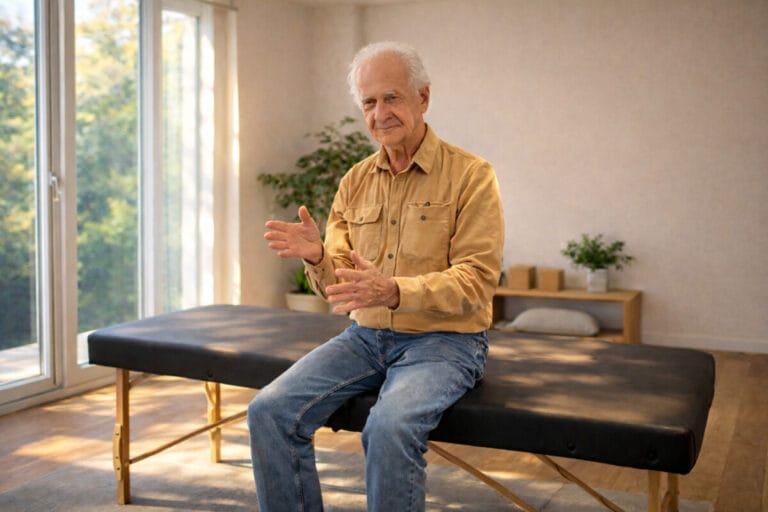
Moment of Choice: The Hidden Second Where Your Habit Takes Over | Tommy Thompson Class 78
❝ Where does your life actually change—at the movement itself, or in the instant before it? ❞
There is a silent threshold inside every action: a fleeting instant when the nervous system hesitates between repeating the familiar or opening into something new. Most people never sense it. Yet this subtle pause is where the deepest transformations of the Alexander Technique take place.
On October 8, 2025, in Boston, Massachusetts, USA, Tommy Thompson invited us to step into this nearly invisible space. He asked us to feel where we were in thought, emotion, perception, and physical presence—because without knowing where we are, we cannot know what is choosing for us. In this class, Tommy led us into the moment of choice, the quiet instant in which the organism whispers a possibility: You do not have to do what you usually do.
“Stop them at the moment you want them to be able to stop themselves.”
This line shaped the entire class. His hands, his timing, his questions—all were oriented toward helping a person encounter the exact moment where habit prepares to act. When awareness enters this space, a new coordination becomes possible. This is where wellness begins—not as correction or self-improvement, but as a restoration of agency and presence.
Key Objectives of the Class:
- To guide students into the instant before habitual action forms.
- To clarify the intention behind touch, listening, and direction.
- To reveal the space where one can choose not to do the usual pattern.
- To explore how the moment of choice transforms activity in life.
This blog series is based on Tommy Thompson’s Alexander Technique classes. Each post follows the flow and insights of the class to expand both self-awareness and practical consciousness applicable to everyday life.
New here?
If you’re new to the Alexander Technique, you can start with the resources below.
Alexander Technique Class Flow at a Glance

1. The Opening Question
❝ Where is the exact instant when you commit to your habit—and can you meet it differently? ❞
This question goes straight to the heart of the class. Before muscles tighten or old strategies take over, there is a split-second when the nervous system organizes for action. In that instant, the teacher helps the student discover that they do not have to follow the familiar pattern. This is the moment of choice, where freedom is born.
Tommy’s Word
“Stop them at the moment you want them to be able to stop themselves.”
Tommy’s insight places responsibility back into the student’s system. A teacher does not fix or adjust; they reveal the timing of the habitual response and create the conditions for a different coordination to emerge. This is the Alexander Technique at its most transformative.
2. Core Learnings from This Class
In this moment from Tommy Thompson’s class, the focus shifts from trying harder to staying connected. Rather than forcing a better result, the work returns to the quality of connection and responsiveness.
Watch how letting go of effort allows a more natural and integrated response to emerge.
Are You Trying Too Hard? You’re Losing the Connection | Alexander Technique
Class 78 · October 8, 2025 · Boston, MA
Core Concepts
- Self-location opens the field of work
The teacher cannot guide someone without knowing where they are in thought, feeling, perception, and physical presence. - Every touch must have a reason
“Why am I here?” “Why is my hand here?”
The clarity of intention shapes timing, pressure, direction, and connection. - The moment of choice creates change
Habit forms just before movement. Catching this instant gives access to a new coordination. - Not doing restores freedom
Guiding someone to the point where they can stop themselves interrupts the automatic past and opens space for something new. - Withholding definition allows reorganization
Pausing the impulse to label, react, or anticipate lets the organism redefine the self in the present moment.
Five Key Messages
- Change begins before the movement.
- A teacher reveals timing, not solutions.
- The hands must follow intention, not habit.
- You have the right not to do what you usually do.
- Stillness creates the moment of choice.
Essential Terms
- Moment of Choice — The instant before habit takes hold; the space where a new option becomes available.
- Reason for the Hand — The intentional placement and purpose behind each contact in the Alexander Technique.
- Not Doing — The conscious capacity to interrupt automatic patterns and choose a different direction.
- Withholding Definition — Allowing the nervous system to redefine experience without imposing habitual meaning.
- Self-Location — Sensing where one is internally and externally before initiating interaction or touch.
3. Tommy’s Insights
In Tommy’s words during class, there are not only the core principles of the Alexander Technique, but also practical wisdom that can be applied directly to daily life. His words go beyond simple advice about movement and prompt us to deeply consider how we choose to exist.“First year teaching, my teacher — you. One thing you can think about as you’re working is just, where am I relative to what I’m trying to accomplish? Where am I in my thoughts, my feelings, my perceptions, and my physicality? Where am I? So you immediately establish a relationship.”
➤ Awareness becomes orientation; by locating oneself in thought, feeling, perception, and physicality, the teacher cultivates the primary condition for conscious coordination.
“Just remind yourself, as you work and while you’re there, What am I trying to accomplish? You don’t have to get perfection.”
➤ He emphasizes direction over outcome, honoring the Alexander principle that change arises through non-striving, not through the pursuit of ideal form.
“You’re not giving opinions; you’re giving them the experience of what it’s like to bring the consequences of this work into a moment in life. And we already do that, and then we have a whole bunch.”
➤ Teaching becomes a lived encounter: the student senses the consequences of new coordination in real time, discovering meaning through experience rather than instruction.
“I think the only thing I would do is have them explore the possibilities in an activity, and when we get off the table, explore the possibilities. Because I don’t know any more than they know. They might be right, and they might not.”
➤ Exploration replaces correction; activity becomes the laboratory where both teacher and student discover what the system reveals when interference drops away.
“Whenever you have your hand as a teacher, there wants to be a reason, even if you’re drawn to a place and didn’t consciously make the choice. You’re looking for the reason. Why did I go there? Sometimes you know why you go there, and sometimes you just go. But then you ask yourself, What’s the reason for being here? What’s the reason for being here right now?”
➤ Hands serve as relational instruments, expressing intention and clarity; they inquire rather than impose, uncovering the organism’s habitual strategies with precision and care.
“What can you get from freeing right in here? And what can you get from freeing right in here? And am I free enough? It’s more of the same thing: Why is my hand here? Why did I put it here? Is there a reason for it again? And in that reason, am I giving too much pressure? Am I not giving just enough?”
➤ Freedom is not muscular release but the teacher’s capacity to remain expansive and available while touching patterns that often invite compression.
“You connect by listening — really listening to what they’re saying. And there’s a desire to communicate—always—as best you can, what you believe in, what you teach.”
➤ Relational presence lies at the core of Tommy’s teaching: deep listening becomes an embodied dialogue that aligns teacher, student, and the field of attention.
“You’re guiding a person toward the ability to not do what they usually do. This is the moment when a new choice becomes possible.”
➤ In this pause before action, the nervous system reorganizes, allowing a fresh coordination to emerge beyond habit.

4. Practical Tips for Everyday Life
What’s the Goal?
To meet the instant before your habit takes over—the quiet threshold where the body prepares to act. In that pause, you remember that you have the right not to do what you usually do.
How to Practice
- Before You Move
Catch the moment just before the foot lifts or the hand reaches. Stay for one breath.
Withhold defining the movement and let it appear instead of being pushed. - As You Sit or Stand
Notice when your system prepares to tighten or sink.
Pause there. Let the chair or the floor receive you without fixing anything. - When Pressure Rises
Shoulders lift, breath narrows—habit is coming.
Stop for a second. Allow the system to reorganize without following the impulse. - In Conversation
Before replying, feel the pull to answer from habit.
Pause. Listen first—really listen.
What You’ll Notice
- Less urgency and effort
- Breath that expands naturally
- Movements that feel discovered rather than driven
- Emotional responses with more choice
- A grounded sense of wellness woven through daily life
5. Closing the Class
Key Takeaways
- Change happens before movement—at the instant just before habit commits.
- A teacher does not deliver solutions; they reveal timing.
- Habit begins in preparation, not in the action itself.
- The capacity to pause restores the possibility of choice.
Core Insights
- “Stop them at the moment you want them to be able to stop themselves.”
This single line distills Tommy’s teaching: guidance is not correction but illumination—helping a student sense the timing where freedom becomes available. - The body is always preparing for what comes next. When you learn to notice that preparation—to pause, to listen—you begin acting from presence instead of from the past.
- Freedom does not come from doing something better. It arises the moment you discover the moment of choice—the quiet instant where something new can begin.
A Final Invitation
This class was not about a method but a way of living.
In every movement, breath, word, or relationship, notice the instant just before the pattern takes over.
In that small, quiet space, you are free to choose differently—every single time.
6. One Key Practice
If you practice nothing else from this class, practice this:
Pause at the exact instant before your habit commits.
Just one second. One breath. One quiet recognition of what your system is preparing to do.
Do not improve it. Do not correct it.
Simply stay—withholding definition—long enough to sense that you have the right not to follow the familiar pattern.
Let the movement, the breath, or the response wait for you. When the system realizes you are not rushing toward the old decision, new coordination begins on its own.
Ten seconds a day is enough.
7. Three Questions to Ask Yourself
- “Where am I right now—in my thinking, in my feeling, in my body?”
Before any action, locate yourself. Let the answer come quietly. - “What is my system preparing to do in this next moment?”
Sense the organization before movement. Notice the plan your habit is already making. - “Do I have to do what I’m about to do?”
Stay with the question long enough to feel the moment of choice open.
8. For Those Who Wish to Learn More
Recommended Book
Touching Presence – Tommy Thompson
A clear and intimate exploration of the timing, presence, and relational awareness at the heart of this class. Tommy shows how touch is not a technique but a way of listening—how a person reorganizes in the quiet instant before habit commits itself. His writing brings you directly into the moment of choice, revealing how new coordination emerges when you withhold defining yourself and let awareness lead the way.
Official Website of Tommy Thompson
www.easeofbeing.com
This is the official website personally managed by Tommy Thompson, offering a wide range of resources and programs to deepen your understanding and practice of the Alexander Technique:
- Private session reservations and inquiries
- Workshop and seminar schedules
- Overview of international teacher training programs
- Essays and articles on the Alexander Technique
9. Next Class Sneak Peek
The next class turns toward a question that goes even deeper into the Alexander work:
What enters first — the movement, or the story you’ve been living inside?
In Class 79, Tommy shifts the focus to the subtle but powerful influence of Personal Narrative—the internal identity that steps into the moment before you’re even aware of moving. This upcoming class explores how narrative quietly shapes coordination, how it fuses with use inside activity, and how recognizing it can transform the very beginning of movement.
In Class 79, we’ll explore:
- How Personal Narrative takes hold before action,
- How identity and use blend into a single pattern,
- And how seeing the story can open the door to a new way of moving.
10. Join the Alexander Technique Journey
Did this class leave a small resonance within you? Feel free to quietly hold it in your heart or share it in just a sentence or two. The comments are always open. Your one simple word may leave a gentle ripple in this ongoing journey.The journey of Resonance Flow continues across social media as well. Let’s continue this journey together.
 YouTube
 Instagram
 Threads
 Facebook