Integrated Movement and Embodied Neutrality | Tommy Thompson Class 16
❝ What if you’ve been trying to relax the wrong way all along? ❞
Maybe you’ve been trying to “release” your shoulders. Loosen your jaw. Drop your weight. But real relaxation—true ease—doesn’t come from effort or even from letting go. It comes from integration.
On October 22, 2024, in Boston, Massachusetts, USA, Tommy Thompson led a profound class in the Alexander Technique teacher training course. His focus wasn’t on posture correction or physical control. It was on something far deeper: Integrated Movement—the kind that doesn’t begin with doing, but with remembering.
This was a class about allowing. About letting your body re-discover what it already knows—how to coordinate, how to balance, how to move without forcing. As Tommy put it, “You don’t turn a muscle off. You integrate it.” And when you do, you don’t just move differently. You relate differently—to your breath, your thoughts, your history, even your future.
Through gentle guidance, perceptive touch, and vivid metaphor, Tommy led trainees into a space where relaxation was not the goal, but the result—a natural consequence of a system returned to wholeness.
Key Objectives of the Class:
- To explore Integrated Movement as the ground for natural poise, breath, and presence
- To experience neutrality not as absence, but as quiet readiness—a space of support
- To understand why relaxation is the result of inner coordination, not the act of letting go
- To reconnect with movement as something inherently intelligent, arising from attention rather than force
This blog series is based on Tommy Thompson’s Alexander Technique classes. Each post follows the flow and insights of the class to expand both self-awareness and practical consciousness applicable to everyday life.
New here?
If you’re new to the Alexander Technique, you can start with the resources below.
Alexander Technique Class Flow at a Glance

1. The Opening Question
❝ Can you feel what’s already moving before you move? ❞
This is how Tommy began the class—not with instruction, but with perception. He didn’t ask trainees to do anything. He asked them to notice. And in that simple shift, everything began to change.
Before movement becomes visible, something subtle is already in motion. Breath. Thought. Tone. The quiet way the body organizes itself beneath conscious control. Tommy’s question pointed us there—to the space just before action, the very seed of Integrated Movement in the Alexander Technique.
In this work, that space is not a pause. It’s a possibility. A place of responsiveness, not reaction. A moment where the body isn’t being told what to do, but is being allowed to coordinate from within.
Tommy said,
“We don’t begin with position. We begin with attention.”
And when that attention includes the neck, the breath, the spine, and the intention behind it all—movement doesn’t need to be fixed. It begins already integrated.
This question wasn’t meant to be answered with the mind. It was meant to be lived through sensation.
2. Core Learnings from This Class
Core Concepts
- Integrated Movement is remembering, not doing
Tommy often said, “The body doesn’t need fixing. It needs reminding.” Movement isn’t something you produce—it’s something that emerges when the system is no longer at war with itself. In the Alexander Technique, integration is structural, neural, and perceptual. It’s about coming back to what the body already knows. - Neutrality is a lived space, not a concept
Tommy compared it to being at a red light: “You’re not holding. You’re waiting, knowing green is coming.” This kind of neutral readiness allows the body to respond—not with habit, but with possibility. It’s not a pause. It’s a quiet invitation. - The neck leads the body—not by force, but by freedom
“If the neck is compressed, there is no integration.” Tommy emphasized that freedom in the platysma, Sternocleidomastoid muscle(SCM), and trapezius muscles is foundational. The neck is not just a passage—it’s a gateway. When it’s free, the whole body finds its way into balance. - Relaxation is the byproduct of integration—not its technique
“You don’t turn a muscle off. You integrate muscle.” This wasn’t a metaphor. Tommy meant it literally. True relaxation doesn’t come from effort or release—it arises when the system is organized enough to stop gripping. - We move in the direction of our focus—so watch where you’re looking from
“Let it come to you.” Movement, in the Alexander Technique, begins not with action, but with orientation. Attention isn’t neutral. It organizes. And so, movement begins with how and where you’re attending.
Five Key Messages
- Start where you are, not where you’re trying to get.
→ Real change in the Alexander Technique begins by noticing, not correcting. - You don’t release a muscle. You return it to relationship.
→ Relaxation isn’t the absence of effort—it’s what happens when support is restored. - Tension isn’t the problem. Habitual support is.
→ Tommy showed us that we’re not holding on—we’re often just not being held up. - Neutrality is support, not suspension.
→ It’s not a blank space. It’s a responsive one. - We move in the direction of attention—so attend to the space before the movement.
→ Before you act, there’s a moment. That’s where freedom lives.
Essential Terms
- Integrated Movement
Movement that arises when structural, sensory, and perceptual systems are in conversation—not command. It’s movement without interference. - Primary Movement
The natural, dynamic relationship between the head, neck, and torso—this is not something to manage, but something to remember.
Tommy often emphasized that movement begins before motion, and Primary Movement reflects the body’s innate intelligence when interference is absent. It’s not about getting into the right position. It’s about allowing the system to organize itself from a place of attention, not control.
As Tommy said: “It’s not control. It’s permission.” - Neutral Readiness
A poised, receptive state that replaces bracing or hesitation. Neither active nor passive—just available. - Platysma
A thin, expressive neck muscle Tommy described as “a wet cloth stuck to you.” When released, it often dissolves deeper emotional and physical tension patterns. - Fascial Sheath
A membrane that forms around patterns of contraction. In Tommy’s teaching, it symbolizes both literal constraint and emotional defense. - Primary Control
The natural relationship of head, neck, and torso that underpins the Alexander Technique. When honored—not managed—it organizes everything else. - Non-doing
Not doing nothing—but not adding anything either. Non-doing is a quality of presence that allows what already wants to move, to move—without interference, without command.
3. Tommy’s Insights
In Tommy’s words during class, there are not only the core principles of the Alexander Technique, but also practical wisdom that can be applied directly to daily life. His words go beyond simple advice about movement and prompt us to deeply consider how we choose to exist.“What we do is free the whole neuromuscular structure, allowing the fascia to experience being in complete support. So this is available to you, and it won’t last forever, but the memory of it will last. The experience of it lasts.”
Integration is not permanent, but the body remembers the experience deeply and structurally.
“Neutrality is also a state of integration. It is a state in which the nerves, muscles, skeleton, and fascia are in balance. This state is not just about supporting the body; it also supports breathing, the heart, and the limbic system. When this happens, there is no need to cling to familiar patterns or habitual ways of acting.”
True neutrality is a whole-system support, not stillness—it replaces habitual control with systemic readiness.
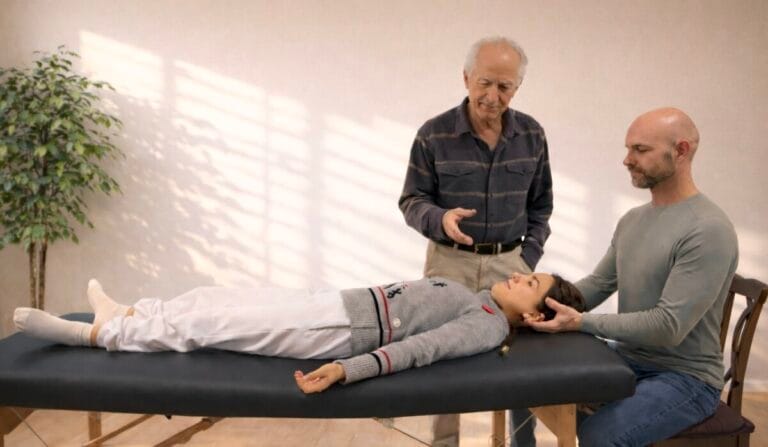
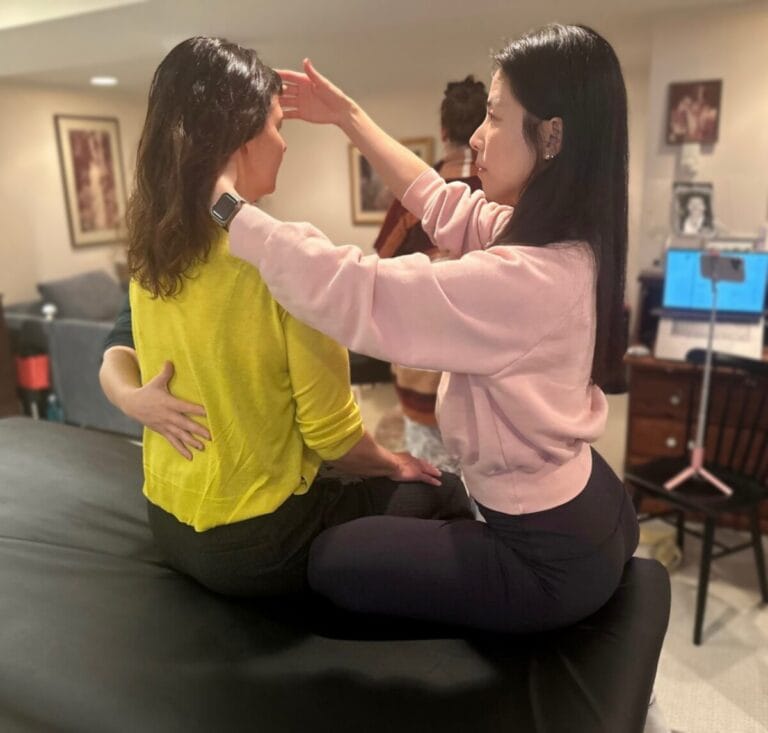
“What we can do is only act as a guide. By contacting a person in a specific way, we stimulate their muscle tissue and help it function as it was originally designed. In this way, the person no longer needs the behavior patterns they had unconsciously relied upon.”
The teacher does not fix; they awaken the body’s original design through informed contact.
“Relaxation is the byproduct of integration. That’s just what it is. Really, truly—when you get relaxed, you don’t turn a muscle off. You integrate muscle. You bring poise through integrated movement, which is always born from the occipital region, the cervical spine, and the cervical messengers.”
Relaxation happens not by switching off effort, but by reconnecting the system into unified movement.
“Until there is a deep enough release in the head and neck area, it’s hard to really feel much freedom anywhere else. Now, you can free the neck indirectly through the fingers, thumb, big toe, heel—whatever. But the neck has to be free. So when the neck is free, the rest of the body follows naturally. That’s why you start here.”
The neck is the gateway to total freedom; it initiates full-body release when given space.
“Eventually, all the work starts within yourself. As you get to know yourself better, you get closer to the depth of the work.”
True transformation begins not with external technique, but with internal awareness. The deeper your self-knowledge, the deeper the work becomes.
“We move in the direction of the focus, of our intention, inevitably and most of our attention, is this way of something, turning yourself around to face it. You can let it come to you.”
Where attention goes, the body follows—movement begins with orientation, not action.

4. Practical Tips for Everyday Life
Why Attention, Not Effort, Creates Integration in the Alexander Technique?
The goal of this class was not to teach you how to do something better—but to show you what happens when you stop doing what’s in the way.
In the Alexander Technique, true change begins when attention replaces effort, and the system is given space to return to balance. This is the foundation of Integrated Movement: movement that doesn’t come from force, but from support.
How to Practice Integrated Movement in Everyday Life
1. Lie Down and Let Support Find You
Set aside five minutes. Lie on your back, knees bent, on a firm surface. Feel the ground—not as something you’re pressing into, but something that’s already supporting you. Notice where effort shows up. Don’t fix it.
→ In Alexander Technique, letting the floor do the work reminds the body that support is always available.
2. See Without Reaching
Choose an object nearby. Soften your eyes. Let the object come to you visually, as Tommy often said, just as light enters the visual cortex.
→ This isn’t about focus—it’s about receiving. Let your body respond to what you see, rather than strain toward it.
3. Let the Neck Lead the Way
Before you stand, walk, or speak—pause.
Sense the space at the base of your skull. Is it compressed? Is your head pulled back or down? Let the neck be free to lengthen—not by doing, but by no longer holding.
→ When the neck is free, the entire body reorganizes. This is where Integrated Movement begins.
What You’ll Notice When You Stop Fixing
- Your breath deepens, without you controlling it.
- Movements become more coordinated and calm, even when complex.
- Small pauses in attention lead to big shifts in perception.
- Tension drops not by effort, but by withdrawing interference.
- The body feels smarter, more trustworthy—like it remembers something ancient.
5. Closing the Class
Key Takeaways
- Integrated Movement cannot be imposed from the outside; it must emerge from the release of habitual tension—especially in the neck.
- The Alexander Technique offers a way to experience structural freedom, not through effort but through recognition and relationship.
- Tommy often reminded us that movement reorganizes naturally when interference is removed, not when perfection is demanded.
Core Insights
As Tommy taught, the neck is a central integrative axis, not just anatomically, but perceptually and emotionally.
“The neck encompasses the sternocleidomastoid and trapezius, along with a whole bunch of internal muscles in the neck. It also includes the platysma, which is like a wet cloth just thrown up against you. If these muscles become tense, they form a sheath, a connective tissue sheath. So when you place your hands on this area, the platysma also releases.”
This fascia-like sheath doesn’t just limit movement—it blocks perception. So we don’t begin by trying to do it right. We begin by releasing what gets in the way of sensing.
Learning through the Alexander Technique isn’t about achieving, but about returning to honesty—holding both attention and softness, even when we feel stuck. Presence requires space, not pressure. And so, every true change begins by choosing to pay attention—before choosing to act.
A Final Invitation
Before you finish reading, take a moment. Place your hand near your neck or collarbone. Not to fix—just to feel.
Can you notice what’s already supporting you?
This is how Integrated Movement begins: not with mastery, but with noticing. Not by doing more, but by doing differently. And from that place—soft, aware, honest—let the next moment find you.
6. One Key Practice
What if your neck already knows the way?
Don’t try to fix it. Don’t try to feel the “right” thing. Just pause before you move, and let your awareness rest softly at the base of your skull. Touch there lightly—no pressure. Let the weight of your attention do the work. If you notice any pulling, any holding… allow less.
Try this: Let yourself come into sitting. Close your eyes, and simply feel the space behind your jaw. Can you allow it to soften—without doing anything?
Integrated Movement begins when you stop managing it. That’s when support shows up.
7. Three Questions to Ask Yourself
Before you move again, pause. Let these questions come to you—not as problems to solve, but as places to feel from.
- What part of me is holding when nothing needs to be held?
(Notice the places that prepare, even when nothing is asked of them.) - Can I let movement begin before I try to make it happen?
(Watch for the impulse, the breath, the quiet nudge—then follow it.) - If I trusted this moment, what would I soften?
(Let your answer come from sensation, not strategy.)
8. For Those Who Wish to Learn More
The work doesn’t stop when class ends—it deepens through curiosity. If you want to keep exploring the terrain of integrated movement and embodied awareness, start here:
Recommended Books
- The Thinking Body – Mabel Elsworth Todd
A foundational exploration of how perception, intention, and neuromuscular coordination shape the way we move. Todd’s view that “posture is an action, not a position” echoes Tommy’s belief in movement as remembering. - Anatomy Trains – Thomas W. Myers
A dynamic map of the fascial system and how it shapes whole-body patterns of tension and support. If you’ve ever wondered how a delicate muscle like the platysma could influence your breath, balance, and emotional expression—this book maps the fascial pathways that shape them.
Official Website of Tommy Thompson
www.easeofbeing.com
This is the official website personally managed by Tommy Thompson, offering a wide range of resources and programs to deepen your understanding and practice of the Alexander Technique:
- Private session reservations and inquiries
- Workshop and seminar schedules
- Overview of international teacher training programs
- Essays and articles on the Alexander Technique
9. Next Class Sneak Peek
In the next class, we explore the subtle but powerful terrain of automatic bodily responses—and how to meet them with conscious choice.
The Alexander Technique shows us that patterns aren’t problems to fix, but relationships to understand. Next session guides trainees to notice, name, and shift the ingrained responses that shape how we move—and who we believe we are.
What’s Coming Next:
- Pattern Recognition – Why familiar movements repeat, even when we try to change.
- Regulating Automatic Responses – How to intercept unconscious cues before they become action.
- Identity and Use – How body usage reflects emotional and cognitive identity.
- Practice-Based Repatterning – Guided ways to move differently and notice what shifts.
Reflect Before You Return:
- What happens in me when a familiar movement begins?
- How have my habits shaped my sense of self?
- Can a shift in movement change my inner state?
Next time, we meet the moment before it becomes action. Are you ready to feel what’s already moving you?
10. Join the Alexander Technique Journey
Did this class leave a small resonance within you? Feel free to quietly hold it in your heart or share it in just a sentence or two. The comments are always open. Your one simple word may leave a gentle ripple in this ongoing journey.The journey of Resonance Flow continues across social media as well. Let’s continue this journey together.
 YouTube
 Instagram
 Threads
 Facebook