A Shift in Being, Beginning with Freedom of the Neck | Tommy Thompson Class 01
“When your neck feels stiff and your body feels heavy — what if you could move with lightness and ease?”
In this moment, are you ready for your movement to change?
On September 17, 2024, I had the opportunity to join Tommy Thompson’s Alexander Technique teacher training course in Boston Massachusetts, USA. After completing four semesters of study in Korea, I stepped into a new environment — one that invited deeper exploration. As it was the first class, I felt both excitement and anticipation, curious about what insights this experience might bring to the journey ahead.
From the very beginning, we didn’t just correct posture — we began to restore natural movement and sensory awareness. We laid the foundation for a new way of using ourselves.
Key Objectives of the Class:
- Cultivate a more balanced, healthy, and free life by deepening emotional stability and self-awareness
- Release unnecessary tension and restore natural movement through neck freedom and spinal integration
- Recognize how physical movement reflects thought direction, and train full presence in the moment
This blog series is based on Tommy Thompson’s Alexander Technique classes. Each post follows the flow and insights of the class to expand both self-awareness and practical consciousness applicable to everyday life.
New here?
If you’re new to the Alexander Technique, you can start with the resources below.

1. The Opening Question
❝ What is the Alexander Technique? ❞
❝ Why is freedom of the neck so important? ❞
These two questions lie at the heart of this work. The Alexander Technique is not a method for fixing the body — it’s a process of remembering how to live in it.
When people first arrive, they often expect a set of physical corrections. But what they begin to discover is a shift in perception: a way of meeting themselves anew. And at the center of this shift is the neck — a seemingly simple structure that quietly governs balance, coordination, and the quality of our presence.
Freedom in the neck is not just about movement; it’s about restoring the natural communication between the head, spine, and the rest of the body. From this place, we begin to experience the body not as an object to control, but as a responsive, intelligent system shaped by how we think, feel, and attend.
How you move is inseparable from how you live. And it all begins with attention — especially, attention to the neck.
Tommy’s Word
The Alexander Technique restores sensory awareness and helps you recognize repeatedly occurring patterns of unnecessary tension and behavioral reactions that arise unconsciously, so that you can choose new possibilities in the moment.
It is not merely about physical alignment, but a deep inquiry into self-perception, ways of thinking, and how we relate to others — ultimately, a redefinition of how we exist.
In every moment of life, we can begin to recover a sense of using ourselves as we were originally designed. That journey becomes a reconciliation with ourselves and an inner foundation for forming genuine relationships with others.
Within that, we don’t just adjust our posture and movement — we begin to discover a new way of living as a whole being.
If you’d like to learn more about the Alexander Technique, read “The Self-Awareness You Need Before You Fix Your Posture.” The way you perceive your body may begin to change.
“When you free and allow the neck to lengthen, the head moves away from the body, the spine lengthens, and the back widens.”
Tommy’s words reveal the heart of this work: a return to our original design, a way of using ourselves that doesn’t resist gravity but works with it. Most of us live in a state of habitual compression, shaped by unconscious reactions — to stress, to time, to others’ expectations.
The Alexander Technique doesn’t just offer relief; it offers recognition. It helps us notice what we’re doing, and let go of what no longer serves us.The neck is the threshold. When it’s free, the body begins to reorganize itself — the spine lengthens, the back broadens, breath opens, and the mind clears.
More than posture, this work cultivates a deeper presence: one that allows the whole self to come into balance, not through control, but through choice. When that happens, the way you move through the world changes — and that, truly, is the beginning.
2. Core Learnings from This Class
Core Concepts
- Freedom of the Neck and the Organismic Integration of the Spine
Freedom of the neck is a central principle in the use of the self. When unnecessary tension in the neck is released, the spine naturally lengthens, the back widens, and the entire body responds with greater balance and coordination.
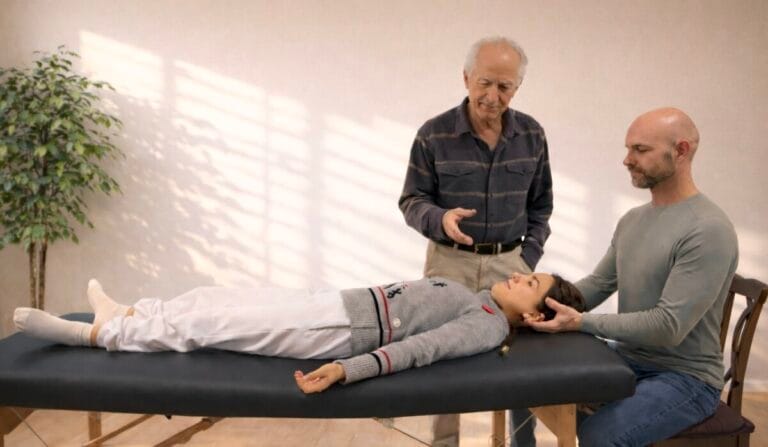
Example: At the table, bring awareness to how you’re using your body and let go of excess neck tension. - Depth of Work and Direction of Thinking
Depth in this work is not about technical skill alone — it arises from your direction of thinking and your orientation toward life.
Example: In table work, practice coordinating your thinking “forward and up” to ease unnecessary tension. - Utilizing Cranial Nerves
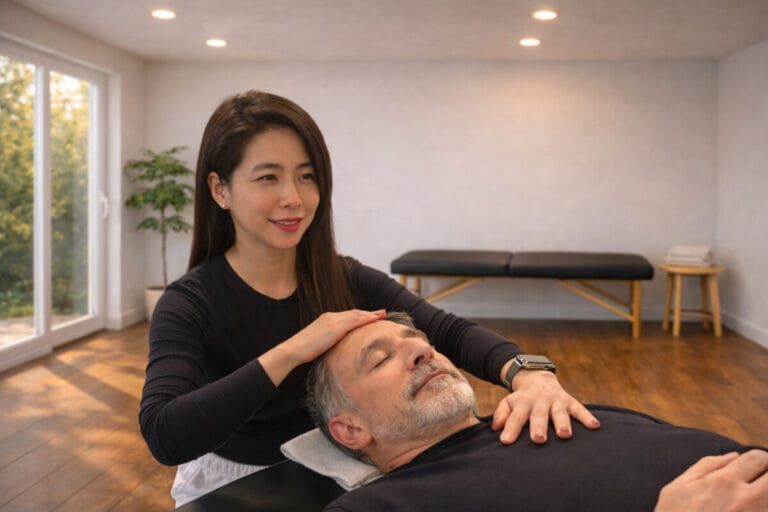
The cranial nerves integrate facial expression, movement, and emotional tone. Gentle touch or even a subtle shift in facial expression can promote emotional grounding and physical release.
Example: Soften your face and notice how both body and mind respond. - Becoming the Agent of Your Activity
We are not passive reactors to activity — we are conscious beings capable of choosing how we move. Being present allows thought and movement to act as one.
Example: In your daily routines, try noticing “How am I moving right now?” and practice a sense of freedom and agency in your activity.
Five Key Messages
- Movement isn’t something to fix. It’s something to recover.
- Physical freedom arises when sensation and thought are coordinated together.
- Instead of trying to eliminate tension, pause and stop unnecessary reactions.
- The direction of thought determines how the body is used. Choosing direction is the beginning of freedom.
- When I become aware of myself in this moment, I become the agent of my life.
Essential Terms
- Freedom of the Neck
The beginning of everything. When the tension between the head and spine softens, a whole new conversation within the body begins. It’s not about holding the neck — it’s about allowing movement to start from ease. - Spinal Lengthening
A natural unfolding that comes not from trying to be upright, but from letting gravity and breath support us. The spine doesn’t need to be held — it needs to be freed. - Direction of Thinking
The silent influence behind every movement. When thinking becomes spacious and clear, movement does too. - Forward and Up
A simple phrase, but a radical shift. It’s not about pushing — it’s about orienting toward freedom and openness. - Inhibition
The pause that changes everything. Not a freeze, but a space where new choices begin. - Being the Agent of Your Activity
Moving with conscious intention, not automatic reaction. This is where choice lives. - Cranial Nerves
A subtle but powerful system that connects facial expression, emotional tone, and integrated movement. Soften the face, and the whole self begins to respond.
3. Tommy’s Insights
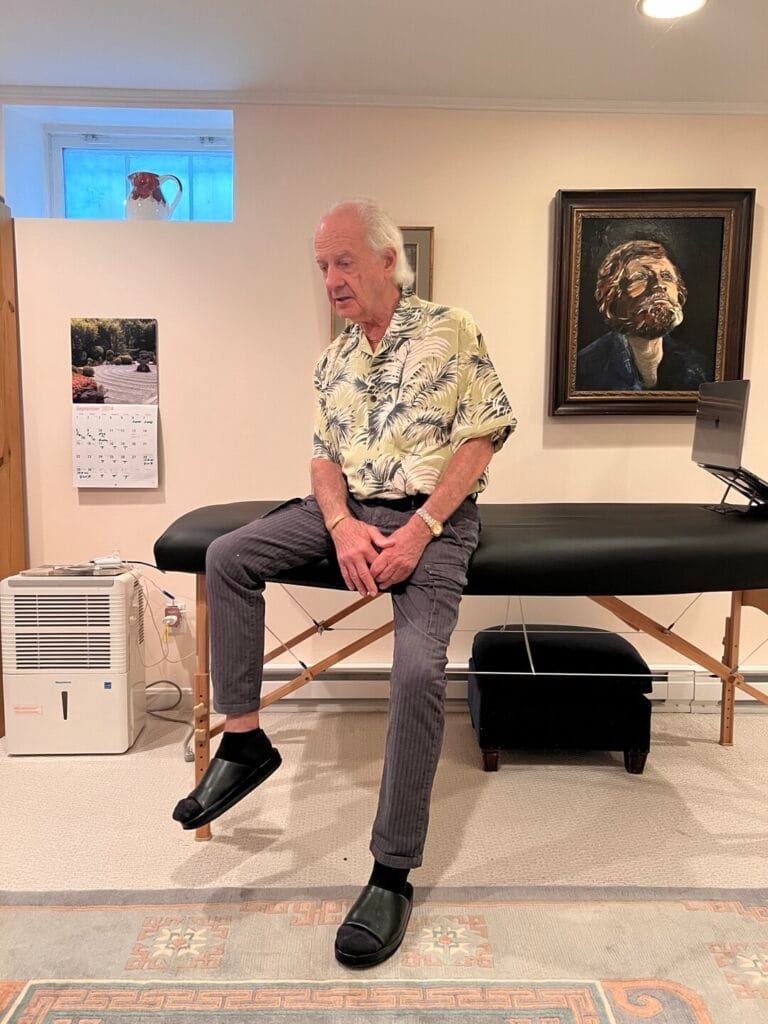
“The work of an Alexander Technique teacher is what you make of it.”
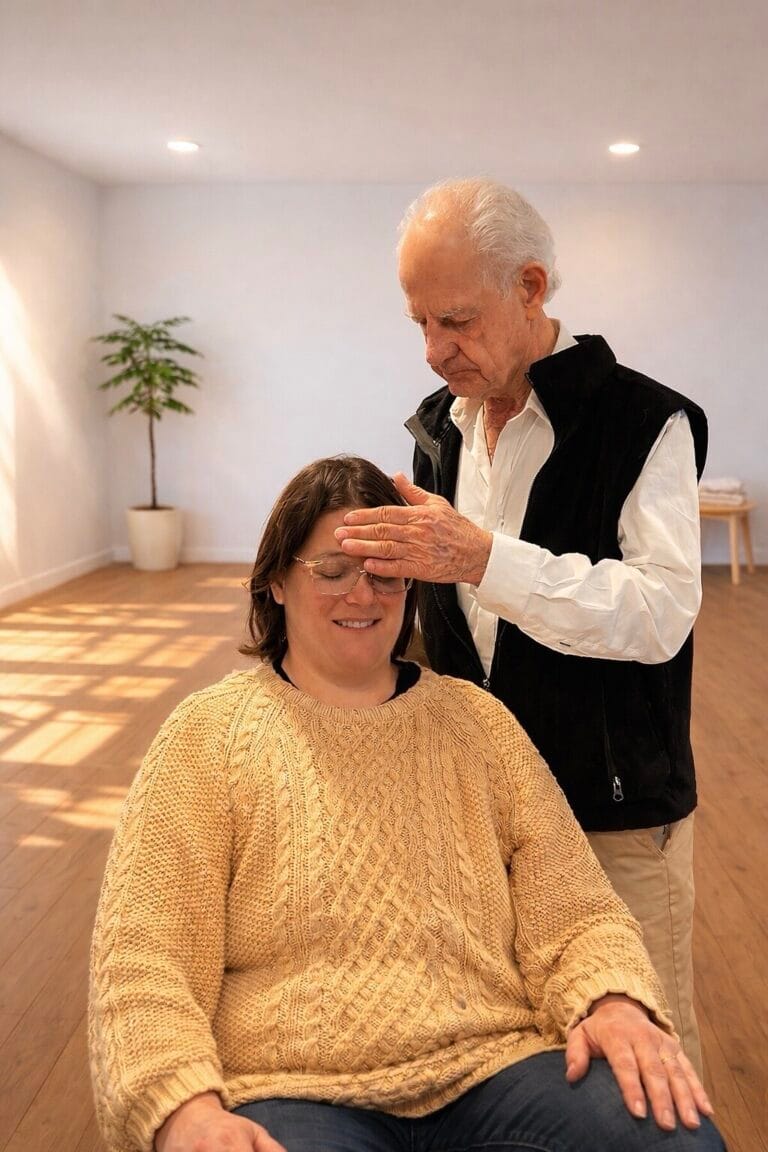
The teacher’s direction of thought and quality of touch directly influence the depth of the work. Tommy demonstrated how conscious presence shapes transformation.
“Thought and the process of thinking are fundamental to everything, and ultimately, the direction of thought is what matters most.”
Releasing the neck and allowing the head to move freely begins with setting the direction—forward and up.
“The depth of Alexander Technique work can only be understood through an awareness that stems from how one lives their life.”
True transformation comes not from mechanical adjustments, but through reflecting on how you live and how you think.
“You’re using yourself in closer alignment with the way that you’re actually designed to take in information.”
We are built for freedom and balanced movement. The Alexander Technique helps us return to this natural way of using ourselves.
“You must ask yourself whether there are greater possibilities available to you in this very moment.”
At the moment of inhibition, pause and become aware of your ability to choose a new response.
“Do not let activities control you; instead, consciously and intentionally make use of the activities.”
Even in challenging situations, you can maintain freedom of movement and act with self-direction and intention.
“What matters most in activity is being fully present as your true self in that moment.”
The practice starts with experiencing thought and sensation together, in the present moment.
4. Practical Tips for Everyday Life
What’s the Goal?
To reconnect with the body through awareness, release unconscious tension, and move with conscious direction — moment by moment.
These small, simple practices help restore coordination, presence, and a sense of agency in everyday life.
How to Practice
1. Notice and Pause Neck Tension
During screen time or intense focus, quietly ask:
“Is my neck free right now?”
Don’t fix — just pause and notice.
2. Think ‘Forward and Up’ Before You Move
Before standing, walking, or reaching, think:
“My head moves forward and up.”
Let your body respond without forcing it.
3. Ask Yourself, ‘Am I Choosing This?’
Before speaking or acting, pause for a second.
Ask, “Is this how I want to move right now?”
Let the answer guide your next action.
What You’ll Notice
- Your neck and shoulders soften
- The spine lengthens, movement becomes lighter
- You feel more grounded, aware, and in control of how you act
- Tension decreases, and presence increases — without effort
5. Closing the Class
Key Takeaways
Tommy’s first Alexander Technique class began with a shift in awareness: “How am I using myself?”
In this class, we didn’t just adjust how the body moves—we experienced a transformation in the direction of our thinking, the clarity of our sensations, and our overall way of being. When freedom of the neck, spinal lengthening, and agency in activity come together, integration between body and thought becomes truly possible.
Core Insights
When physical tension is released and natural alignment is restored, the body regains its original stability and fluidity.
Freedom of the neck is not just about one part of the body—it’s the starting point for coordinating sensation and thought.
The direction of thinking (forward and up) is a conscious choice that precedes movement and prevents habitual reactions. The Alexander Technique is a practical training that rewires how we respond to life. Everyday life becomes the practice, and sensation becomes the path to recovery.
Motivation
Change begins the moment you notice tension in your neck.
When that tension releases, the neck lengthens, the head moves away from the body, and the head’s direction shifts forward and up—allowing the spine to lengthen.
This one simple flow of thinking can reshape how you move, how you feel, and how you meet your life. In this moment, you can choose a new response. A small moment of awareness can lead to a profound shift.
6. One Key Practice
Release the tension in your neck and allow your spine to lengthen — naturally, not by force.
Don’t try to change your body. Simply return to yourself in this moment.
Even a 10-second pause can shift your entire system.
7. Three Questions to Ask Yourself
1. What reaction can I pause — so I can choose something new?
2. How am I using my body right now?
3. What helps me stay fully present in this moment?
8. For Those Who Wish to Learn More
Recommended Books
Indirect Procedures: A Musician’s Guide to the Alexander Technique – Pedro de Alcantara
A brilliant, creative guide that blends anatomy, imagination, and sensory experience. Though written for musicians, this book is widely valued across disciplines for its vivid explanations of body use, spatial thinking, and the art of allowing.
Ideal for learners who want a more embodied, artistic, and practical understanding of the Technique.
The Use of the Self – F. M. Alexander
The original and most essential text from the founder himself. This book is more than a case study — it’s a philosophical blueprint of the Alexander Technique. Alexander shares how habitual reaction patterns affect posture, breath, and voice, and how conscious inhibition opens the door to transformation.
For those who want to go to the source and understand this work as a complete re-education of the self.
Official Website of Tommy Thompson
www.easeofbeing.com
This is the official website personally managed by Tommy Thompson, offering a wide range of resources and programs to deepen your understanding and practice of the Alexander Technique:
- Private session reservations and inquiries
- Workshop and seminar schedules
- Overview of international teacher training programs
- Essays and articles on the Alexander Technique
9. Next Class Sneak Peek
Have you ever noticed how a simple sensation in your fingertips can echo through your entire body?
In the next class, you’ll explore Triadic Resonance — a subtle but powerful practice taught by Tommy, where rhythm and touch from the hands unlock tension and shift the emotional and physical tone of the whole system.
This isn’t just about relaxing. It’s about refining how you move, how you feel, and how you direct your attention. Through your hands, you’ll begin to experience the Alexander Technique’s essential principles — Direction and Inhibition — in a deeply embodied way.
Using the structure, rhythm, and sensitivity of the hands, we’ll explore how to integrate body and emotion, from the spine to the deeper layers of feeling. As your awareness grows more precise, a new kind of listening begins — one where you can finally feel the language of your body as it speaks.
10. Join the Alexander Technique Journey
Did this class leave a small resonance within you? Feel free to quietly hold it in your heart or share it in just a sentence or two. The comments are always open. Your one simple word may leave a gentle ripple in this ongoing journey.The journey of Resonance Flow continues across social media as well. Let’s continue this journey together.
 YouTube
 Instagram
 Threads
 Facebook