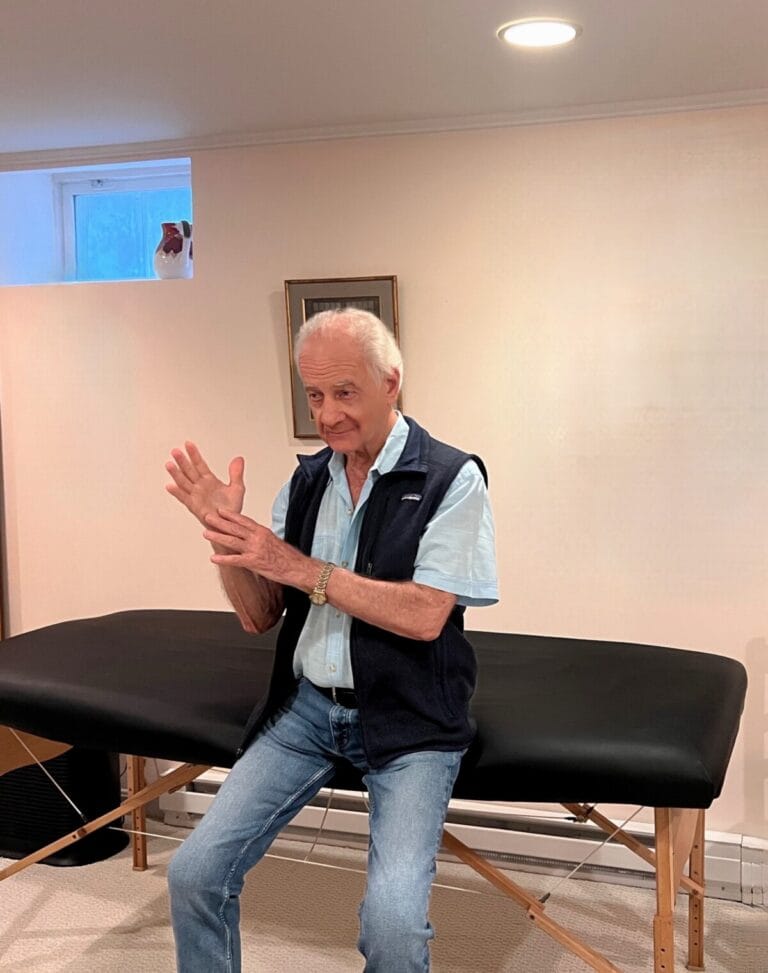
Support in Gravity: The Discovery Hidden Beneath Habit | Tommy Thompson Class 102
❝ What if gravity is not the force you must resist, but the very support that organizes your whole organism? ❞
Most people assume that better coordination comes from trying to hold themselves upright against gravity. Yet in the exploration of the Alexander Technique, a different possibility begins to appear: the organism may already be designed to discover support within gravity itself.
On December 10, 2025, in Boston, Massachusetts, USA, Tommy Thompson led a class in the Alexander Technique teacher training course exploring how genuine coordination emerges when the organism stops interfering with its own design.
Through observations of the postural set, experiments with withholding defining, and hands-on work that cooperates with gravity, the class revealed a deeper insight: support is not something a teacher imposes or a student creates through effort. It is something the organism begins to discover when unnecessary doing falls away.
Support in gravity appears when the organism is allowed to organize itself rather than being forced into position.
Key Objectives of the Class:
- Explore how the organism naturally discovers Support in Gravity rather than trying to hold itself upright
- Recognize the role of the postural set in the moment before movement
- Understand how withholding defining allows the organism’s deeper intelligence to organize action
This blog series is based on Tommy Thompson’s Alexander Technique classes. Each post follows the flow and insights of the class to expand both self-awareness and practical consciousness applicable to everyday life.
New here?
If you’re new to the Alexander Technique, you can start with the resources below.
Alexander Technique Class Flow at a Glance
1. The Opening Question
❝ What do you sense in the instant before the body moves? ❞
Before a person sits, stands, or reaches, something subtle can already be sensed. The organism begins preparing itself. A faint impulse appears before the visible movement occurs.
In this class, Tommy invited the trainees to slow down enough to notice that moment. Most people move immediately once the impulse appears. But when the impulse is observed without reaction, something different begins to unfold. The organism begins reorganizing itself in relation to gravity rather than reacting through familiar patterns.
This exploration revealed an important discovery: coordination does not improve by forcing the body into position. It appears when the organism begins to discover support in gravity.
Tommy’s Word
As Tommy explained in the class, the body already organizes itself before we consciously decide to move. That early preparation is what he describes as the postural set.
The work is not to eliminate this preparation but to notice it clearly. When a person senses the impulse to move yet refrains from acting immediately, the organism has the opportunity to reorganize itself.
In that pause, the organism often discovers a deeper relationship with gravity and support than effort could create.
2. Core Learnings from This Class
Core Concepts
- The organism continuously organizes itself in relation to gravity.
Coordination improves not by forcing the body into position but by allowing the organism to rediscover support in gravity. - The postural set reveals the body’s preparation before movement.
When this moment is noticed without immediate reaction, the organism begins reorganizing itself with greater ease and balance. - Withholding defining interrupts habitual instructions about how an action must occur.
This pause allows the organism’s deeper intelligence to guide movement rather than repeating patterns formed in the past.
Five Key Messages
- Coordination improves when unnecessary doing decreases.
- Awareness of the moment before movement changes the quality of action.
- The organism naturally organizes itself to maintain balance and support.
- Hands-on work helps the nervous system recognize freedom instead of forcing change.
- Real support appears when the body cooperates with gravity rather than resisting it.
Essential Terms
Postural Set
The organism’s natural preparation for movement that appears before any visible action begins.
Withholding Definition
The practice of suspending the habitual tendency to define or interpret experience immediately. When definition is withheld, the organism is free to discover a different response rather than repeating familiar patterns of instruction.
Support in gravity
The experience that the organism can organize itself within gravity rather than trying to oppose it.
Organism Intelligence
The inherent capacity of the organism to reorganize coordination when interference decreases.
AO Joint
The atlanto-occipital relationship that allows the head and spine to reorganize within gravity.
3. Tommy’s Insights
In Tommy’s words during class, there are not only the core principles of the Alexander Technique, but also practical wisdom that can be applied directly to daily life. His words go beyond simple advice about movement and prompt us to deeply consider how we choose to exist.“Part of letting the neck—the musculature of the neck, which involves ligamentous tissue and all the surrounding tissues—function freely is a state of mind in which you simply let your body function the way it’s designed.”
➤ Coordination emerges when the teacher refrains from interference and allows the organism’s inherent design to organize itself.
“When you sit down, the typical traditional approach would be this: the moment you start to sit, you’ll sense a movement before you actually move. You start to stand, you’ll sense a movement. And that’s the postural set. There’s nothing wrong with a postural set. A diver uses it. But it is accompanied by movement. So if you’re going to sit down, you have in mind that you want to sit down. Notice what you sense—but don’t do anything about it.“
➤ The Alexander Technique recognizes the postural set as the organism’s anticipatory organization, and freedom begins when we observe it without immediately acting on it.
“You’re more ready to sit than before, because before you were up here. You can play with withholding defining that you’re going to stand up, but withhold defining how you should stand up. The brain knows you’re going to stand up because it’s smarter than we are.“
➤ Through withholding defining, habitual instructions are suspended so the organism’s deeper intelligence can reorganize movement.
“Our entire organism arranges itself in the best way possible to support you as you are. If it weren’t doing that, it would have no real life. So you are letting something happen.“
➤ In Alexander work the body is not corrected but allowed to reorganize, revealing the organism’s inherent capacity for support.
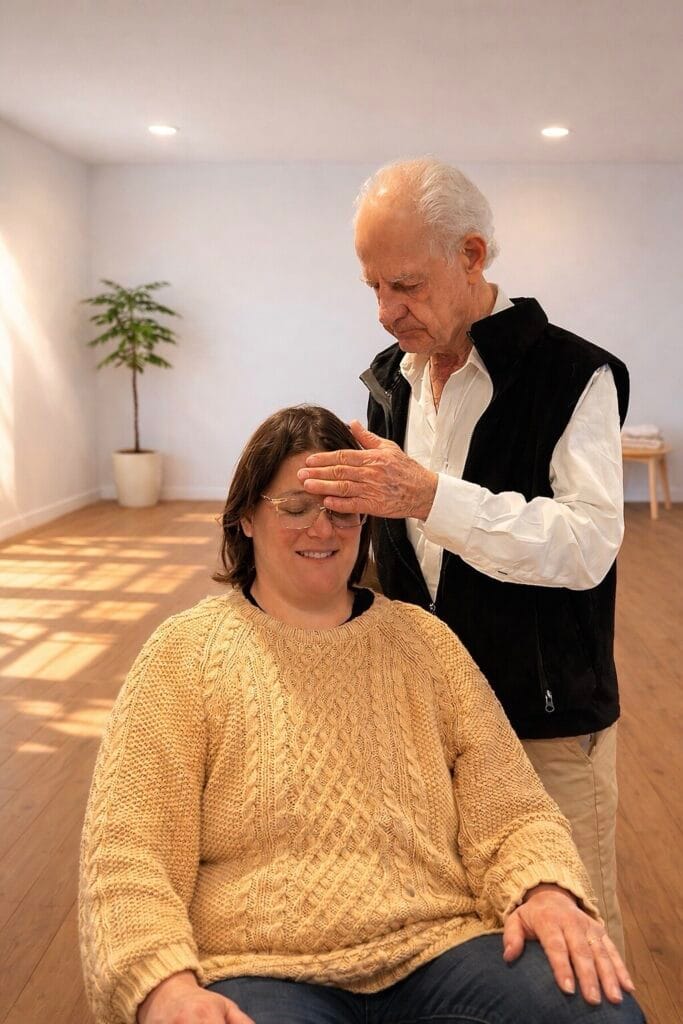
“I’m sensing how this allows the force of gravity to do its thing. There is movement through your body regardless of which area I touch. I can touch specific areas where release happens most readily—but I can touch anywhere. And then you simply let gravity do its thing.“
➤ Skilled hands-on work cooperates with gravity, allowing it to redistribute tone and movement throughout the whole organism.
“When I touch an area that’s right for you and that area is freed, you’ll come back enough to yourself. If it’s too spinal, I adjust. If there’s strain, I take the doing away. Then I ask you to look into the world, not your body, and take it in as a visual impression, like Monet. Don’t try to figure it out.“
➤ Effective touch removes unnecessary doing and restores the student’s relationship with the world.
“Now I’m tweaking the AO joint again and connecting with the tissue. It’s like the water exercise—I go into the tissue until I feel support. Then I wait. When it responds, it releases. Now the pelvis releases. 1-2-3… you just let go. Now backwards: 1-2-3, 1-2-3.”
➤ Release arises when the teacher patiently meets the tissue until the system recognizes support and reorganizes from within.
“All I’m trying to do is point out the value of withholding defining yourself. We do it all the time, but in moments when you’re struggling, if you feel yourself denying the experience you’re actually having, go back. That doesn’t have to be elementary theory. It’s story work. Story work really counts.“
➤ In teaching, story work reconnects students with lived experience, where genuine change becomes possible beyond abstract explanation.
4. Practical Tips for Everyday Life
What’s the Goal?
The goal is not to correct posture or control the body. The aim is to recognize how the organism prepares for action and allow coordination to reorganize itself in relation to gravity.
When effort decreases, the organism begins to rediscover support in gravity.
How to Practice
- Notice the impulse before movement.
Before sitting, standing, or reaching, pause briefly and sense the subtle preparation in the body. - Practice withholding defining.
Decide to move, but do not define how the movement should happen. Let the organism find its own coordination. - Let gravity participate.
Instead of holding yourself upright, allow the body to settle and feel how support appears through gravity.
What You’ll Notice
At first the pause may feel unfamiliar. But gradually the body begins reorganizing with less effort.
Movements often feel lighter, and balance becomes easier.
You begin to experience gravity not as something to resist, but as support.
5. Closing the Class
Key Takeaways
This class revealed a fundamental discovery at the heart of the Alexander Technique: the organism is already organizing itself in the best possible way to support us.
Tommy explained that gravity is constant. The body is always responding to it, whether we notice it or not. The real difficulty is not gravity itself, but the habits that interfere with the organism’s natural coordination.
Through the kayak story, Tommy described how he discovered this directly. Sitting on the ocean, he began to feel the movement beneath the waves and realized that the water was already supporting him.
The same discovery becomes possible when we begin to sense support in gravity.
Core Insights
The work of the Alexander Technique is not to force posture or control the body. Instead, it removes the interference created by habit.
As Tommy explained, the organism continually arranges itself to support us. When unnecessary effort decreases, coordination begins to reorganize in response to gravity.
Tommy once described this realization simply: we must move beyond habit in order to rediscover the support that is already there.
To experience support in gravity, we must get past habit and allow the organism to respond.
A Final Invitation
Rather than trying to correct yourself, begin by noticing where support already exists.
Gravity is always present, and the organism is always responding to it. When habitual interference softens, that relationship becomes easier to perceive.
When habit no longer dominates our reactions, support in gravity becomes perceptible again.
6. One Key Practice
Pause for a moment during the day—standing, walking, or sitting—and notice your relationship with gravity.
Instead of trying to hold yourself upright, allow the body to respond to the ground beneath you.
Notice whether support in gravity begins to appear when effort softens.
Tommy illustrated this through the water exercise: beneath the turbulent surface of water, a deeper support becomes perceptible.
In the same way, when unnecessary effort decreases, the body begins to rediscover the support already present in gravity.
7. Three Questions to Ask Yourself
- When I pause, can I sense support in gravity beneath my body?
- Where might habit be interfering with the organism’s natural organization?
- If I soften effort slightly, does the body begin to reorganize in response to gravity?
8. For Those Who Wish to Learn More
Recommended Books
The Universal Constant in Living – F. M. Alexander
In this final and most philosophical book, Alexander explores how human coordination is shaped by the forces acting upon the body. Rather than trying to hold ourselves upright through effort, he points to a deeper principle: the organism functions best when it organizes itself in harmony with natural forces.
The class you have just explored reflects this same insight. When unnecessary effort decreases, the body begins to discover support within gravity rather than struggling against it.
This shift—from forcing posture to rediscovering balance—lies at the heart of the Alexander Technique and is beautifully explored in this book.
Official Website of Tommy Thompson
www.easeofbeing.com
This is the official website personally managed by Tommy Thompson, offering a wide range of resources and programs to deepen your understanding and practice of the Alexander Technique:
- Private session reservations and inquiries
- Workshop and seminar schedules
- Overview of international teacher training programs
- Essays and articles on the Alexander Technique
9. Next Class Sneak Peek
In the next class, Tommy Thompson introduces Inspansion—the recognition that the organism already lives within a gravitational field rather than needing to hold itself up through effort.
As this awareness begins to expand, the relationship of the head, spine, and whole body begins to reorganize.
Class 103 explores what happens when we allow our sense of self to extend into the environment instead of trying to control the body from within.
10. Join the Alexander Technique Journey
Did this class leave a small resonance within you? Feel free to quietly hold it in your heart or share it in just a sentence or two. The comments are always open. Your one simple word may leave a gentle ripple in this ongoing journey.The journey of Resonance Flow continues across social media as well. Let’s continue this journey together.
 YouTube
 Instagram
 Threads
 Facebook