What Happens When Touch Becomes Relationship? | Tommy Thompson Class 74
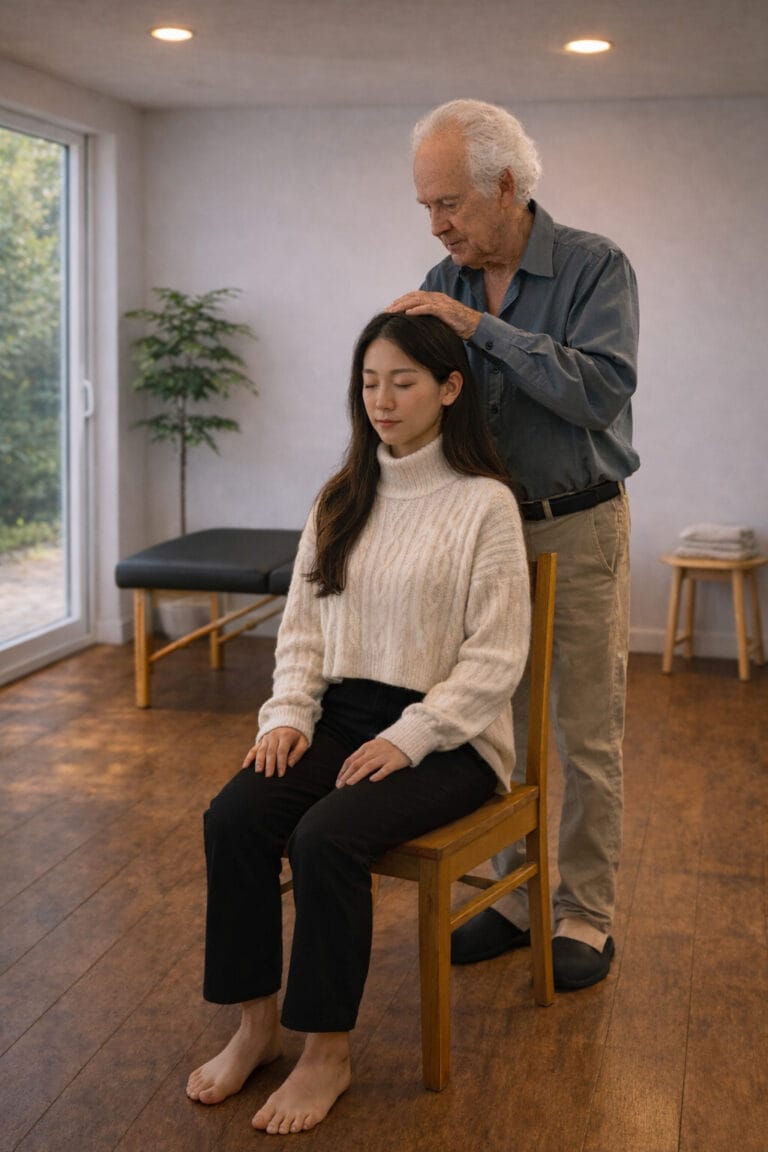
❝ When was the last time someone truly touched you—not to fix, adjust, or teach, but to recognize you? ❞
Have you ever felt the difference between being touched as a body… and being touched as a person?
On September 11, 2025, in a quiet training studio in Boston, Massachusetts, Tommy Thompson led a class in the Alexander Technique teacher training course that reshaped how we think about touch. But more than that, it reshaped how we think about human connection.
This wasn’t class on technique. It was a deep investigation into what happens when we place a hand—not on someone, but with someone.
Touch, as Tommy reminded us, is not a tool. It is a relationship.
Whether you’re a longtime teacher or new to the Alexander Technique, what unfolded in this class may challenge your habits, deepen your awareness, and call you into something far more essential than alignment or posture. It calls you into presence—with yourself, and with others.
Key Objectives of the Class:
- To explore Touch as Relationship beyond physical manipulation
- To train intentional contact that acknowledges personhood, not just form
- To refine the teacher’s use of self in service of deepened presence and mutual awareness
This blog series is based on Tommy Thompson’s Alexander Technique classes. Each post follows the flow and insights of the class to expand both self-awareness and practical consciousness applicable to everyday life.
New here?
If you’re new to the Alexander Technique, you can start with the resources below.
Alexander Technique Class Flow at a Glance
1. The Opening Question
❝ What if the foundation of the Alexander Technique wasn’t movement—but how you relate to another person through touch? ❞
Before your hands begin to guide, before a word is spoken or a posture addressed—something deeper begins. A presence. A willingness to recognize, not correct. A shift from technique to encounter. This is where the work truly starts.
Tommy doesn’t begin class by asking students to align or adjust. He starts by drawing attention to the intention behind touch—the very relationship it creates, or fails to create.
Tommy’s Word
“So the moment you touch the person, you form a relationship with that person.”
➤ This one sentence, spoken quietly at the beginning of the class, reframed everything. Touch wasn’t a step in the process—it was the process. As Alexander Technique trainees, we weren’t just learning contact—we were learning connection. And that required us to be in touch with our own presence before offering it to another.
2. Core Learnings from This Class
Core Concepts
- Touch as Relationship
This class did not treat touch as a technique but as a gateway to connection. Every contact was framed as a mutual act of recognition, not instruction. - The Person, Not the Body
Tommy emphasized that we aren’t touching “bodies” but living organisms—thinking, sensing beings whose coordination and self-awareness are shaped by the quality of our contact. - Teacher Presence Before Technique
What a teacher brings to the moment—their stillness, intention, and inhibition—is what shapes the quality of touch more than any physical placement. - Self-Use as a Continuous Inquiry
Instead of applying a fixed technique, Tommy guided trainees to observe their own use in real time, constantly inviting presence and choice. - The First Lesson Begins Before the First Touch
Contact doesn’t begin with hands—it begins with how we see the other person, how we stand near them, and how we relate to ourselves in that moment.
Five Key Messages
- The moment you touch someone, a relationship begins.
➤ It’s not about fixing; it’s about entering a space of mutual recognition. - Your touch can either invite or shut down their coordination.
➤ The nervous system responds to attention before it responds to technique. - Most people have never been touched in a way that supports awareness.
➤ This class opened a new sensory experience for both trainee and receiver. - When you stop doing what you always do, the brain has space to reorganize.
➤ Inhibition is not withholding—it’s clearing the way for natural function. - The Alexander Technique begins with how you use yourself in relationship.
➤ The hands are secondary; presence is primary.
Essential Terms
- Alexander Technique
A method of psychophysical re-education that brings awareness to how we move, perceive, and respond in our daily lives. - Touch as Relationship
The core idea that touch is not mechanical but relational, shaped by awareness, intention, and presence. - Use of Self
How we apply ourselves in action—not just physically, but mentally and emotionally. - Inhibition
The conscious pause before habitual response; creating space for new coordination to emerge. - Presence
The quality of being attuned and available—both to oneself and to the other person—without agenda or manipulation. - Organism (vs. Body)
A living, sensing being, as opposed to a mechanical body. Tommy uses this to reframe how we see and touch another person.
3. Tommy’s Insights
In Tommy’s words during class, there are not only the core principles of the Alexander Technique, but also practical wisdom that can be applied directly to daily life. His words go beyond simple advice about movement and prompt us to deeply consider how we choose to exist.“You have to ponder over that. It’s just a momentary thing. Normally, the teacher is trained to touch adaptive use from their own perspective of what more appropriate use is, given the circumstance. The teacher is also working with themselves as they work with the person—to be in touch. The moment you touch the person, you form a relationship with that person.”
➤ Touch becomes meaningful only when guided by presence and inhibition—not correction.
“The moment you touch the person, you have that person’s attention, too. If it’s the first time, they’re registering—through their intention—a different quality of touch. They’re not used to being touched that way. They’re not used to being touched in a way that facilitates their movement, their thinking, their involvement in what they’re doing.”
➤ Skilled touch invites a whole-person response that reshapes internal coordination.
“It gives them a different experience of being themselves, given what they’re doing. They’re not used to that. And you want to bear that in mind. And—and that’s part of your job, really, as a teacher: to touch them in a way they are unaccustomed to and draw them into a different sphere of relating to themselves. On a good day, it all works.”
➤ We don’t introduce change; we create the conditions for new perception to arise.
“When I touched his body, that’s matter. But if the thinking is set and not going to let the touch in, it’s more difficult. So if you simply think that this is a person I’m touching, it’s going to change your touch.”
➤ The clarity of our internal intention fundamentally alters the way our hands communicate.
“The fact is, once you put your hand on a given individual, you’re putting your hand on a person. Focus entirely on touching a person. I am touching a person’s person.”
➤ In Alexander work, form and person are not separate—how you think of them shapes what you meet.
“To touch another—it’s a gift to them, and it’s a gift to you—touch and be touched. So when we’re working, bear that in mind.”
➤ Every moment of embodied contact is reciprocal: to reach is also to receive.
“They come in with a need. And they tell you what that need is. And then you look at each other. And if you’re really seeing the person—and not observing their use so much—when you observe a person’s use, you don’t look at them. They will feel looked at, and they will not tell you the truth. They will not really tell you why they’re there. But if you just assume it’s like a mirror neuron, you know, you’re not even aware that you’re doing it.”
➤ Honest interaction begins when we stop analyzing and start witnessing.
“So when you’re seeing a person, and you touch the person, it’s just a different way of starting a lesson. It’s just acknowledging the humanity of both of you. That it is a gift to them, hopefully—it is a gift to you, to understand more about what it is to teach. Because you’re constantly working with yourself as well.”
➤ The act of teaching begins with shared presence, not instruction.
“So the moment of highest tension is when I’m about to do exactly what I’m used to doing. But I withhold defining myself as only being able to do that, and I wait. The moment I do that, you free the brain to do what it’s designed to do, because the brain knows exactly what I’m doing. So the brain then does it from the way you’re designed to function. So that inhibited moment that you take… well, essentially, you’re just not doing it the way you usually do it.”
➤ Inhibition is not resistance; it’s choosing possibility over repetition.

4. Practical Tips for Everyday Life
What’s the Goal?
To make touch a shared moment of recognition—not correction. The goal is not to apply technique, but to offer presence. This practice is about becoming more responsive, more receptive, and less outcome-driven.
How to Practice
- Let the person arrive into your hands
➤ Don’t “place” your hands. Let your hands be a place. Invite rather than direct. As Tommy described, it’s like water rising into the bowl of your palms. Wait—not hesitation, but receptivity. - Soften your visual presence before touching
➤ Your eyes carry intention. Before contact, let your gaze relax—not stare, not scan. Just see. The softening of vision becomes the softening of touch. - Inhale a moment of presence
➤ Take a breath—not to prepare the touch, but to let go of agenda. That one conscious breath grounds you in your own use, so that your hand expresses clarity, not control.
What You’ll Notice
When you practice in this way, people often respond before you even place your hands. They sense they are being seen, not handled.
Your hand becomes a messenger of your whole self—inviting awareness, not applying change.
This kind of touch lingers. It resonates—and sometimes, it teaches more than words ever could.
5. Closing the Class
Key Takeaways
The hands may meet the body, but it’s the presence that meets the person.
This class wasn’t about “fixing” anything. It wasn’t about performance or postural ideals. It was about recognition—recognizing the person beneath the posture, the organism beneath the structure.
What we practiced wasn’t a technique of placement. It was a practice of perception. And perception, in the Alexander Technique, is never passive—it’s an invitation to reorganization.
Core Insights
As Tommy often reminded the class:
“Once you put your hand on a given individual, you’re putting your hand on a person.”
To truly touch someone, we must first inhibit our assumptions, and step into that moment empty-handed and open-eyed.
The inhibited moment, as Tommy described, is where change becomes possible—not through effort, but through stopping what we always do, and waiting for something more intelligent to appear.
In this, the Alexander Technique becomes more than a system. It becomes a way of being in relationship—with ourselves, with others, with life.
A Final Invitation
The invitation of this class is simple:
Touch with less intention to influence, and more willingness to witness.
Presence—not performance—is what teaches. And when you learn to listen through your hands, you may discover that the person before you was listening all along.
Because the gift isn’t in the contact. It’s in the mutual recognition that something sacred is already here.
6. One Key Practice
Pause before your hands know what to do
This is not hesitation. It’s not indecision. It’s a conscious moment where your habitual pattern doesn’t rush in to take over.
Tommy didn’t ask trainees to get the hand “right.” He asked them to not do what they always do. In that small, inhibited moment—when your hands hover with intent but without grasp—you open a space for the Alexander Technique to emerge.
When you pause with awareness, your touch becomes an act of relationship, not technique.
Touch as Relationship begins with that pause—a moment of un-doing that invites clarity, presence, and the other person’s whole system to reorganize.
You’re not placing your hands on the neck or back. You’re offering space for the person to arrive.
7. Three Questions to Ask Yourself
These are not questions to judge or evaluate. They are invitations—to presence, to listening, to a way of being that lives in the heart of the Alexander Technique.
- Am I here with this person, or am I still trying to do something to them?
→ True relationship begins when intention replaces technique. - Is my touch recognizing a body… or honoring a person?
→ Your contact carries a message. What is it saying? - What would happen if I stopped doing and simply waited?
→ In that pause, you might find the whole person meeting you.
8. For Those Who Wish to Learn More
Recommended Book
Touching Presence – by Tommy Thompson
This landmark book distills over 50 years of teaching into one simple, radical principle: how the quality of presence transforms touch, awareness, and human connection. For Tommy Thompson, presence is not a posture—it’s a way of being-with, before doing anything at all.
At the heart of this book lies a powerful invitation: to meet students—and life—not with preconceptions, but with what Tommy calls withholding definition. By suspending habitual labels and roles, we allow a new kind of relationship to emerge—one built on attention, not correction.
For anyone seeking to deepen their understanding of the Alexander Technique beyond mechanical adjustments, this book offers a guide to living the work, moment by moment.
Official Website of Tommy Thompson
www.easeofbeing.com
This is the official website personally managed by Tommy Thompson, offering a wide range of resources and programs to deepen your understanding and practice of the Alexander Technique:
- Private session reservations and inquiries
- Workshop and seminar schedules
- Overview of international teacher training programs
- Essays and articles on the Alexander Technique
9. Next Class Sneak Peek
You’ve seen that helping someone isn’t about fixing them.
It’s about being with them — with presence, with direction, with trust in the unknown.
That’s where understanding begins.
In Class 75, we’ll go deeper into what Tommy calls
“the gift of your understanding.”
It’s not something you say. It’s something you share —
through your hands, your breath, your timing.
We’ll explore how understanding is not mental —
it’s physical, relational, moment-by-moment.
And we’ll ask:
Can you offer your presence… without trying to help?
10. Join the Alexander Technique Journey
Did this class leave a small resonance within you? Feel free to quietly hold it in your heart or share it in just a sentence or two. The comments are always open. Your one simple word may leave a gentle ripple in this ongoing journey.The journey of Resonance Flow continues across social media as well. Let’s continue this journey together.
 YouTube
 Instagram
 Threads
 Facebook