Withholding Definition: Why You Keep Becoming the Same Person | Tommy Thompson Class 104
❝ Can you stop before you become the self you always are, even for a moment in the Alexander Technique? ❞
There is a moment so brief it is almost always missed, when you stop. Not because you try to stop, but because something in you hesitates before becoming what it always becomes. In that quiet interval, before reaction turns into identity and before sensation becomes interpretation, there is space. And in that space, you are no longer who you think you are.
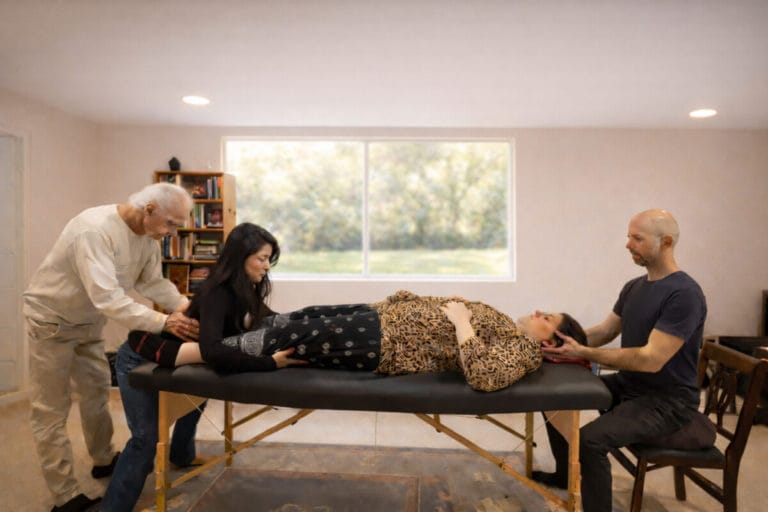
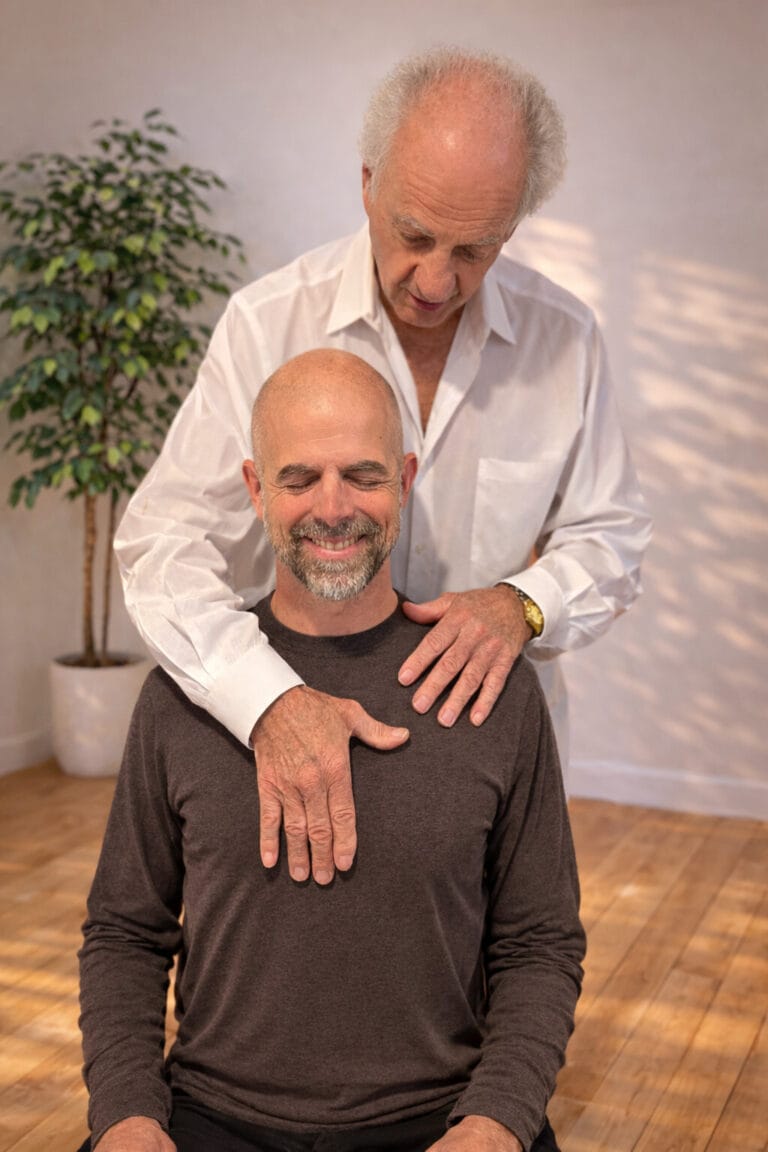
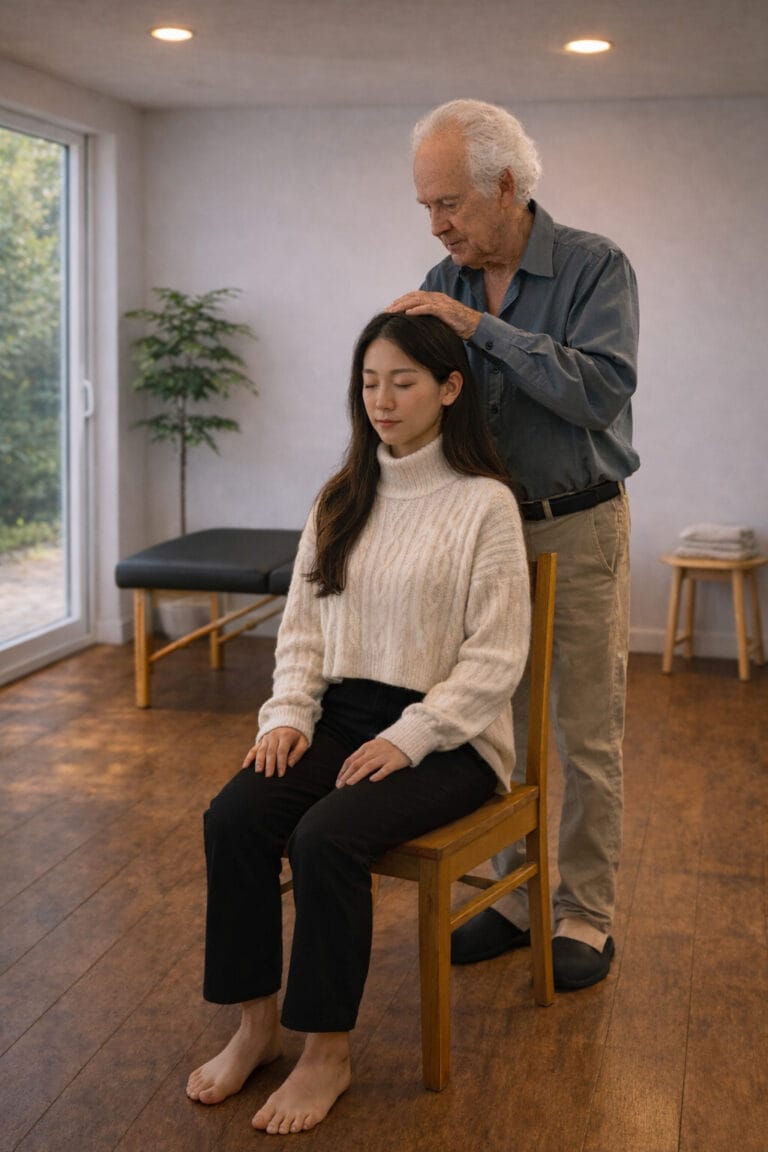
On December 16, 2025, in Boston, Massachusetts, USA, Tommy Thompson led a class in the Alexander Technique teacher training course where this moment was not explained, but experienced. A hand made contact, not to fix or correct, but to listen. A trainee paused slightly longer than usual, and something unfamiliar began to emerge.
This is where Withholding Definition becomes real. Not as an idea, but as a lived experience. In the Alexander Technique, change is not about improving the same self, but about suspending the act of defining oneself. When definition is withheld, even briefly, the organism is no longer compelled to repeat its past.
Key Objectives of the Class:
- To encounter the liminal moment where reaction has not yet become identity
- To experience Withholding Definition as a direct, perceptual event
- To recognize how personal narrative shapes the use of self
- To develop touch as listening rather than control
This blog series is based on Tommy Thompson’s Alexander Technique classes. Each post follows the flow and insights of the class to expand both self-awareness and practical consciousness applicable to everyday life.
New here?
If you’re new to the Alexander Technique, you can start with the resources below.
Alexander Technique Class Flow at a Glance
1. The Opening Question
❝ What happens just before you become who you think you are? ❞
In this class, everything begins in a moment most people never notice. A trainee reaches, then pauses. Nothing changes on the surface, yet something has already shifted. The familiar movement does not complete itself, and for an instant, the usual self is not there.
This is the threshold Tommy points to. Not stopping action, but suspending the act of becoming who you already believe yourself to be. In that instant, Withholding Definition is not an idea, but the lived absence of the identity you habitually return to.
When you do not define yourself, even briefly, you are no longer bound to repeat yourself.
Within the Alexander Technique, change does not come from improving the same patterns. It emerges when self-definition is interrupted, allowing the organism to reorganize and a different coordination to arise through awareness.
Tommy’s Word
“F. M. Alexander’s inhibitive moment is a liminal space in which, through increased awareness, you consciously meet yourself being yourself and decide whether this is the self you wish to be, or, more to the point, is this the self I truly am? This moment is a threshold of potential where familiar responses are less automatically pursued, where the usual choices are momentarily suspended, and where you can withhold defining yourself as you have previously defined yourself.”
This reveals the heart of the work. The significance of Withholding Definition is that it interrupts identification at its source. In this liminal moment, awareness meets habit before it becomes action, allowing a more integrated use to arise from the present rather than the past.
2. Core Learnings from This Class
Core Concepts
- You are not reacting—you are continuing a pattern already in motion.
What feels like choice is often the continuation of an established use. - The real change happens before the action begins.
The moment just before movement determines the quality of the whole response. - Withholding Definition creates the conditions for reorganization.
When you do not rush to define, the organism has space to change.
Five Key Messages
- Most actions are not chosen; they are continued.
- The moment before action shapes the outcome.
- Pausing is not delaying—it is allowing.
- You do not fix the body; you stop interfering with it.
- Change begins when you stop becoming the same person.
Essential Terms
Withholding Definition
The act of not immediately defining or becoming a reaction. It creates a gap where change becomes possible.
Perception
Your immediate awareness of yourself in the moment. This is where all change begins.
As Tommy often reminded the class, if perception is unclear, action cannot be free.
Sensory Interpretation
The way you interpret what you feel. It is often unreliable, yet it drives your reactions.
What feels “natural” is often learned and repeated.
Use of Self
The way you organize your whole self in action—thought, sensation, and movement as one.
In the Alexander Technique, use reflects your relationship with yourself.
Pause (Inhibition through Withholding Definition)
Not stopping action, but not rushing into it. It allows the organism to reorganize.
When you do not rush to act, something else has time to happen.
3. Tommy’s Insights
In Tommy’s words during class, there are not only the core principles of the Alexander Technique, but also practical wisdom that can be applied directly to daily life. His words go beyond simple advice about movement and prompt us to deeply consider how we choose to exist.“F. M. Alexander’s inhibitive moment is a liminal space in which, through increased awareness, you consciously meet yourself being yourself and decide whether this is the self you wish to be, or, more to the point, is this the self I truly am? This moment is a threshold of potential where familiar responses to given circumstances are less automatically pursued, where the usual choices are momentarily suspended, and where you can withhold defining yourself as you have previously defined yourself, in a quiet moment of absence”
➤ Inhibition is the liminal threshold at which habit is suspended and conscious self-recognition precedes action.
“In that moment, you are briefly absent from the habitual ‘use of self,’ and your brain and all the systems of life support are given the opportunity to supply a more integrated use, more closely aligned with the way you are designed to function. From this, new choices arise through heightened awareness not previously perceived. The story you ascribe to your life becomes more fluid, more available, allowing personal freedom to change and to make choices more befitting the circumstances and your growth and well-being.”
➤ Integrated use arises when interference ceases, allowing awareness to generate new choice.
“At night, we sleep with our story, and in the morning we awaken with our story. We do not go to sleep and wake up with our ‘use’ alone. One’s use reflects one’s attachment to personal narrative. It is the attachment to personal narrative that we are truly changing when we change our use. Otherwise, we are simply becoming better at being the person we have always been—and there is certainly value in that.”
➤ Use of self is the embodied expression of narrative, and change occurs as attachment to that narrative shifts.
“Change happens in a moment, and a moment is a movement. All change takes place in the ongoing present, in the space between stimulus and response—the liminal moment. You were given a ticket to ride at the moment of birth. You may remain defined by attachment to your story, or you may step aboard the train of change.”
➤ Change exists only in the present moment, where awareness interrupts reaction and establishes new direction.
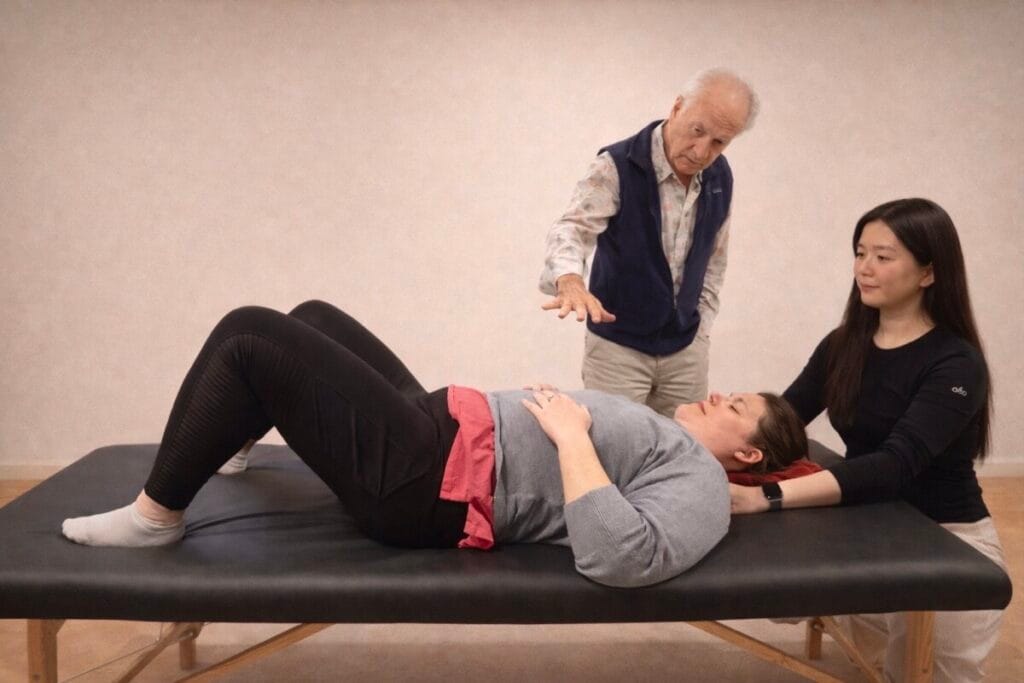
“If I put my hands here and do that, I’m going to set off a stretch reflex, and the brain will defend itself against my touch. But when I put my hand here with just enough pressure to make contact, this is listening. I make just enough contact to stimulate the muscle tissue to lengthen. But I need to know what lengthening means. There’s a bit of inspansion taking place before there’s expansion that goes all the way up into the neck reflexes. Inspansion is not simply moving inward. It’s like putting your hands on the surface of water and calming the water down.”
➤ Listening contact initiates inspansion, allowing the system to release before expansion.
“Have your hand there and listen to the muscle tissue respond. Feel a slight lengthening. When you feel it, add a little pressure and direct it toward upright organization—back and up the front, down the back.”
➤ Direction emerges from response, organizing the body toward upright integration without force.
“Make contact and move into the tissue. When the tissue listens, it greets you. You acknowledge the greeting and go deeper. It’s always a combination of inspansion and expansion. Just think of going deeper into the tissue. That’s it.”
➤ Touch is reciprocal communication in which depth emerges through the interplay of inspansion and expansion.
“Inspansion and expansion happen almost at the same time. You’re inducing an inspansion, and the expansion will just take place. That’s just like dropping right into the water—barely perceptible contact—and the water will respond. The tension will respond. The form moves. The tissue will speak to you. So now there’s a dialogue between you and her, and you can go a little deeper into that dialogue. And now you’re spreading the tissue out.”
➤ Coordination is a dialogue in which inspansion evokes whole-body integration through immediate expansion.
4. Practical Tips for Everyday Life
What’s the Goal?
The goal is not to change what you do, but to notice the moment before you become who you always are. In the Alexander Technique, this is where Withholding Definition becomes real.
If you can stay there even for a second, something different begins.
How to Practice
- Reaching for Your Phone
Notice the impulse before your hand moves. Pause for just a second. Do not fix or adjust anything. Let the action remain undefined, then move. - Speaking
Feel the urge to speak, but do not follow it immediately. Stay with it. Then speak and notice what changes. - Standing Up
Before you move, stop. Let the movement not be decided yet. Then allow yourself to stand.
What You’ll Notice
At first, it feels unfamiliar. Then you begin to notice something subtle. Movements feel less forced, reactions slow down, and you are no longer repeating yourself in the same way.
There is a moment where you are not your habit, and in that moment, something new becomes possible.
5. Closing the Class
Key Takeaways
This class was not about doing something new, but about seeing what is already happening. What feels like choice is often the continuation of a pattern already in motion.
If you notice the moment before you move, something has already changed.
Core Insights
Change does not come from effort. It begins when you do not rush to become what you feel.
As Tommy often reminded the class, when you stop defining yourself, the organism begins to reorganize.
A Final Invitation
Before your next movement, pause—not to control, but to notice.
Do not try to be different. Do not try to improve anything. Simply remain with the moment before it becomes you.
Stay there, even briefly—and see what happens.
6. One Key Practice
Take one moment today before you move, speak, or respond. Do not try to change anything. Simply notice the impulse and do not become it immediately.
Stay with the moment before it becomes action.
Let it remain undefined for a second, then move. You may notice the action feels different—not because you controlled it, but because you did not rush into it.
7. Three Questions to Ask Yourself
These are not questions to think about later, but invitations to notice what is happening now. Not to analyze, but to perceive.
- As you are about to move, can you notice the moment before you become the movement?
- When an impulse appears, do you immediately become it, or can you stay with it without defining it?
- Right now, can you sense how you are organizing yourself before you act?
Can you remain with yourself without rushing to become what you already know?
8. For Those Who Wish to Learn More
Recommended Books
- Touching Presence – Tommy Thompson
This book is not about learning a technique. It is an invitation into the space where change actually happens. Built from real class experiences, it reveals how we begin to see ourselves before we become our habits.
Rather than telling you what to do, it brings you into the moment where doing has not yet begun. Each page reads like a lesson—not asking you to understand, but to notice.
This is not a book about the body. It is about the moment you stop becoming what you already know.
Official Website of Tommy Thompson
www.easeofbeing.com
This is the official website personally managed by Tommy Thompson, offering a wide range of resources and programs to deepen your understanding and practice of the Alexander Technique:
- Private session reservations and inquiries
- Workshop and seminar schedules
- Overview of international teacher training programs
- Essays and articles on the Alexander Technique
9. Next Class Sneak Peek
In the next class, the work moves beyond contact into something more precise: going Into the Tissue.
What if change does not happen from what you do, but from how deeply you can enter without forcing?
You will explore how the body begins to reorganize when contact becomes listening, and how lengthening emerges from within rather than being imposed
10. Join the Alexander Technique Journey
Did this class leave a small resonance within you? Feel free to quietly hold it in your heart or share it in just a sentence or two. The comments are always open. Your one simple word may leave a gentle ripple in this ongoing journey.The journey of Resonance Flow continues across social media as well. Let’s continue this journey together.
 YouTube
 Instagram
 Threads
 Facebook