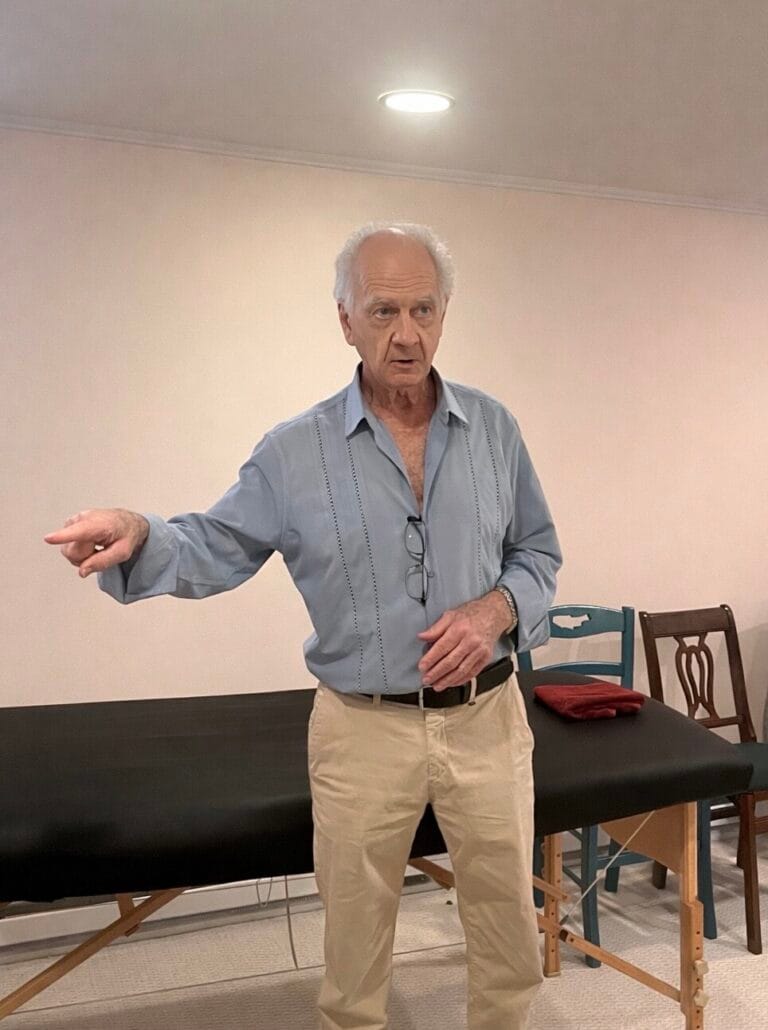
Relational Listening: Why the Alexander Technique Changes You Before You Try| Tommy Thompson Class 92
❝ What if the most important thing you do as a teacher is not what you change—but what you listen to? ❞
In the Alexander Technique, real change does not begin with correction.
It begins with Relational Listening—listening to response, stillness, and the organism before deciding what to do.
In this class, Tommy Thompson shows that inhibition, direction, and availability are not techniques to apply, but conditions that allow experience to reorganize itself. The teacher listens first—to their own use, to the student’s response, and to the relationship unfolding between them—before any instruction is given.
On November 11, 2025, in Boston, Massachusetts, USA, this Alexander Technique teacher training class reframed teaching as a relational and perceptual art, where experience leads and technique follows.
This was not about making “better use.”
It was about making room for life to respond.
Key Objectives of the Class:
- To understand Relational Listening as the foundation of Alexander Technique teaching
- To practice withholding definition as lived inhibition
- To experience direction as response, not instruction
- To recognize teaching as availability to the person as they are
This blog series is based on Tommy Thompson’s Alexander Technique classes. Each post follows the flow and insights of the class to expand both self-awareness and practical consciousness applicable to everyday life.
New here?
If you’re new to the Alexander Technique, you can start with the resources below.
Alexander Technique Class Flow at a Glance
1. The Opening Question
❝ What are you listening to before you decide what to do? ❞
This question sits at the center of the class.
Before hands are placed, before directions are given, before anything is changed, what is the teacher actually listening for?
In this work, Relational Listening is not passive attention. It is an active, perceptual engagement with response—listening to stillness, to movement emerging, and to the organism as a whole. Without this listening, inhibition collapses into hesitation, and direction becomes instruction rather than response.
The class repeatedly returns to this moment before action. Not to delay change, but to allow experience to organize itself so that any direction offered has value.
Tommy’s Word
“I’m listening to your stillness.
I’m listening to you respond to me.”
In this statement, Tommy Thompson makes the teacher’s task unmistakably clear. The primary act is not doing something to the student, but listening for response within relationship. Stillness is not absence of movement—it is information. Response is not outcome—it is communication.
From this place, teaching shifts. The teacher no longer imposes change, but stays available long enough for the student to experience themselves changing themselves.
2. Core Learnings from This Class
In this moment from Tommy Thompson’s class, trainees explore how habitual movement patterns quietly shape the way we move, exercise, write, and respond to daily life.
Rather than mechanically correcting posture, the teacher guides awareness first, allowing movement to reorganize through observation and conscious use.
Watch how guided movement begins to interrupt habitual coordination patterns without force.
You Keep Moving the Same Way… That’s the Problem | Alexander Technique
Class 92 · May 23, 2026 · Boston, MA
Core Concepts
- Relational Listening
Teaching begins by listening for response—stillness, change, hesitation, availability—before deciding what to do. Listening is the primary act that organizes everything else. - Inhibition as Withholding Definition
Inhibition is not stopping action, but suspending habitual interpretation. By withholding definition, the teacher creates perceptual space in which new coordination can emerge without force. - Direction as Response, Not Instruction
Direction has value only when it arises from what has been listened to. When offered too soon, direction becomes instruction; when offered after listening, it becomes supportive. - Experience Before Technique
Technique does not lead change. Experience does. The student must first sense themselves changing themselves for any technical intervention to be meaningful. - Teaching as Availability
Effective teaching requires the willingness to remain with the person as they are. The desire to help must, at times, override the desire to teach.
Five Key Messages
- Listening comes before doing.
Without listening, action is premature and often reinforcing habit. - Inhibition clears perception, not behavior.
What changes first is how the teacher perceives the moment. - Direction follows relationship.
Direction has value only within a relational context. - Change must be experienced, not imposed.
The student needs to feel themselves reorganizing. - The teacher is a guide, not an authority.
Teaching supports discovery rather than enforcing correctness.
Essential Terms
- Relational Listening
An active, perceptual listening to response within relationship, prior to intervention. - Inhibition (Withholding Definition)
The capacity to pause immediate reaction or action, allowing choice to become possible. - Withholding Definition
A stance of suspending habitual interpretation and self-definition, allowing perception to open. - Direction
A supportive orientation that emerges from listening, not a command. - Availability
The teacher’s capacity to remain present with the student’s experience. - Experience
The immediate, lived sensing of change that precedes technique.
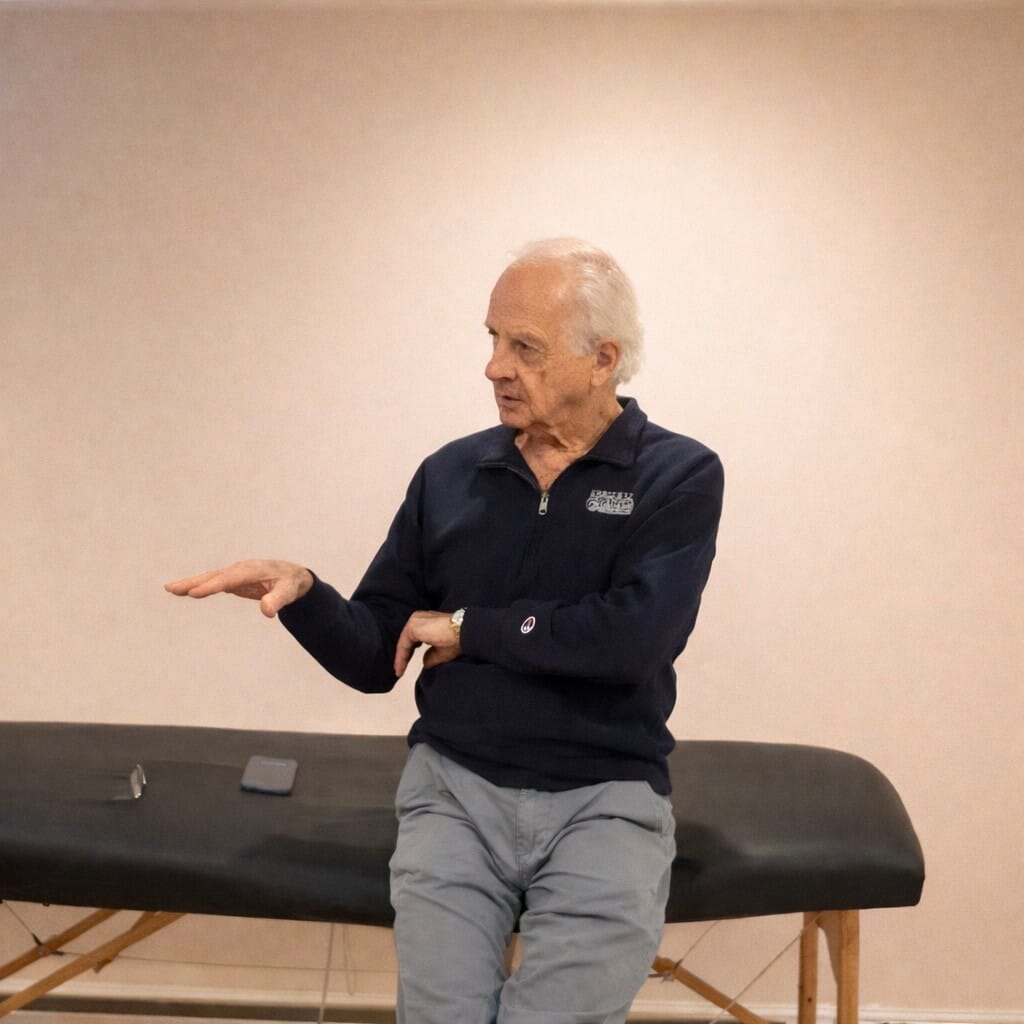
3. Tommy’s Insights
In Tommy’s words during class, there are not only the core principles of the Alexander Technique, but also practical wisdom that can be applied directly to daily life. His words go beyond simple advice about movement and prompt us to deeply consider how we choose to exist.I’m letting my neck be free to let my head move away from the body. And it’s happening. You’re doing it. I’m going to let my neck be free to let my head move away from my body. I’m going to let my head be free. Let my head move. My hands are on. I’m giving the directions to do the same thing with you. I put my hands on and let my neck be free. I’m talking to myself as I’m doing that.
➤ The teacher’s hands are inseparable from their own use; direction begins as a lived inner conversation before it ever becomes an external intervention.
If you’re training to teach and put your hands on somebody, you may know what the purpose is of putting your hands on somebody and where you put them, etc., to affect a particular thing. But in doing that—without the moment of inhibition, which is the holding of definition—without defining the way you usually use yourself, you’re probably not going to give them a direction that’s valuable.
➤ Without suspending habitual self-definition, any direction risks reinforcing the very patterns the work seeks to undo.
Eventually, you can choose not to do that and do it a different way. The movement is ahead. Or, having freed your neck, which then permits a greater movement away from the pulling into the body—moving away from the body, either forward and up or as it needs to, because the body probably knows more than what I know. It is cellular consciousness, and it’s taking care of me like a beehive.
➤ True direction respects the organism’s intrinsic intelligence, allowing coordinated change to emerge rather than be imposed.
You can also choose to do movement completely separate from the movement you usually do. That actually frees your system from constantly being invited to do it habitually.
➤ Non-habitual movement interrupts compulsive patterns and restores choice as a lived, embodied reality.
You’re not doing this work to make your use better—necessarily. You’re doing this work to restore the healthy whole system. I would do that more and more.
➤ Alexander work is not optimization but restoration—returning the organism to integrated functioning.
What the Alexander work does is ask you to look at what you’re doing and the way that you’re performing what you’re doing, and ask: Is this the most effective way of achieving what I want without harming my body, to get what I want from what I’m doing?
➤ The work reframes efficiency through care, insisting that means and ends must align somatically as well as functionally.
You can demonstrate that postural set quite easily with the sit-to-stand motion of your body. Because most people, when they get up from wherever they are, go into a postural set of movement that isn’t necessary before they actually move. It usually involves the relationship ahead of the organs. So the teacher guides the person into a conscious awareness of how they’re using themselves to accomplish what they do.
➤ Everyday actions reveal unconscious strategies, and teaching becomes an invitation to see rather than a demand to correct.
The teacher helps you explore that aspect of yourself. But as a teacher, you have to glean—you may not know, but at least glean—that something is going on with that person. You won’t do that if you’re only focusing on better use. “Use” is just one aspect of use. Their experience of this moment matters. I’m going to hold this—hold this for them to experience.
➤ Teaching begins with perceptive listening to experience, not with fixing form or enforcing ideals of use.
I’m listening to your stillness. I’m listening to you listening to me. I’m just listening to you. I’m listening to you respond to me.
➤ Stillness becomes communicative when the teacher listens for response rather than outcome.
A lot of teachers try to teach, teach for a couple of years, and then quit. That desire to be available for another person must intrude on your desire to teach from time to time. I need to be here for this person, as they are, in the best way I know how. All of a sudden, you weave the teaching in there.
➤ Teaching, at its highest level, yields to relationship—allowing technique to arise organically from presence.
4. Practical Tips for Everyday Life
What’s the Goal?
The goal is to stay available long enough to listen before intervening.
Rather than trying to improve use, this practice invites you to remain with what is already happening—without rushing to define or fix. When listening leads, change does not need to be forced.
How to Practice
- Pause before action
Before standing, writing, or reaching for your phone, notice what is already present. Do not define it. This pause is withholding definition in action. - Listen for response
As you move, attend to how your system responds—ease, resistance, balance, or stillness. Let direction arise only after listening. - Stay with the activity
Keep attention with the activity itself, not on correcting your body. Listening within activity interrupts habit.
What You’ll Notice
- Less effort without trying to relax
- Clearer moments of when not to intervene
- Coordination emerging on its own
- Greater trust in experience over technique
Over time, practice shifts from doing something to yourself toward allowing change through listening—supporting movement, choice, and Wellness.
5. Closing the Class
Key Takeaways
- Change begins with listening, not correction.
- Inhibition is the moment that makes perception possible.
- Direction has value only when it follows response.
- Teaching is an act of availability, not authority.
Core Insights
At the heart of this class is a simple but demanding truth: experience must be trusted before technique is applied. When the teacher listens—to their own use, to the student’s stillness, and to the relationship forming between them—change organizes itself without force.
As Tommy Thompson demonstrates throughout the class, listening is not passive. It is a disciplined attentiveness that allows the organism’s intelligence to lead. From this place, direction becomes supportive rather than corrective, and teaching becomes guidance rather than control.
A Final Invitation
Let this work accompany you beyond the studio.
Before you act, pause.
Before you instruct, listen.
Before you try to change anything, stay long enough to sense what is already changing.
This is not a technique to apply.
It is a way of meeting life—through listening.
6. One Key Practice
Before you do anything—pause just long enough to listen for response.
Today, choose one ordinary action you already do often: standing up, sitting down, writing, or reaching for your phone.
Before you move, do not correct yourself. Do not prepare. Do not decide.
Pause briefly and notice:
- Is there stillness?
- Is there a pull?
- Is something already organizing?
Then let the movement happen without adding anything.
This pause is not a trick.
It allows experience to lead before habit does.
7. Three Questions to Ask Yourself
- What am I listening to before I decide what to do?
- Am I responding to what is happening, or to what I think should happen?
- Can I stay available long enough to let this moment teach me?
These are not questions to answer.
They are questions to live with—quietly, inside activity.
8. For Those Who Wish to Learn More
Recommended Book
Touching Presence – Tommy Thompson
This book expresses the heart of this class with clarity. Rather than giving a list of techniques, it explores how we can belong to the moment, stop defining ourselves by habit, and remain present in relationship with ourselves and others—key themes in this class. Drawing on stories, reflections, and principles from over fifty years of teaching, it supports deeper understanding of listening before doing, withholding definition, and presence as lived experience.
If this class felt less like instruction and more like an invitation to live from presence rather than fix what’s wrong, this book continues that invitation—into daily life, teaching, and the art of being fully present.
Official Website of Tommy Thompson
www.easeofbeing.com
This is the official website personally managed by Tommy Thompson, offering a wide range of resources and programs to deepen your understanding and practice of the Alexander Technique:
- Private session reservations and inquiries
- Workshop and seminar schedules
- Overview of international teacher training programs
- Essays and articles on the Alexander Technique
9. Next Class Sneak Peek
In the next class, the work turns toward the instant that usually goes unnoticed—the moment just before you act.
Not movement yet. Not decision. But the place where habit gathers speed.
In Class 93, we’ll explore how the Inhibiting Moment becomes a lived practice: how waiting, even briefly, allows coordination, support, and direction to emerge without effort.
In Class 93, we’ll explore:
What really happens when you don’t go—and why that moment changes everything.
10. Join the Alexander Technique Journey
Did this class leave a small resonance within you? Feel free to quietly hold it in your heart or share it in just a sentence or two. The comments are always open. Your one simple word may leave a gentle ripple in this ongoing journey.The journey of Resonance Flow continues across social media as well. Let’s continue this journey together.
 YouTube
 Instagram
 Threads
 Facebook