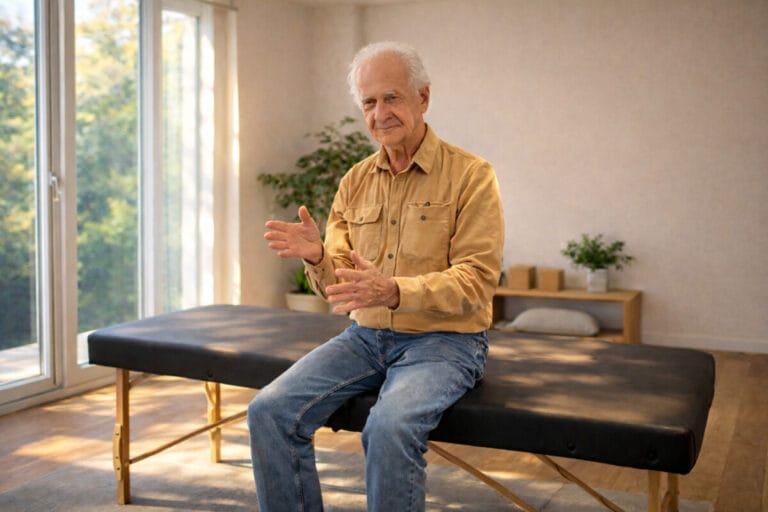
The Quality of Touch and the Art of Unwinding the Body and Mind | Tommy Thompson Class 07
❝ If a single touch could release the tension in your body and mind, wouldn’t you want to experience it for yourself? ❞
In this class, we explore how the quality of touch and unwinding help to release physical tension and cultivate natural movement and inner harmony.
On October 1, 2024, in Boston, Tommy Thompson led an Alexander Technique class centered around experiencing a deep connection between body and mind through the principles of touch and unwinding. Participants engaged in a transformative journey, learning to release tension in the body while integrating movement and thought through innovative approaches.
The class focused on refining the quality of touch and using self-observation and unwinding as pathways to reconnect the body and mind.
Key Objectives of the Class:
- Enhance the quality of touch to encourage the body’s natural movement.
- Release fascial tension through unwinding to restore physical balance.
- Strengthen the connection between body and mind through self-observation and compassion.
- Practice withholding definition to foster genuine connection with others.
This blog series is based on Tommy Thompson’s Alexander Technique classes, with each post following the flow and insights of the class to expand both self-awareness and practical consciousness applicable to everyday life.
New here?
If you’re new to the Alexander Technique, you can start with the resources below.
This blog series is based on Tommy Thompson’s Alexander Technique classes. Each post follows the flow and insights of the class to expand both self-awareness and practical consciousness applicable to everyday life.
New here?
If you’re new to the Alexander Technique, you can start with the resources below.
Alexander Technique Class Flow at a Glance
1. The Opening Question
❝ How can touch release tension in the body and mind? ❞
“The quality of touch depends on how honestly one engages in the work.”
— Tommy Thompson
The quality of touch is not merely a technical skill; it is rooted in the attitude and sincerity with which we approach the act of touching. A heartfelt touch has the power to deeply release tension in the body and mind, restoring a natural sense of connection.
Unwinding facilitates the release of fascial tension, allowing the body to reclaim its originally intended movement patterns. Touch and observation become powerful tools that ease tension and open the way to a deeper integration of body and mind. This process helps to transform habitual tension patterns and contributes to the restoration of physical balance and freedom.

2. Core Learnings from This Class
Core Concepts
The quality of touch and unwinding formed the foundation of this class, guiding students into a deeper awareness of how tension and connection interplay through the body.
- Unwinding
The process of releasing tension in the fascia, allowing the body to return to its natural, originally intended patterns of movement. This process unfolds beyond conscious control, as the body responds involuntarily and reflexively, guiding itself toward healing. - Habituation and Inhibition
The practice of pausing habitual physical reactions and unconscious behaviors, creating space for the nervous system to reorganize and adapt. By establishing a gap between stimulus and response, new possibilities for conscious choice emerge. - The Importance of Touch
Touch transcends mere physical contact, integrating the eyes, hands, and heart into a unified process. Through this integration, the relationship between body and mind is reestablished, opening the door to transformation. - Withholding Definition
The conscious choice to suspend immediate judgment of others and experience them as they are. This attitude forms the essential foundation for deeper understanding and authentic connection. - The Quality of Touch
The impact of touch extends far beyond the fingertips. When we first make contact with another through our eyes and heart, we invite deeper responses and greater possibilities for transformation.
Five Key Messages
- Touch is a holistic process that encompasses visual observation and intention, going beyond mere physical contact.
- Unwinding releases fascial tension and helps the body reclaim its natural balance.
- Moments of inhibition open the opportunity for profound self-observation.
- Withholding definition enables deeper and more authentic connections.
- Ultimately, touch and unwinding become powerful pathways for liberating the body and mind, and for deepening self-understanding and growth.
Essential Terms
- Fascia
The connective tissue that encases muscles and organs, playing a crucial role in facilitating the release of tension and supporting the body’s natural movement. - Stimulus and Response
The process by which the nervous system reacts to external stimuli, with inhibition creating the possibility to modulate and choose one’s response. - Self-Observation
The practice of observing oneself without judgment or definition, allowing for the expansion of self-understanding. - Withholding Definition
The attitude of refraining from immediately categorizing or judging oneself or others, opening up a receptive space for authentic experience. - Involuntary Movement
Movements that arise reflexively as the body naturally releases tension or seeks to restore balance without conscious direction.
3. Tommy’s Insights
In Tommy’s words during class, there are not only the core principles of the Alexander Technique, but also practical wisdom that can be applied directly to daily life. His words go beyond simple advice about movement and prompt us to deeply consider how we choose to exist.“A trainee engages in involuntary movement when it is prepared and ready for it. If the body is touched correctly, it will move on its own.”
This highlights how the body, when ready and approached correctly, naturally initiates its own movement without conscious control.
“Unwinding is the release of the fascia. The unconscious part you habitually live through is your habituation. Beneath that habituation lies the unconscious design of the fascia, functioning exactly as it was intended to.”
This explains that beneath habitual patterns lies a natural, original design embedded in the fascia, guiding authentic movement once it is released.
“The inhibited moment is when you bear witness to yourself by withholding the definition of yourself or another, even for just a brief moment. In that pause, the nervous system begins to initiate change within you.”
These insights reveal that inhibition creates a vital pause, allowing for deep self-observation and initiating reorganization within the nervous system.
“How I perceive this person—and the act of observing that—is a form of inhibition. Or more simply, it is withholding definition.”
This shows that true observation involves suspending judgment, allowing space for deeper perception and connection.
“Before you touch someone else, you must first learn how to touch yourself. When you do, you do not define yourself—you simply continue withholding definition as you look.”
This emphasizes the importance of cultivating self-awareness and openness as a foundation for meaningful connection with others.
“Touch begins with vision. Even if a person is blind, they are still sensing others. You first touch with your vision, and then you decide how to touch based on who you perceive.”
These reflections suggest that true touch begins with perceptive awareness, deeply rooted in emotional and mental connection.
“Ultimately, everything comes back to touch. But before you touch with your hands and fingers, you must first touch with your eyes and your mind.”
This reminds us that authentic physical connection is rooted first in mindful observation and inner sensing.
4. Practical Tips for Everyday Life
What’s the Goal?
To restore the natural connection between body and mind,
and to cultivate the ability to remain centered even while engaging with others. Practicing the quality of touch and unwinding is a practical way to nurture this balance.
How to Practice
Each exercise below is designed to develop your sensitivity through the quality of touch and unwinding
Observing Others While Withholding Definition
Carefully observe the posture, movements, and expressions of the people around you. Rather than judging or interpreting, simply experience their movement and presence as they are.
Beginning Touch with the Hands and Eyes
Gently place your hand on yourself or an object (such as a book or a table), and attentively feel the texture and temperature. First observe with your eyes, then naturally extend that perception through your fingertips, exploring how the two senses connect.
Practicing Inhibition
When you feel the urge to move or speak, pause for a moment. During this moment of inhibition, observe your bodily sensations and arising thoughts, and allow yourself the space to choose.
What You’ll Notice
You will experience a deeper understanding of others. A space will open up between your sensations and reactions, allowing you to naturally feel a warm connection before judgment arises.
By integrating the quality of touch and unwinding into your daily life, you can deepen the connection between your body and mind and support natural, lasting transformation.
5. Closing the Class
Key Takeaways
This class explored two core concepts — the quality of touch and unwinding — focusing on the connection between body and mind and the potential for transformation. Through the practice of quality of touch and unwinding, trainees experienced profound shifts in their natural balance and cultivated deeper self-awareness.
Touch was approached not as mere physical contact, but as an integrated process involving visual observation, intention, and self-awareness. Unwinding supports the release of fascial tension, helping the body return to its original state of balance and contributing to the transformation of habitual patterns.
Core Insights
- Touch and observation serve as powerful tools for fostering deeper self-understanding and authentic connection with others.
- The moment of inhibition and the practice of withholding definition create the space to pause immediate reactions, enabling genuine observation and initiating changes within the nervous system.
- Self-compassion is the foundation of all growth, essential for restoring harmony between the body and the mind.
A Final Invitation
Through touch and unwinding, awaken the latent potential within your body and mind, and experience natural movement and inner peace in your daily life. Practice what you have learned in this class to expand your freedom of the body and the depth of self-observation.
Touch and observation are not mere techniques; they are powerful ways to connect more deeply with yourself and others. This journey fosters not only personal growth but also brings transformation to those around you.
Through the quality of touch and unwinding, we begin to access an embodied state where physical release and self-awareness naturally reinforce each other. Integrating the quality of touch and unwinding into your daily awareness can further support this transformation.
6. One Key Practice
Spend a day observing others, focusing solely on their movement and presence without passing judgment.
- Carefully observe people’s gait, posture, and facial expressions.
- Instead of labeling anything as “good” or “bad,” simply tune into the flow and rhythm of their movement.
- Sense the naturalness in their actions, while also noticing your own emotional and physical responses during observation.
- Afterward, ask yourself:
- “What did I feel in this moment?”
- “What changed when I stopped judging?”
7. Three Questions to Ask Yourself
- What new insights emerged when you observed others without defining them?
- How did your physical and emotional responses shift through the practices of touch and observation?
- Which habitual patterns in your body seem to hinder you, and what could you do to begin changing them?
8. For Those Who Wish to Learn More
Recommended Books

- Body Moveable by David Gorman
A visually rich exploration of the human musculoskeletal system, featuring thousands of detailed illustrations and explanations. An essential resource for understanding movement principles and the foundations of touch. - Looking at Ourselves by David Gorman
A collection of essays that delve into sensory experience, thought patterns, and beliefs, and how they influence physical functioning—guiding readers toward a more accurate self-awareness.
These two books are highly recommended for those seeking a deeper understanding of the Alexander Technique and the fundamental principles of body use.
Official Website of Tommy Thompson
www.easeofbeing.com
This is the official website personally managed by Tommy Thompson, offering a wide range of resources and programs to deepen your understanding and practice of the Alexander Technique:
- Private session reservations and inquiries
- Workshop and seminar schedules
- Overview of international teacher training programs
- Essays and articles on the Alexander Technique
9. Next Class Sneak Peek
In the next Alexander Technique class, we will explore how to harmonize sensory awareness and the mind. We will deepen our experience with the quality of touch and unwinding, using these practices to support this harmony.
We will continue practicing how to release unnecessary tension through touch and self-observation, allowing the body to move naturally and enhancing our ability to perceive ourselves with greater clarity.
We will particularly focus on the experience of consciously moving beyond long-held habitual patterns. Through this work, you will learn how to restore the body’s inherent balance and freedom, and how to open the door to greater possibilities.
Are you ready to awaken the potential within you through natural movement and deeper self-awareness?
10. Join the Alexander Technique Journey
Did this class leave a small resonance within you? Feel free to quietly hold it in your heart or share it in just a sentence or two. The comments are always open. Your one simple word may leave a gentle ripple in this ongoing journey.The journey of Resonance Flow continues across social media as well. Let’s continue this journey together.
 YouTube
 Instagram
 Threads
 Facebook