Inhibition: The Hidden Skill Behind Real Change | Tommy Thompson Class 36
❝ What happens when you stop doing what you’ve always done? ❞
Most of us try to fix ourselves by doing more: straighten up, sit better, hold our posture, be mindful, do the right thing. But what if the key to better movement, better living, and even better thinking is found in doing… less?
February 12, 2025, in Boston, Massachusetts, USA, Tommy Thompson led a class in the Alexander Technique teacher training course unlike any other. This was Class 36, and the focus was simple yet radical: inhibition.
Not as repression, not as avoidance. But as an intelligent pause. A living, breathing choice not to react in the same old way. The class was a deep dive into how inhibition is not the absence of action but the freedom to not reinforce old patterns — and in that space, to allow reflexive intelligence to emerge.
Key Objectives of the Class:
- To experience and understand inhibition as a space of possibility.
- To discover how reflexive movement is restored through non-interference.
- To redefine “support” as something experienced, not achieved.
- To distinguish between coaching and true Alexander teaching.
This blog series is based on Tommy Thompson’s Alexander Technique classes. Each post follows the flow and insights of the class to expand both self-awareness and practical consciousness applicable to everyday life.
New here?
If you’re new to the Alexander Technique, you can start with the resources below.
Alexander Technique Class Flow at a Glance
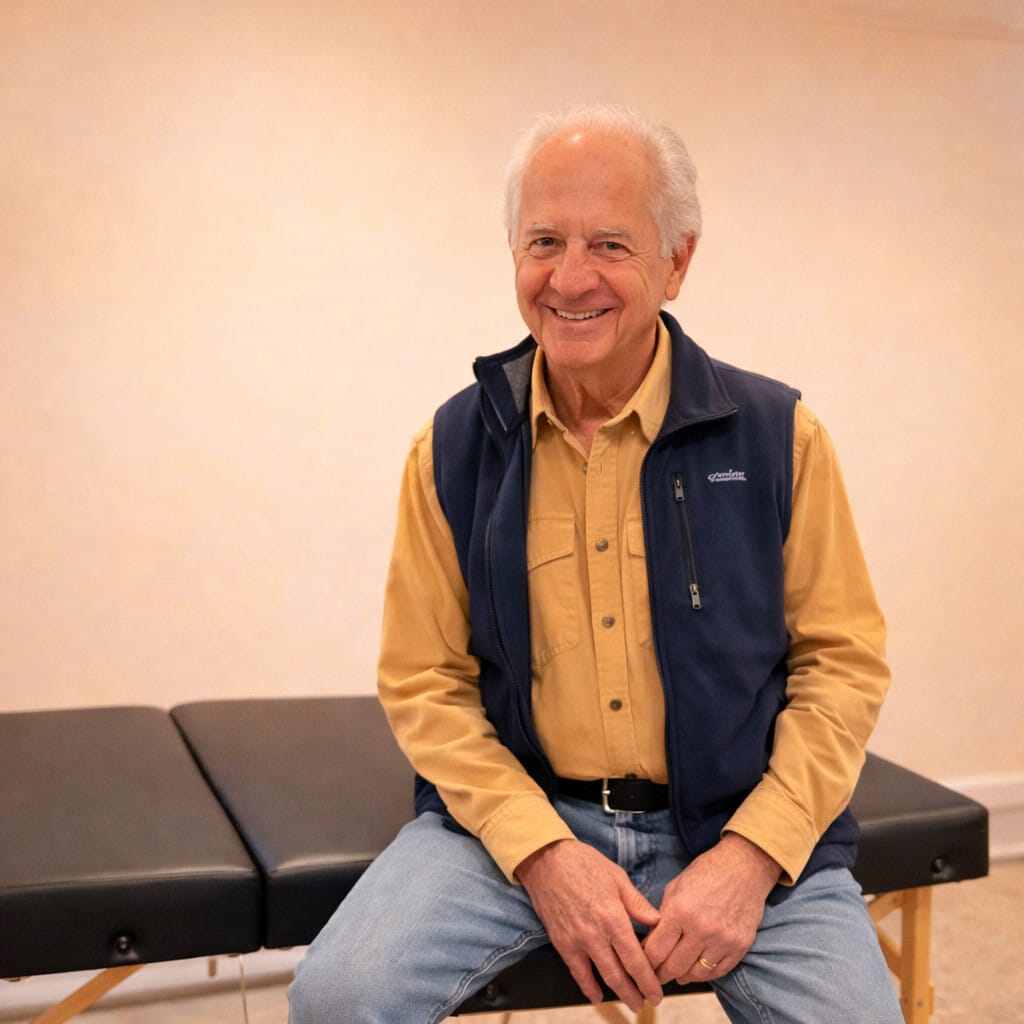
1. The Opening Question
❝ What if your body already knows what to do—and your job is to get out of the way? ❞
What if real change isn’t about learning something new, but about stopping something old? In this class, Tommy showed how inhibition isn’t passive. It’s profoundly active. It’s a skill. A discipline. And ultimately, it’s an invitation for your reflexive self to take the lead.
Tommy’s Word
“You’re creating a space in time—in nervous system time—where the brain is not being asked to do what you trained the brain to do in response to the way that you feel you have to respond to your life.”
Tommy describes inhibition as an innate capacity — a pause that restores agency to the nervous system. The result? Freedom, efficiency, and the quiet return of natural coordination.
2. Core Learnings from This Class
In this moment from Tommy Thompson’s class, trainees explore inhibition through the habit of “sitting up straight.” Rather than improving posture, they begin to notice how trying creates tension.
Watch how letting go of this impulse allows support and coordination to emerge naturally.
What If Fixing Your Posture Is Making It Worse? | Alexander Technique
Class 36 · February 12, 2025 · Boston, MA
Core Concepts
- Inhibition is a conscious pause that restores reflexive movement.
Rather than adding effort, inhibition removes interference so that your neuromuscular system can do what it already knows how to do. - Voluntary effort often disrupts natural coordination.
When we try to “do it right,” we override the reflexive patterns that organize movement efficiently. - Support is something you allow, not something you create.
Real support arises when you stop trying to hold yourself up and instead allow the body’s design to work. - Use of self is fundamentally behavioral.
As Tommy often reminded the class, “How you behave is how you use yourself. You don’t just have a body—you are using it, constantly.” - True change happens in the space before reaction.
That space—what Tommy called “nervous system time”—is where you can choose not to follow your habitual script. - Identity shapes movement before intention.
Tommy emphasized that how we move begins before we even know we’re moving. Our habits are not just physical—they are neurological and existential.
Five Key Messages
- Inhibition creates space for choice.
Every movement begins with a decision to not act out the old pattern. - The head cannot move independently.
Movement is a whole-body response; freedom begins with the neck, but is supported everywhere. - Posture is not a position—it’s a total response of the whole organism within a gravitational field.
It reflects your response to gravity, thought, emotion, and habit. - You can’t give someone support unless you’ve received it.
As Tommy said, “You can only give what you’ve received yourself.” - Reflexes are facilitators, not obstacles.
Letting go of voluntary control often allows the reflexes to do their job more effectively.
Essential Terms
- Inhibition
A conscious refusal to react in the habitual way, making space for reflexive coordination to emerge instead. - Reflexive Intelligence
The body’s innate organizing capacity that surfaces when interference is removed and effort is paused. - Use of Self
A central principle in the Alexander Technique, referring to the integrated way a person perceives, thinks, moves, and acts. - Nervous System Time
The internal, felt duration between stimulus and response. A moment when the habitual pathway can be interrupted and re-routed. - Support
A condition of dynamic ease arising not from effort, but from trust in the body’s design and in gravity.
3. Tommy’s Insights
In Tommy’s words during class, there are not only the core principles of the Alexander Technique, but also practical wisdom that can be applied directly to daily life. His words go beyond simple advice about movement and prompt us to deeply consider how we choose to exist.“First of all, the head can’t move by itself. The head doesn’t move. The head moves when given the freedom and the muscular response of the muscles of the head, neck, torso, and the rest of the body.”
➤ Movement does not originate in isolation—it is the result of distributed, whole-body coordination.
“You’re creating a space in time—in nervous system time—where the brain, if you anthropomorphize the brain, is not being asked to do what you trained the brain to do in response to the way that you feel you have to respond to your life.”
➤ Inhibition opens a physiological pause where habitual reactivity is suspended and possibility reenters.
“What is freedom? You’re free to let the muscles not shorten, because if you’re overly contracted, you are taking over the job of the reflexive aspect of yourself, and when you do that, you shorten the muscles in your neck. So, you’re free to lengthen the muscles.”
➤ Freedom is not an action but a permission—the decision to let go of interference and allow reflexive order.
“Posture is actually the organism’s total response within a gravitational field, given your thoughts, feelings, perceptions, and attitude.”
➤ Posture reflects the sum of your internal and external orientation, not simply a mechanical arrangement.
“It’s a method of neuromuscular training whereby the voluntary does not impede the reflex, and the reflex facilitates the voluntary.”
➤ In the Alexander Technique, reflex and will are not enemies—their cooperation is the goal.
“What’s important is that a person understands that if they don’t behave in a certain way, their use of self is affected. Use of self is behavior. I behave in a certain way—that’s how I use myself, right? I use my body in a specific way.”
➤ The way you behave is your use; movement and identity are never separate.
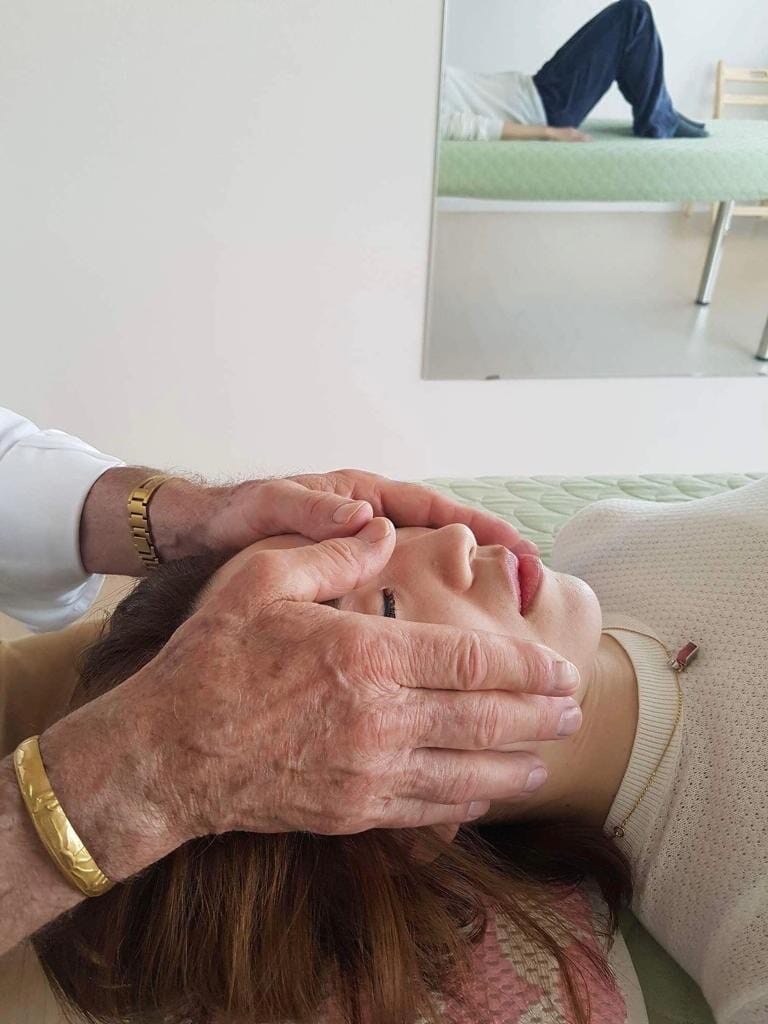
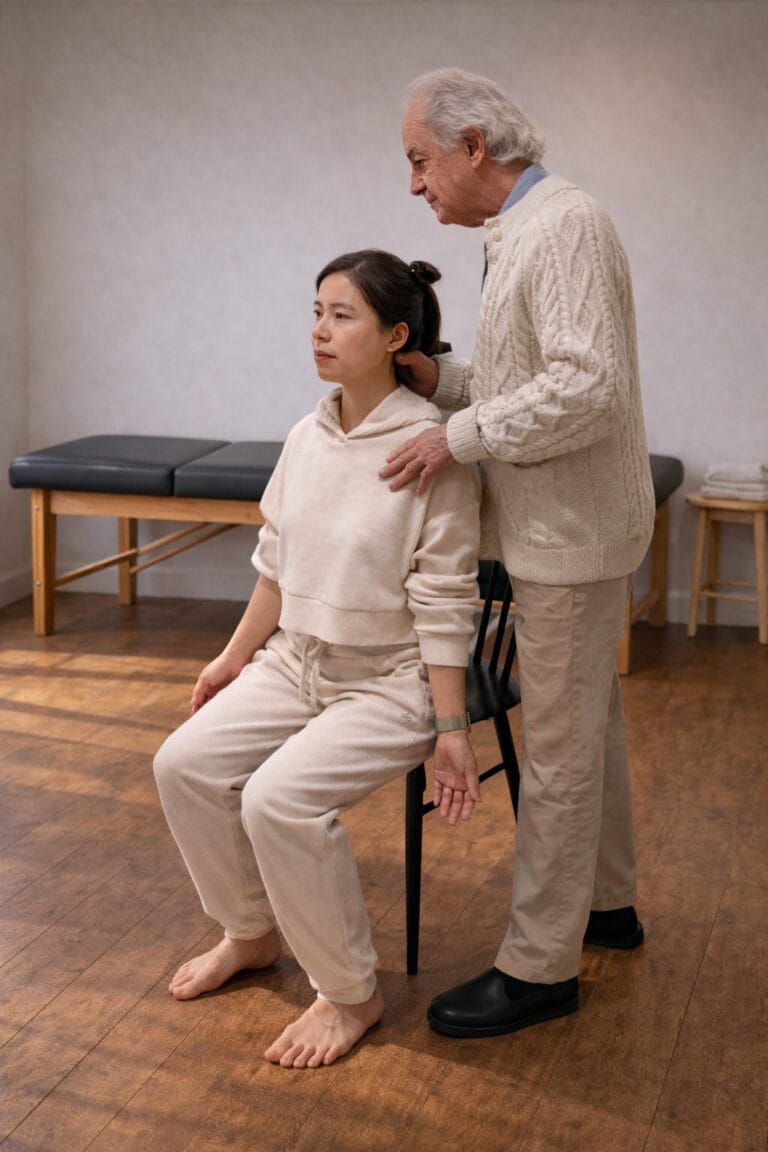
“In the inhibitive moment, you need to allow the person to move in a new way rather than their habitual pattern. Using your hands is particularly effective because it changes the relationship between the head and the body. This ensures that voluntary movement does not interfere with reflexive movement.”
➤ Skilled touch helps redirect a person’s system toward reflex-based organization without imposing control.
4. Practical Tips for Everyday Life
What’s the Goal?
To apply the Alexander Technique in daily life—not by improving posture, but by interrupting habits. These are not exercises, but small experiments in awareness.
How to Practice
1. Sit Without Holding Yourself Up
Use a firm chair. Don’t try to “sit well.” Instead, allow the chair to support you. Let your sitting bones fully meet the surface. Say quietly: “I’m not holding myself up—I’m letting go.”
2. Pause Before You Move
Before standing, turning, or walking, pause for one breath. Bring attention to your neck. Let it soften. The pause isn’t delay—it’s space for choice.
3. Let the Head Be Carried
Let your neck be free to lengthen, allowing your head to move away from your body and float gently up and forward. “Don’t lead or hold—just allow. Let your body follow with ease.
What You’ll Notice
You’ll feel more upright and at ease—without trying. Movements will smooth out. Instead of forcing good posture, you’ll begin to sense coordination as something already present.
Most of all, you’ll start trusting that less effort brings more freedom.
5. Closing the Classclosing-class
Key Takeaways
This class wasn’t about changing posture. It was about changing relationship—especially with time, habit, and reaction.
Inhibition, as Tommy taught it, is not passive. It is an act of presence, a refusal to obey the familiar just because it feels urgent.
Core Insights
Tommy often reminded the class:
“You’re free to let the muscles not shorten.”
That’s not just anatomy—it’s a worldview. To live without collapsing inward, to pause when the body screams for repetition, to allow intelligence to rise instead of forcing it through—this is the real work.
As Tommy said elsewhere,
“Use of self is behavior.”
Every gesture, every breath, every choice of when to move or not move is your self in motion. There’s no separation between how you think and how you coordinate.
A Final Invitation
This isn’t a method to learn. It’s a lens to live through.
Let inhibition become a daily practice—in walking, speaking, reaching, and even pausing.
Let support reveal itself in the spaces where you stop fixing.
You are not here to hold yourself up.
You are here to discover how deeply supported you already are.
6. One Key Practice
Stop before you begin. That’s the whole practice
Before you stand, speak, or reach—stop. Not to plan or fix, but to allow. One breath is enough.
Let your neck be free and your breath return. In that space, let something deeper organize your movement—not habit, but reflexive intelligence.
This is inhibition.
This is where new use begins.
And it’s always right there, in the instant between impulse and action.
7. Three Questions to Ask Yourself
1. What am I preparing for right now—without realizing it?
Every subtle tension has a purpose—but is it still necessary? This question helps reveal unconscious habits so you can choose not to follow them.
2. Am I allowing or directing?
Are you letting movement emerge, or trying to control it? This shifts you from automatic doing to conscious coordination.
3. Can I move without improving anything?
What if this breath or step didn’t need to be better, just clearer? This invites trust in your reflexes instead of chasing correction.
8. For Those Who Wish to Learn More
Recommended Book
The Use of the Self – F. M. Alexander
If you want to understand the foundation of this work—not as theory, but as lived experience—this book is essential. Especially the chapter “The Evolution of a Technique” echoes what Tommy demonstrated throughout this class: that transformation begins not with doing, but with refusing to repeat.
Alexander doesn’t offer steps. He offers a shift in perception that becomes a shift in use.
It’s not a method—it’s a mirror.
Official Website of Tommy Thompson
www.easeofbeing.com
This is the official website personally managed by Tommy Thompson, offering a wide range of resources and programs to deepen your understanding and practice of the Alexander Technique:
- Private session reservations and inquiries
- Workshop and seminar schedules
- Overview of international teacher training programs
- Essays and articles on the Alexander Technique
9. Next Class Sneak Peek
The next class explores how the body regains its natural coordination—not through effort, but through release. Using principles like unwinding, fit, structured movement, and cradling, we’ll discover what happens when we stop controlling and start allowing.
This work isn’t about correcting movement—it’s about trusting that the body remembers balance. Your role is to get out of its way.
In Class 37, we’ll explore:
- how to let the body find balance on its own
- how to reduce unnecessary effort and move with ease
- how relational touch restores trust and timing in movement
10. Join the Alexander Technique Journey
Did this class leave a small resonance within you? Feel free to quietly hold it in your heart or share it in just a sentence or two. The comments are always open. Your one simple word may leave a gentle ripple in this ongoing journey.The journey of Resonance Flow continues across social media as well. Let’s continue this journey together.
 YouTube
 Instagram
 Threads
 Facebook